
Determinants of Mobile Phone Use in West Africa
Determinants of Mobile Phone Use in West Africa: Findings from an Empirical Study in The Gambia Prof. Dr. Martin Emmer Johanna Hartung Freie Universität Berlin Institute for Media and Communication Studies
Structure 1. Introduction 2. Research questions 3. Theoretical background 4. Methodology 5. Description of data 6. Results 7. Conclusion 7 th CMI Conference, 17. 11. 2014 2/13
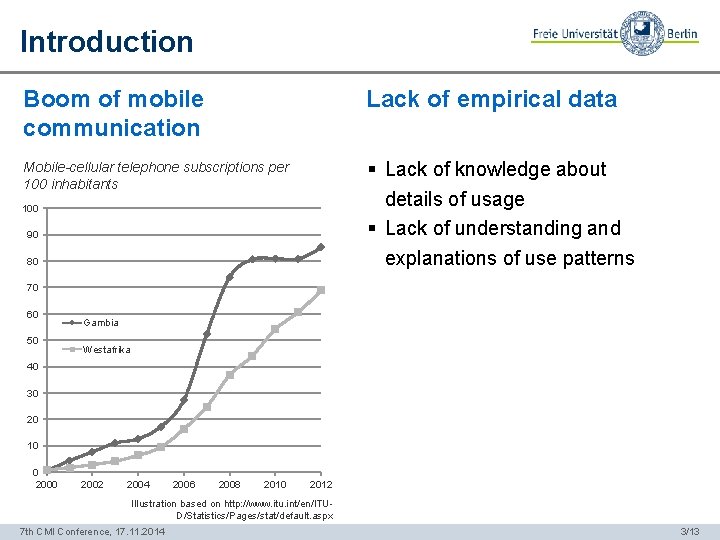
Introduction Boom of mobile communication Lack of empirical data Mobile-cellular telephone subscriptions per 100 inhabitants § Lack of knowledge about details of usage § Lack of understanding and explanations of use patterns 100 90 80 70 60 50 Gambia Westafrika 40 30 20 10 0 2002 2004 2006 2008 2010 2012 Illustration based on http: //www. itu. int/en/ITUD/Statistics/Pages/stat/default. aspx 7 th CMI Conference, 17. 11. 2014 3/13
Research questions § How do Gambians use their mobile phones? § What patterns of mobile phone use are emerging? § How can single use patterns be explained by the influence of functional expectations, restrictions and norms? 7 th CMI Conference, 17. 11. 2014 4/13
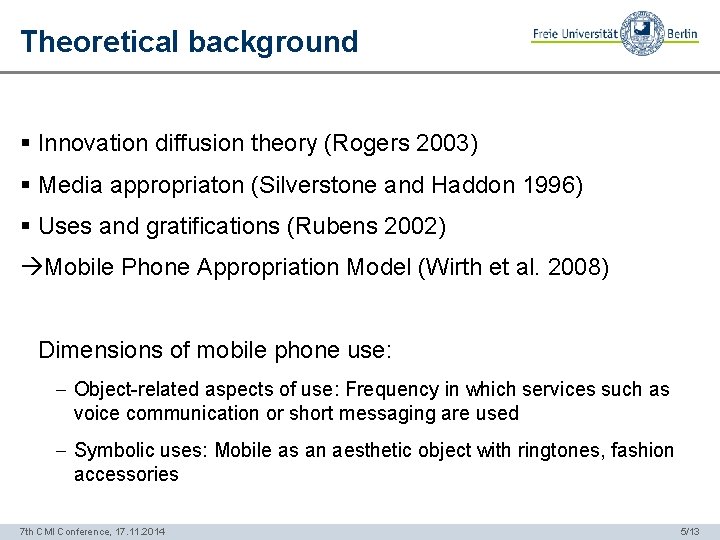
Theoretical background § Innovation diffusion theory (Rogers 2003) § Media appropriaton (Silverstone and Haddon 1996) § Uses and gratifications (Rubens 2002) àMobile Phone Appropriation Model (Wirth et al. 2008) Dimensions of mobile phone use: - Object-related aspects of use: Frequency in which services such as voice communication or short messaging are used - Symbolic uses: Mobile as an aesthetic object with ringtones, fashion accessories 7 th CMI Conference, 17. 11. 2014 5/13
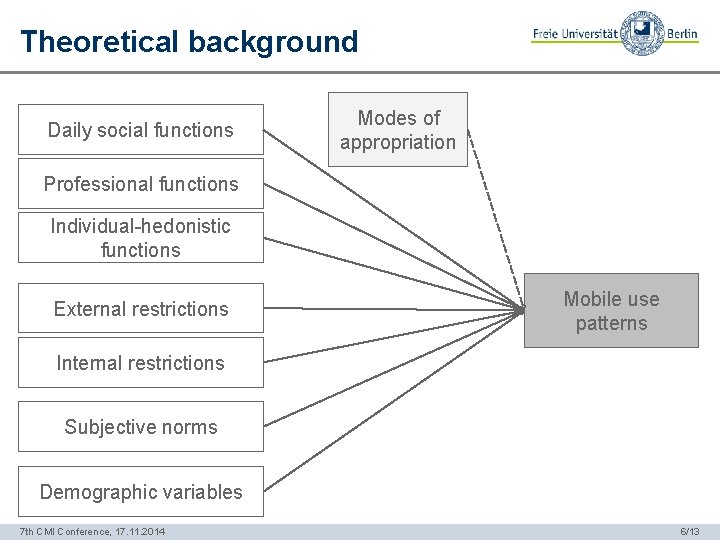
Theoretical background Daily social functions Modes of appropriation Professional functions Individual-hedonistic functions External restrictions Mobile use patterns Internal restrictions Subjective norms Demographic variables 7 th CMI Conference, 17. 11. 2014 6/13
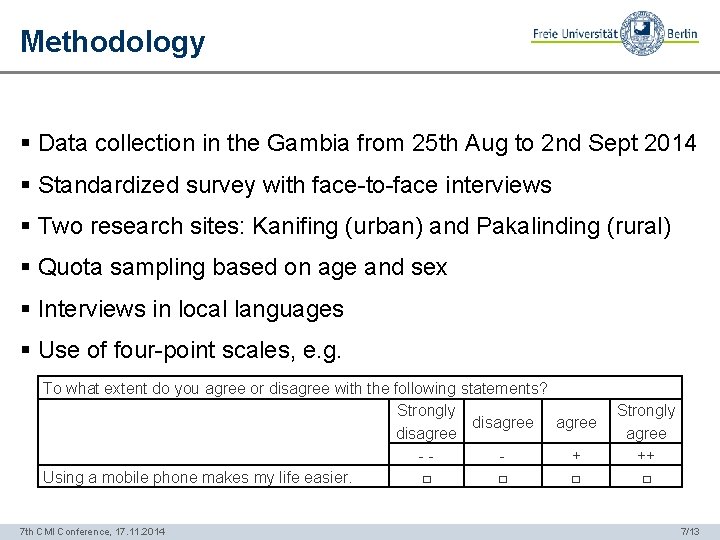
Methodology § Data collection in the Gambia from 25 th Aug to 2 nd Sept 2014 § Standardized survey with face-to-face interviews § Two research sites: Kanifing (urban) and Pakalinding (rural) § Quota sampling based on age and sex § Interviews in local languages § Use of four-point scales, e. g. To what extent do you agree or disagree with the following statements? Strongly disagree -+ Using a mobile phone makes my life easier. □ □ □ 7 th CMI Conference, 17. 11. 2014 Strongly agree ++ □ 7/13
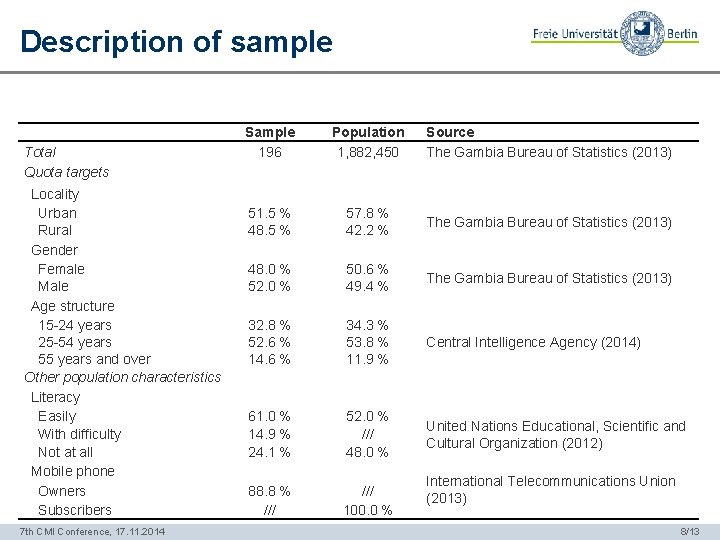
Description of sample Total Quota targets Locality Urban Rural Gender Female Male Age structure 15 -24 years 25 -54 years 55 years and over Other population characteristics Literacy Easily With difficulty Not at all Mobile phone Owners Subscribers 7 th CMI Conference, 17. 11. 2014 Sample 196 Population 1, 882, 450 Source The Gambia Bureau of Statistics (2013) 51. 5 % 48. 5 % 57. 8 % 42. 2 % The Gambia Bureau of Statistics (2013) 48. 0 % 52. 0 % 50. 6 % 49. 4 % The Gambia Bureau of Statistics (2013) 32. 8 % 52. 6 % 14. 6 % 34. 3 % 53. 8 % 11. 9 % Central Intelligence Agency (2014) 61. 0 % 14. 9 % 24. 1 % 52. 0 % /// 48. 0 % United Nations Educational, Scientific and Cultural Organization (2012) 88. 8 % /// 100. 0 % International Telecommunications Union (2013) 8/13
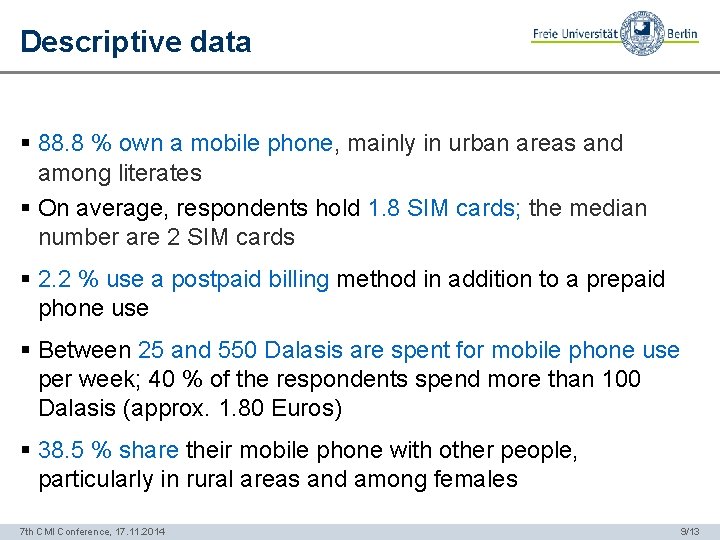
Descriptive data § 88. 8 % own a mobile phone, mainly in urban areas and among literates § On average, respondents hold 1. 8 SIM cards; the median number are 2 SIM cards § 2. 2 % use a postpaid billing method in addition to a prepaid phone use § Between 25 and 550 Dalasis are spent for mobile phone use per week; 40 % of the respondents spend more than 100 Dalasis (approx. 1. 80 Euros) § 38. 5 % share their mobile phone with other people, particularly in rural areas and among females 7 th CMI Conference, 17. 11. 2014 9/13
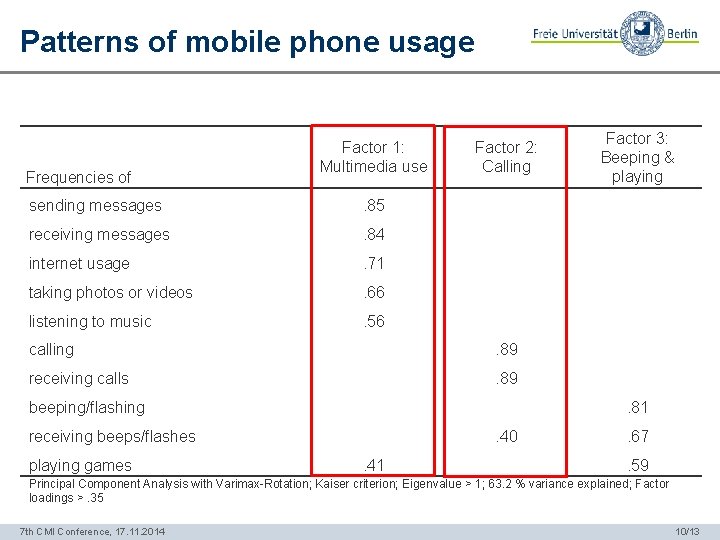
Patterns of mobile phone usage Frequencies of Factor 1: Multimedia use sending messages . 85 receiving messages . 84 internet usage . 71 taking photos or videos . 66 listening to music . 56 Factor 2: Calling calling . 89 receiving calls . 89 beeping/flashing . 81 receiving beeps/flashes playing games Factor 3: Beeping & playing . 40. 41 . 67. 59 Principal Component Analysis with Varimax-Rotation; Kaiser criterion; Eigenvalue > 1; 63. 2 % variance explained; Factor loadings >. 35 7 th CMI Conference, 17. 11. 2014 10/13
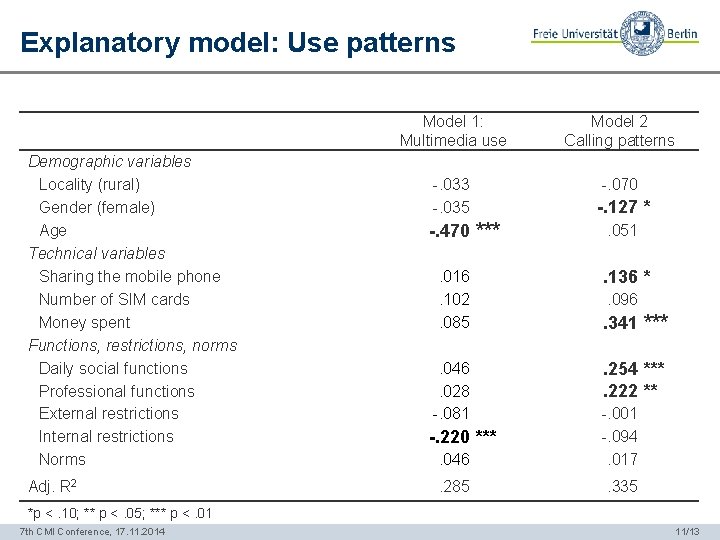
Explanatory model: Use patterns Demographic variables Locality (rural) Gender (female) Age Technical variables Sharing the mobile phone Number of SIM cards Money spent Functions, restrictions, norms Daily social functions Professional functions External restrictions Internal restrictions Norms Adj. R 2 Model 1: Multimedia use Model 2 Calling patterns -. 033 -. 035 -. 070 -. 470 ***. 016. 102. 085. 046. 028 -. 081 -. 127 *. 051 . 136 *. 096 . 341 ***. 254 ***. 222 ** . 046 -. 001 -. 094. 017 . 285 . 335 -. 220 *** *p <. 10; ** p <. 05; *** p <. 01 7 th CMI Conference, 17. 11. 2014 11/13
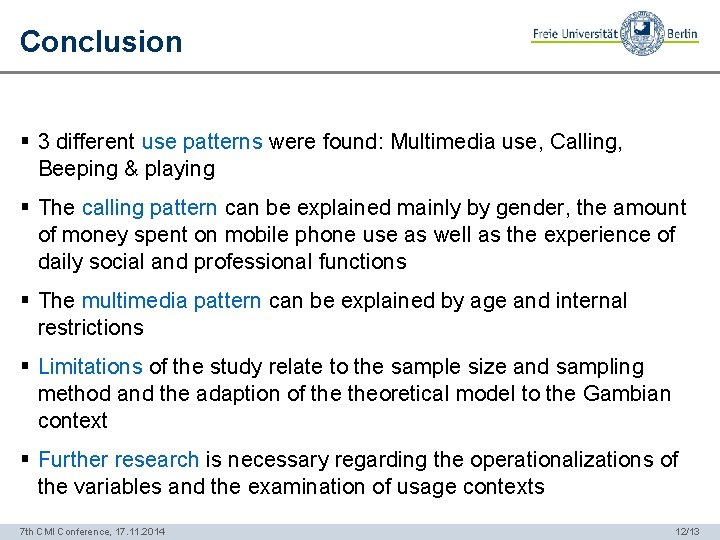
Conclusion § 3 different use patterns were found: Multimedia use, Calling, Beeping & playing § The calling pattern can be explained mainly by gender, the amount of money spent on mobile phone use as well as the experience of daily social and professional functions § The multimedia pattern can be explained by age and internal restrictions § Limitations of the study relate to the sample size and sampling method and the adaption of theoretical model to the Gambian context § Further research is necessary regarding the operationalizations of the variables and the examination of usage contexts 7 th CMI Conference, 17. 11. 2014 12/13
Conclusion § Do more research - to enquire about usage patterns and explanations of usage - to synchronize research between African countries § Recommendations: - Policies towards the inclusion of females and illiterates - Business models for professional and social uses of mobile phones 7 th CMI Conference, 17. 11. 2014 13/13
Thank you for your attention. Johanna Hartung johanna. hartung@fu-berlin. de Prof. Dr. Martin Emmer martin. emmer@fu-berlin. de
- Slides: 14