
Determinants of Consent in the German SOEP Establishment
Determinants of Consent in the German SOEP Establishment Survey M. Weinhardt*, A. Meyermann**, S. Liebig**, J. Schupp* EESW, Nuremberg, Sep 10 2013 * DIW Berlin, Free University Berlin; ** Bielefeld University
1 Organisational Consent to Record Linkage Informed consent is necessary, but refused regularly. Who gives consent and who doesn’t? Of interest for survey methods and substantive researchers Ø sample size Ø selection issues Several levels involved: • response person • interview situation • interviewer • establishment → see for example Sala et al. 2010, Antoni 2011, Korbmacher and Schröder 2013, Sakshaug et al. 2013
1 The CAM-Model of organisational survey response (Tomaskovic-Devey 1994): Capacity (C): information exists , is known and accessible • Depends on (amongst others) internal complexity of organisation (e. g. number of departments) Authority (A): person has legitimisation to respond • Depends on hierarchical structure in the company (e. g. number of levels) Motive (M): willingness to respond • Depends on company policy relation and organizational relations to the environment (e. g. image / clients) Organisational or individual (TP) level? Ø Both
2 Data: The Linked-Employer. Employee Study of the Socio-economic Panel (SOEP-LEE)
2 The Socio-economic panel study SOEP • A representative, large-scale household panel survey of the German population • About 10. 000 households and 20. 000 individuals • Annual basis, started in 1984 • Wide range of topics: labour force status, income, wealth, household characteristics, attitudes, personality traits • Changing and expanding all the time
2 Objectives and Conception of SOEP-LEE • Objectives of the Project: • Realization of a representative employer survey • data set which can be used individually or linked to the SOEP • Linking to data held by the Fed. Employment Agency (IAB) • Adding longitudinal information on establishments • Extensive measurement of meta- and paradata • Contact and interview protocol • Interviewer questionnaire, respondent information • Audio recordings of a subsample of interviews • Raw data and editing protocol
2 Employee-first Method • Employees sampled first (SOEP), employers second Ø Selection probability proportional to number of employees • At least five employees, no self-employed, Germany only • TP: “most knowledgeable Person”, management or HR • • • Field time: August 2012 – March 2013 1708 interviews Response Rate: just above 30% F 2 f - PAPI: 61 Questions, ~160 items Duration: Mean: 42 min, Median: 40 min 30 audio-recordings
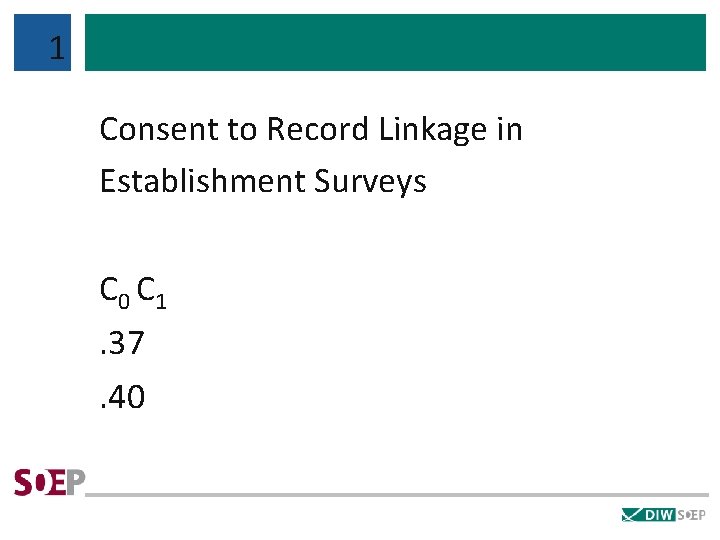
4 The Consent Question • 9 Sentences, 110 words, 768 characters • Explaining the linkage • Emphasizing confidentiality • Emphasizing the importance to science • Question-answer sequence duration in audio sample: • Mean = 53 seconds (min=18; max=120) • Positioning in the middle of the questionnaire (Q 30 of 61) • at the end of section of staff/personnel section Øpotentially a bad idea • Item Nonresponse: 2. 4 % ØConsent: 35. 2 % / 34. 4 %
3 Methods
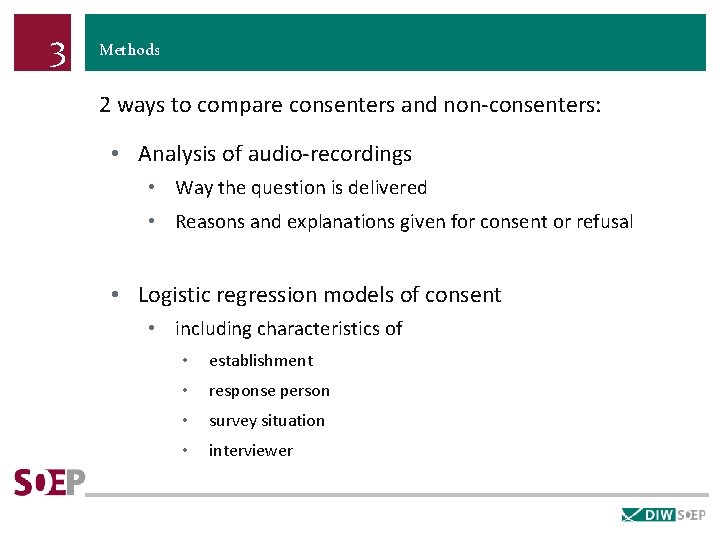
3 Methods 2 ways to compare consenters and non-consenters: • Analysis of audio-recordings • Way the question is delivered • Reasons and explanations given for consent or refusal • Logistic regression models of consent • including characteristics of • establishment • response person • survey situation • interviewer
4 Results I: Analysis of Audio-recordings
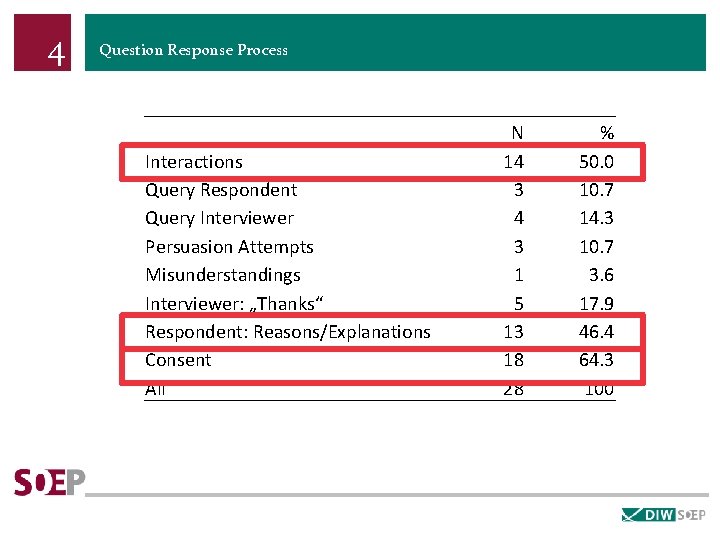
4 Question Response Process Interactions Query Respondent Query Interviewer Persuasion Attempts Misunderstandings Interviewer: „Thanks“ Respondent: Reasons/Explanations Consent All N 14 3 1 5 13 18 28 % 50. 0 10. 7 14. 3 10. 7 3. 6 17. 9 46. 4 64. 3 100
4 Reasons and Explanations for REFUSAL: Not authorised, no access, but motivated: R 8: “Yes, that's not for me to decide, the HR department has to do that, I mean, the management does things like that. Here, i don't even have access to this data. ” I: “Ok, then. ” R 8: “That's not for me to decide, because I don't have access, as I said. Well, I can tell you whatever I know, that's completely fine, but if you want to have direct data access, then you have to go to the HR department. ”
4 Reasons and Explanations for REFUSAL: Not feasible / impossible: (1) R 7: ”That wouldn't work for you, because at the employment agency, the whole city is registered as one establishment there, that means, you have 4000 employees there and the departments are not kept separate. ”
4 Reasons and Explanations for CONSENT: Confidentiality (1) R 1: “If they data are transmitted anonymously, yes. ” (2) R 2: “That means, there is no inference [Rückschluss] possible? ” I: Yes. R 2: “Then, we can do that. ” (3) R 3: “Yes. ” I: “Yes, I put down a Yes. ” R 3. “I hope that is confidential. ”
4 Reasons and Explanations for CONSENT: Others “Nothing to hide” attitude: R 4: “Yes, we can do that. There's everything in order”. R 5: “Nothing speaks against”. No additional response burden: R 6: “Well, if we don't have to deliver the data, then you can do it, yes. ”
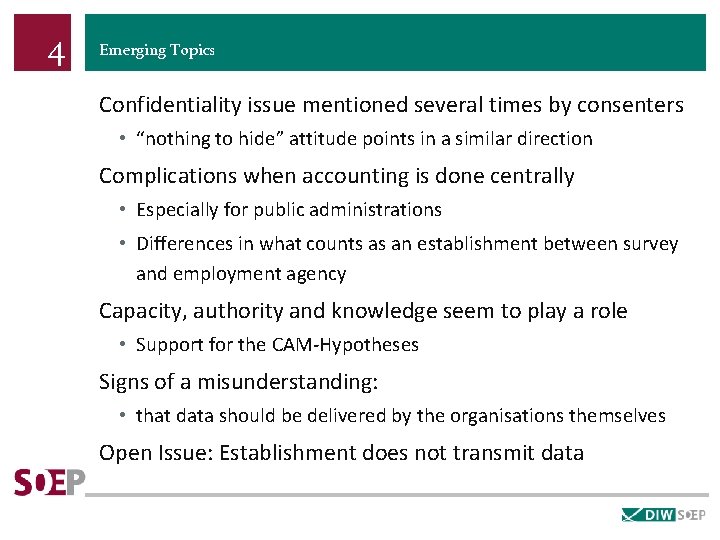
4 Emerging Topics Confidentiality issue mentioned several times by consenters • “nothing to hide” attitude points in a similar direction Complications when accounting is done centrally • Especially for public administrations • Differences in what counts as an establishment between survey and employment agency Capacity, authority and knowledge seem to play a role • Support for the CAM-Hypotheses Signs of a misunderstanding: • that data should be delivered by the organisations themselves Open Issue: Establishment does not transmit data
5 Results II: Logistic Regression Model
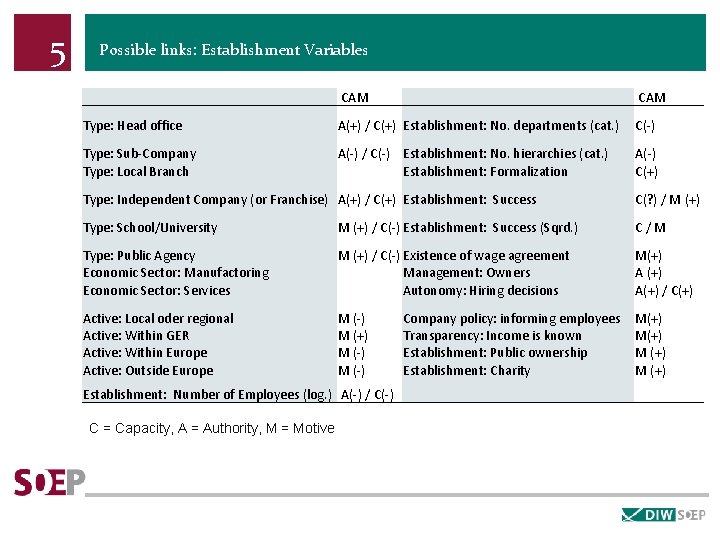
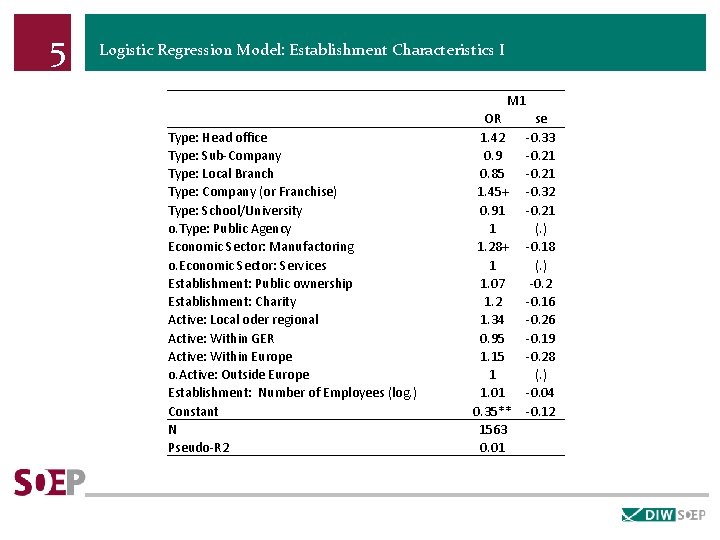
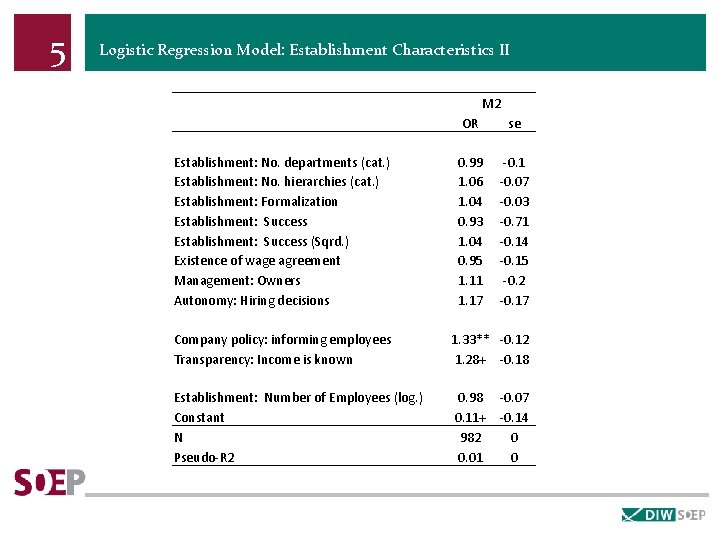
5 Possible links: Establishment Variables CAM Type: Head office A(+) / C(+) Establishment: No. departments (cat. ) C(-) Type: Sub-Company Type: Local Branch A(-) / C(-) Establishment: No. hierarchies (cat. ) Establishment: Formalization A(-) C(+) Type: Independent Company (or Franchise) A(+) / C(+) Establishment: Success C(? ) / M (+) Type: School/University M (+) / C(-) Establishment: Success (Sqrd. ) C/M Type: Public Agency Economic Sector: Manufactoring Economic Sector: Services M (+) / C(-) Existence of wage agreement Management: Owners Autonomy: Hiring decisions M(+) A(+) / C(+) Active: Local oder regional Active: Within GER Active: Within Europe Active: Outside Europe M (-) M (+) M (-) M(+) M (+) Establishment: Number of Employees (log. ) A(-) / C(-) C = Capacity, A = Authority, M = Motive Company policy: informing employees Transparency: Income is known Establishment: Public ownership Establishment: Charity
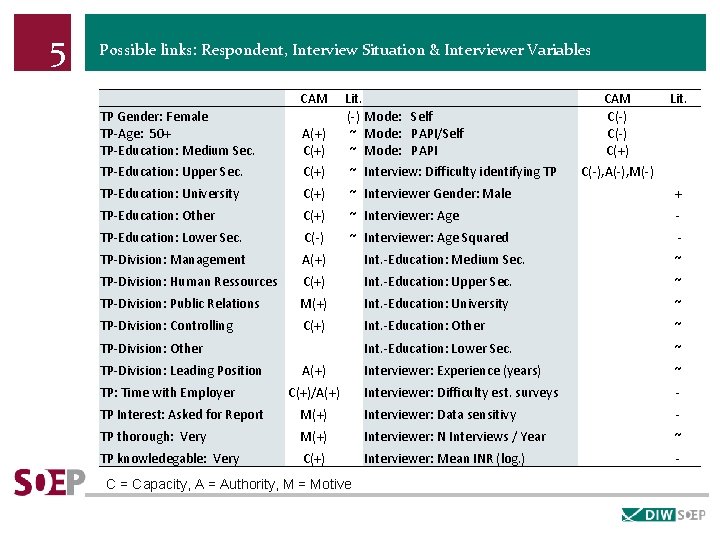
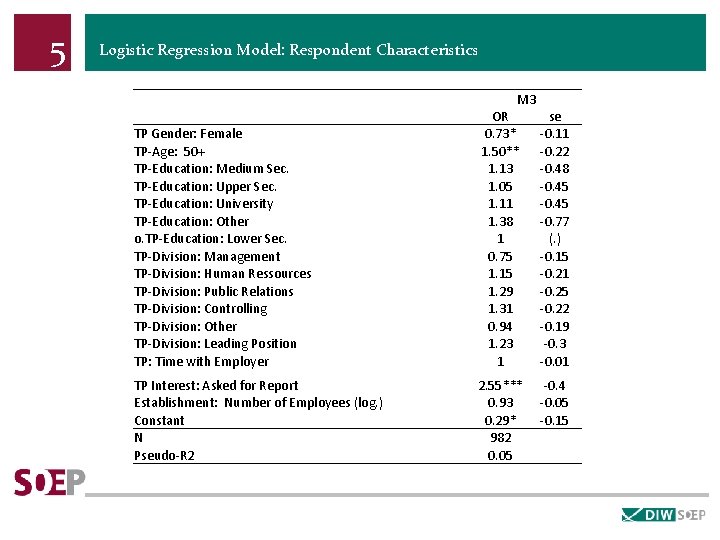
5 Possible links: Respondent, Interview Situation & Interviewer Variables CAM Lit. (-) Mode: Self ~ Mode: PAPI/Self ~ Mode: PAPI ~ Interview: Difficulty identifying TP CAM C(-) C(+) C(-), A(-), M(-) Lit. TP Gender: Female TP-Age: 50+ TP-Education: Medium Sec. TP-Education: Upper Sec. A(+) C(+) TP-Education: University C(+) ~ Interviewer Gender: Male + TP-Education: Other C(+) ~ Interviewer: Age - TP-Education: Lower Sec. C(-) ~ Interviewer: Age Squared - TP-Division: Management A(+) Int. -Education: Medium Sec. ~ TP-Division: Human Ressources C(+) Int. -Education: Upper Sec. ~ TP-Division: Public Relations M(+) Int. -Education: University ~ TP-Division: Controlling C(+) Int. -Education: Other ~ Int. -Education: Lower Sec. ~ Interviewer: Experience (years) ~ Interviewer: Difficulty est. surveys - TP-Division: Other TP-Division: Leading Position TP: Time with Employer A(+) C(+)/A(+) TP Interest: Asked for Report M(+) Interviewer: Data sensitivy - TP thorough: Very M(+) Interviewer: N Interviews / Year ~ TP knowledegable: Very C(+) Interviewer: Mean INR (log. ) - C = Capacity, A = Authority, M = Motive
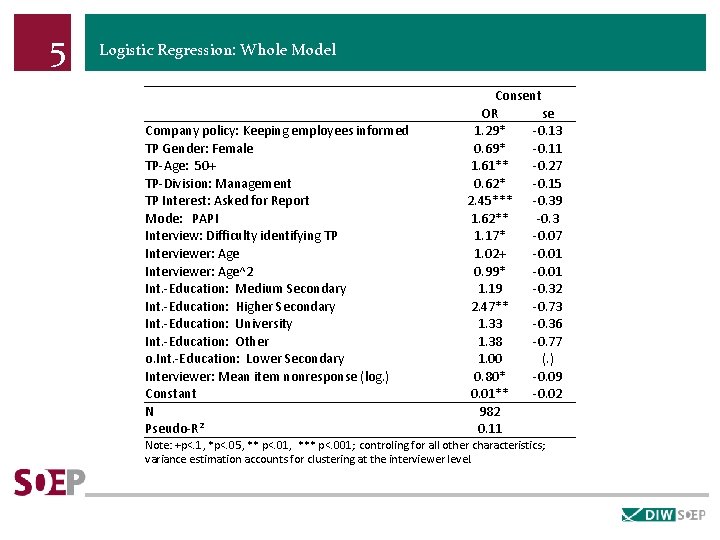
5 Logistic Regression: Whole Model Company policy: Keeping employees informed TP Gender: Female TP-Age: 50+ TP-Division: Management TP Interest: Asked for Report Mode: PAPI Interview: Difficulty identifying TP Interviewer: Age^2 Int. -Education: Medium Secondary Int. -Education: Higher Secondary Int. -Education: University Int. -Education: Other o. Int. -Education: Lower Secondary Interviewer: Mean item nonresponse (log. ) Constant N Pseudo-R² Consent OR se 1. 29* -0. 13 0. 69* -0. 11 1. 61** -0. 27 0. 62* -0. 15 2. 45*** -0. 39 1. 62** -0. 3 1. 17* -0. 07 1. 02+ -0. 01 0. 99* -0. 01 1. 19 -0. 32 2. 47** -0. 73 1. 33 -0. 36 1. 38 -0. 77 1. 00 (. ) 0. 80* -0. 09 0. 01** -0. 02 982 0. 11 Note: +p<. 1, *p<. 05, ** p<. 01, *** p<. 001; controling for all other characteristics; variance estimation accounts for clustering at the interviewer level.

6 Discussion and Outlook
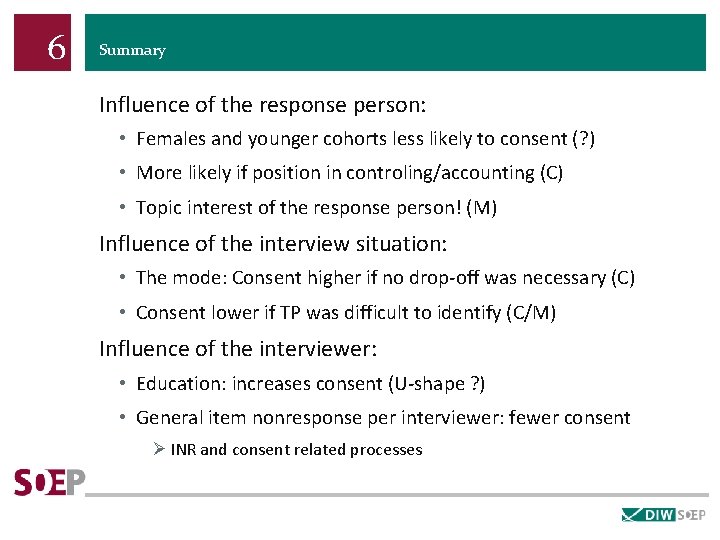
6 Summary Influence of the response person: • Females and younger cohorts less likely to consent (? ) • More likely if position in controling/accounting (C) • Topic interest of the response person! (M) Influence of the interview situation: • The mode: Consent higher if no drop-off was necessary (C) • Consent lower if TP was difficult to identify (C/M) Influence of the interviewer: • Education: increases consent (U-shape ? ) • General item nonresponse per interviewer: fewer consent Ø INR and consent related processes
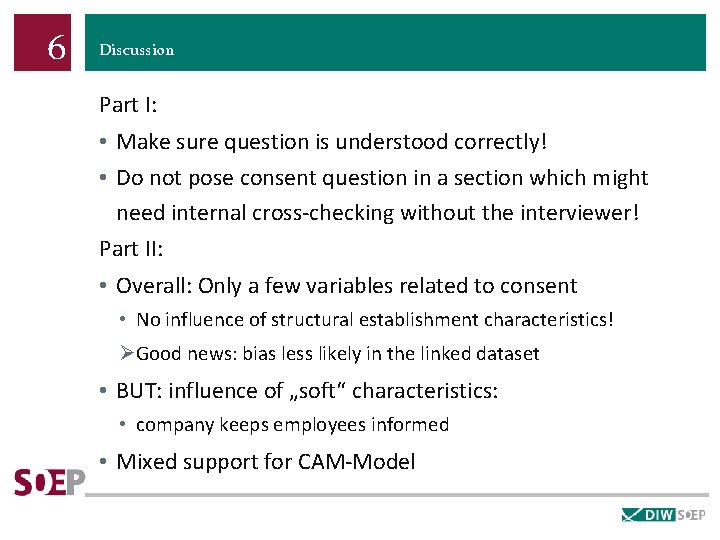
6 Discussion Part I: • Make sure question is understood correctly! • Do not pose consent question in a section which might need internal cross-checking without the interviewer! Part II: • Overall: Only a few variables related to consent • No influence of structural establishment characteristics! ØGood news: bias less likely in the linked dataset • BUT: influence of „soft“ characteristics: • company keeps employees informed • Mixed support for CAM-Model
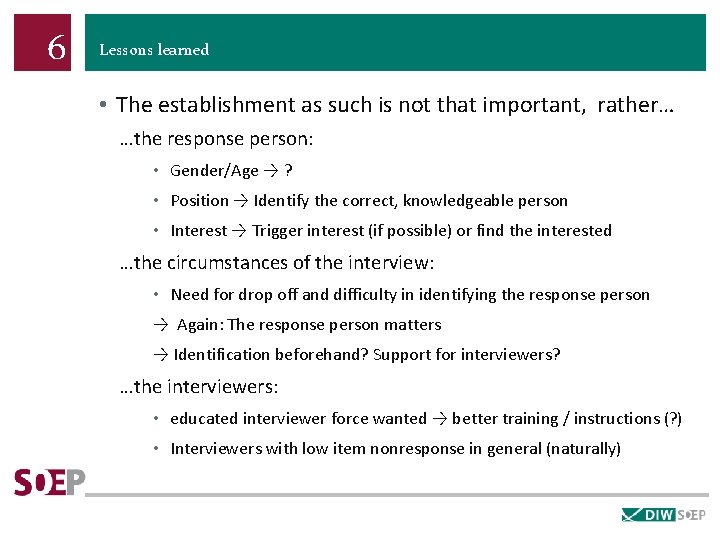
6 Lessons learned • The establishment as such is not that important, rather… …the response person: • Gender/Age → ? • Position → Identify the correct, knowledgeable person • Interest → Trigger interest (if possible) or find the interested …the circumstances of the interview: • Need for drop off and difficulty in identifying the response person → Again: The response person matters → Identification beforehand? Support for interviewers? …the interviewers: • educated interviewer force wanted → better training / instructions (? ) • Interviewers with low item nonresponse in general (naturally)
Thank you for your attention. DIW Berlin — Deutsches Institut für Wirtschaftsforschung e. V. Mohrenstraße 58, 10117 Berlin www. diw. de Editor Corresponding Author: Michael Weinhardt mweinhardt@diw. de
Literatur • Antoni, M. (2011). Linking survey data with administrative employment data: The case of the IABALWA survey. • Tomaskovic-Devey, D. , Leiter, J. , & Thompson, S. (1994). Organizational survey nonresponse. Administrative Science Quarterly, 439 -457.
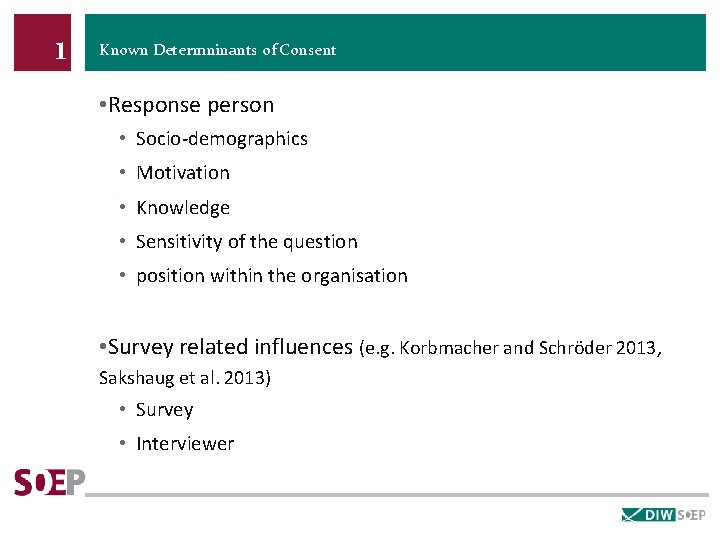
1 Known Determninants of Consent • Response person • Socio-demographics • Motivation • Knowledge • Sensitivity of the question • position within the organisation • Survey related influences (e. g. Korbmacher and Schröder 2013, Sakshaug et al. 2013) • Survey • Interviewer
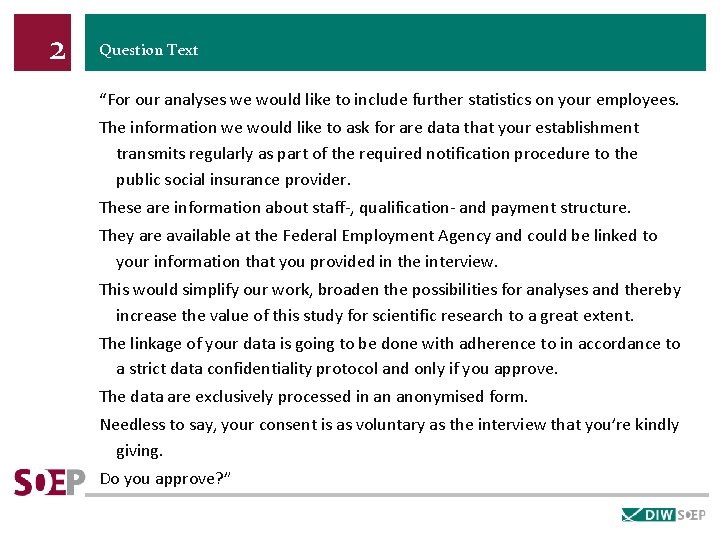
2 Question Text “For our analyses we would like to include further statistics on your employees. The information we would like to ask for are data that your establishment transmits regularly as part of the required notification procedure to the public social insurance provider. These are information about staff-, qualification- and payment structure. They are available at the Federal Employment Agency and could be linked to your information that you provided in the interview. This would simplify our work, broaden the possibilities for analyses and thereby increase the value of this study for scientific research to a great extent. The linkage of your data is going to be done with adherence to in accordance to a strict data confidentiality protocol and only if you approve. The data are exclusively processed in an anonymised form. Needless to say, your consent is as voluntary as the interview that you’re kindly giving. Do you approve? ”
• (2) • R 8: “No, that's not possible actually, because the whole accounting is done via the Landes-headquarters. There they do the accounting for a thousand people, you can't filter them out. Only financially, that doesn't work at all. That's technically impossible. ”
5 Logistic Regression Model: Establishment Characteristics I M 1 Type: Head office Type: Sub-Company Type: Local Branch Type: Company (or Franchise) Type: School/University o. Type: Public Agency Economic Sector: Manufactoring o. Economic Sector: Services Establishment: Public ownership Establishment: Charity Active: Local oder regional Active: Within GER Active: Within Europe o. Active: Outside Europe Establishment: Number of Employees (log. ) Constant N Pseudo-R 2 OR 1. 42 0. 9 0. 85 1. 45+ 0. 91 1 1. 28+ 1 1. 07 1. 2 1. 34 0. 95 1. 15 1 1. 01 0. 35** 1563 0. 01 se -0. 33 -0. 21 -0. 32 -0. 21 (. ) -0. 18 (. ) -0. 2 -0. 16 -0. 26 -0. 19 -0. 28 (. ) -0. 04 -0. 12
5 Logistic Regression Model: Establishment Characteristics II M 2 Establishment: No. departments (cat. ) Establishment: No. hierarchies (cat. ) Establishment: Formalization Establishment: Success (Sqrd. ) Existence of wage agreement Management: Owners Autonomy: Hiring decisions OR se 0. 99 1. 06 1. 04 0. 93 1. 04 0. 95 1. 11 1. 17 -0. 1 -0. 07 -0. 03 -0. 71 -0. 14 -0. 15 -0. 2 -0. 17 Company policy: informing employees Transparency: Income is known 1. 33** -0. 12 1. 28+ -0. 18 Establishment: Number of Employees (log. ) Constant N Pseudo-R 2 0. 98 -0. 07 0. 11+ -0. 14 982 0 0. 01 0
5 Logistic Regression Model: Respondent Characteristics M 3 TP Gender: Female TP-Age: 50+ TP-Education: Medium Sec. TP-Education: Upper Sec. TP-Education: University TP-Education: Other o. TP-Education: Lower Sec. TP-Division: Management TP-Division: Human Ressources TP-Division: Public Relations TP-Division: Controlling TP-Division: Other TP-Division: Leading Position TP: Time with Employer OR 0. 73* 1. 50** 1. 13 1. 05 1. 11 1. 38 1 0. 75 1. 15 1. 29 1. 31 0. 94 1. 23 1 se -0. 11 -0. 22 -0. 48 -0. 45 -0. 77 (. ) -0. 15 -0. 21 -0. 25 -0. 22 -0. 19 -0. 3 -0. 01 TP Interest: Asked for Report Establishment: Number of Employees (log. ) Constant N Pseudo-R 2 2. 55*** 0. 93 0. 29* 982 0. 05 -0. 4 -0. 05 -0. 15
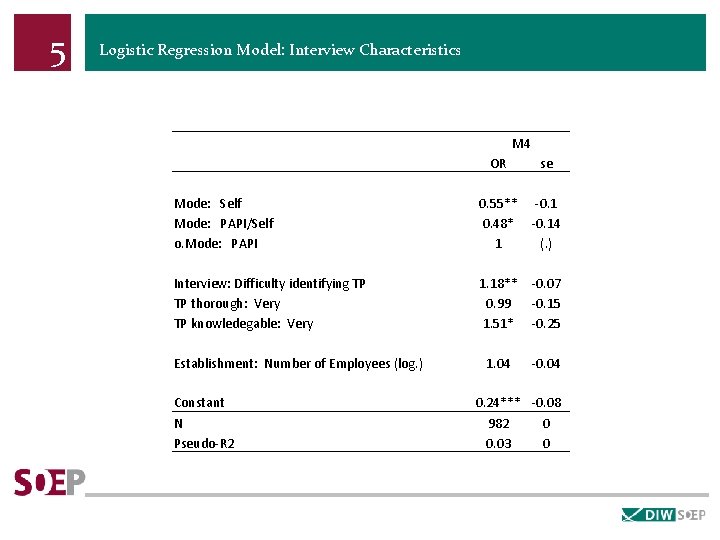
5 Logistic Regression Model: Interview Characteristics M 4 OR se Mode: Self Mode: PAPI/Self o. Mode: PAPI 0. 55** 0. 48* 1 -0. 14 (. ) Interview: Difficulty identifying TP TP thorough: Very TP knowledegable: Very 1. 18** 0. 99 1. 51* -0. 07 -0. 15 -0. 25 1. 04 -0. 04 Establishment: Number of Employees (log. ) Constant N Pseudo-R 2 0. 24*** -0. 08 982 0 0. 03 0
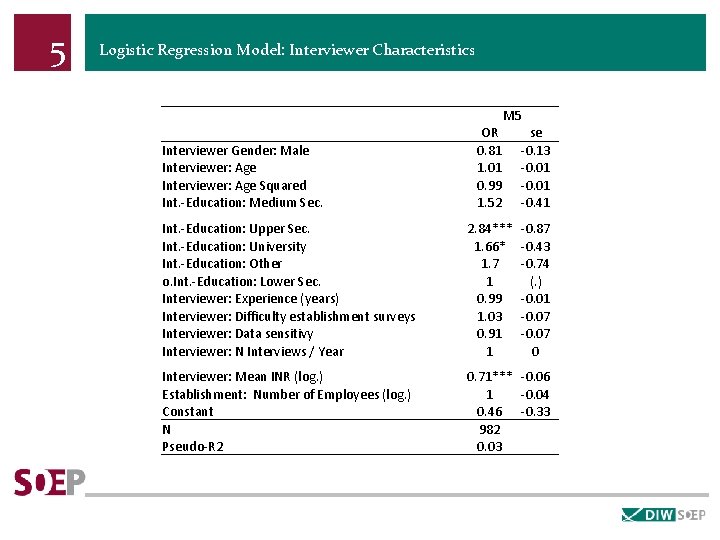
5 Logistic Regression Model: Interviewer Characteristics M 5 OR 0. 81 1. 01 0. 99 1. 52 se -0. 13 -0. 01 -0. 41 Int. -Education: Upper Sec. Int. -Education: University Int. -Education: Other o. Int. -Education: Lower Sec. Interviewer: Experience (years) Interviewer: Difficulty establishment surveys Interviewer: Data sensitivy Interviewer: N Interviews / Year 2. 84*** 1. 66* 1. 7 1 0. 99 1. 03 0. 91 1 -0. 87 -0. 43 -0. 74 (. ) -0. 01 -0. 07 0 Interviewer: Mean INR (log. ) Establishment: Number of Employees (log. ) Constant N Pseudo-R 2 0. 71*** -0. 06 1 -0. 04 0. 46 -0. 33 982 0. 03 Interviewer Gender: Male Interviewer: Age Squared Int. -Education: Medium Sec.
1 Consent to Record Linkage in Establishment Surveys C 0 C 1. 37. 40
- Slides: 36