
Detectors Measurements How we do physics without seeing
- Slides: 34
Detectors & Measurements: How we do physics without seeing… Overview of Detectors and Fundamental Measurements: From Quarks to Lifetimes Prof. Robin D. Erbacher University of California, Davis References: R. Fernow, Introduction to Experimental Particle Physics, Ch. 14, 15 D. Green, The Physics of Particle Detectors, Ch. 13 http: //pdg. lbl. gov/2004/reviews/pardetrpp. pdf� Lectures from CERN, Erbacher, Conway, …
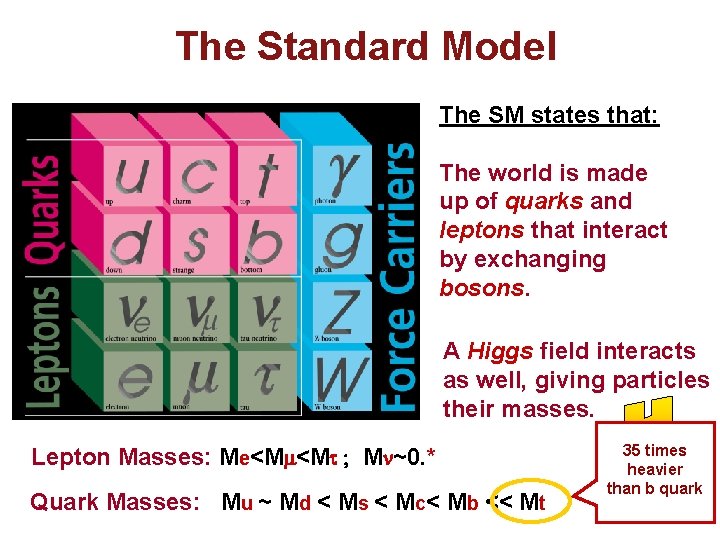
The Standard Model The SM states that: The world is made up of quarks and leptons that interact by exchanging bosons. A Higgs field interacts as well, giving particles their masses. Lepton Masses: Me<M <M ; M ~0. * Quark Masses: Mu ~ Md < Ms < Mc< Mb << Mt 35 times heavier than b quark
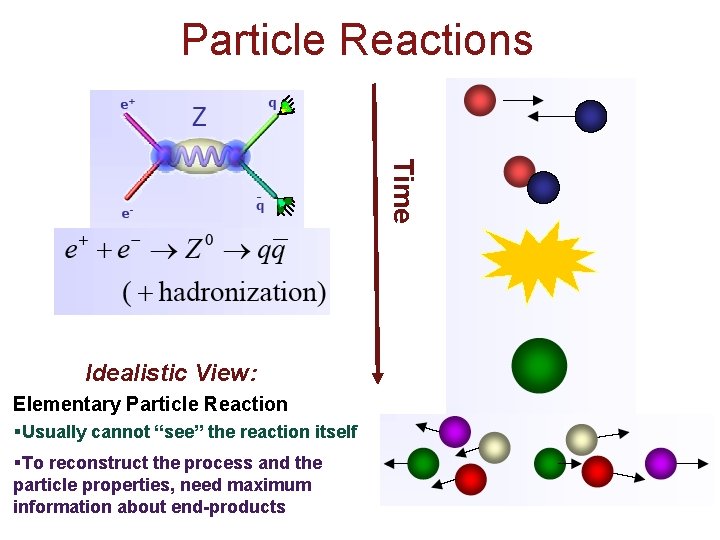
Particle Reactions Time Idealistic View: Elementary Particle Reaction §Usually cannot “see” the reaction itself §To reconstruct the process and the particle properties, need maximum information about end-products
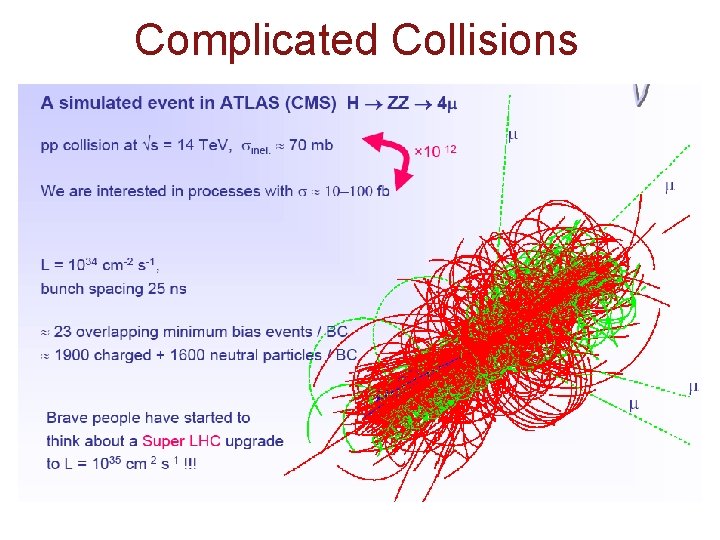
Complicated Collisions
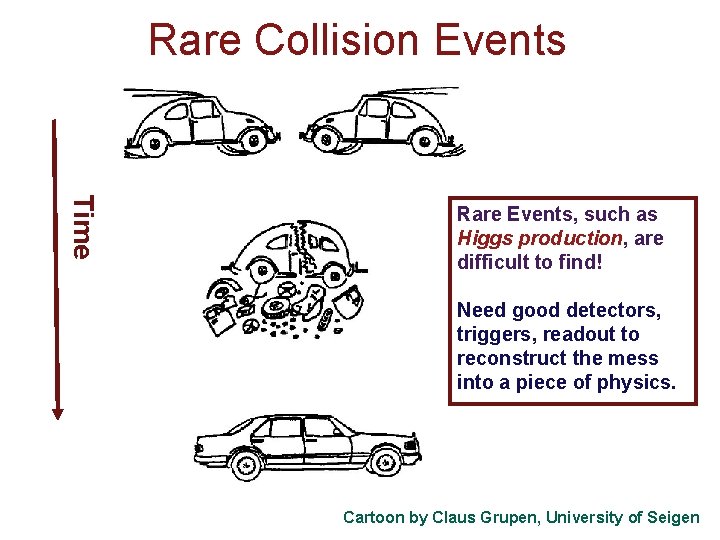
Rare Collision Events Time Rare Events, such as Higgs production, are difficult to find! Need good detectors, triggers, readout to reconstruct the mess into a piece of physics. Cartoon by Claus Grupen, University of Seigen
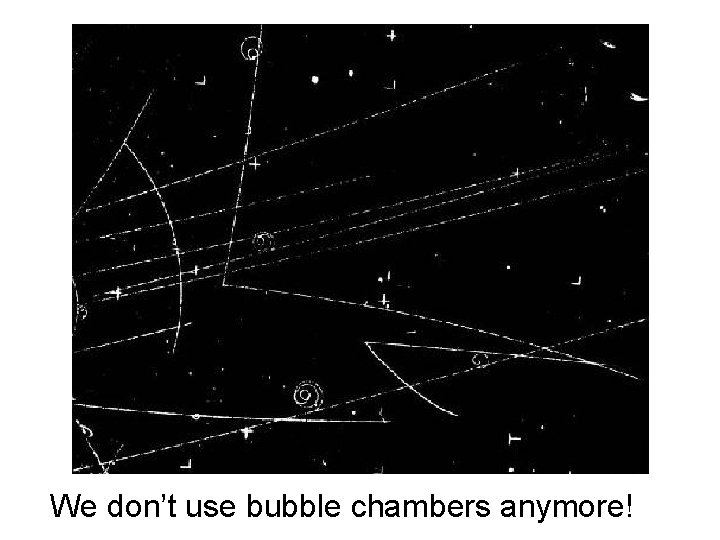
We don’t use bubble chambers anymore!
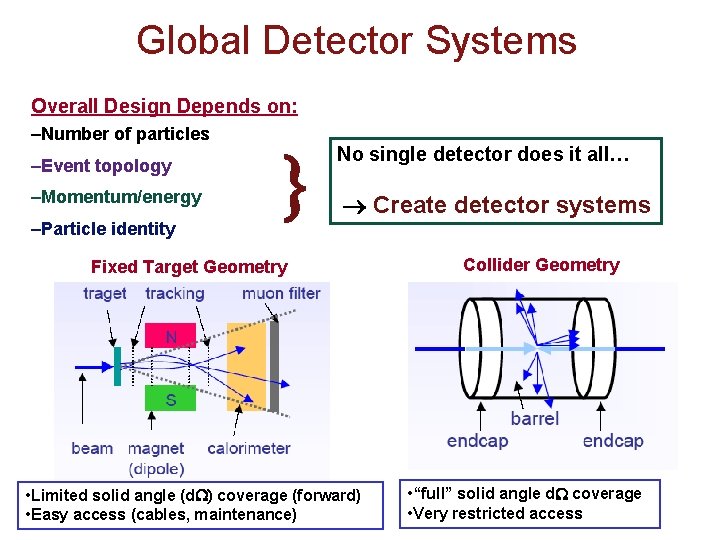
Global Detector Systems Overall Design Depends on: –Number of particles –Event topology –Momentum/energy –Particle identity No single detector does it all… Create detector systems Fixed Target Geometry • Limited solid angle (d coverage (forward) • Easy access (cables, maintenance) Collider Geometry • “full” solid angle d coverage • Very restricted access
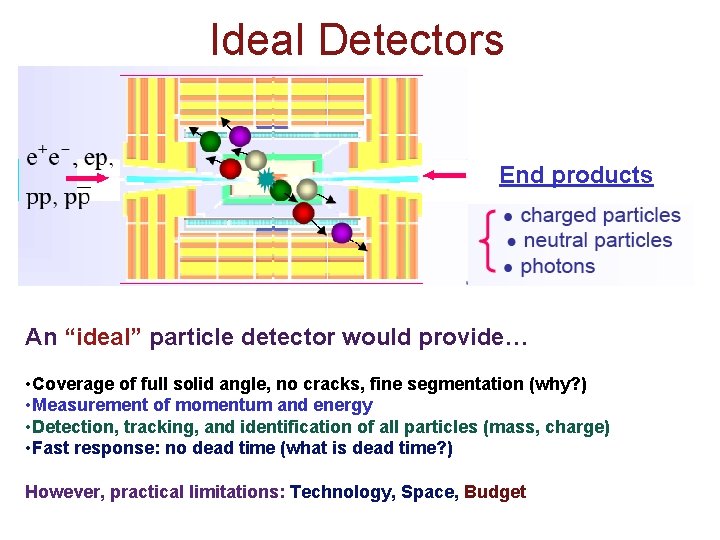
Ideal Detectors End products An “ideal” particle detector would provide… • Coverage of full solid angle, no cracks, fine segmentation (why? ) • Measurement of momentum and energy • Detection, tracking, and identification of all particles (mass, charge) • Fast response: no dead time (what is dead time? ) However, practical limitations: Technology, Space, Budget
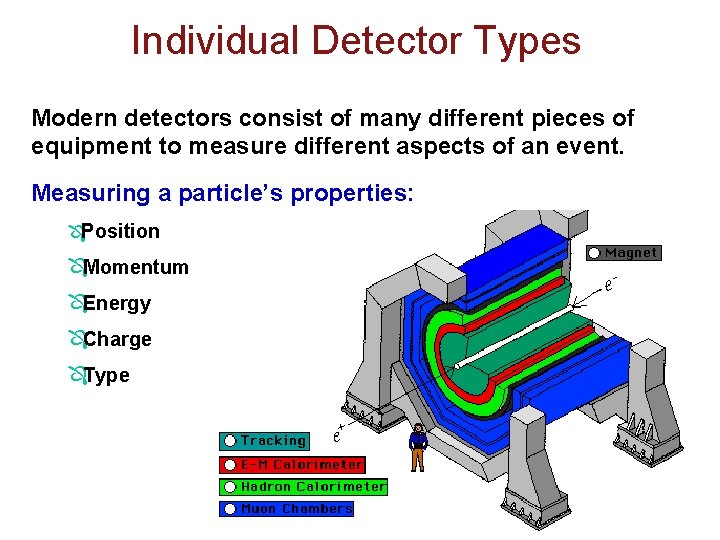
Individual Detector Types Modern detectors consist of many different pieces of equipment to measure different aspects of an event. Measuring a particle’s properties: ÔPosition ÔMomentum ÔEnergy ÔCharge ÔType
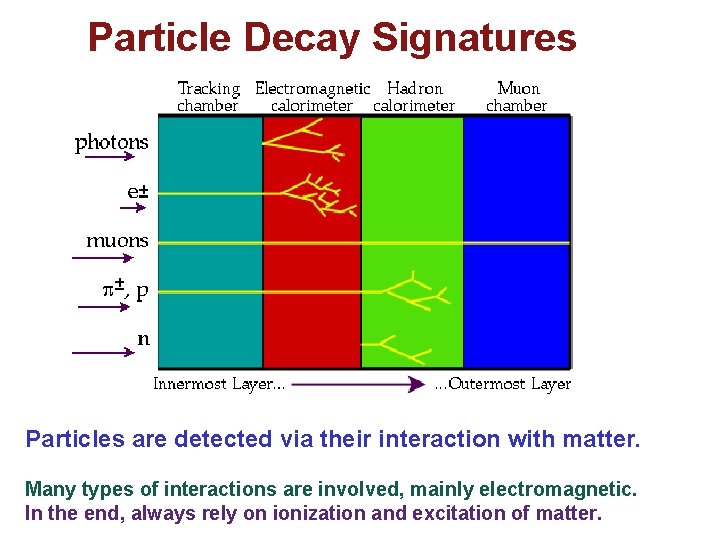
Particle Decay Signatures Particles are detected via their interaction with matter. Many types of interactions are involved, mainly electromagnetic. In the end, always rely on ionization and excitation of matter.
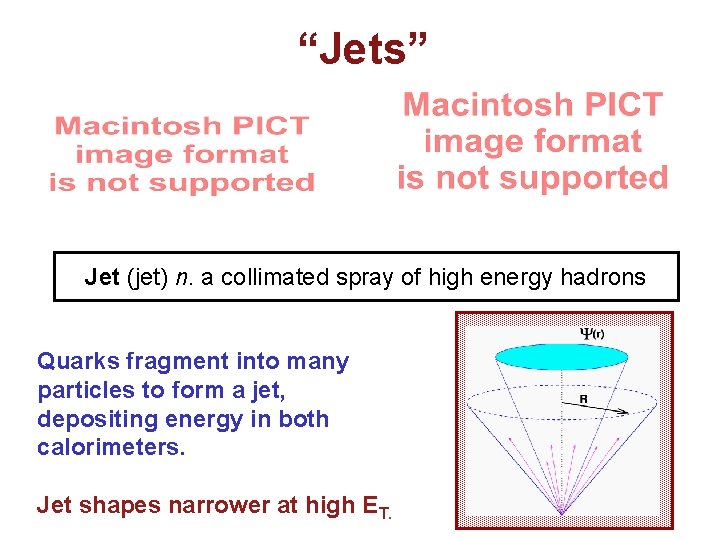
“Jets” Jet (jet) n. a collimated spray of high energy hadrons Quarks fragment into many particles to form a jet, depositing energy in both calorimeters. Jet shapes narrower at high ET.
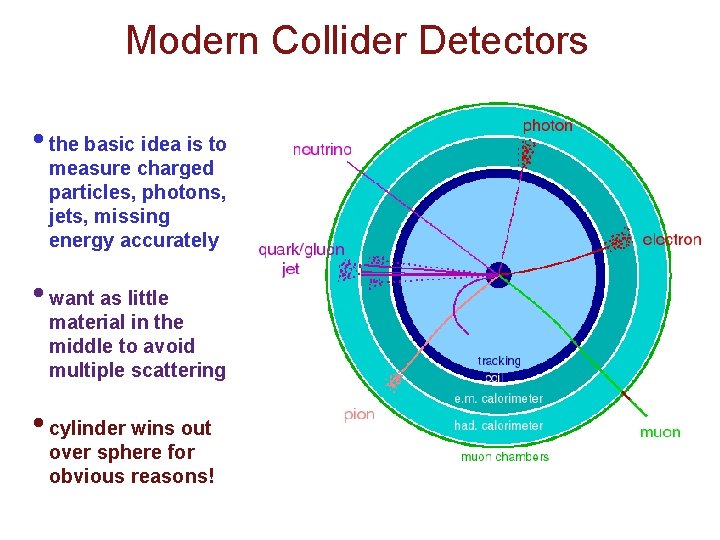
Modern Collider Detectors • the basic idea is to measure charged particles, photons, jets, missing energy accurately • want as little material in the middle to avoid multiple scattering • cylinder wins out over sphere for obvious reasons!
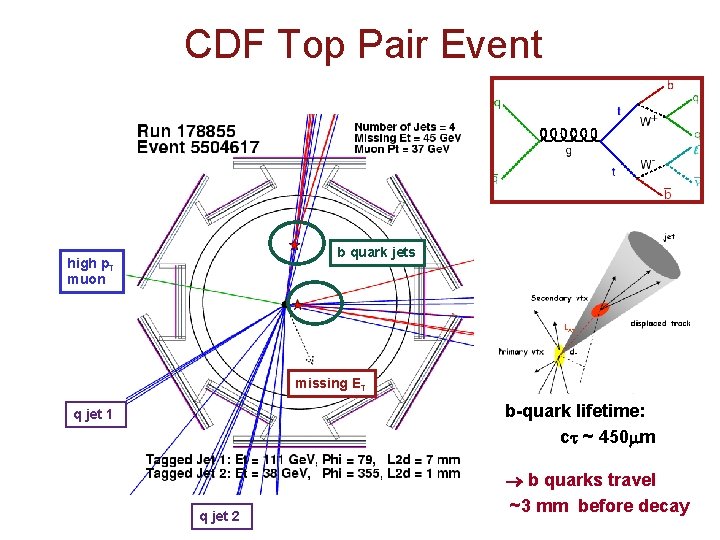
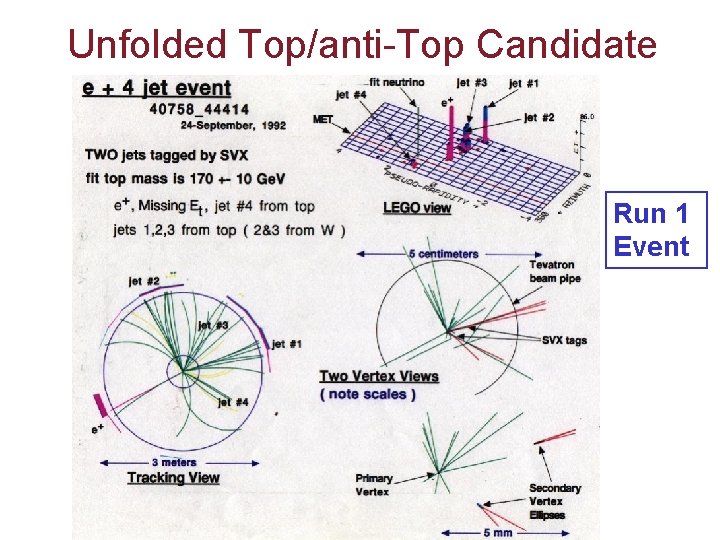
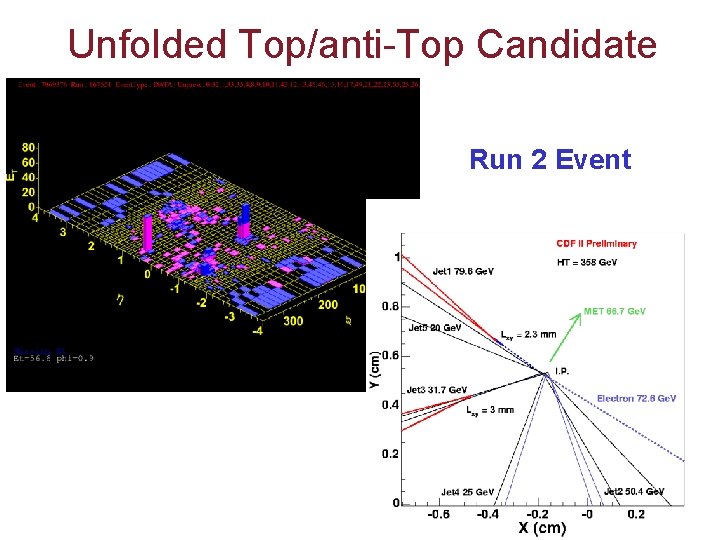
CDF Top Pair Event b quark jets high p. T muon missing ET b-quark lifetime: c ~ 450 m q jet 1 q jet 2 b quarks travel ~3 mm before decay
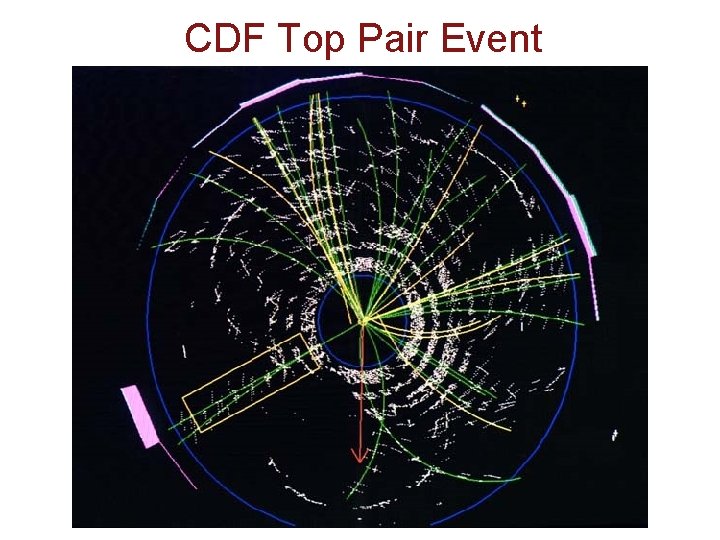
CDF Top Pair Event
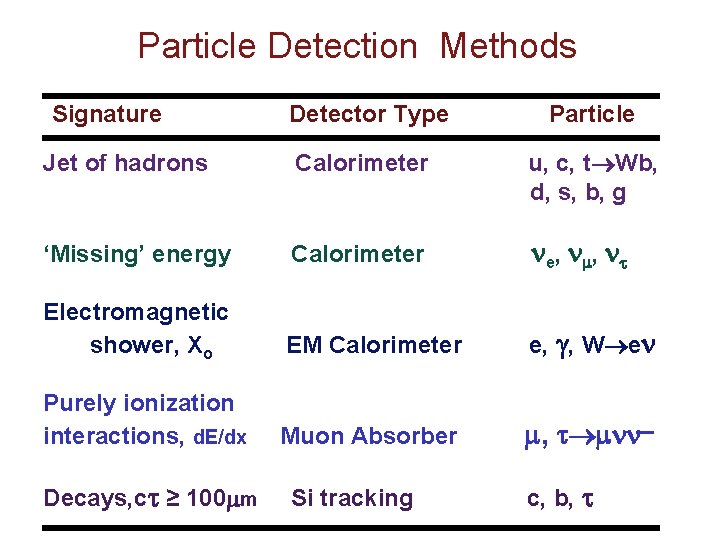
Particle Detection Methods Signature Detector Type Particle Jet of hadrons Calorimeter u, c, t Wb, d, s, b, g ‘Missing’ energy Calorimeter e, , Electromagnetic shower, Xo EM Calorimeter e, , W e Purely ionization interactions, d. E/dx Muon Absorber , Decays, c ≥ 100 m Si tracking c, b,
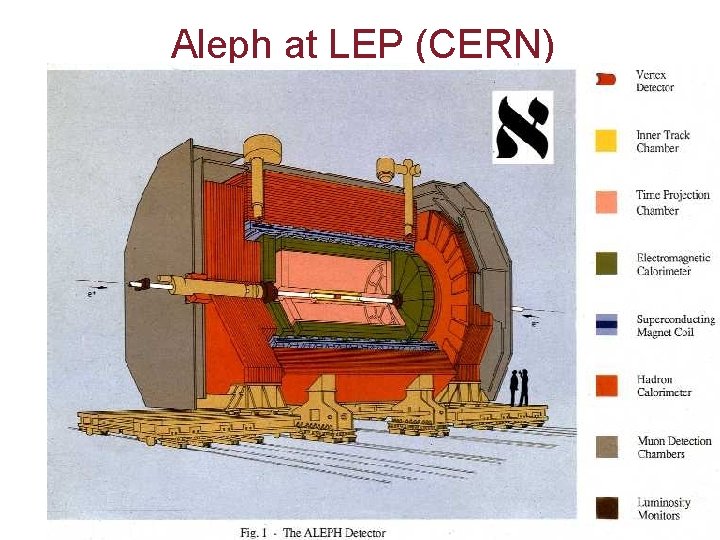
Aleph at LEP (CERN)
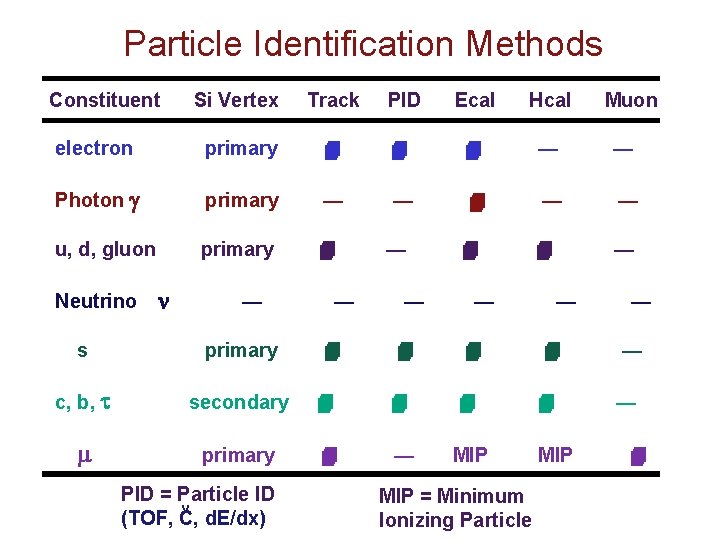
Particle Identification Methods Constituent Si Vertex Track PID Ecal Hcal primary — — Photon primary — — u, d, gluon electron Neutrino primary — — — — s primary c, b, secondary primary — MIP PID = Particle ID v (TOF, C, d. E/dx) MIP = Minimum Ionizing Particle Muon — — —
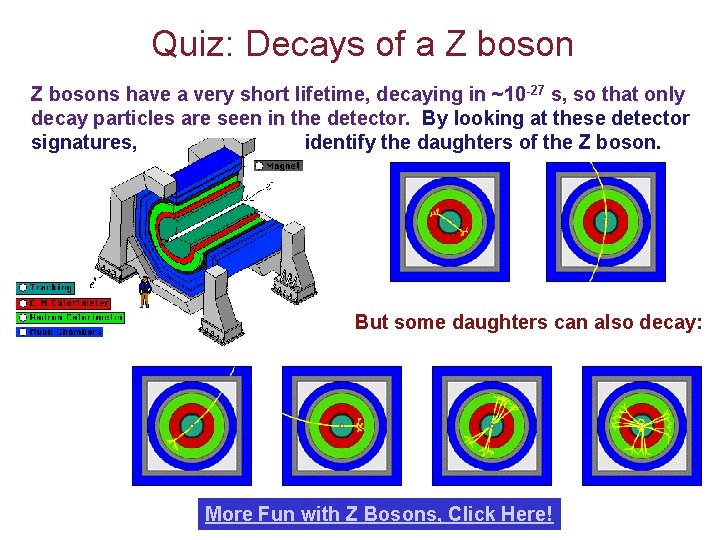
Quiz: Decays of a Z bosons have a very short lifetime, decaying in ~10 -27 s, so that only decay particles are seen in the detector. By looking at these detector signatures, identify the daughters of the Z boson. But some daughters can also decay: More Fun with Z Bosons, Click Here!
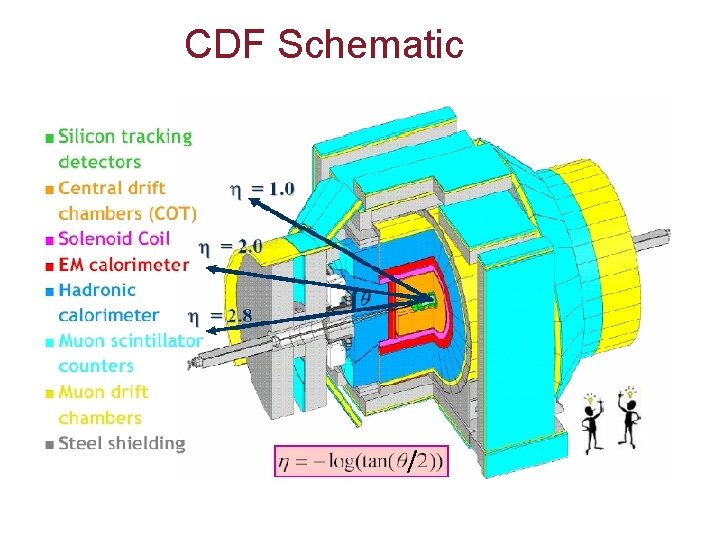
CDF Schematic
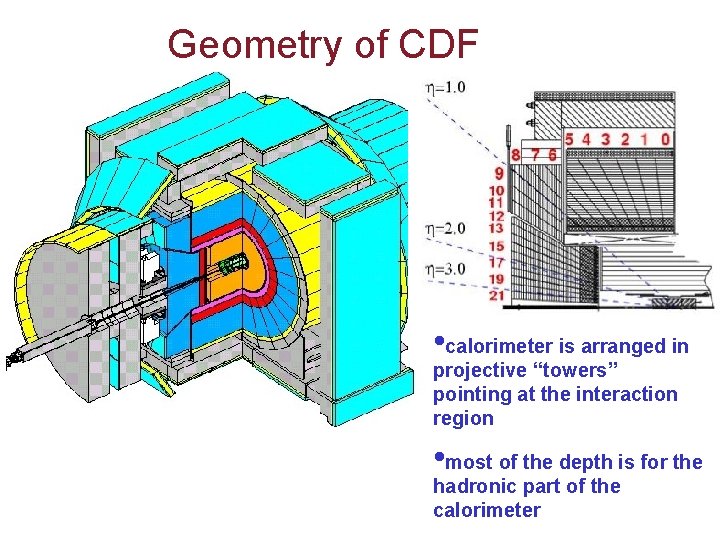
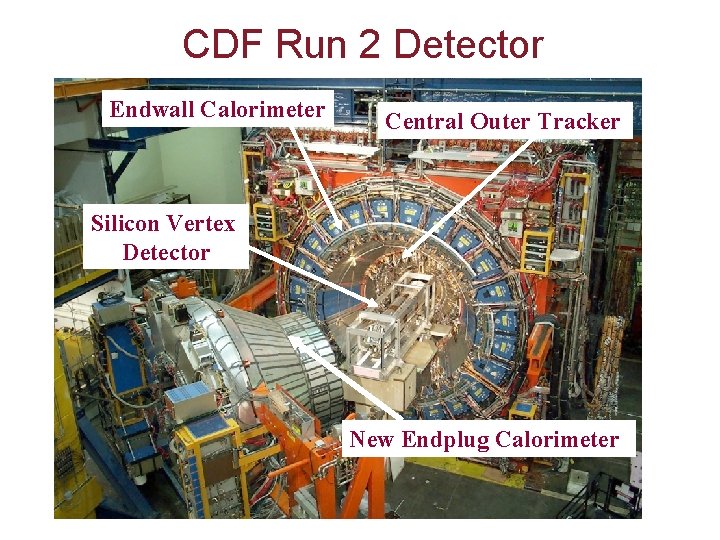
Geometry of CDF • calorimeter is arranged in projective “towers” pointing at the interaction region • most of the depth is for the hadronic part of the calorimeter
CDF Run 2 Detector Endwall Calorimeter Central Outer Tracker Silicon Vertex Detector New Endplug Calorimeter
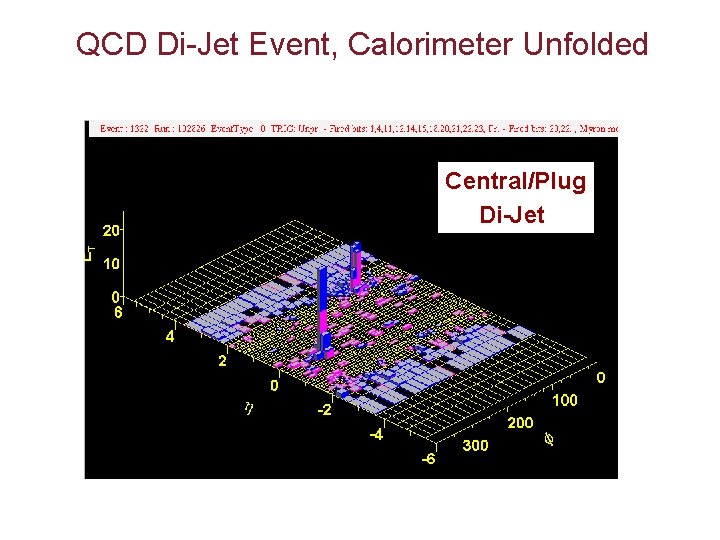
QCD Di-Jet Event, Calorimeter Unfolded Central/Plug Di-Jet
Unfolded Top/anti-Top Candidate Run 1 Event
Unfolded Top/anti-Top Candidate Run 2 Event
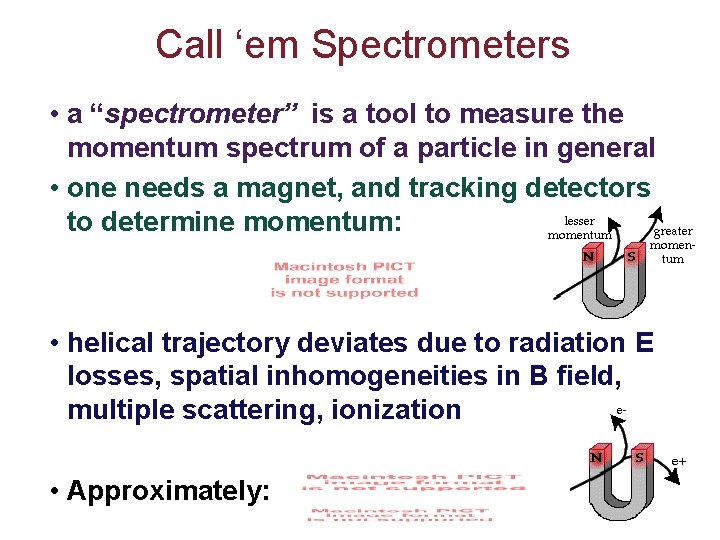
Call ‘em Spectrometers • a “spectrometer” is a tool to measure the momentum spectrum of a particle in general • one needs a magnet, and tracking detectors to determine momentum: • helical trajectory deviates due to radiation E losses, spatial inhomogeneities in B field, multiple scattering, ionization • Approximately:
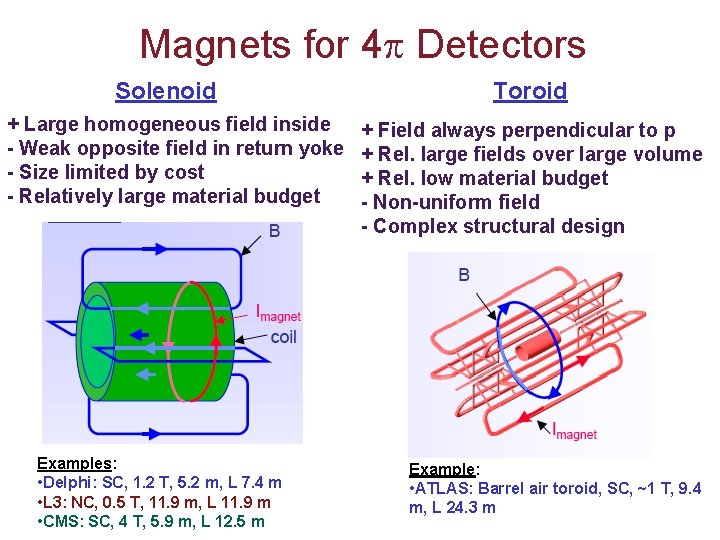
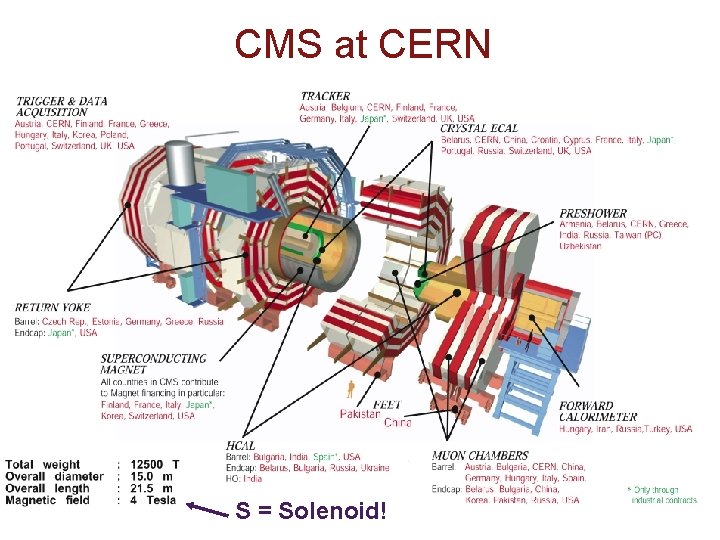
Magnets for 4 Detectors Solenoid + Large homogeneous field inside - Weak opposite field in return yoke - Size limited by cost - Relatively large material budget Examples: • Delphi: SC, 1. 2 T, 5. 2 m, L 7. 4 m • L 3: NC, 0. 5 T, 11. 9 m, L 11. 9 m • CMS: SC, 4 T, 5. 9 m, L 12. 5 m Toroid + Field always perpendicular to p + Rel. large fields over large volume + Rel. low material budget - Non-uniform field - Complex structural design Example: • ATLAS: Barrel air toroid, SC, ~1 T, 9. 4 m, L 24. 3 m
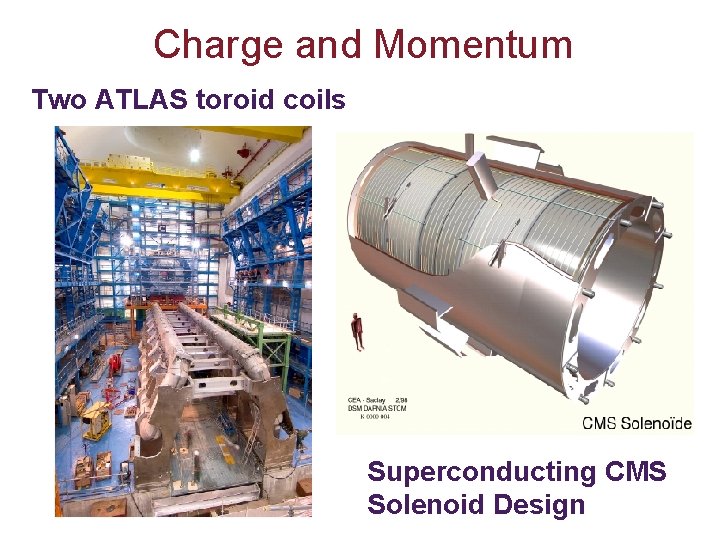
Charge and Momentum Two ATLAS toroid coils Superconducting CMS Solenoid Design
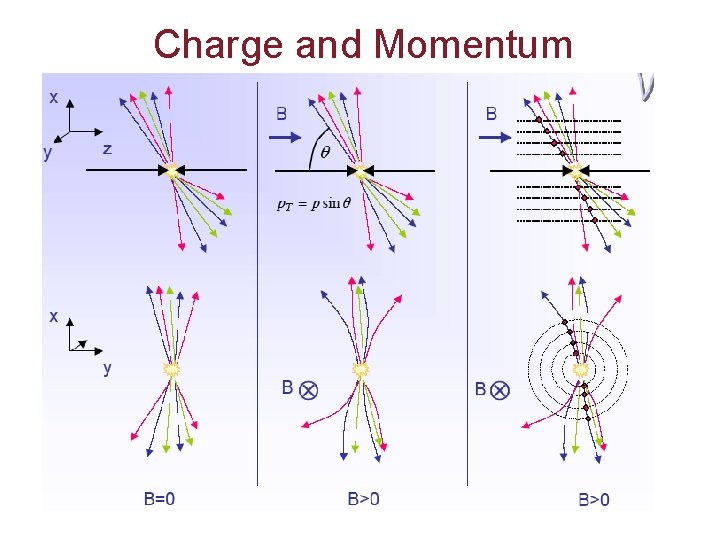
Charge and Momentum
CMS at CERN S = Solenoid!
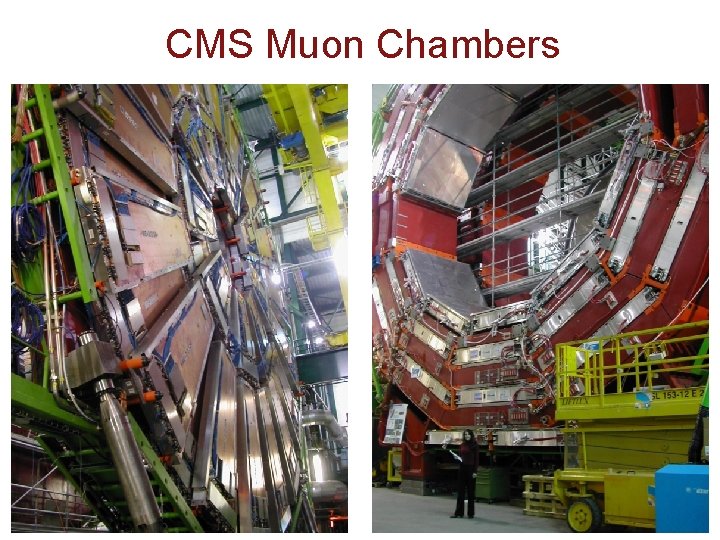
CMS Muon Chambers
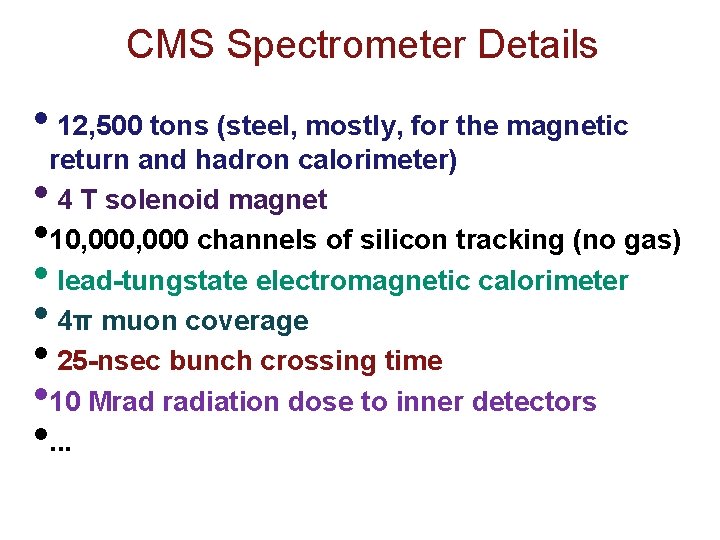
CMS Spectrometer Details • 12, 500 tons (steel, mostly, for the magnetic • • return and hadron calorimeter) 4 T solenoid magnet 10, 000 channels of silicon tracking (no gas) lead-tungstate electromagnetic calorimeter 4π muon coverage 25 -nsec bunch crossing time 10 Mrad radiation dose to inner detectors. . .
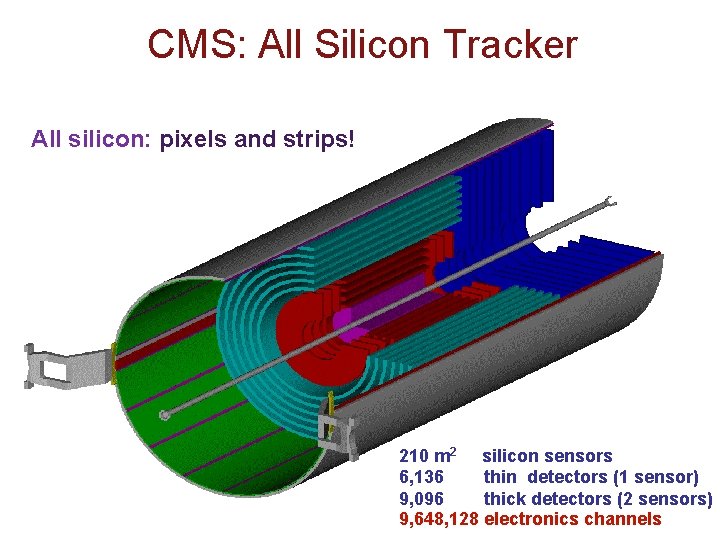
CMS: All Silicon Tracker All silicon: pixels and strips! 210 m 2 silicon sensors 6, 136 thin detectors (1 sensor) 9, 096 thick detectors (2 sensors) 9, 648, 128 electronics channels
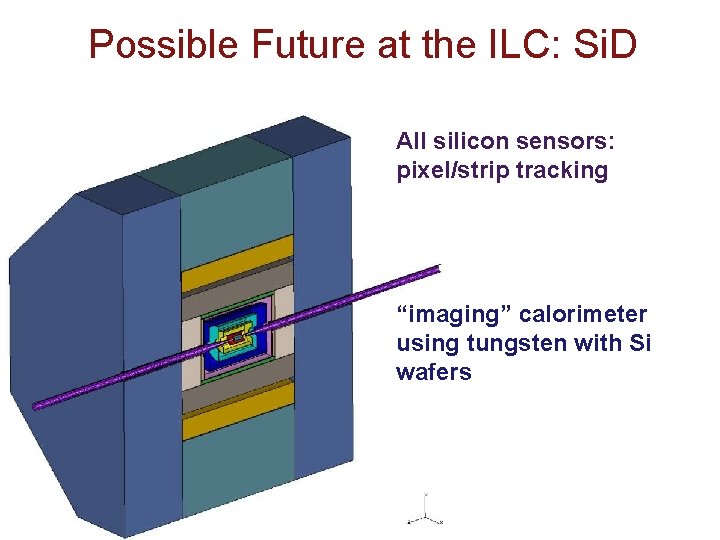
Possible Future at the ILC: Si. D All silicon sensors: pixel/strip tracking “imaging” calorimeter using tungsten with Si wafers
Fixed Target Spectrometers Coming next time…