
Detectors for a LC from design to reality

- Slides: 34
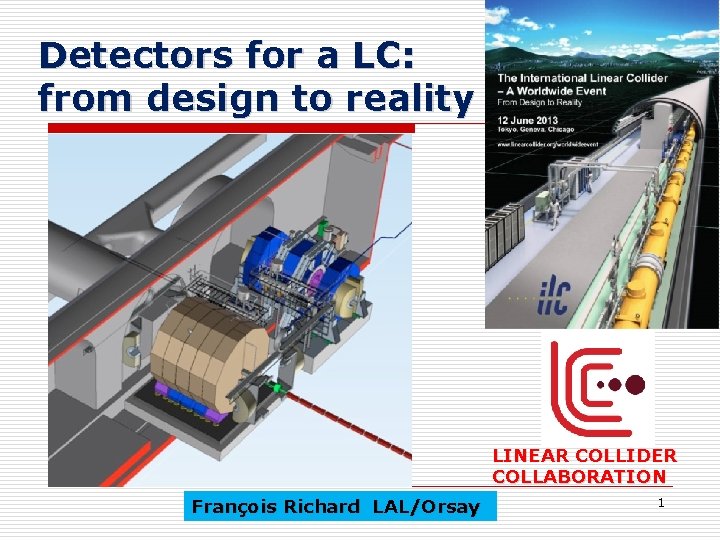
Detectors for a LC: from design to reality LINEAR COLLIDER COLLABORATION F. Richard June 2013 François Richard LAL/Orsay 1
Outline o What do we expect from LC detectors ? o Are the two proposed detectors (ILD & Si. D) fit for this mission ? o What is the degree of realism achieved so far for the Detailed Baseline Design o How do these detectors differ from the existing ones ? o What is still needed ? F. Richard June 2013 2
LC physics environment o Known (and speculated) physics channels dictate detector properties o A LC is a H/top/W factory with well defined initial state (mono-energetic e+ and e- with adjustable energy for scans) and excellent signal/background (e. g. top quarks as often produced as ordinary quarks in contrast to LHC) o Direct and very precise access to electroweak couplings using polarized beams o Far easier environment than at LHC but with much more ambitious goals in terms of accuracy (below %) and complexity (high efficiency for multi-jet events) F. Richard June 2013 3
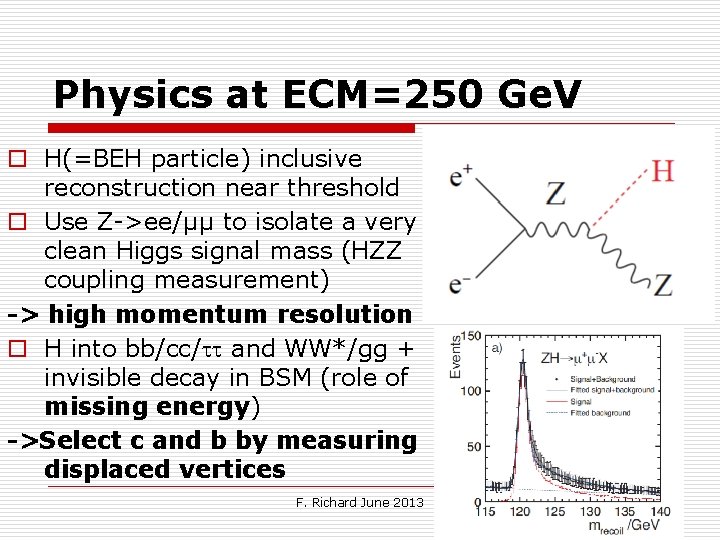
Physics at ECM=250 Ge. V o H(=BEH particle) inclusive reconstruction near threshold o Use Z->ee/µµ to isolate a very clean Higgs signal mass (HZZ coupling measurement) -> high momentum resolution o H into bb/cc/tt and WW*/gg + invisible decay in BSM (role of missing energy) ->Select c and b by measuring displaced vertices F. Richard June 2013 4
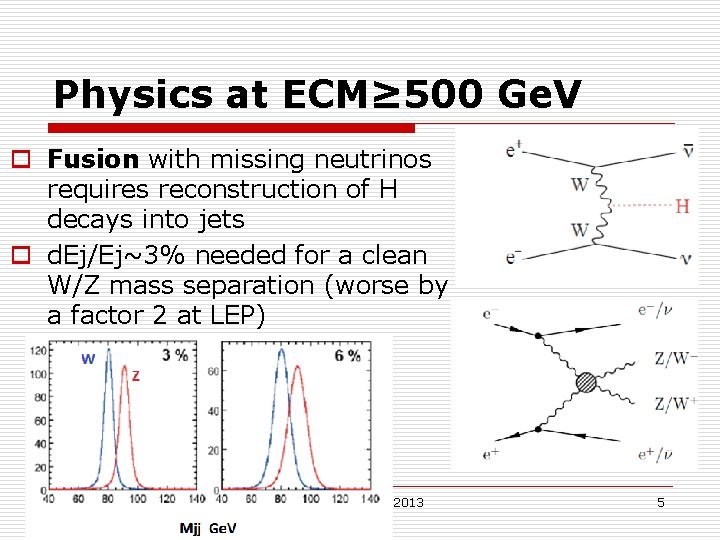
Physics at ECM≥ 500 Ge. V o Fusion with missing neutrinos requires reconstruction of H decays into jets o d. Ej/Ej~3% needed for a clean W/Z mass separation (worse by a factor 2 at LEP) F. Richard June 2013 5
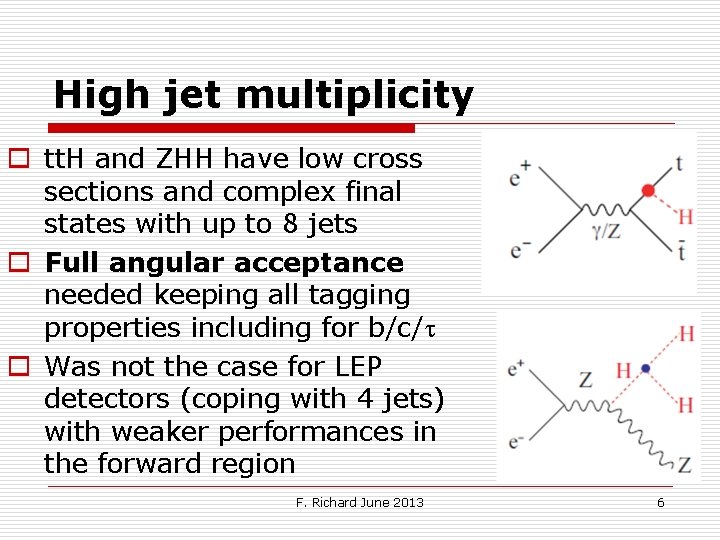
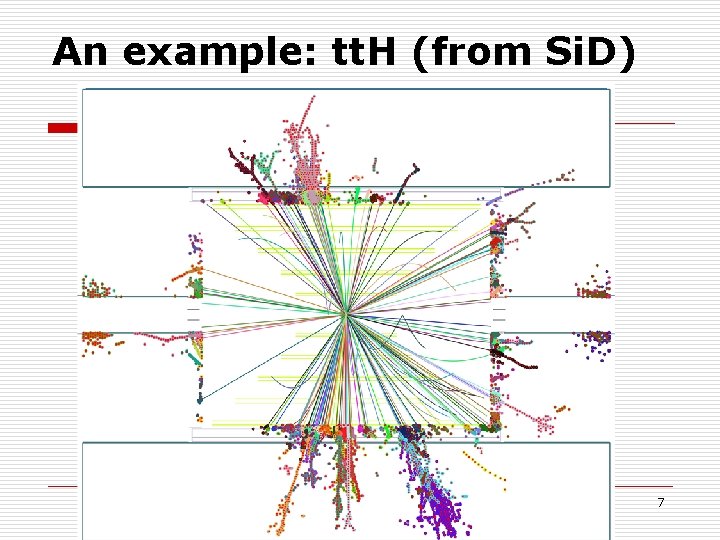
High jet multiplicity o tt. H and ZHH have low cross sections and complex final states with up to 8 jets o Full angular acceptance needed keeping all tagging properties including for b/c/t o Was not the case for LEP detectors (coping with 4 jets) with weaker performances in the forward region F. Richard June 2013 6
An example: tt. H (from Si. D) F. Richard June 2013 7
Bias free selection o Possible discoveries beyond LHC are not excluded o A bias free selection is therefore essential to cover any unforeseen physics scenario o The beam time structure (~ms bunch trains at 5 Hz) allows to replace hardware triggering by software triggering in between trains o Detectors act as a camera where all the useful information (noise suppressed) is stored during the whole bunch train F. Richard June 2013 8
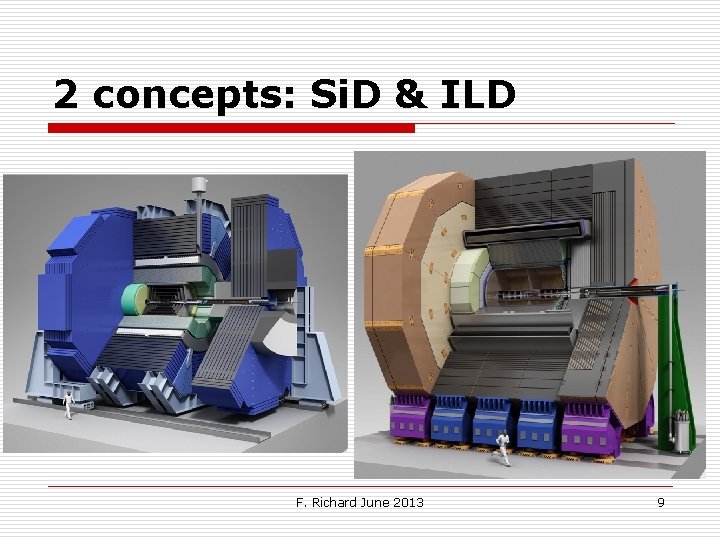
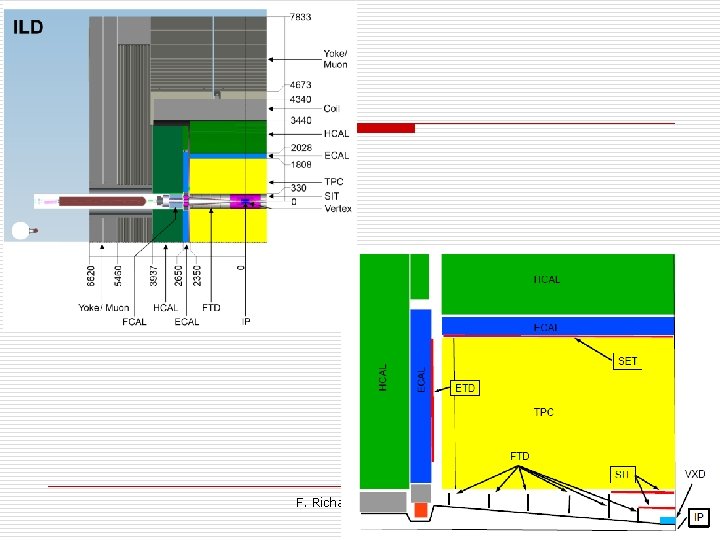
2 concepts: Si. D & ILD F. Richard June 2013 9
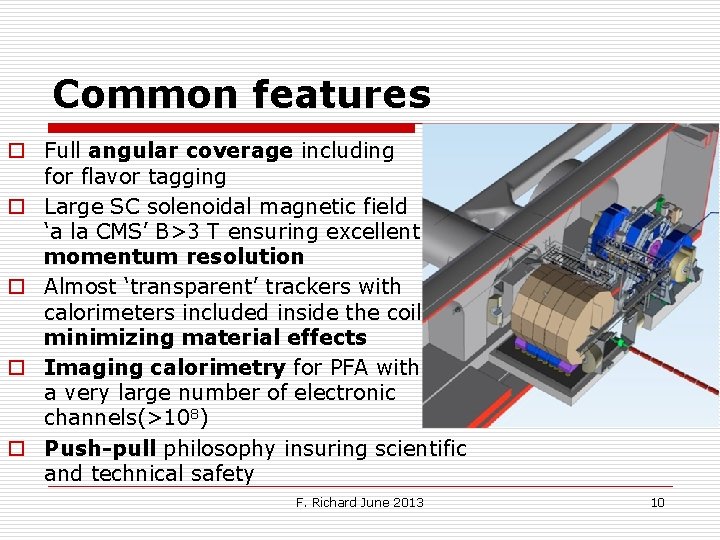
Common features o Full angular coverage including for flavor tagging o Large SC solenoidal magnetic field ‘a la CMS’ B>3 T ensuring excellent momentum resolution o Almost ‘transparent’ trackers with calorimeters included inside the coil minimizing material effects o Imaging calorimetry for PFA with a very large number of electronic channels(>108) o Push-pull philosophy insuring scientific and technical safety F. Richard June 2013 10
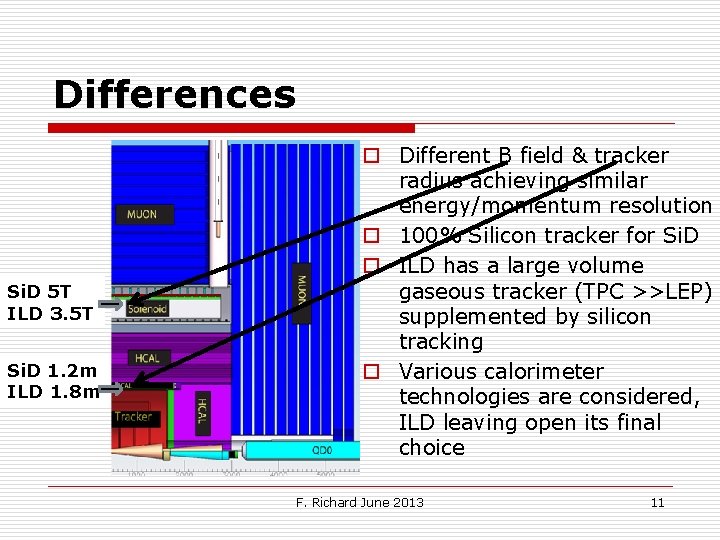
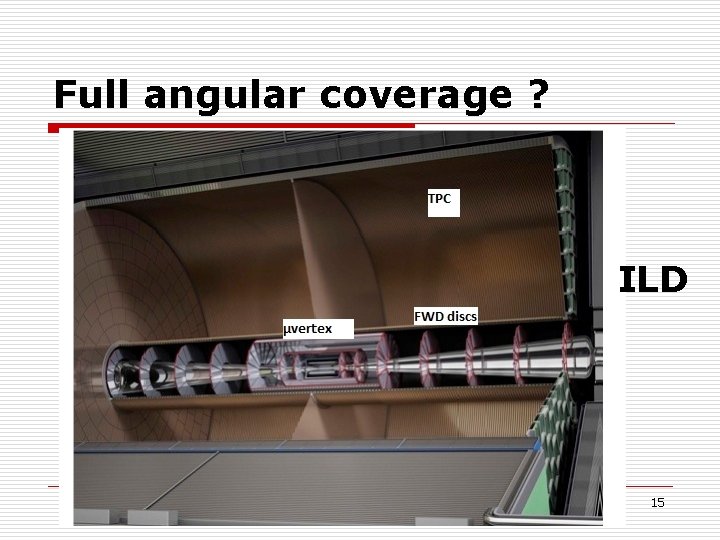
Differences Si. D 5 T ILD 3. 5 T Si. D 1. 2 m ILD 1. 8 m o Different B field & tracker radius achieving similar energy/momentum resolution o 100% Silicon tracker for Si. D o ILD has a large volume gaseous tracker (TPC >>LEP) supplemented by silicon tracking o Various calorimeter technologies are considered, ILD leaving open its final choice F. Richard June 2013 11
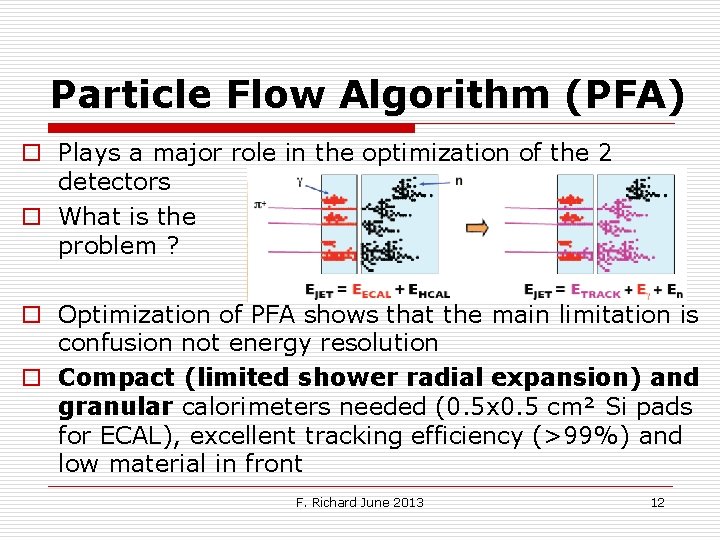
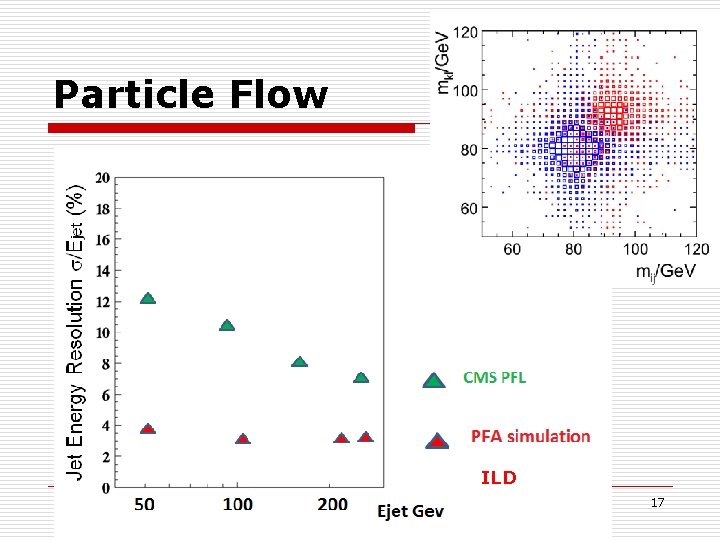
Particle Flow Algorithm (PFA) o Plays a major role in the optimization of the 2 detectors o What is the problem ? o Optimization of PFA shows that the main limitation is confusion not energy resolution o Compact (limited shower radial expansion) and granular calorimeters needed (0. 5 x 0. 5 cm² Si pads for ECAL), excellent tracking efficiency (>99%) and low material in front F. Richard June 2013 12
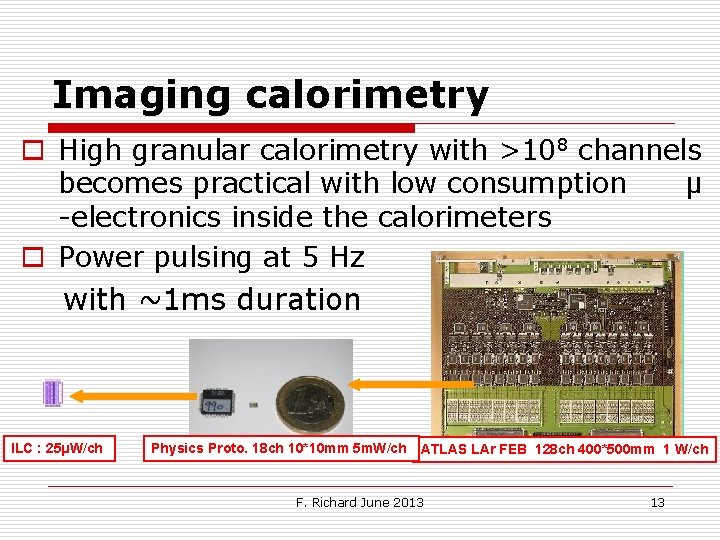
Imaging calorimetry o High granular calorimetry with >108 channels becomes practical with low consumption µ -electronics inside the calorimeters o Power pulsing at 5 Hz with ~1 ms duration ILC : 25µW/ch Physics Proto. 18 ch 10*10 mm 5 m. W/ch ATLAS LAr FEB 128 ch 400*500 mm 1 W/ch F. Richard June 2013 13
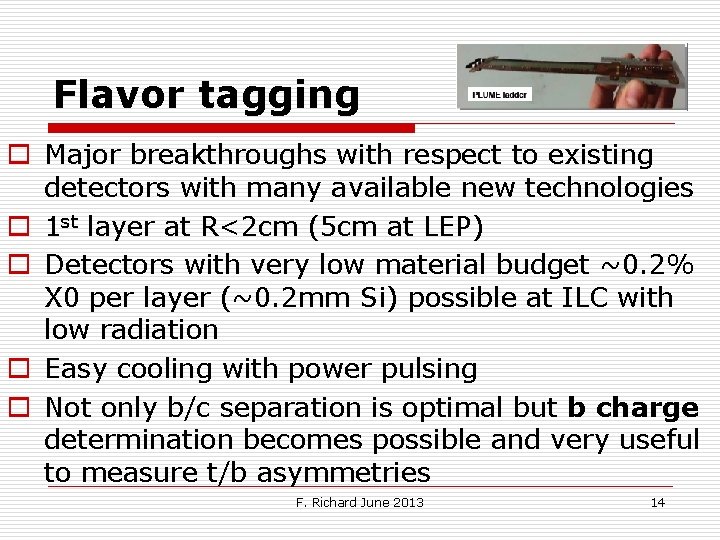
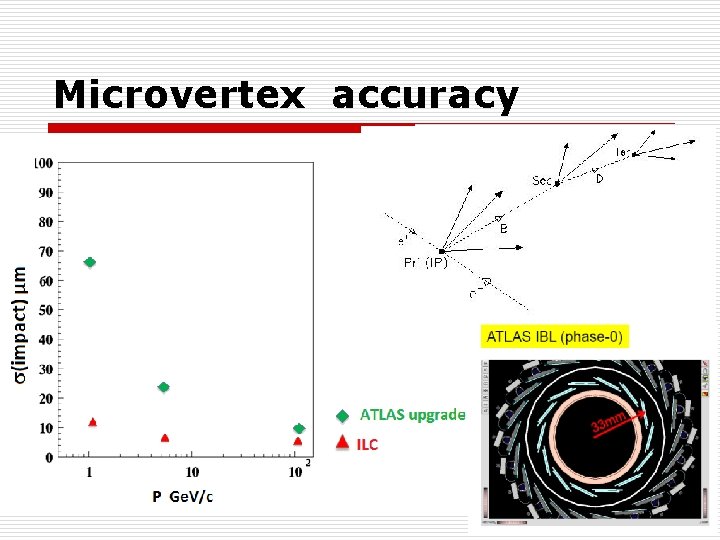
Flavor tagging o Major breakthroughs with respect to existing detectors with many available new technologies o 1 st layer at R<2 cm (5 cm at LEP) o Detectors with very low material budget ~0. 2% X 0 per layer (~0. 2 mm Si) possible at ILC with low radiation o Easy cooling with power pulsing o Not only b/c separation is optimal but b charge determination becomes possible and very useful to measure t/b asymmetries F. Richard June 2013 14
Full angular coverage ? ILD F. Richard June 2013 15
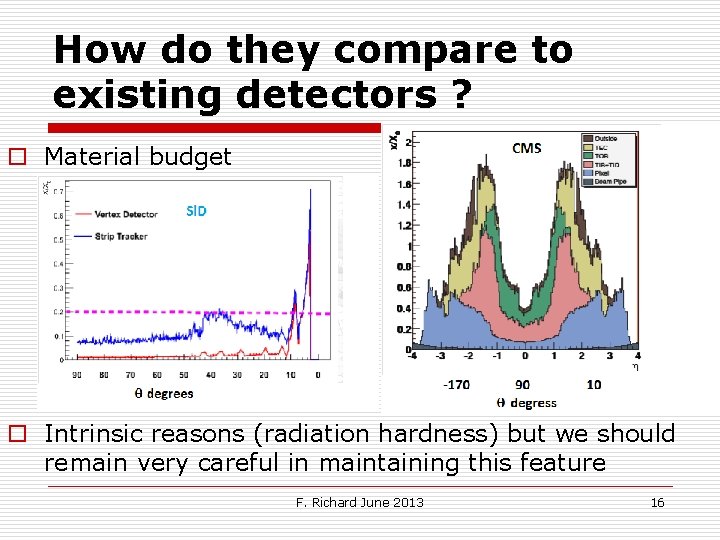
How do they compare to existing detectors ? o Material budget o Intrinsic reasons (radiation hardness) but we should remain very careful in maintaining this feature F. Richard June 2013 16
Particle Flow ILD F. Richard June 2013 17
Microvertex accuracy F. Richard June 2013 18
How realistic are these detectors ? o More than 10 years of coordinated R&D with large prototypes allow realistic evaluations of innovative technologies and insure moderate risks o This effort is internationally embedded in WW collaborations: CALICE, LCTPC, FCAL…with international peer reviewing o Present DBD documents organized around 2 detector concepts with close connection to R&D o Europe well structured through European contracts (AIDA etc…) and participation of CERN F. Richard June 2013 19
R&D o Several alternate technologies are developed e. g. for calorimetry and µ-vertexing which allows a good safety margin in case of unexpected problems o As an example 3 cubic m HCAL prototypes (500000 RO channels) with Fe and W absorbers tested at CERN, FNAL, DESY… o An ECAL prototype with 10000 equipped Si channels has been associated to these prototypes o A large scale TPC prototype is currently operated at DESY o A wealth of applications has resulted from these efforts in various domains which extend well beyond HEP F. Richard June 2013 20
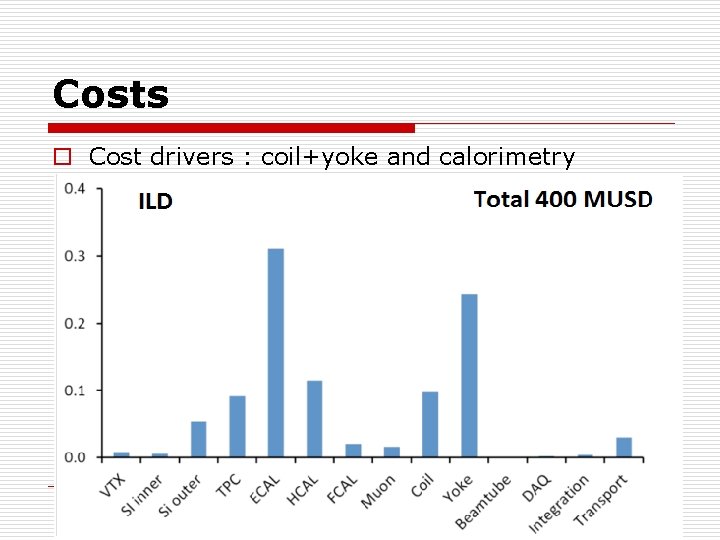
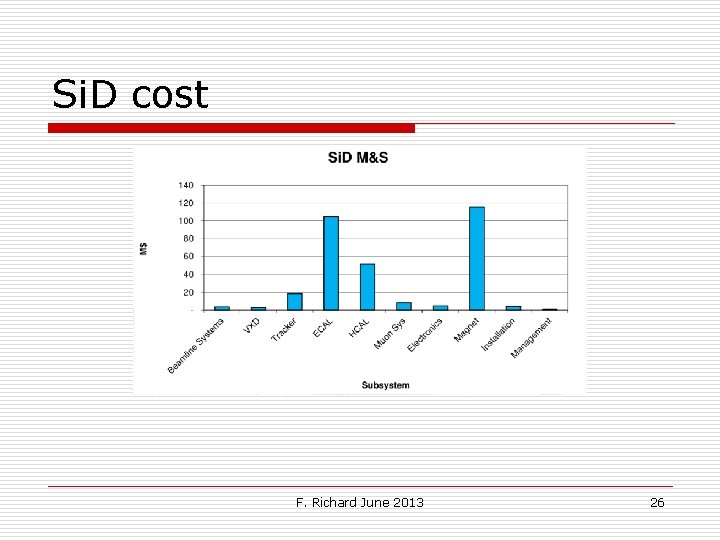
Costs o Cost drivers : coil+yoke and calorimetry F. Richard June 2013 21
What remains to be done o ‘Devil is in the details’: cabling, supports, cooling have been investigated but more is needed to fully assess the present set up o A lot has been done including installation and integration aspects but this is a ‘DBD’ not a TDR which would require knowledge of the site chosen for construction o More engineering efforts are therefore needed for a full TDR (ready for construction) level project o Work with industry for construction has to start F. Richard June 2013 22
Summary o After a long and intense phase of R&D at the worldwide level two detector concepts are proposed for a LC operating up to 1 Te. V center of mass o Realistic physics studies have shown that these detectors, with unprecedented reconstruction accuracies, optimally cover the physics needs o Engineering studies provide a solid proof of realism of these detectors close to a ‘ready for construction level’ (TDR) but full realism requires industrialization and understanding of the various assembly constraints within a well defined site o Resources should be provided to achieve these goals with a move toward two detector collaborations replacing the concept groups F. Richard June 2013 23
Quoting a conclusion from Erice: ‘The initiative from the Japanese particle physics community to host the ILC in Japan is most welcome, and European groups are eager to participate’ F. Richard June 2013 24
BACK UPS F. Richard 25
Si. D cost F. Richard June 2013 26
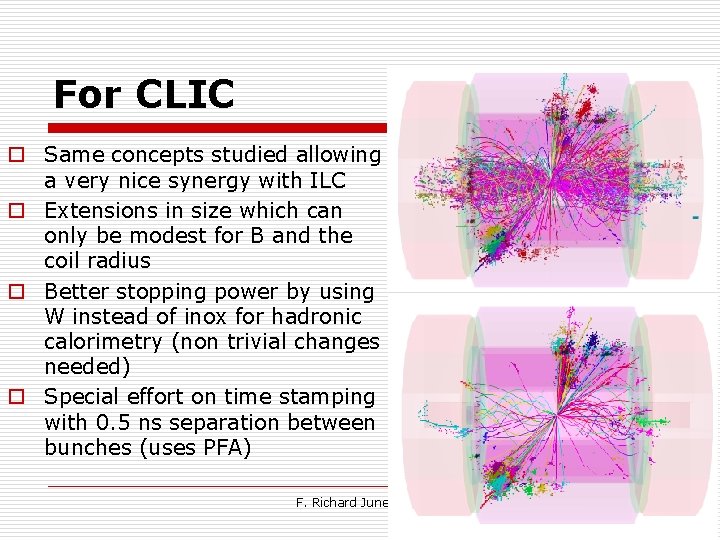
For CLIC o Same concepts studied allowing a very nice synergy with ILC o Extensions in size which can only be modest for B and the coil radius o Better stopping power by using W instead of inox for hadronic calorimetry (non trivial changes needed) o Special effort on time stamping with 0. 5 ns separation between bunches (uses PFA) F. Richard June 2013 27
Some spin-offs o o o o Ref (M. Demateau at IEEE LC event): https: //indico. desy. de/conference. Display. py? conf. Id=6537 The LC effort has served various purposes: Particle physics itself with various synergies with ALICE (ALTRO chip forb TPC & Calorimetry), T 2 K (TPC, Si. PM), Belle-II at Super. Ke. Kb (DEPFET), STAR at RHIC (µvertex) , CMS (Si. PM for calorimetry) Other research fields (PEBS ballon experiment with ASICS), X ray dectors for imaging in astronomy Medical : proton (Si. PM for calorimetry) and PET positron emission tomography (ECAL technology) , gamma camera (ASICS) Vulcano tomography Si. PM ‘everywhere’ was started by this activity F. Richard June 2013 28
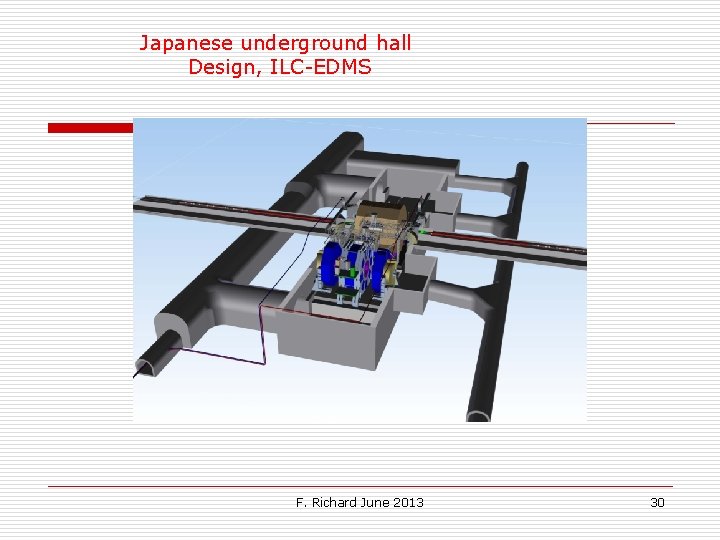
Machine-Detector interface o In a LC the design of a detector is more tightly connected to machine constraints: o Focusing elements are embedded inside the detector and require tight alignments (nm beam spots) o Backgrounds aspects have to be studied in common o Detectors need to be moved and realigned easily with the push-pull constraints o ~One week needed for replacement and realignment F. Richard June 2013 29
Japanese underground hall Design, ILC-EDMS F. Richard June 2013 30
F. Richard June 2013 31
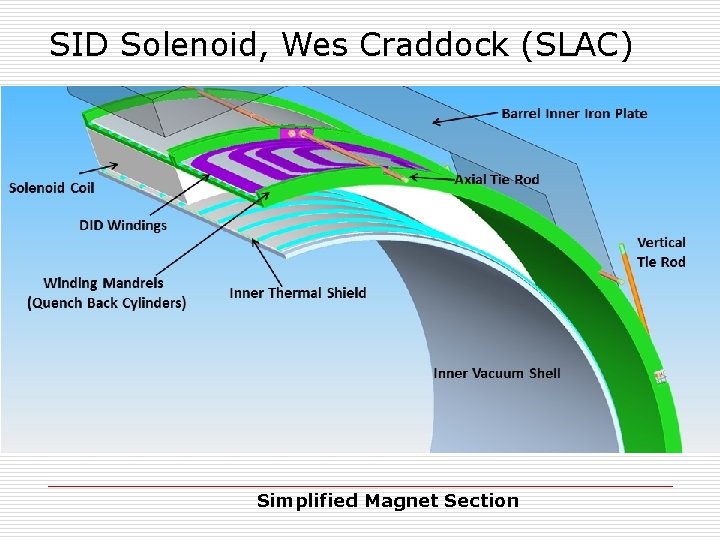
SID Solenoid, Wes Craddock (SLAC) Simplified Magnet Section
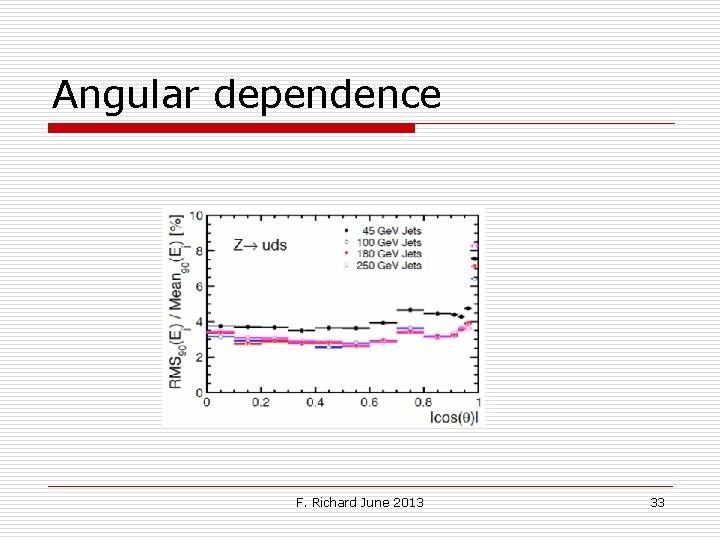
Angular dependence F. Richard June 2013 33
F. Richard June 2013 34