
Detector Modeling for Associated Particle Imaging Seth Mc

- Slides: 5
Detector Modeling for Associated Particle Imaging Seth Mc. Conchie WANDA 2020 March 3 -5 ORNL is managed by UT-Battelle, LLC for the US Department of Energy
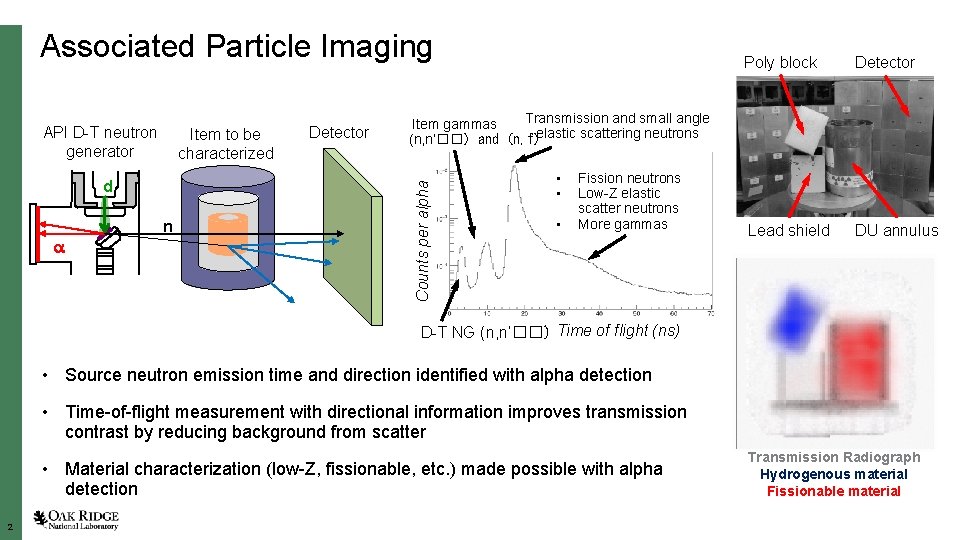
Associated Particle Imaging Item to be characterized d + n a Detector Lead shield DU annulus Transmission and small angle Item gammas (n, n’��) and (n, f)elastic scattering neutrons Counts per alpha API D-T neutron generator Poly block • • • Fission neutrons Low-Z elastic scatter neutrons More gammas D-T NG (n, n’��) Time of flight (ns) 2 • Source neutron emission time and direction identified with alpha detection • Time-of-flight measurement with directional information improves transmission contrast by reducing background from scatter • Material characterization (low-Z, fissionable, etc. ) made possible with alpha detection Transmission Radiograph Hydrogenous material Fissionable material
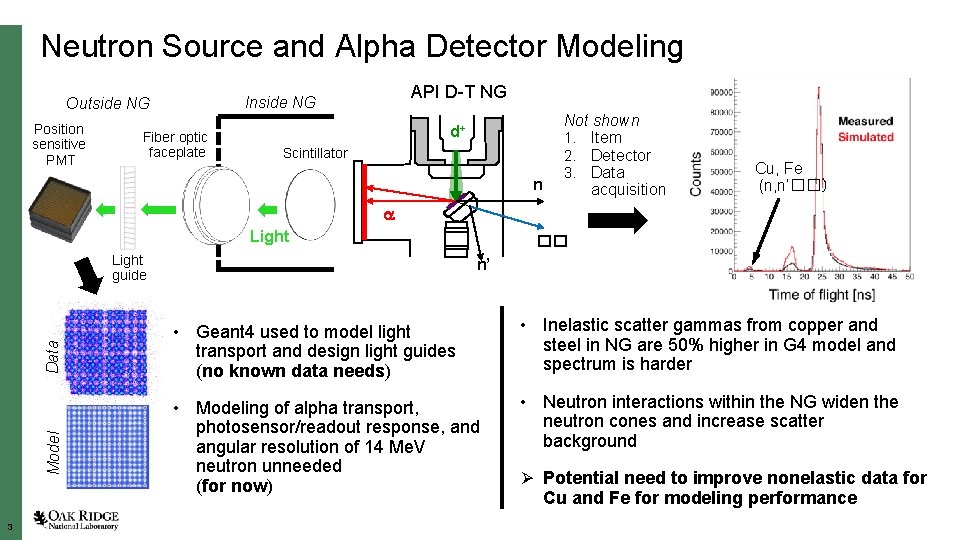
Neutron Source and Alpha Detector Modeling Position sensitive PMT API D-T NG Inside NG Outside NG Fiber optic faceplate d+ Scintillator n Not shown 1. Item 2. Detector 3. Data acquisition Cu, Fe (n, n’��) a Light Model Data Light guide 3 �� n’ • Geant 4 used to model light transport and design light guides (no known data needs) • Inelastic scatter gammas from copper and steel in NG are 50% higher in G 4 model and spectrum is harder • Modeling of alpha transport, photosensor/readout response, and angular resolution of 14 Me. V neutron unneeded (for now) • Neutron interactions within the NG widen the neutron cones and increase scatter background Ø Potential need to improve nonelastic data for Cu and Fe for modeling performance
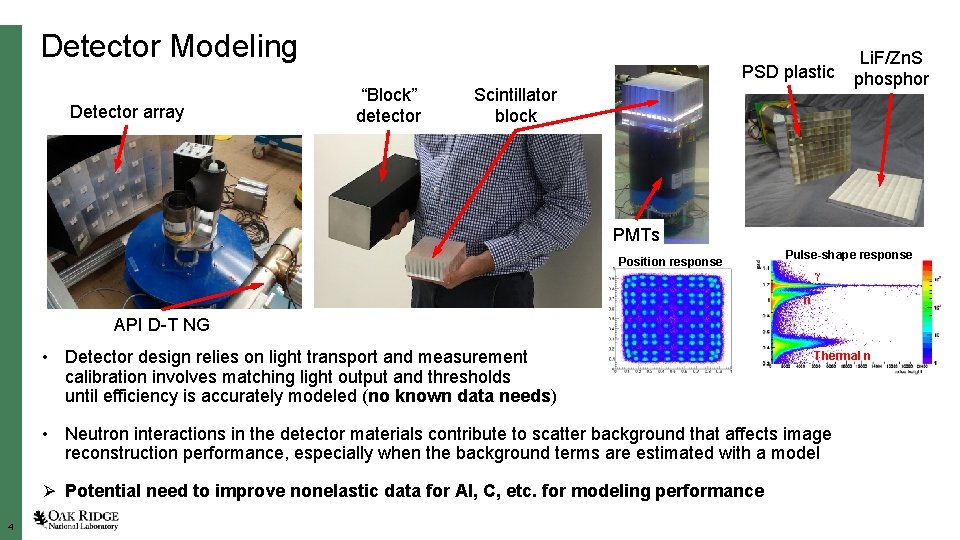
Detector Modeling Detector array PSD plastic “Block” detector Scintillator block Li. F/Zn. S phosphor PMTs Position response Pulse-shape response g n API D-T NG • Detector design relies on light transport and measurement calibration involves matching light output and thresholds until efficiency is accurately modeled (no known data needs) • Neutron interactions in the detector materials contribute to scatter background that affects image reconstruction performance, especially when the background terms are estimated with a model Ø Potential need to improve nonelastic data for Al, C, etc. for modeling performance 4 Thermal n
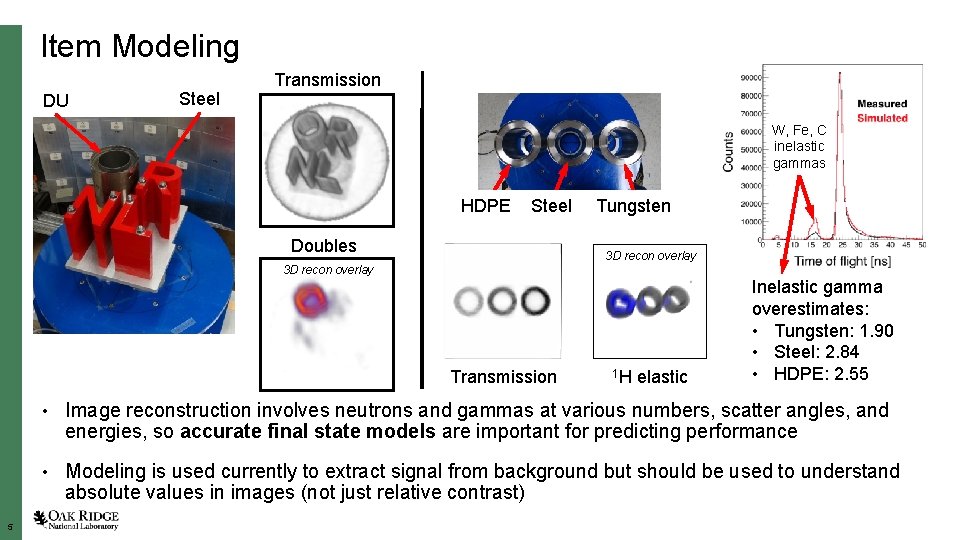
Item Modeling DU Steel Transmission W, Fe, C inelastic gammas HDPE Steel Doubles Tungsten 3 D recon overlay Transmission 1 H elastic Inelastic gamma overestimates: • Tungsten: 1. 90 • Steel: 2. 84 • HDPE: 2. 55 • Image reconstruction involves neutrons and gammas at various numbers, scatter angles, and energies, so accurate final state models are important for predicting performance • Modeling is used currently to extract signal from background but should be used to understand absolute values in images (not just relative contrast) 5