
Detector Magnets for the Future Circular Collider Evolution
- Slides: 16
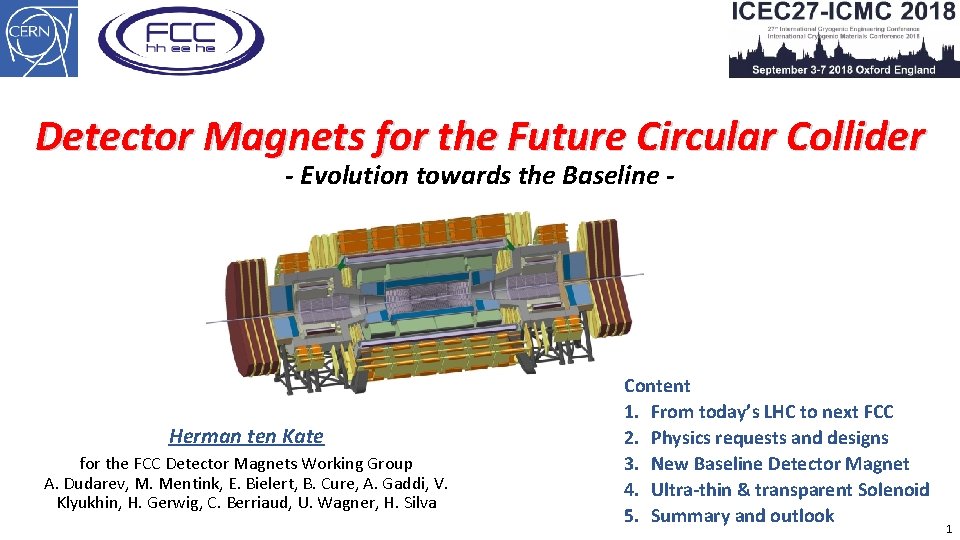
Detector Magnets for the Future Circular Collider - Evolution towards the Baseline - Herman ten Kate for the FCC Detector Magnets Working Group A. Dudarev, M. Mentink, E. Bielert, B. Cure, A. Gaddi, V. Klyukhin, H. Gerwig, C. Berriaud, U. Wagner, H. Silva Content 1. From today’s LHC to next FCC 2. Physics requests and designs 3. New Baseline Detector Magnet 4. Ultra-thin & transparent Solenoid 5. Summary and outlook 1
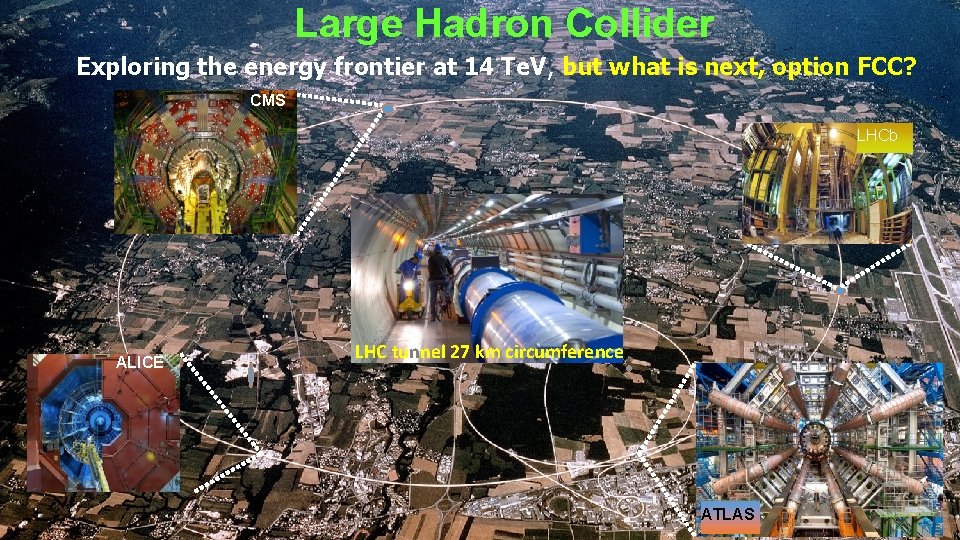
Enter Large a New Era. Hadron in Fundamental Science Collider Start-up the Large frontier Hadron Collider (LHC), one of the what largest and truly global Exploring theofenergy at 14 Te. V, but is next, option FCC? scientific projects ever, is the most exciting turning point in particle physics. CMS LHCb ALICE LHC tunnel 27 km circumference Germany and CERN | May 2009 2 VIP Template/ March ATLAS 2010
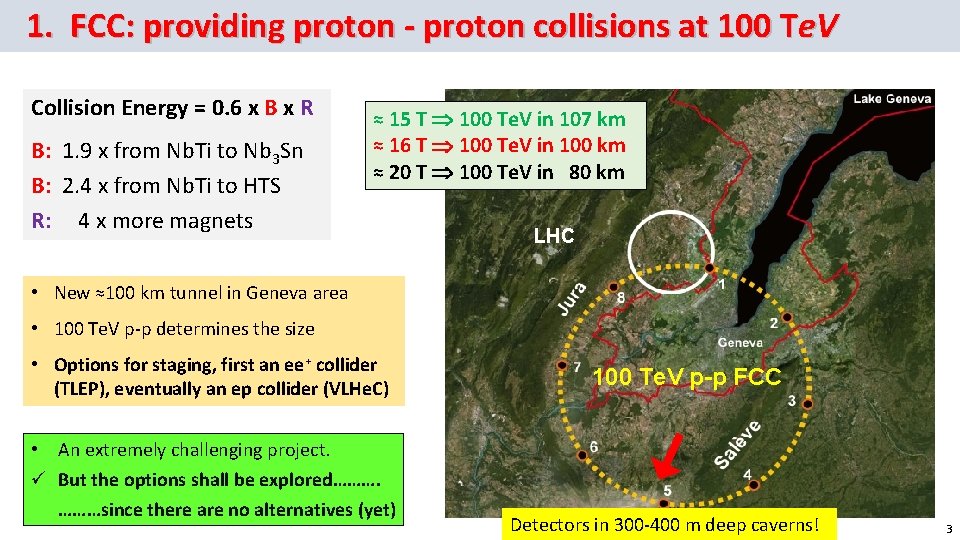
1. FCC: providing proton - proton collisions at 100 Te. V Collision Energy = 0. 6 x B x R B: 1. 9 x from Nb. Ti to Nb 3 Sn B: 2. 4 x from Nb. Ti to HTS R: 4 x more magnets ≈ 15 T 100 Te. V in 107 km ≈ 16 T 100 Te. V in 100 km ≈ 20 T 100 Te. V in 80 km LHC • New ≈100 km tunnel in Geneva area • 100 Te. V p-p determines the size • Options for staging, first an ee+ collider (TLEP), eventually an ep collider (VLHe. C) • An extremely challenging project. ü But the options shall be explored………. ………since there are no alternatives (yet) 100 Te. V p-p FCC Detectors in 300 -400 m deep caverns! 3
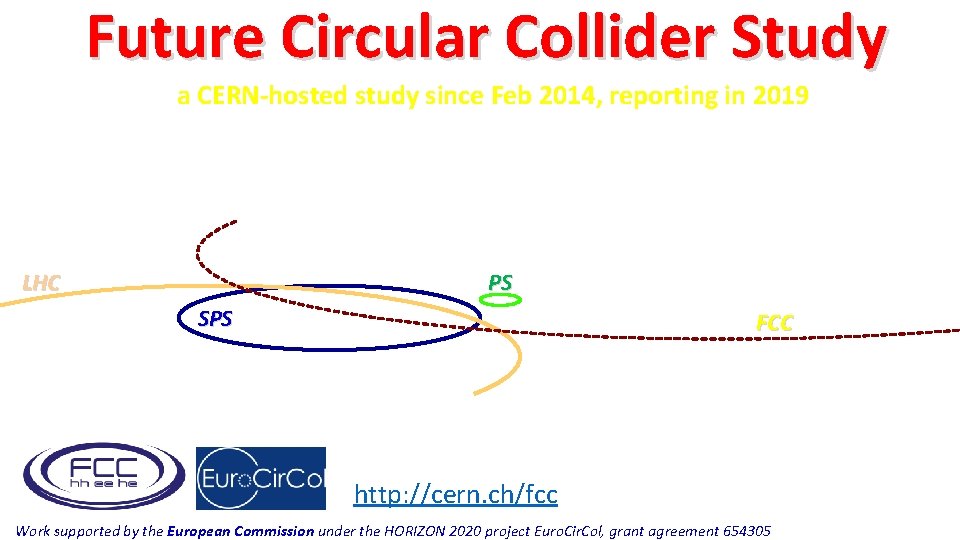
Future Circular Collider Study a CERN-hosted study since Feb 2014, reporting in 2019 LHC PS SPS FCC http: //cern. ch/fcc Work supported by the European Commission under the HORIZON 2020 project Euro. Cir. Col, grant agreement 654305
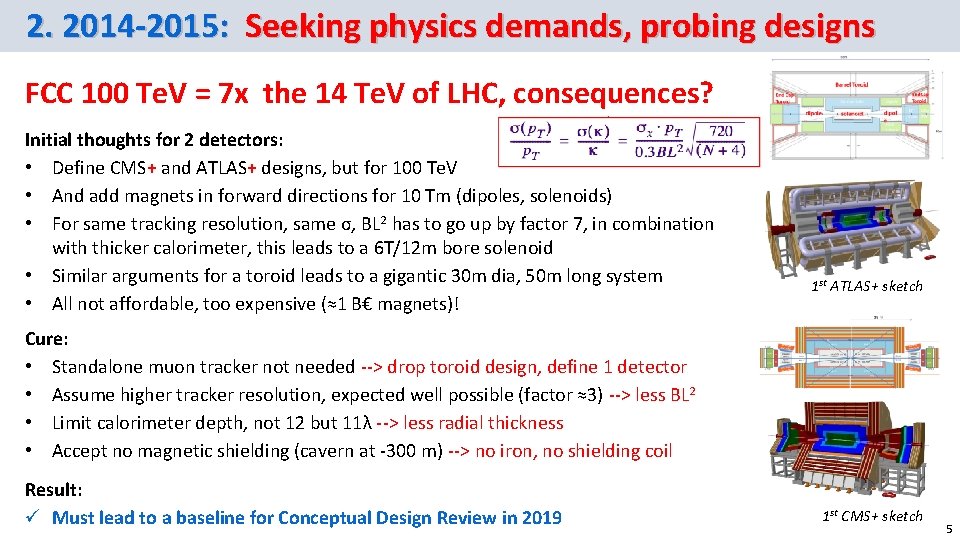
2. 2014 -2015: Seeking physics demands, probing designs FCC 100 Te. V = 7 x the 14 Te. V of LHC, consequences? Initial thoughts for 2 detectors: • Define CMS+ and ATLAS+ designs, but for 100 Te. V • And add magnets in forward directions for 10 Tm (dipoles, solenoids) • For same tracking resolution, same σ, BL 2 has to go up by factor 7, in combination with thicker calorimeter, this leads to a 6 T/12 m bore solenoid • Similar arguments for a toroid leads to a gigantic 30 m dia, 50 m long system • All not affordable, too expensive (≈1 B€ magnets)! 1 st ATLAS+ sketch Cure: • Standalone muon tracker not needed --> drop toroid design, define 1 detector • Assume higher tracker resolution, expected well possible (factor ≈3) --> less BL 2 • Limit calorimeter depth, not 12 but 11λ --> less radial thickness • Accept no magnetic shielding (cavern at -300 m) --> no iron, no shielding coil Result: ü Must lead to a baseline for Conceptual Design Review in 2019 1 st CMS+ sketch 5
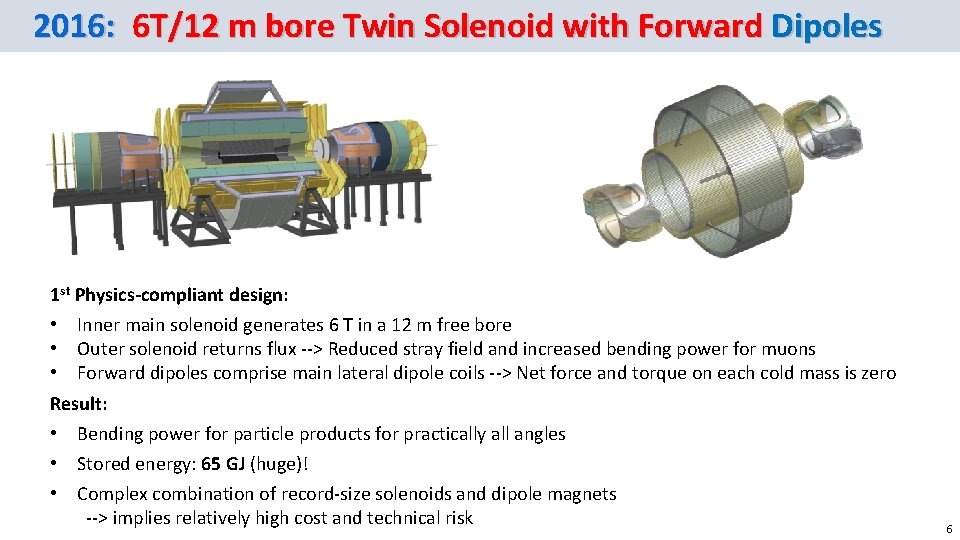
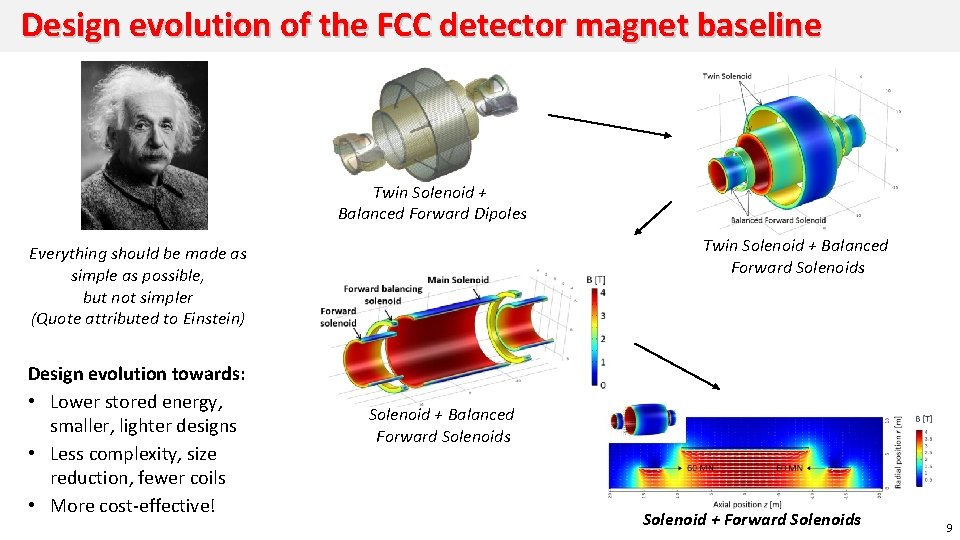
2016: 6 T/12 m bore Twin Solenoid with Forward Dipoles 1 st Physics-compliant design: • Inner main solenoid generates 6 T in a 12 m free bore • Outer solenoid returns flux --> Reduced stray field and increased bending power for muons • Forward dipoles comprise main lateral dipole coils --> Net force and torque on each cold mass is zero Result: • Bending power for particle products for practically all angles • Stored energy: 65 GJ (huge)! • Complex combination of record-size solenoids and dipole magnets --> implies relatively high cost and technical risk 6
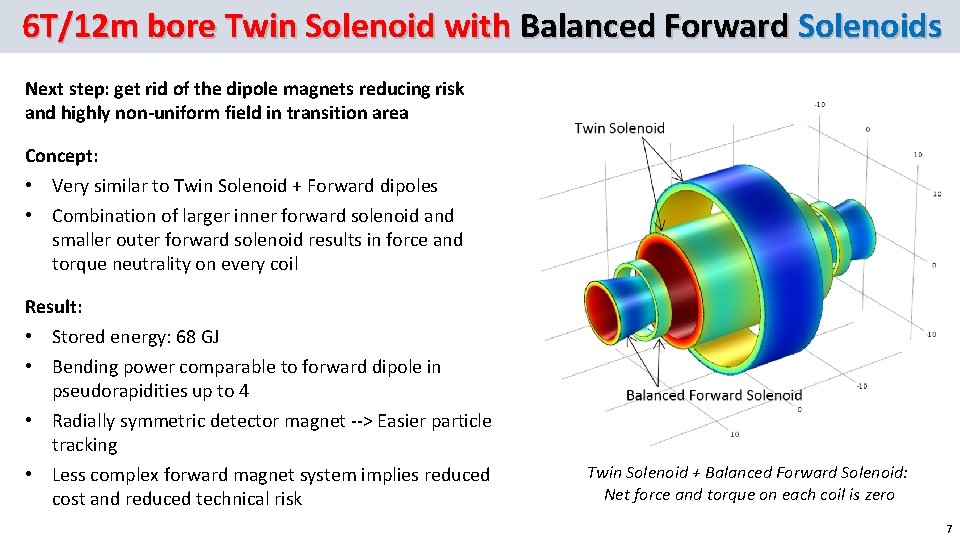
6 T/12 m bore Twin Solenoid with Balanced Forward Solenoids Next step: get rid of the dipole magnets reducing risk and highly non-uniform field in transition area Concept: • Very similar to Twin Solenoid + Forward dipoles • Combination of larger inner forward solenoid and smaller outer forward solenoid results in force and torque neutrality on every coil Result: • Stored energy: 68 GJ • Bending power comparable to forward dipole in pseudorapidities up to 4 • Radially symmetric detector magnet --> Easier particle tracking • Less complex forward magnet system implies reduced cost and reduced technical risk Twin Solenoid + Balanced Forward Solenoid: Net force and torque on each coil is zero 7
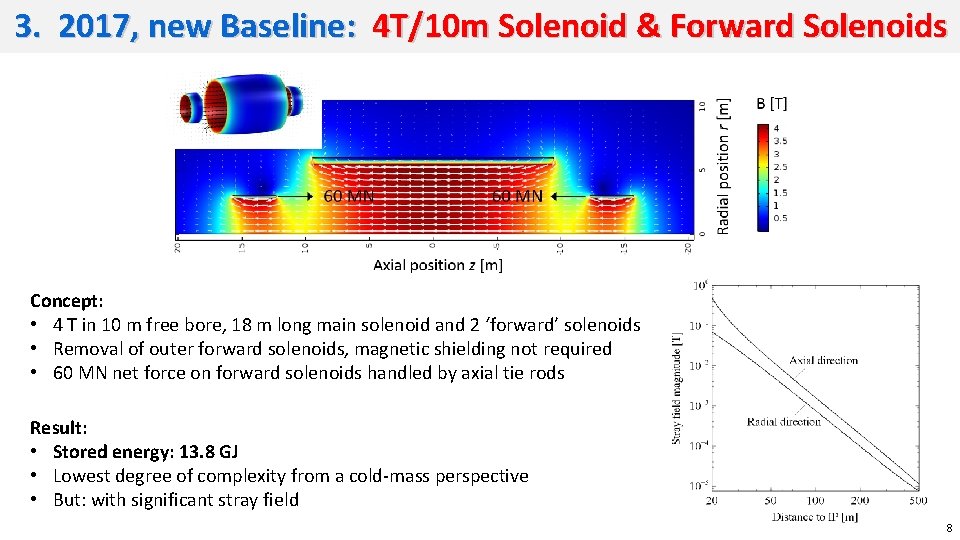
3. 2017, new Baseline: 4 T/10 m Solenoid & Forward Solenoids Concept: • 4 T in 10 m free bore, 18 m long main solenoid and 2 ‘forward’ solenoids • Removal of outer forward solenoids, magnetic shielding not required • 60 MN net force on forward solenoids handled by axial tie rods Result: • Stored energy: 13. 8 GJ • Lowest degree of complexity from a cold-mass perspective • But: with significant stray field 8
Design evolution of the FCC detector magnet baseline Twin Solenoid + Balanced Forward Dipoles Twin Solenoid + Balanced Forward Solenoids Everything should be made as simple as possible, but not simpler (Quote attributed to Einstein) Design evolution towards: • Lower stored energy, smaller, lighter designs • Less complexity, size reduction, fewer coils • More cost-effective! Solenoid + Balanced Forward Solenoids Solenoid + Forward Solenoids 9
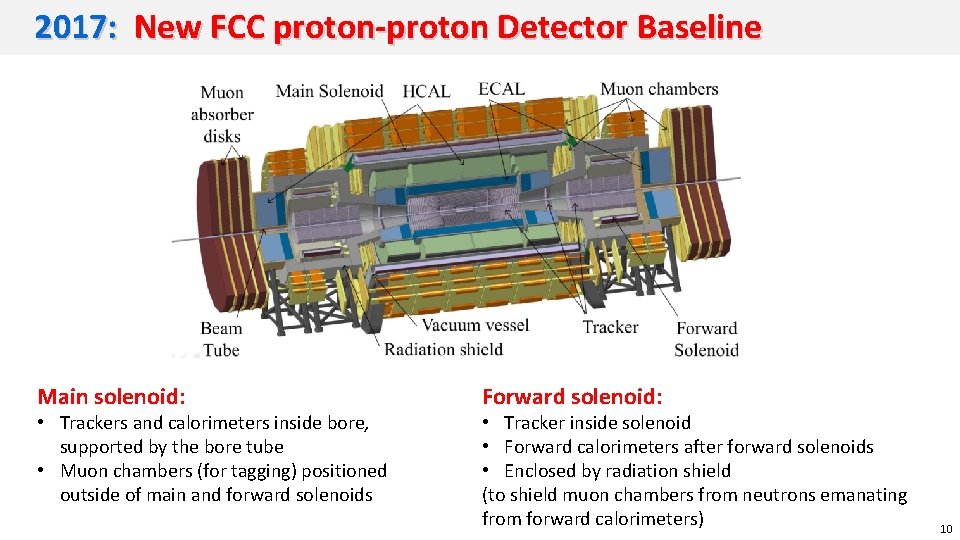
2017: New FCC proton-proton Detector Baseline Main solenoid: • Trackers and calorimeters inside bore, supported by the bore tube • Muon chambers (for tagging) positioned outside of main and forward solenoids Forward solenoid: • Tracker inside solenoid • Forward calorimeters after forward solenoids • Enclosed by radiation shield (to shield muon chambers from neutrons emanating from forward calorimeters) 10
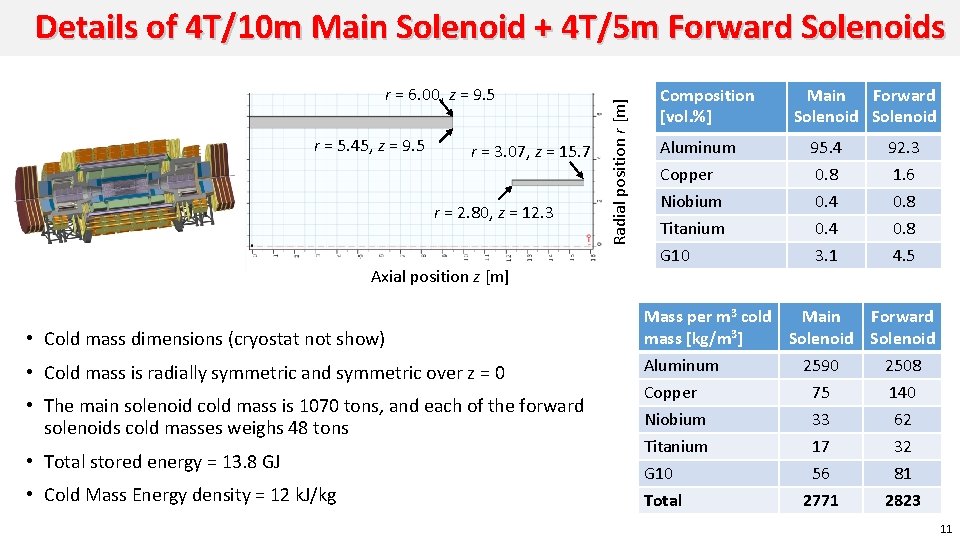
r = 6. 00, z = 9. 5 r = 5. 45, z = 9. 5 r = 3. 07, z = 15. 7 r = 2. 80, z = 12. 3 Axial position z [m] • Cold mass dimensions (cryostat not show) • Cold mass is radially symmetric and symmetric over z = 0 • The main solenoid cold mass is 1070 tons, and each of the forward solenoids cold masses weighs 48 tons • Total stored energy = 13. 8 GJ • Cold Mass Energy density = 12 k. J/kg Radial position r [m] Details of 4 T/10 m Main Solenoid + 4 T/5 m Forward Solenoids Composition [vol. %] Aluminum Copper Niobium Titanium G 10 Main Forward Solenoid 95. 4 0. 8 0. 4 3. 1 92. 3 1. 6 0. 8 4. 5 Mass per m 3 cold Main Forward mass [kg/m 3] Solenoid Aluminum Copper Niobium Titanium G 10 Total 2590 75 33 17 56 2771 2508 140 62 32 81 2823 11
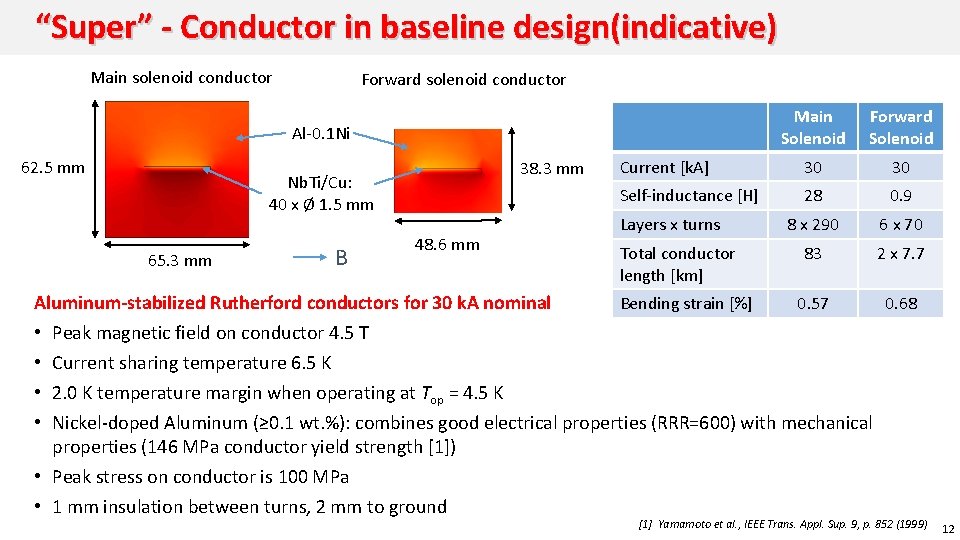
“Super” - Conductor in baseline design(indicative) Main solenoid conductor Forward solenoid conductor Main Solenoid Forward Solenoid Current [k. A] 30 30 Self-inductance [H] 28 0. 9 8 x 290 6 x 70 83 2 x 7. 7 0. 57 0. 68 Al-0. 1 Ni 62. 5 mm 38. 3 mm Nb. Ti/Cu: 40 x Ø 1. 5 mm 65. 3 mm B 48. 6 mm Aluminum-stabilized Rutherford conductors for 30 k. A nominal Layers x turns Total conductor length [km] Bending strain [%] Peak magnetic field on conductor 4. 5 T Current sharing temperature 6. 5 K 2. 0 K temperature margin when operating at Top = 4. 5 K Nickel-doped Aluminum (≥ 0. 1 wt. %): combines good electrical properties (RRR=600) with mechanical properties (146 MPa conductor yield strength [1]) • Peak stress on conductor is 100 MPa • 1 mm insulation between turns, 2 mm to ground • • [1] Yamamoto et al. , IEEE Trans. Appl. Sup. 9, p. 852 (1999) 12
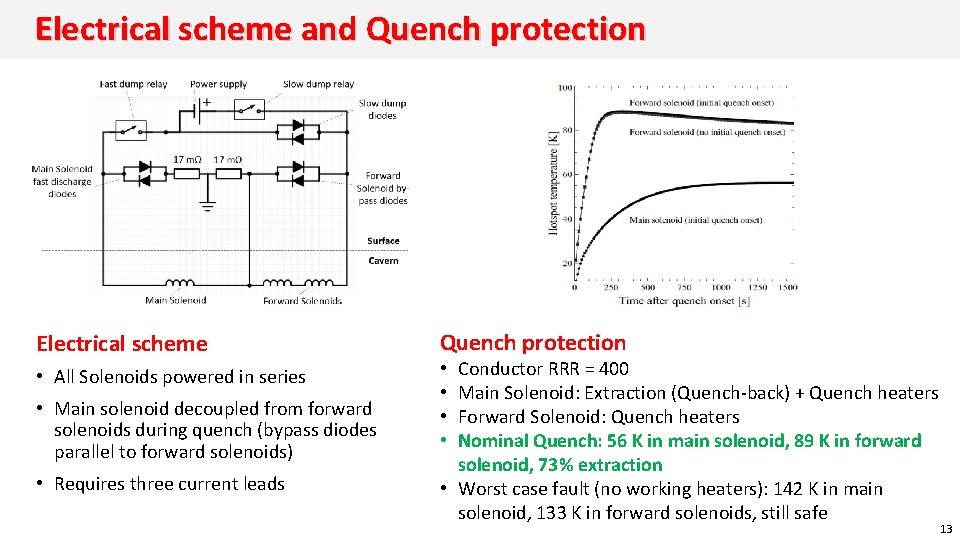
Electrical scheme and Quench protection Electrical scheme • All Solenoids powered in series • Main solenoid decoupled from forward solenoids during quench (bypass diodes parallel to forward solenoids) • Requires three current leads Quench protection Conductor RRR = 400 Main Solenoid: Extraction (Quench-back) + Quench heaters Forward Solenoid: Quench heaters Nominal Quench: 56 K in main solenoid, 89 K in forward solenoid, 73% extraction • Worst case fault (no working heaters): 142 K in main solenoid, 133 K in forward solenoids, still safe • • 13
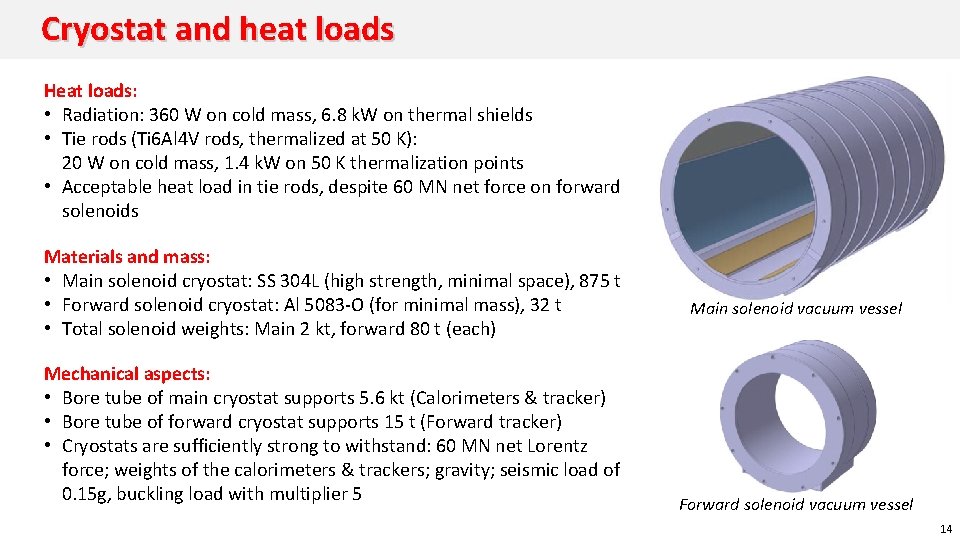
Cryostat and heat loads Heat loads: • Radiation: 360 W on cold mass, 6. 8 k. W on thermal shields • Tie rods (Ti 6 Al 4 V rods, thermalized at 50 K): 20 W on cold mass, 1. 4 k. W on 50 K thermalization points • Acceptable heat load in tie rods, despite 60 MN net force on forward solenoids Materials and mass: • Main solenoid cryostat: SS 304 L (high strength, minimal space), 875 t • Forward solenoid cryostat: Al 5083 -O (for minimal mass), 32 t • Total solenoid weights: Main 2 kt, forward 80 t (each) Mechanical aspects: • Bore tube of main cryostat supports 5. 6 kt (Calorimeters & tracker) • Bore tube of forward cryostat supports 15 t (Forward tracker) • Cryostats are sufficiently strong to withstand: 60 MN net Lorentz force; weights of the calorimeters & trackers; gravity; seismic load of 0. 15 g, buckling load with multiplier 5 Main solenoid vacuum vessel Forward solenoid vacuum vessel 14
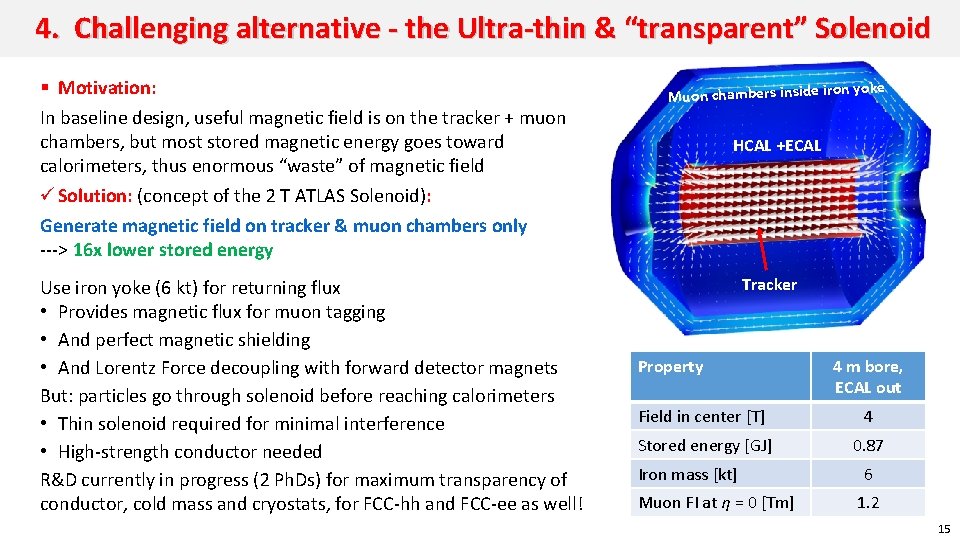
4. Challenging alternative - the Ultra-thin & “transparent” Solenoid § Motivation: In baseline design, useful magnetic field is on the tracker + muon chambers, but most stored magnetic energy goes toward calorimeters, thus enormous “waste” of magnetic field ü Solution: (concept of the 2 T ATLAS Solenoid): Generate magnetic field on tracker & muon chambers only ---> 16 x lower stored energy Use iron yoke (6 kt) for returning flux • Provides magnetic flux for muon tagging • And perfect magnetic shielding • And Lorentz Force decoupling with forward detector magnets But: particles go through solenoid before reaching calorimeters • Thin solenoid required for minimal interference • High-strength conductor needed R&D currently in progress (2 Ph. Ds) for maximum transparency of conductor, cold mass and cryostats, for FCC-hh and FCC-ee as well! n yo Muon chambers inside iro ke HCAL +ECAL Tracker Property 4 m bore, ECAL out Field in center [T] 4 Stored energy [GJ] 0. 87 Iron mass [kt] Muon FI at η = 0 [Tm] 6 1. 2 15
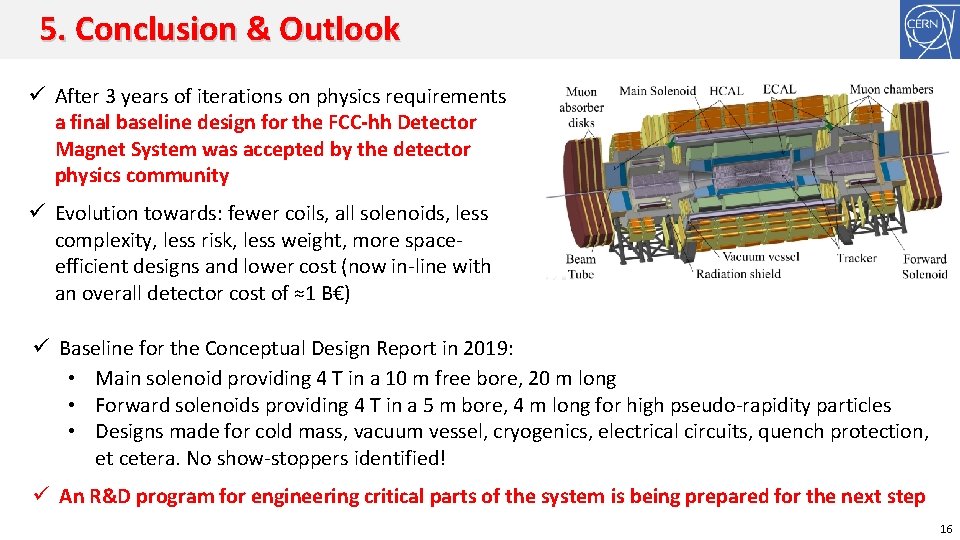
5. Conclusion & Outlook ü After 3 years of iterations on physics requirements a final baseline design for the FCC-hh Detector Magnet System was accepted by the detector physics community ü Evolution towards: fewer coils, all solenoids, less complexity, less risk, less weight, more spaceefficient designs and lower cost (now in-line with an overall detector cost of ≈1 B€) ü Baseline for the Conceptual Design Report in 2019: • Main solenoid providing 4 T in a 10 m free bore, 20 m long • Forward solenoids providing 4 T in a 5 m bore, 4 m long for high pseudo-rapidity particles • Designs made for cold mass, vacuum vessel, cryogenics, electrical circuits, quench protection, et cetera. No show-stoppers identified! ü An R&D program for engineering critical parts of the system is being prepared for the next step 16