
Detector Description of the ATLAS Muon Spectrometer and
- Slides: 26
Detector Description of the ATLAS Muon Spectrometer and H 8 Muon Testbeam D. Pomarède CEA/DAPNIA/SEDI/LILAS - Saclay ACAT 05 - DESY Zeuthen 25/05/2005 1
Outline • The ATLAS Muon Spectrometer • Challenges of the Muon Detector Description • Integration in the ATLAS software chain • Implementation in the ATLAS Simulations and Data Challenges • Implementation in the H 8 Muon Testbeams • Conclusions & Plans D. Pomarède, CEA/DAPNIA/LILAS ACAT 05 25/05/2005 2
The ATLAS Muon Spectrometer • High-momentum final-state muons are among the most promising and robust signatures of physics at the Large Hadron Collider (LHC) • To exploit this potential, the ATLAS Collaboration has designed a highresolution muon spectrometer with stand-alone triggering and momentum measurement capability • The final aim is to reach the highest efficiency with stand-alone momentum resolution of a few % at 10 -100 Ge. V/c and ~10% at 1 Te. V/c • The spectrometer is based on the magnetic deflection of tracks in large superconducting air-core toroid magnets. The tracks are measured in chambers laid out in three layers. An optical alignment system controls the relative positioning of chambers at the 30 mm level. • The layout of the detectors and their intrinsic design are optimized to provide the best acceptance and resolution, taking into account the highlevel background environment, the inhomogeneous magnetic field, and the large size of the apparatus. D. Pomarède, CEA/DAPNIA/LILAS ACAT 05 25/05/2005 3
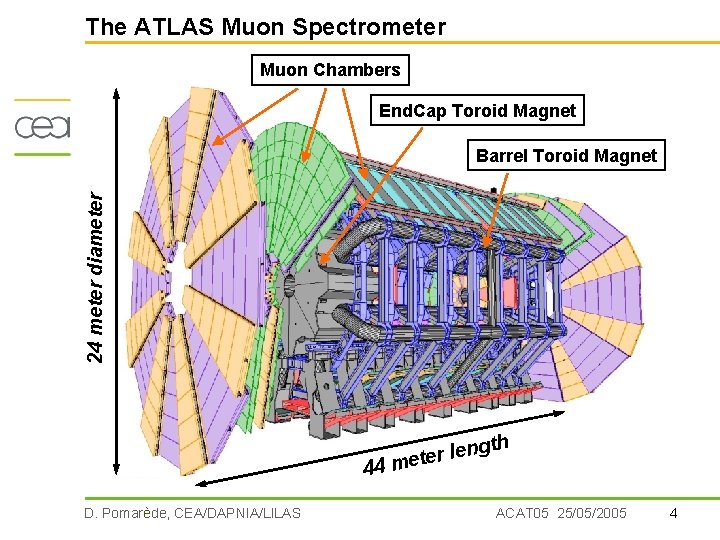
The ATLAS Muon Spectrometer Muon Chambers End. Cap Toroid Magnet 24 meter diameter Barrel Toroid Magnet gth n e l r e t 44 me D. Pomarède, CEA/DAPNIA/LILAS ACAT 05 25/05/2005 4
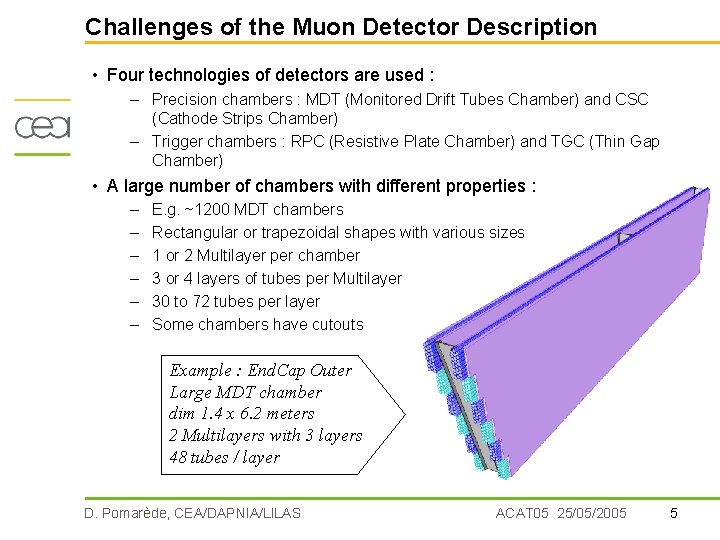
Challenges of the Muon Detector Description • Four technologies of detectors are used : – Precision chambers : MDT (Monitored Drift Tubes Chamber) and CSC (Cathode Strips Chamber) – Trigger chambers : RPC (Resistive Plate Chamber) and TGC (Thin Gap Chamber) • A large number of chambers with different properties : – – – E. g. ~1200 MDT chambers Rectangular or trapezoidal shapes with various sizes 1 or 2 Multilayer per chamber 3 or 4 layers of tubes per Multilayer 30 to 72 tubes per layer Some chambers have cutouts Example : End. Cap Outer Large MDT chamber dim 1. 4 x 6. 2 meters 2 Multilayers with 3 layers 48 tubes / layer D. Pomarède, CEA/DAPNIA/LILAS ACAT 05 25/05/2005 5
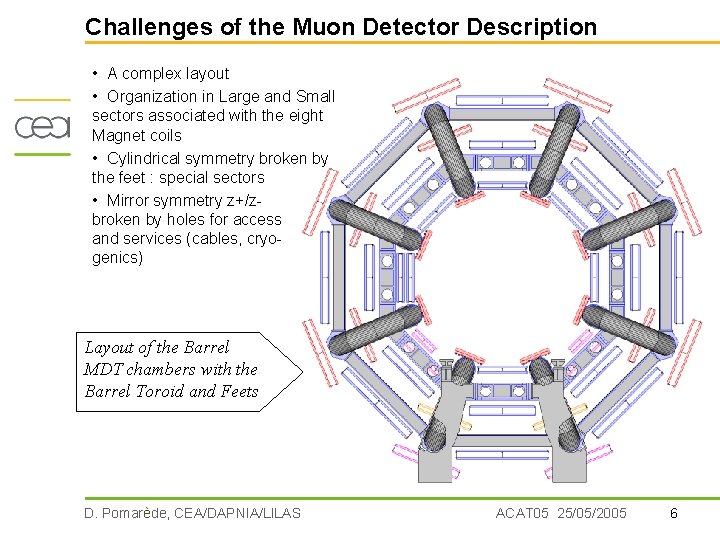
Challenges of the Muon Detector Description • A complex layout • Organization in Large and Small sectors associated with the eight Magnet coils • Cylindrical symmetry broken by the feet : special sectors • Mirror symmetry z+/zbroken by holes for access and services (cables, cryogenics) Layout of the Barrel MDT chambers with the Barrel Toroid and Feets D. Pomarède, CEA/DAPNIA/LILAS ACAT 05 25/05/2005 6
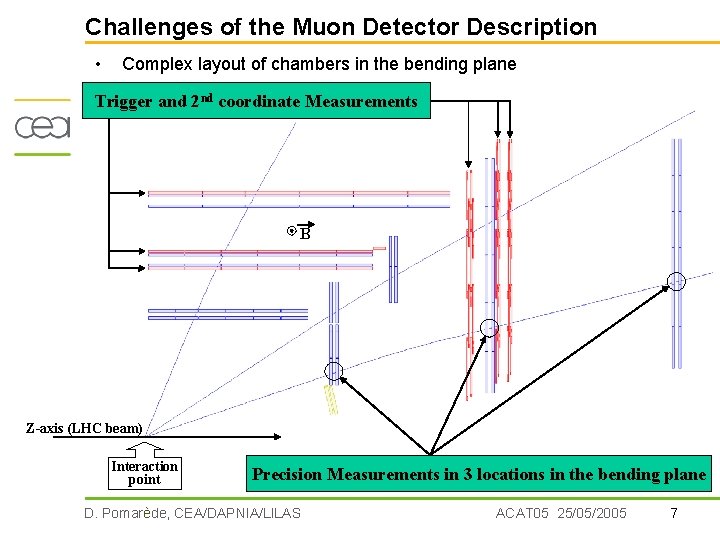
Challenges of the Muon Detector Description • Complex layout of chambers in the bending plane Trigger and 2 nd coordinate Measurements B Z-axis (LHC beam) Interaction point Precision Measurements in 3 locations in the bending plane D. Pomarède, CEA/DAPNIA/LILAS ACAT 05 25/05/2005 7
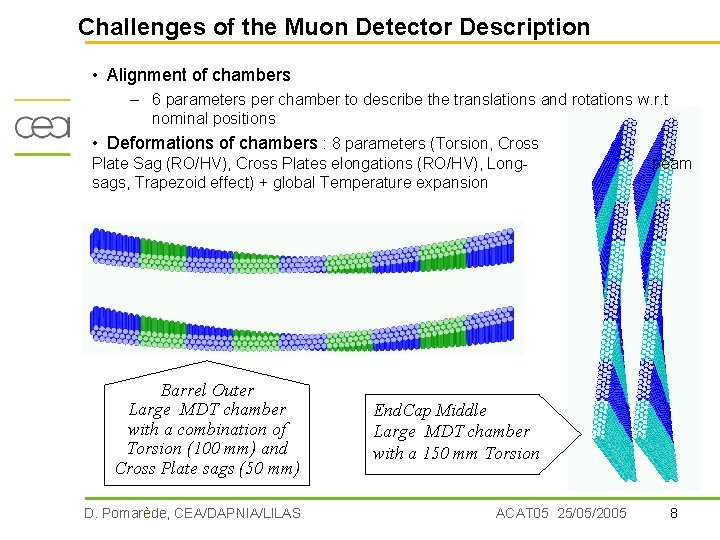
Challenges of the Muon Detector Description • Alignment of chambers – 6 parameters per chamber to describe the translations and rotations w. r. t nominal positions • Deformations of chambers : 8 parameters (Torsion, Cross Plate Sag (RO/HV), Cross Plates elongations (RO/HV), Longsags, Trapezoid effect) + global Temperature expansion Barrel Outer Large MDT chamber with a combination of Torsion (100 mm) and Cross Plate sags (50 mm) D. Pomarède, CEA/DAPNIA/LILAS beam End. Cap Middle Large MDT chamber with a 150 mm Torsion ACAT 05 25/05/2005 8
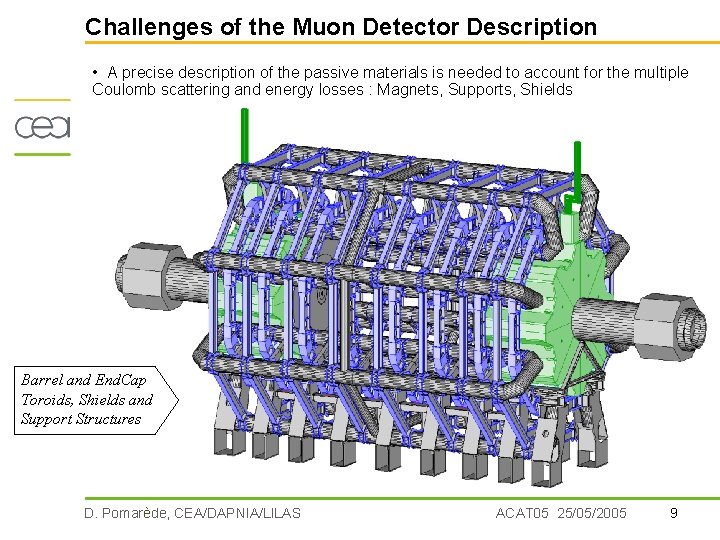
Challenges of the Muon Detector Description • A precise description of the passive materials is needed to account for the multiple Coulomb scattering and energy losses : Magnets, Supports, Shields Barrel and End. Cap Toroids, Shields and Support Structures D. Pomarède, CEA/DAPNIA/LILAS ACAT 05 25/05/2005 9
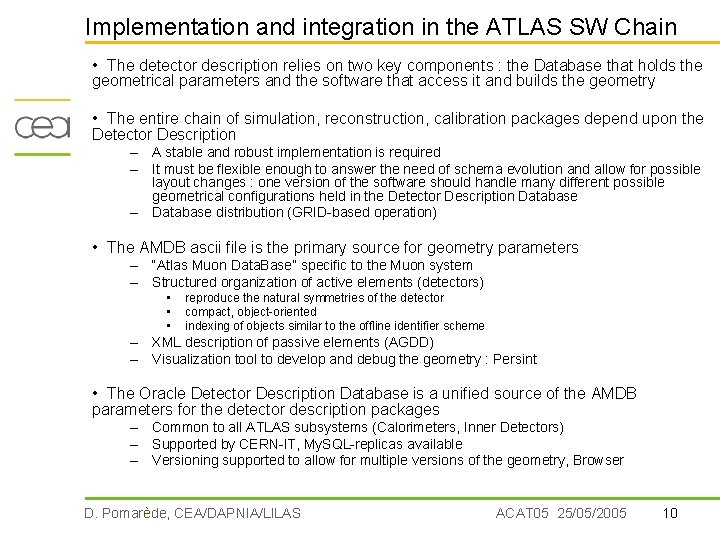
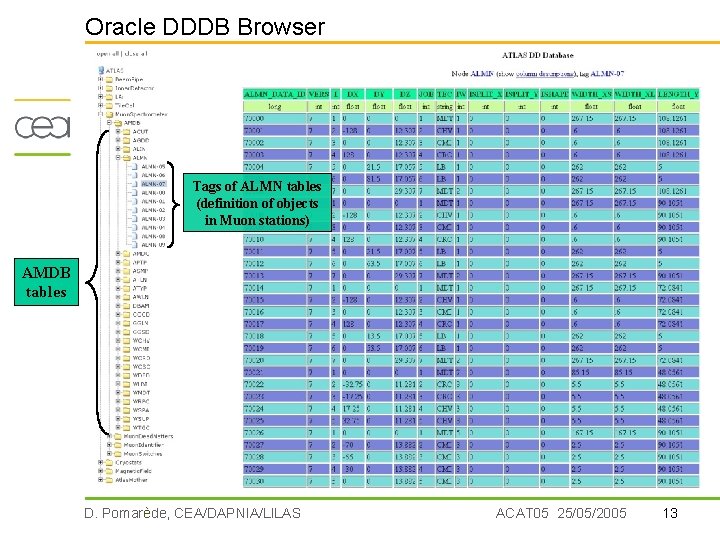
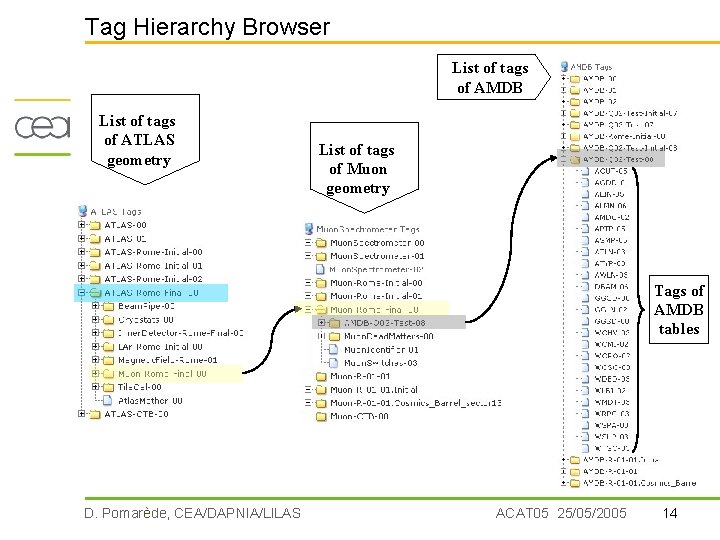
Implementation and integration in the ATLAS SW Chain • The detector description relies on two key components : the Database that holds the geometrical parameters and the software that access it and builds the geometry • The entire chain of simulation, reconstruction, calibration packages depend upon the Detector Description – A stable and robust implementation is required – It must be flexible enough to answer the need of schema evolution and allow for possible layout changes : one version of the software should handle many different possible geometrical configurations held in the Detector Description Database – Database distribution (GRID-based operation) • The AMDB ascii file is the primary source for geometry parameters – “Atlas Muon Data. Base” specific to the Muon system – Structured organization of active elements (detectors) • • • reproduce the natural symmetries of the detector compact, object-oriented indexing of objects similar to the offline identifier scheme – XML description of passive elements (AGDD) – Visualization tool to develop and debug the geometry : Persint • The Oracle Detector Description Database is a unified source of the AMDB parameters for the detector description packages – Common to all ATLAS subsystems (Calorimeters, Inner Detectors) – Supported by CERN-IT, My. SQL-replicas available – Versioning supported to allow for multiple versions of the geometry, Browser D. Pomarède, CEA/DAPNIA/LILAS ACAT 05 25/05/2005 10
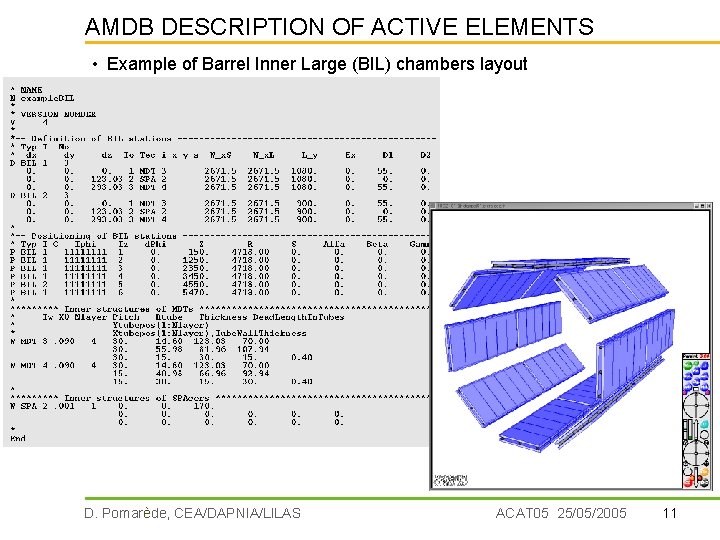
AMDB DESCRIPTION OF ACTIVE ELEMENTS • Example of Barrel Inner Large (BIL) chambers layout D. Pomarède, CEA/DAPNIA/LILAS ACAT 05 25/05/2005 11
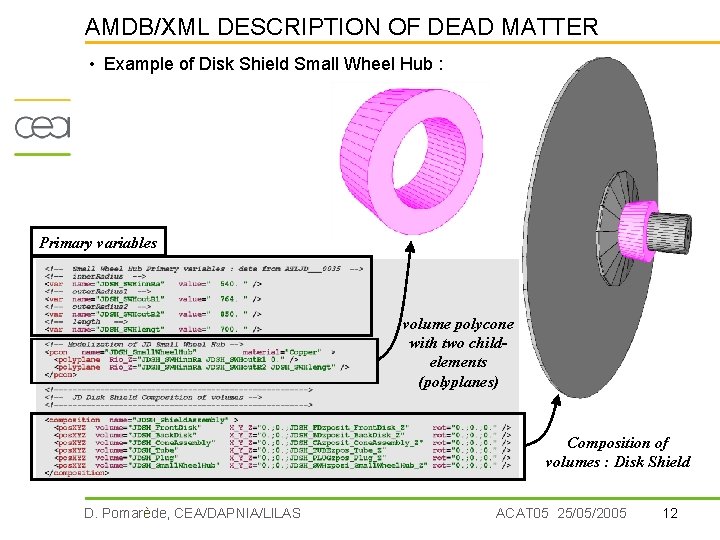
AMDB/XML DESCRIPTION OF DEAD MATTER • Example of Disk Shield Small Wheel Hub : Primary variables volume polycone with two childelements (polyplanes) Composition of volumes : Disk Shield D. Pomarède, CEA/DAPNIA/LILAS ACAT 05 25/05/2005 12
Oracle DDDB Browser Tags of ALMN tables (definition of objects in Muon stations) AMDB tables D. Pomarède, CEA/DAPNIA/LILAS ACAT 05 25/05/2005 13
Tag Hierarchy Browser List of tags of AMDB List of tags of ATLAS geometry List of tags of Muon geometry Tags of AMDB tables D. Pomarède, CEA/DAPNIA/LILAS ACAT 05 25/05/2005 14
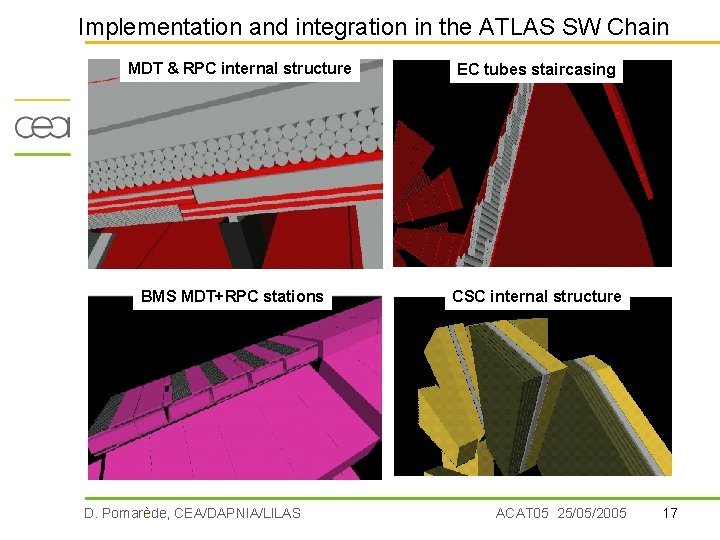
Implementation and integration in the ATLAS SW Chain • The software packages retrieve the parameters from the DB and provide the geometrical informations to the clients in the software framework : – the Amdcsimrec package provides a set of methods to obtain all geometrical informations to build the internal geometry of the client applications • tightly coupled to the AMDB database • schema evolution : a number of different geometries can be described with a single implementation of the software • complex volumes are described using boolean volume operations • visualization tool : Persint – the Muon. Geo. Model package introduced in 2003 • uses a geometry kernel common with all other ATLAS subsystems : – the Geo. Model kernel provides a set of geometrical primitives of common use (tube, box, polyhedron, …) – detector-specific services that are not described in a generic way are implemented as an additional layer – it provides volume operations – it has CLHEP as sole dependency – visualization tool : HEPVis • used by Geant 4 simulations D. Pomarède, CEA/DAPNIA/LILAS ACAT 05 25/05/2005 15
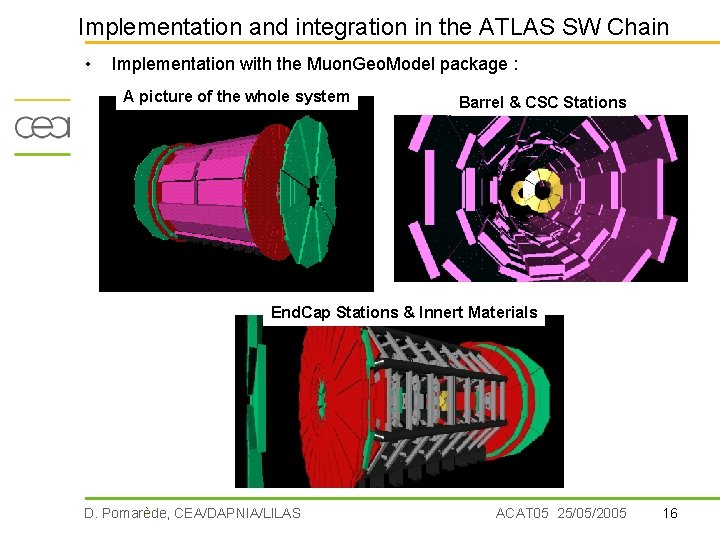
Implementation and integration in the ATLAS SW Chain • Implementation with the Muon. Geo. Model package : A picture of the whole system Barrel & CSC Stations End. Cap Stations & Innert Materials D. Pomarède, CEA/DAPNIA/LILAS ACAT 05 25/05/2005 16
Implementation and integration in the ATLAS SW Chain MDT & RPC internal structure BMS MDT+RPC stations D. Pomarède, CEA/DAPNIA/LILAS EC tubes staircasing CSC internal structure ACAT 05 25/05/2005 17
Implementations in the Simulations and Data Challemges • The design of the Spectrometer was optimized using this Detector Description : – ATLAS Muon Spectrometer Technical Design Report, 1997 • Evaluation of the ATLAS Physics performance (“Layout M”) – Geant 3 simulations – Detector and Physics Performance Technical Design Report, 1999 • Studies of realistic service and access holes, 2001 • ATLAS Data Challenge 1 (“Layout P”), 2001 -2002 – Geant 3 simulations – Athens Physics Workshop 2003 • ATLAS Data Challenge 2 (“Layout Q”), Ongoing – Geant 4 simulations – GRID based – Rome Physics Workshop, June 6 -11 2005 D. Pomarède, CEA/DAPNIA/LILAS ACAT 05 25/05/2005 18
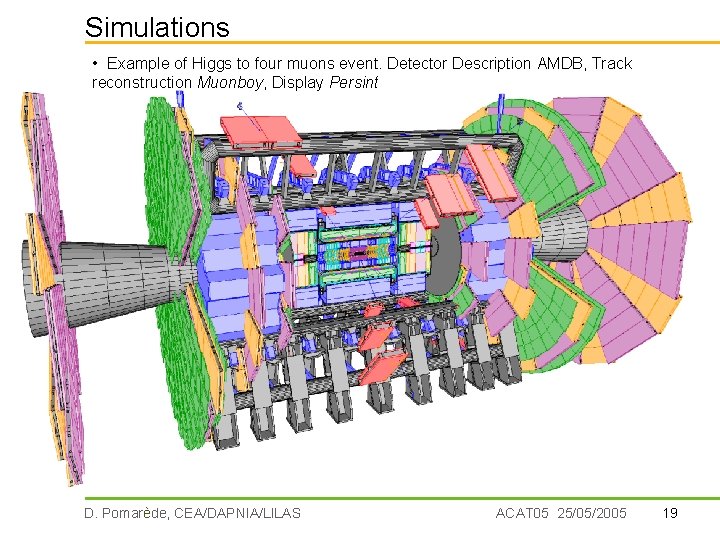
Simulations • Example of Higgs to four muons event. Detector Description AMDB, Track reconstruction Muonboy, Display Persint D. Pomarède, CEA/DAPNIA/LILAS ACAT 05 25/05/2005 19
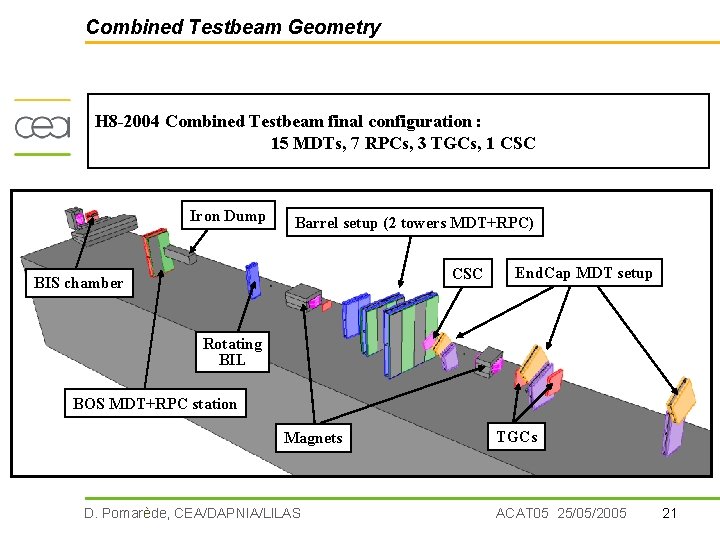
H 8 MUON TESTBEAM • Major testbeams have been conducted at the CERN-SPS H 8 line since 2001 to test the Muon detectors • One of the main objective was to validate the concept of the optical alignment systems of the Muon chambers. • Detector Description is a key component of these tests : – – Description of the nominal geometry Misalignment of chambers w. r. t nominal positions Deformations of chambers Implementation of the geometrical models in both the alignment reconstruction programs (analysis/fitting of data from optical devices) and track reconstruction – Also, test of the description of dead materials : comparison MC/data • Analyses have demonstrated that the geometry can be controlled using alignment corrections from the optical alignment systems – various movements (translations, rotations) and deformations tested – Barrel and End. Cap systems – chambers aligned at the 30 micron level D. Pomarède, CEA/DAPNIA/LILAS ACAT 05 25/05/2005 20
Combined Testbeam Geometry H 8 -2004 Combined Testbeam final configuration : 15 MDTs, 7 RPCs, 3 TGCs, 1 CSC Iron Dump Barrel setup (2 towers MDT+RPC) CSC BIS chamber End. Cap MDT setup Rotating BIL BOS MDT+RPC station Magnets D. Pomarède, CEA/DAPNIA/LILAS TGCs ACAT 05 25/05/2005 21
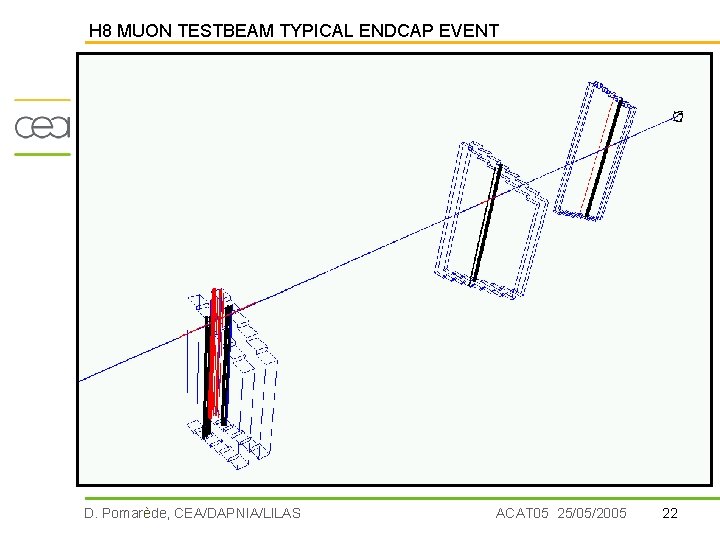
H 8 MUON TESTBEAM TYPICAL ENDCAP EVENT D. Pomarède, CEA/DAPNIA/LILAS ACAT 05 25/05/2005 22
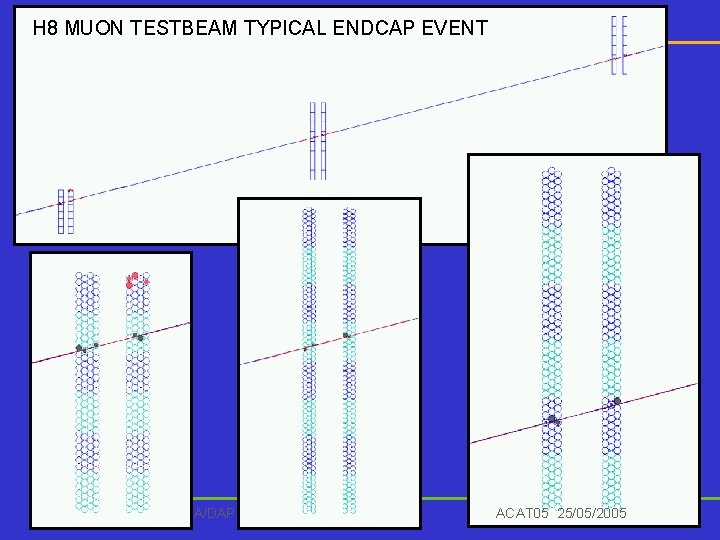
H 8 MUON TESTBEAM TYPICAL ENDCAP EVENT D. Pomarède, CEA/DAPNIA/LILAS ACAT 05 25/05/2005 23
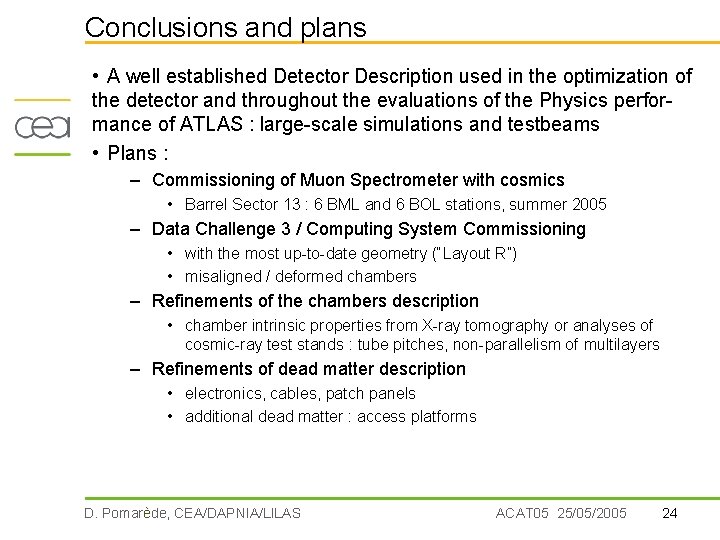
Conclusions and plans • A well established Detector Description used in the optimization of the detector and throughout the evaluations of the Physics performance of ATLAS : large-scale simulations and testbeams • Plans : – Commissioning of Muon Spectrometer with cosmics • Barrel Sector 13 : 6 BML and 6 BOL stations, summer 2005 – Data Challenge 3 / Computing System Commissioning • with the most up-to-date geometry (“Layout R”) • misaligned / deformed chambers – Refinements of the chambers description • chamber intrinsic properties from X-ray tomography or analyses of cosmic-ray test stands : tube pitches, non-parallelism of multilayers – Refinements of dead matter description • electronics, cables, patch panels • additional dead matter : access platforms D. Pomarède, CEA/DAPNIA/LILAS ACAT 05 25/05/2005 24
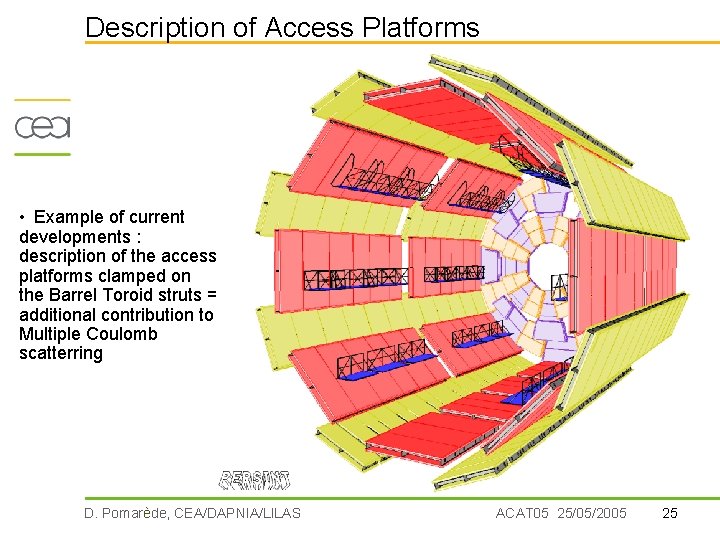
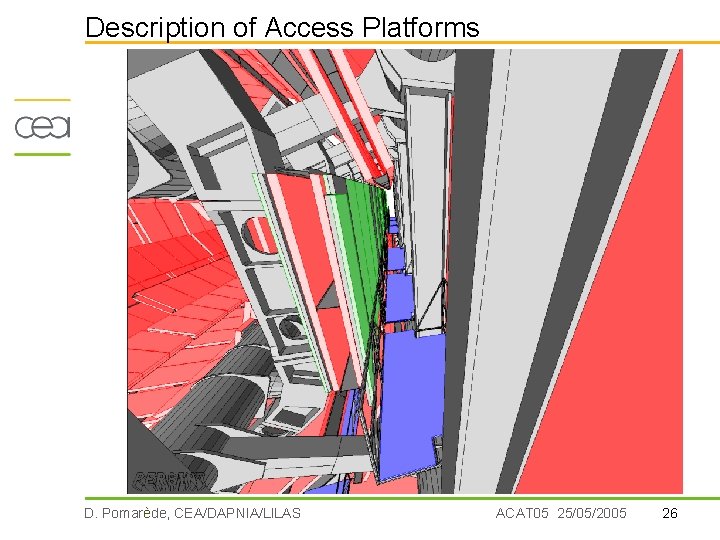
Description of Access Platforms • Example of current developments : description of the access platforms clamped on the Barrel Toroid struts = additional contribution to Multiple Coulomb scatterring D. Pomarède, CEA/DAPNIA/LILAS ACAT 05 25/05/2005 25
Description of Access Platforms D. Pomarède, CEA/DAPNIA/LILAS ACAT 05 25/05/2005 26