
Detector dependency of MODIS Polarization Sensitivity derived from
- Slides: 25
Detector dependency of MODIS Polarization Sensitivity derived from on-orbit characterization Gerhard Meistera, b, Bryan A. Franzb, c, Ewa J. Kwiatkoskad, Robert E. Epleee, b, Charles R. Mc. Clainb, c a: Futuretech Corp. b: OBPG (Ocean Biology Processing Group) c: NASA Goddard Space Flight Center, Code 614. 2 d: TEC-EEP, ESTEC, ESA e: SAIC 8/03/09 Earth Observing Systems XIV, SPIE Optics and Photonics 2009, San Diego
Overview • MODIS prelaunch polarization characterization • MODIS on-orbit polarization characterization using Sea. Wi. FS • Comparison of results • MODIS solar diffuser on-orbit calibration • MODIS on-orbit characterization using Sea. Wi. FS and moon • Comparison of results 2
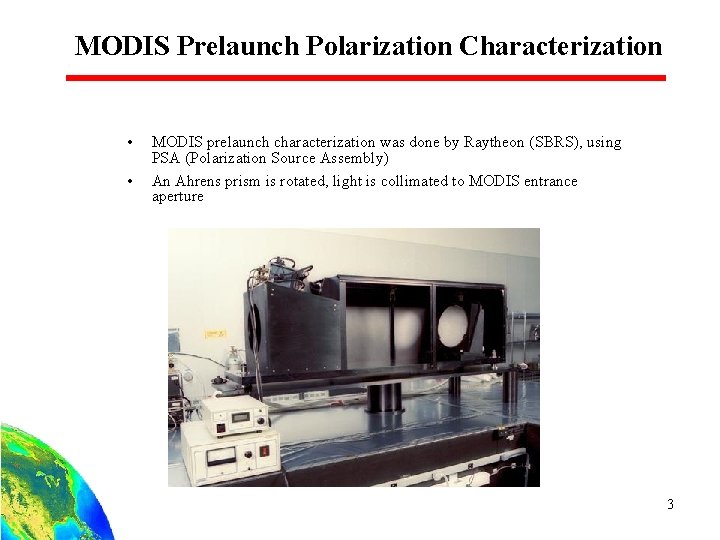
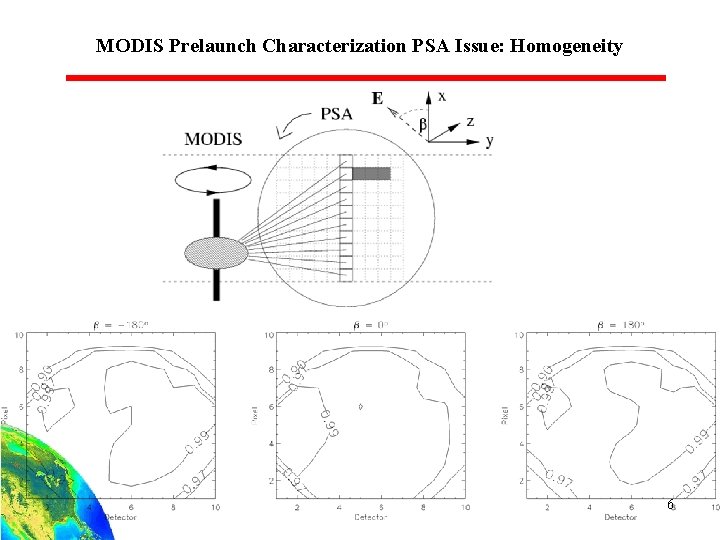
MODIS Prelaunch Polarization Characterization • • MODIS prelaunch characterization was done by Raytheon (SBRS), using PSA (Polarization Source Assembly) An Ahrens prism is rotated, light is collimated to MODIS entrance aperture 3
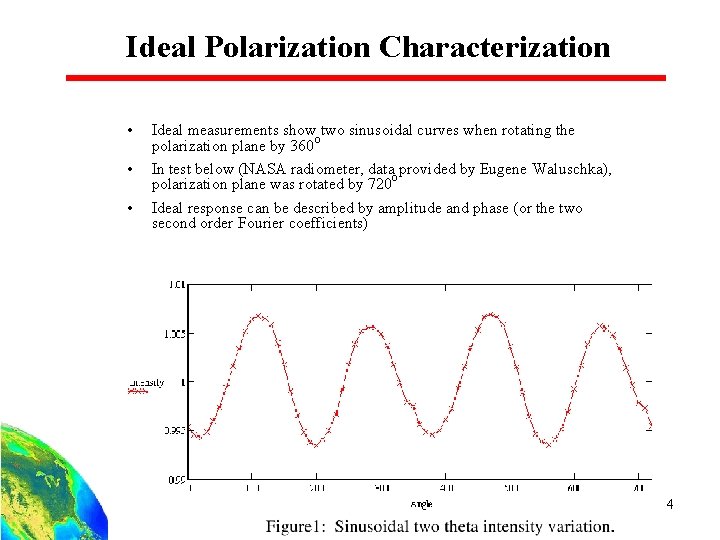
Ideal Polarization Characterization • • • Ideal measurements showotwo sinusoidal curves when rotating the polarization plane by 360 In test below (NASA radiometer, datao provided by Eugene Waluschka), polarization plane was rotated by 720 Ideal response can be described by amplitude and phase (or the two second order Fourier coefficients) 4
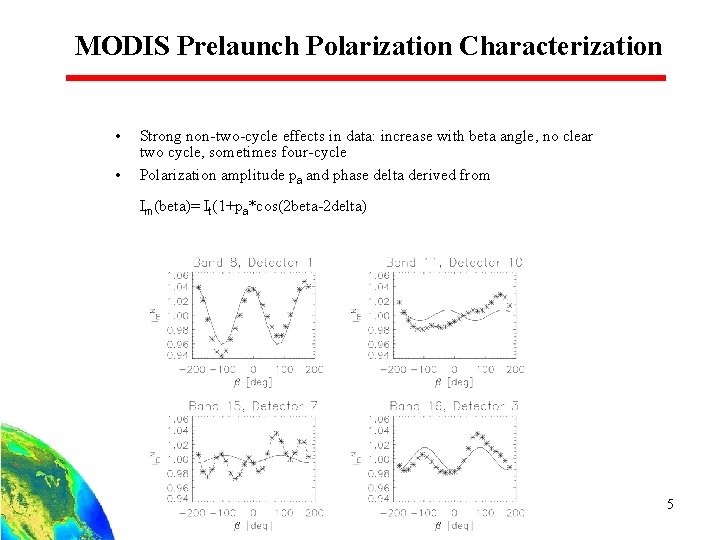
MODIS Prelaunch Polarization Characterization • • Strong non-two-cycle effects in data: increase with beta angle, no clear two cycle, sometimes four-cycle Polarization amplitude pa and phase delta derived from Im(beta)= It(1+pa*cos(2 beta-2 delta) 5
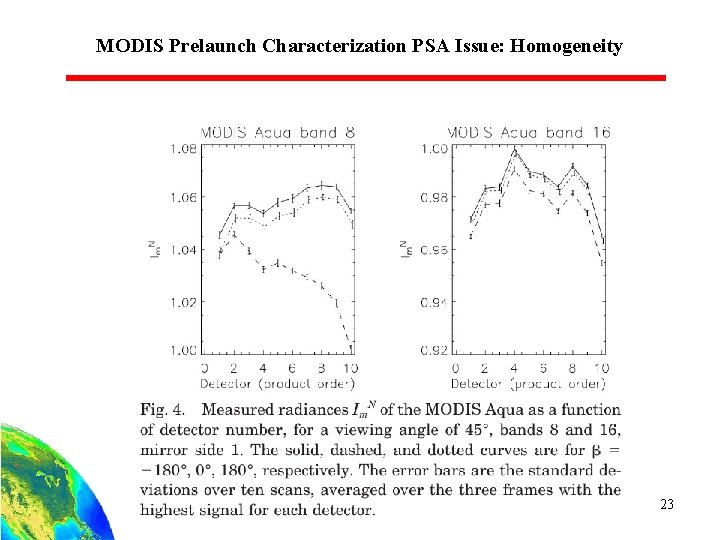
MODIS Prelaunch Characterization PSA Issue: Homogeneity 6
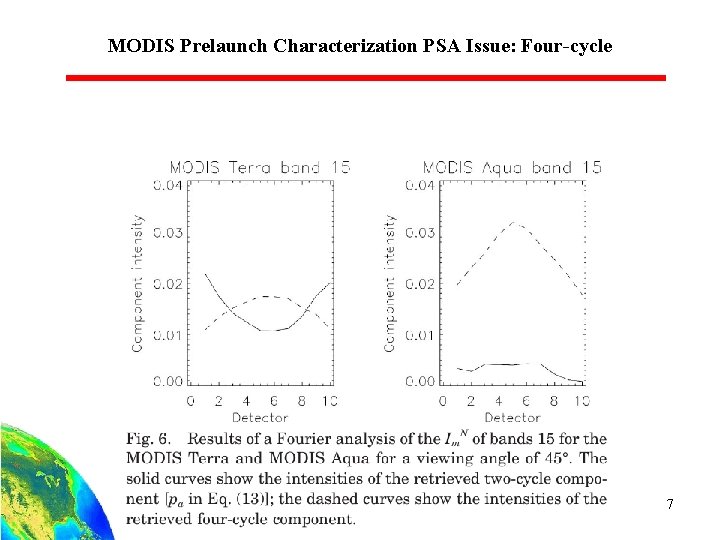
MODIS Prelaunch Characterization PSA Issue: Four-cycle 7
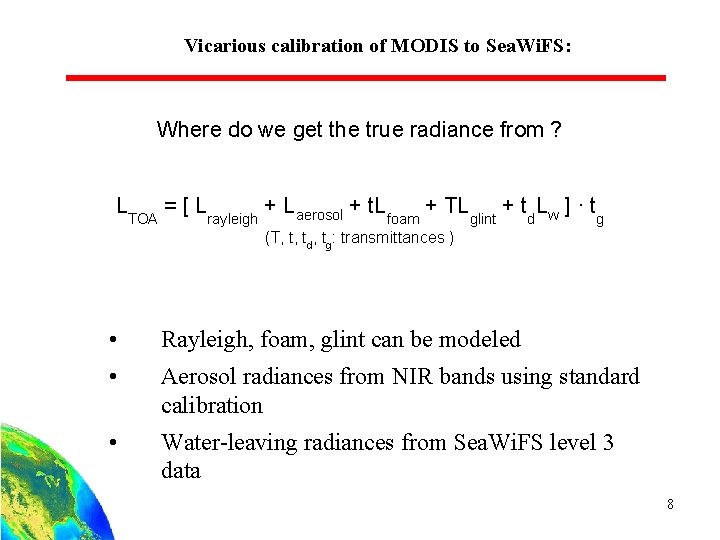
Vicarious calibration of MODIS to Sea. Wi. FS: Where do we get the true radiance from ? L TOA =[L rayleigh + Laerosol + t. L foam + TL glint + t Lw ] · t d g (T, t, td, tg: transmittances ) • Rayleigh, foam, glint can be modeled • Aerosol radiances from NIR bands using standard calibration • Water-leaving radiances from Sea. Wi. FS level 3 data 8
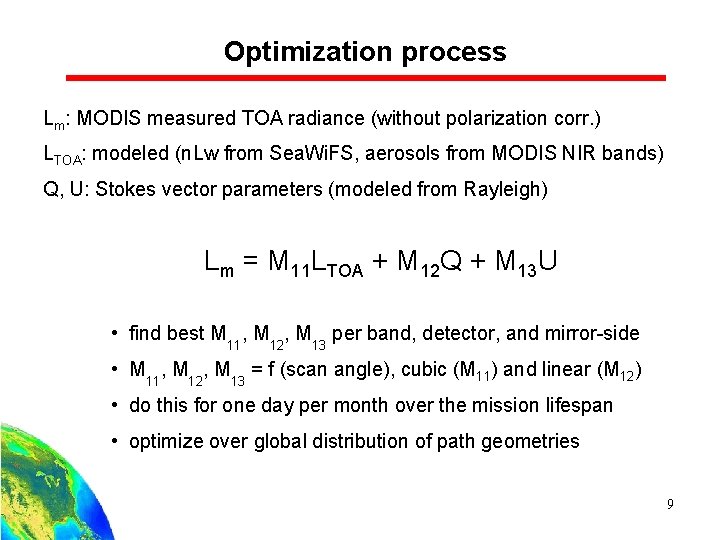
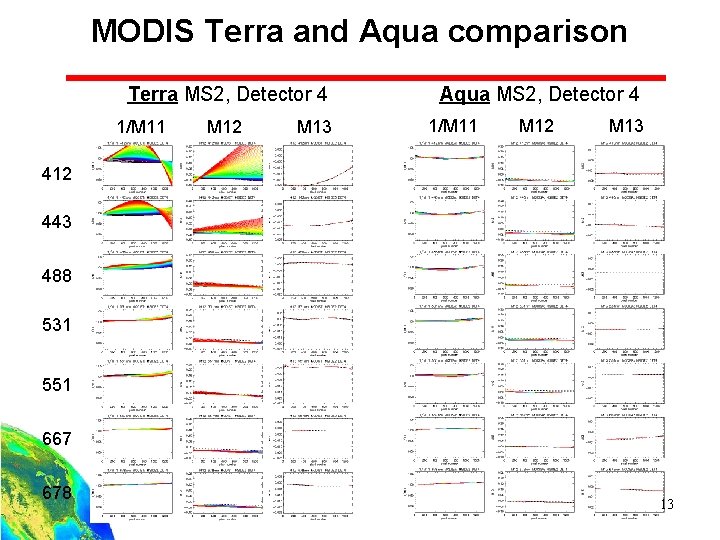
Optimization process Lm: MODIS measured TOA radiance (without polarization corr. ) LTOA: modeled (n. Lw from Sea. Wi. FS, aerosols from MODIS NIR bands) Q, U: Stokes vector parameters (modeled from Rayleigh) Lm = M 11 LTOA + M 12 Q + M 13 U • find best M , M per band, detector, and mirror-side 11 12 13 • M , M = f (scan angle), cubic (M 11) and linear (M 12) 11 12 13 • do this for one day per month over the mission lifespan • optimize over global distribution of path geometries 9
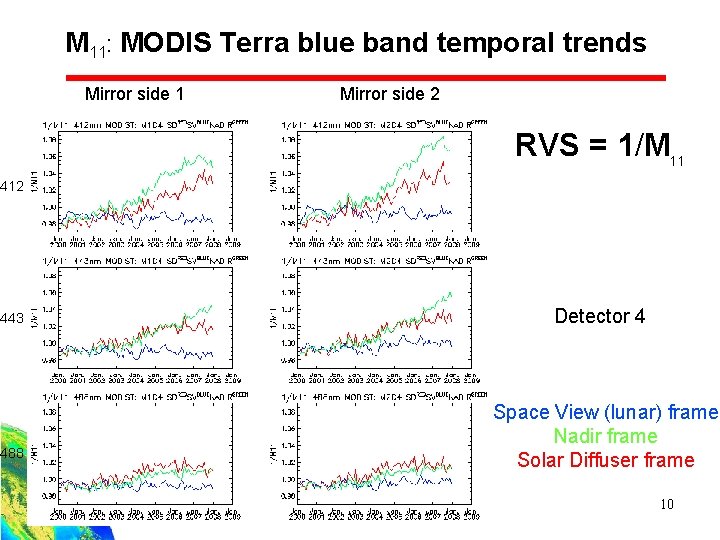
M 11: MODIS Terra blue band temporal trends Mirror side 1 Mirror side 2 RVS = 1/M 11 412 443 488 Detector 4 Space View (lunar) frame Nadir frame Solar Diffuser frame 10
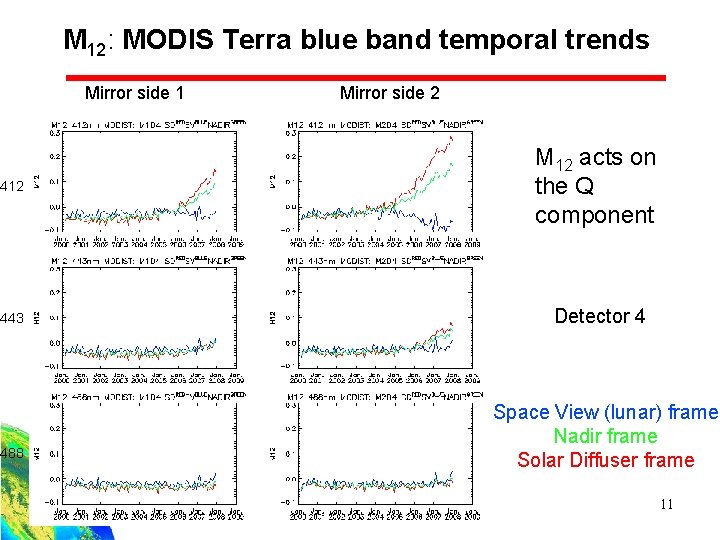
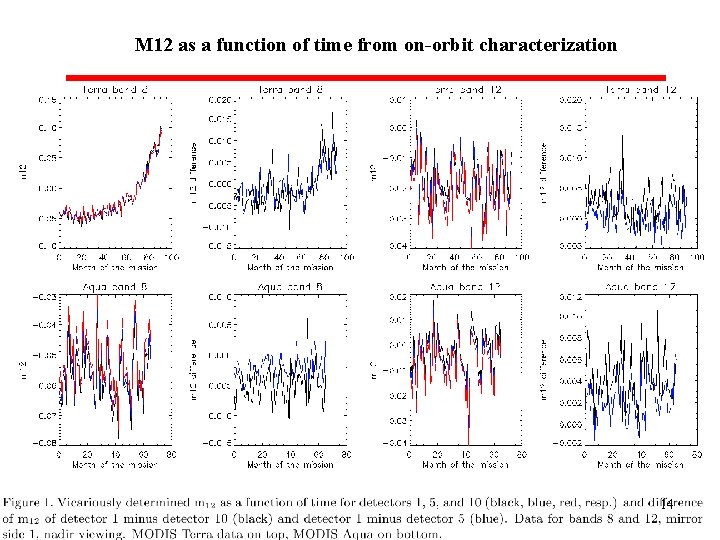
M 12: MODIS Terra blue band temporal trends Mirror side 1 Mirror side 2 412 M 12 acts on the Q component 443 Detector 4 488 Space View (lunar) frame Nadir frame Solar Diffuser frame 11
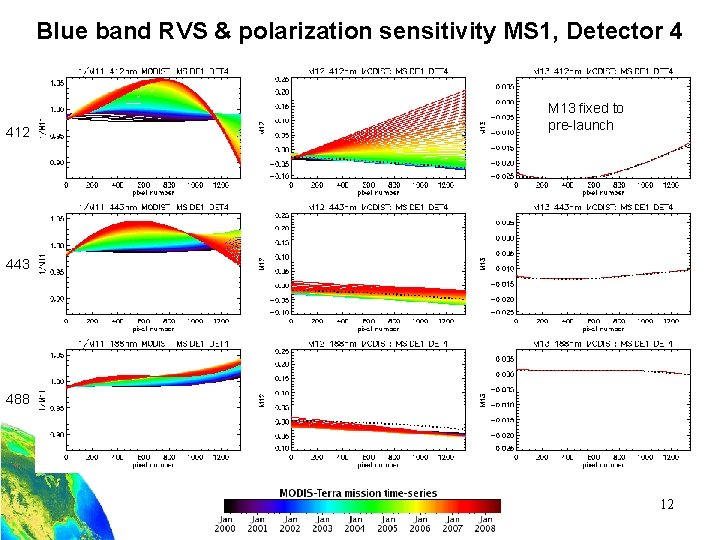
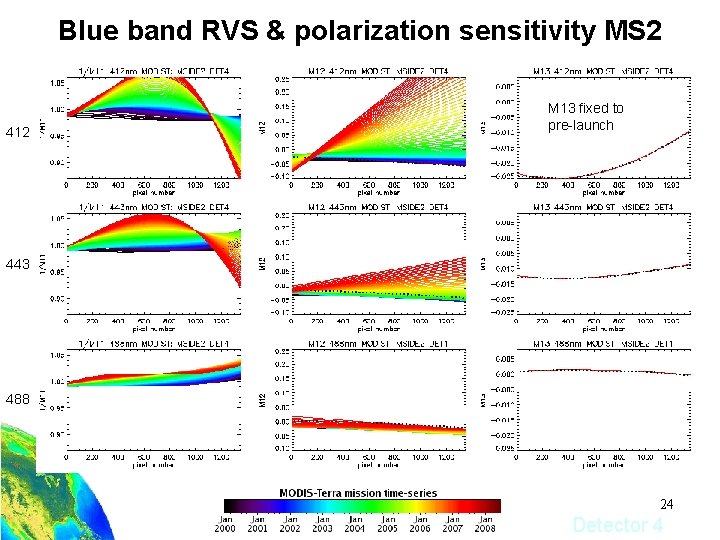
Blue band RVS & polarization sensitivity MS 1, Detector 4 412 M 13 fixed to pre-launch 443 488 12
MODIS Terra and Aqua comparison Terra MS 2, Detector 4 1/M 11 M 12 M 13 Aqua MS 2, Detector 4 1/M 11 M 12 M 13 412 443 488 531 551 667 678 13
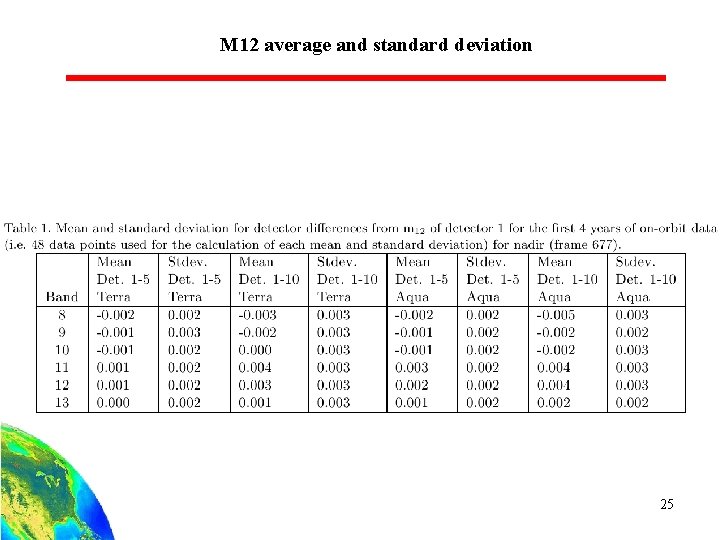
M 12 as a function of time from on-orbit characterization 14
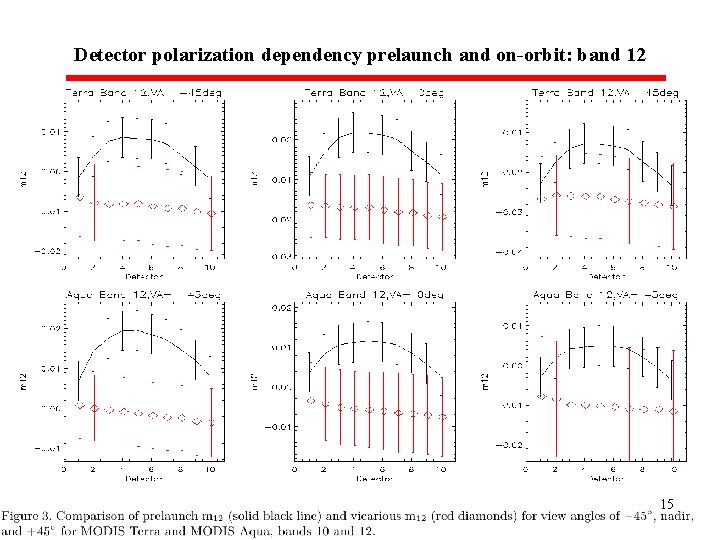
Detector polarization dependency prelaunch and on-orbit: band 12 15
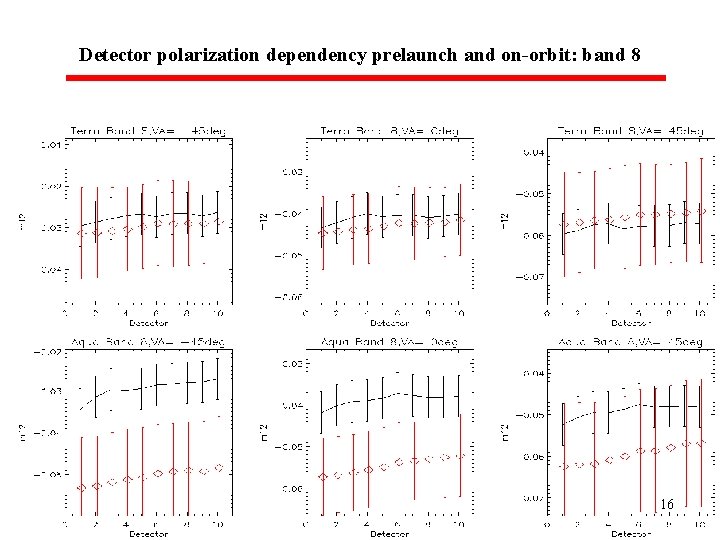
Detector polarization dependency prelaunch and on-orbit: band 8 16
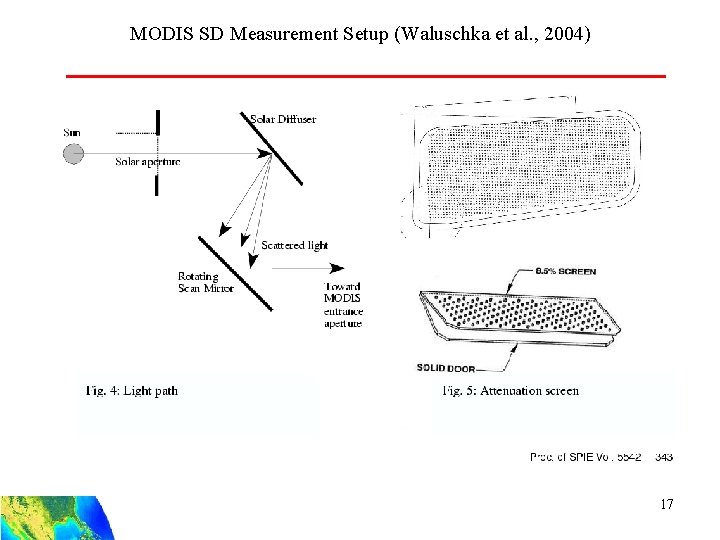
MODIS SD Measurement Setup (Waluschka et al. , 2004) 17
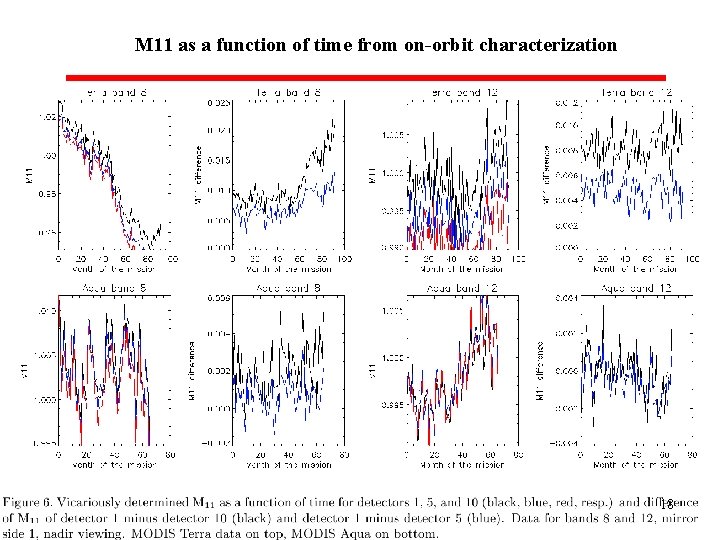
M 11 as a function of time from on-orbit characterization 18
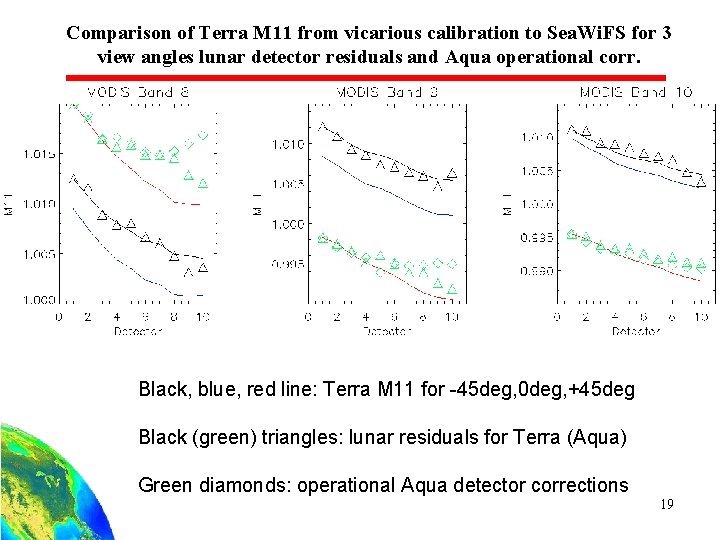
Comparison of Terra M 11 from vicarious calibration to Sea. Wi. FS for 3 view angles lunar detector residuals and Aqua operational corr. Black, blue, red line: Terra M 11 for -45 deg, 0 deg, +45 deg Black (green) triangles: lunar residuals for Terra (Aqua) Green diamonds: operational Aqua detector corrections 19
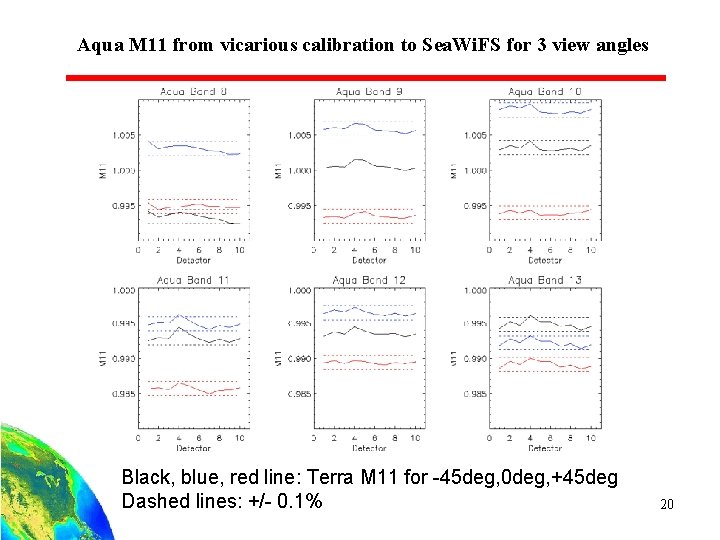
Aqua M 11 from vicarious calibration to Sea. Wi. FS for 3 view angles Black, blue, red line: Terra M 11 for -45 deg, 0 deg, +45 deg Dashed lines: +/- 0. 1% 20
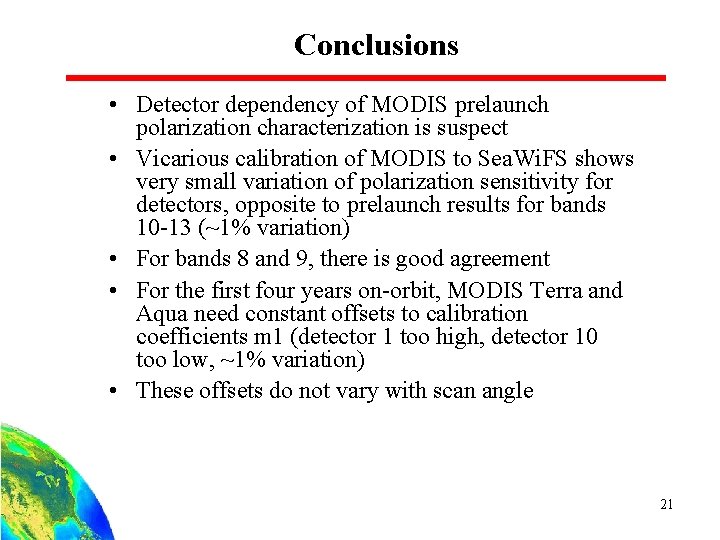
Conclusions • Detector dependency of MODIS prelaunch polarization characterization is suspect • Vicarious calibration of MODIS to Sea. Wi. FS shows very small variation of polarization sensitivity for detectors, opposite to prelaunch results for bands 10 -13 (~1% variation) • For bands 8 and 9, there is good agreement • For the first four years on-orbit, MODIS Terra and Aqua need constant offsets to calibration coefficients m 1 (detector 1 too high, detector 10 too low, ~1% variation) • These offsets do not vary with scan angle 21
Backup slides 22
MODIS Prelaunch Characterization PSA Issue: Homogeneity 23
Blue band RVS & polarization sensitivity MS 2 412 M 13 fixed to pre-launch 443 488 24 Detector 4
M 12 average and standard deviation 25