
Detector connectivity checks in the BLM system for
Detector connectivity checks in the BLM system for the injectors CSABA HAJDU
Overview of the BLMINJ system (1/2) The entire system C. HAJDU: DETECTOR CONNECTIVITY CHECKS IN THE BLM SYSTEM FOR THE INJECTORS 2
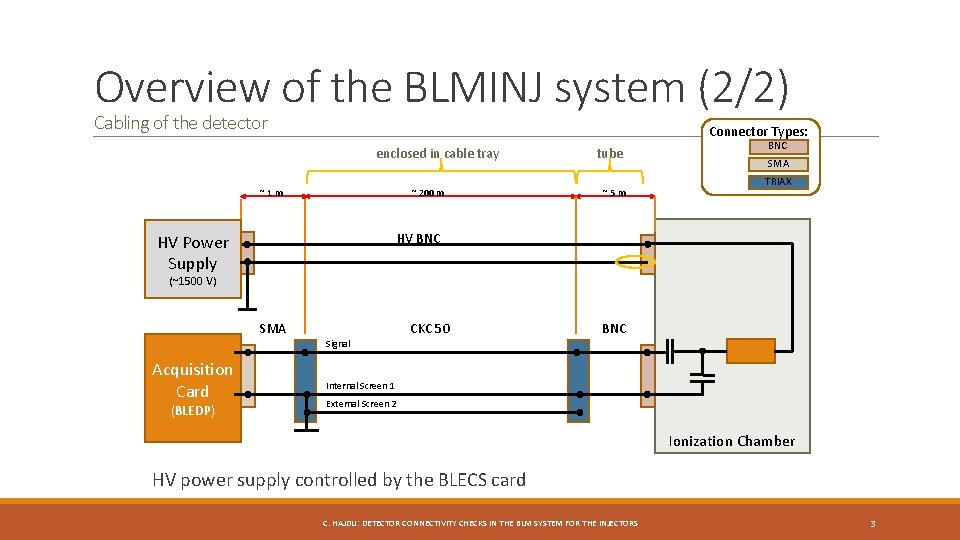
Overview of the BLMINJ system (2/2) Cabling of the detector Connector Types: enclosed in cable tray ~1 m ~ 200 m tube ~5 m BNC SMA TRIAX HV BNC HV Power Supply (~1500 V) CKC 50 SMA BNC Signal Acquisition Card (BLEDP) Internal Screen 1 External Screen 2 Ionization Chamber HV power supply controlled by the BLECS card C. HAJDU: DETECTOR CONNECTIVITY CHECKS IN THE BLM SYSTEM FOR THE INJECTORS 3
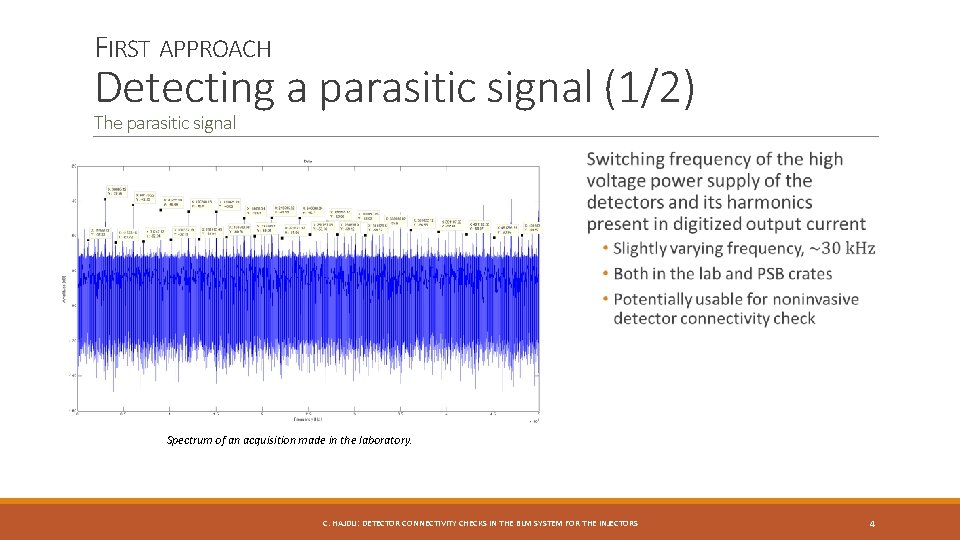
FIRST APPROACH Detecting a parasitic signal (1/2) The parasitic signal Spectrum of an acquisition made in the laboratory. C. HAJDU: DETECTOR CONNECTIVITY CHECKS IN THE BLM SYSTEM FOR THE INJECTORS 4
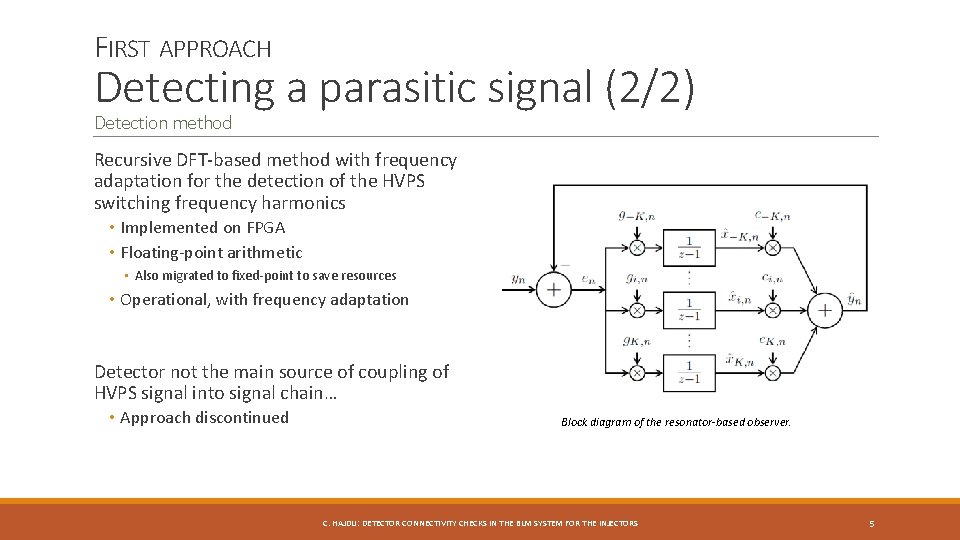
FIRST APPROACH Detecting a parasitic signal (2/2) Detection method Recursive DFT-based method with frequency adaptation for the detection of the HVPS switching frequency harmonics • Implemented on FPGA • Floating-point arithmetic • Also migrated to fixed-point to save resources • Operational, with frequency adaptation Detector not the main source of coupling of HVPS signal into signal chain… • Approach discontinued Block diagram of the resonator-based observer. C. HAJDU: DETECTOR CONNECTIVITY CHECKS IN THE BLM SYSTEM FOR THE INJECTORS 5
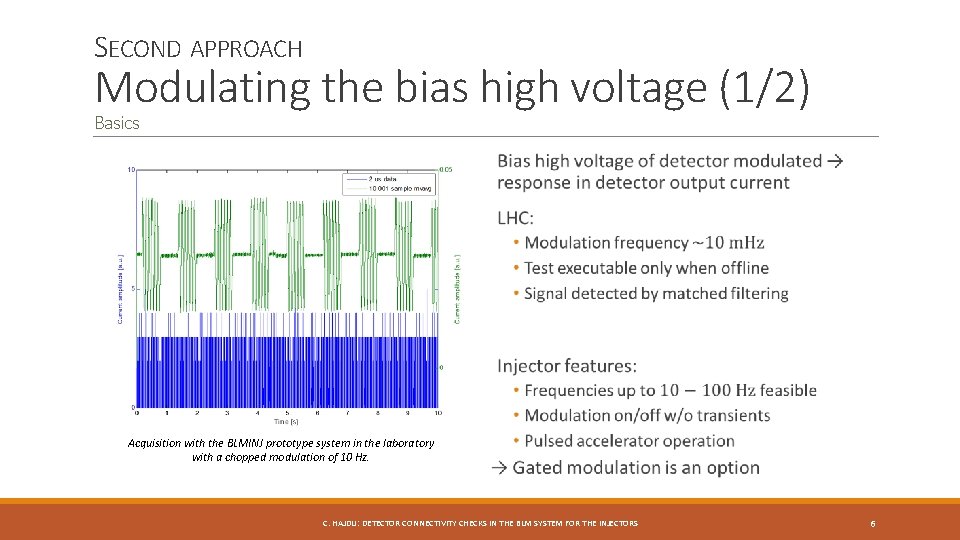
SECOND APPROACH Modulating the bias high voltage (1/2) Basics Acquisition with the BLMINJ prototype system in the laboratory with a chopped modulation of 10 Hz. C. HAJDU: DETECTOR CONNECTIVITY CHECKS IN THE BLM SYSTEM FOR THE INJECTORS 6
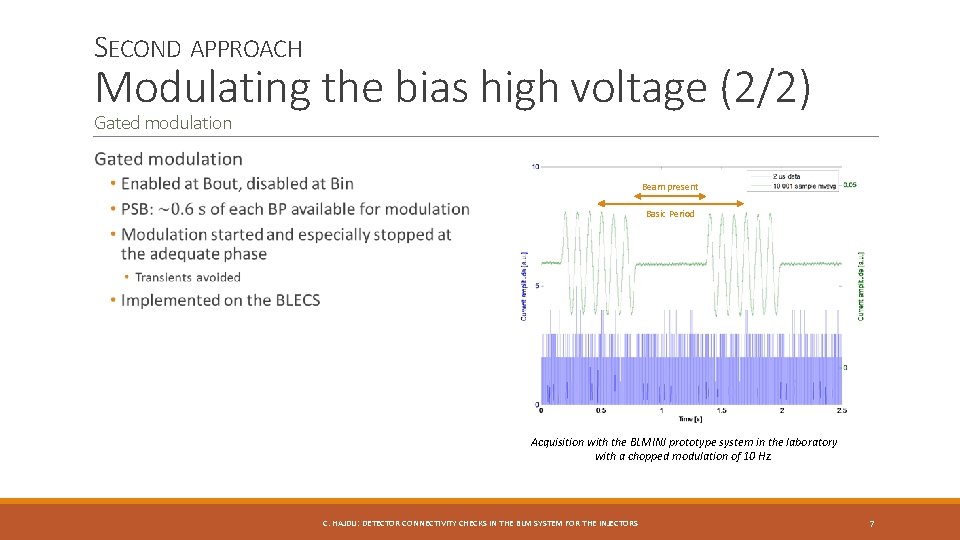
SECOND APPROACH Modulating the bias high voltage (2/2) Gated modulation Beam present Basic Period Acquisition with the BLMINJ prototype system in the laboratory with a chopped modulation of 10 Hz. C. HAJDU: DETECTOR CONNECTIVITY CHECKS IN THE BLM SYSTEM FOR THE INJECTORS 7
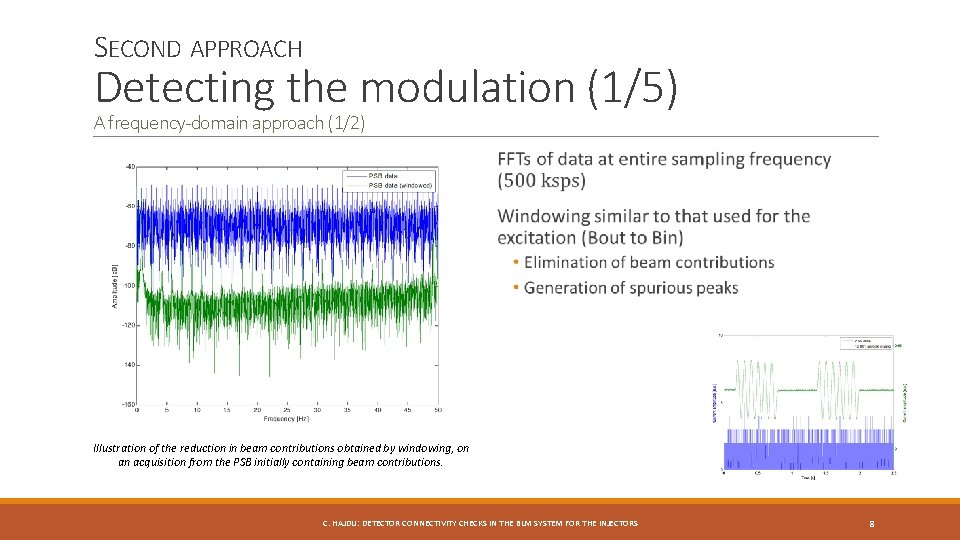
SECOND APPROACH Detecting the modulation (1/5) A frequency-domain approach (1/2) Illustration of the reduction in beam contributions obtained by windowing, on an acquisition from the PSB initially containing beam contributions. C. HAJDU: DETECTOR CONNECTIVITY CHECKS IN THE BLM SYSTEM FOR THE INJECTORS 8
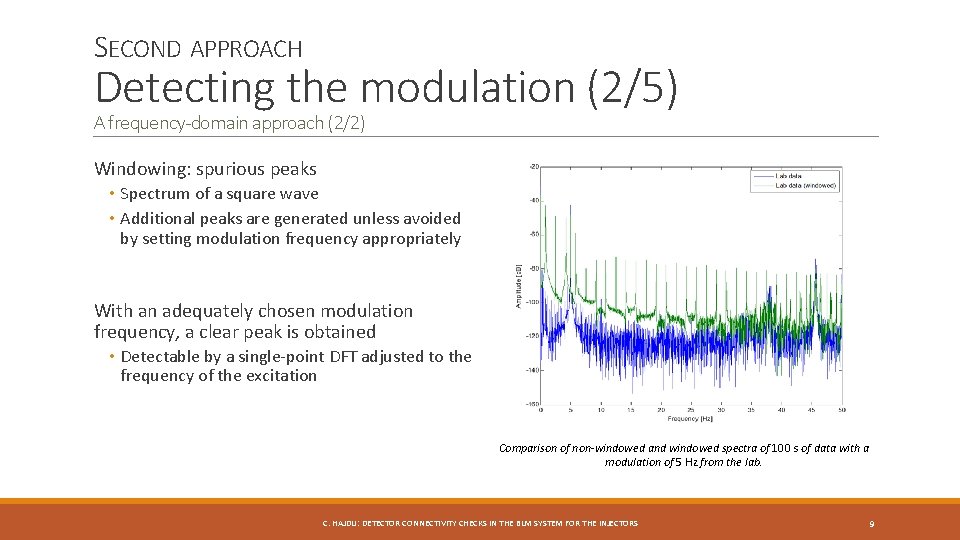
SECOND APPROACH Detecting the modulation (2/5) A frequency-domain approach (2/2) Windowing: spurious peaks • Spectrum of a square wave • Additional peaks are generated unless avoided by setting modulation frequency appropriately With an adequately chosen modulation frequency, a clear peak is obtained • Detectable by a single-point DFT adjusted to the frequency of the excitation Comparison of non-windowed and windowed spectra of 100 s of data with a modulation of 5 Hz from the lab. C. HAJDU: DETECTOR CONNECTIVITY CHECKS IN THE BLM SYSTEM FOR THE INJECTORS 9
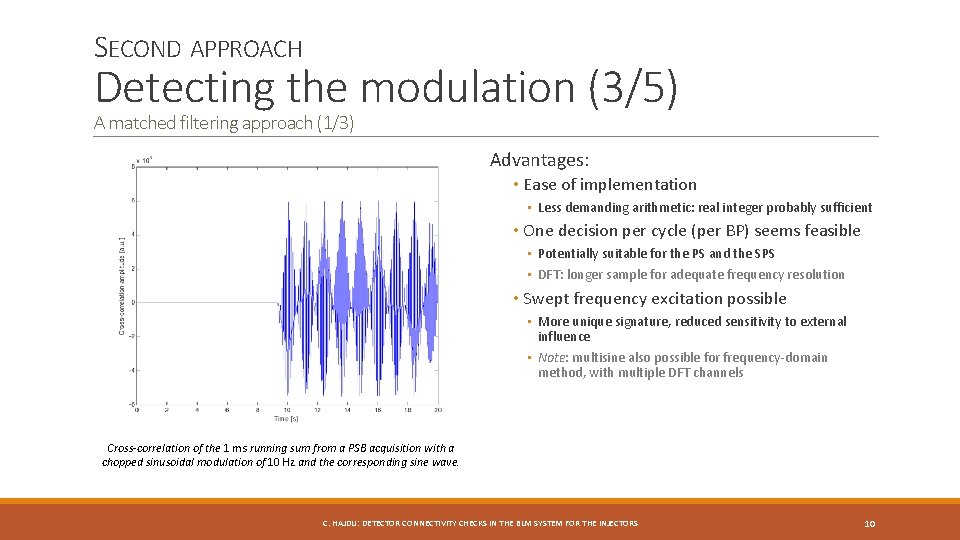
SECOND APPROACH Detecting the modulation (3/5) A matched filtering approach (1/3) Advantages: • Ease of implementation • Less demanding arithmetic: real integer probably sufficient • One decision per cycle (per BP) seems feasible • Potentially suitable for the PS and the SPS • DFT: longer sample for adequate frequency resolution • Swept frequency excitation possible • More unique signature, reduced sensitivity to external influence • Note: multisine also possible for frequency-domain method, with multiple DFT channels Cross-correlation of the 1 ms running sum from a PSB acquisition with a chopped sinusoidal modulation of 10 Hz and the corresponding sine wave. C. HAJDU: DETECTOR CONNECTIVITY CHECKS IN THE BLM SYSTEM FOR THE INJECTORS 10
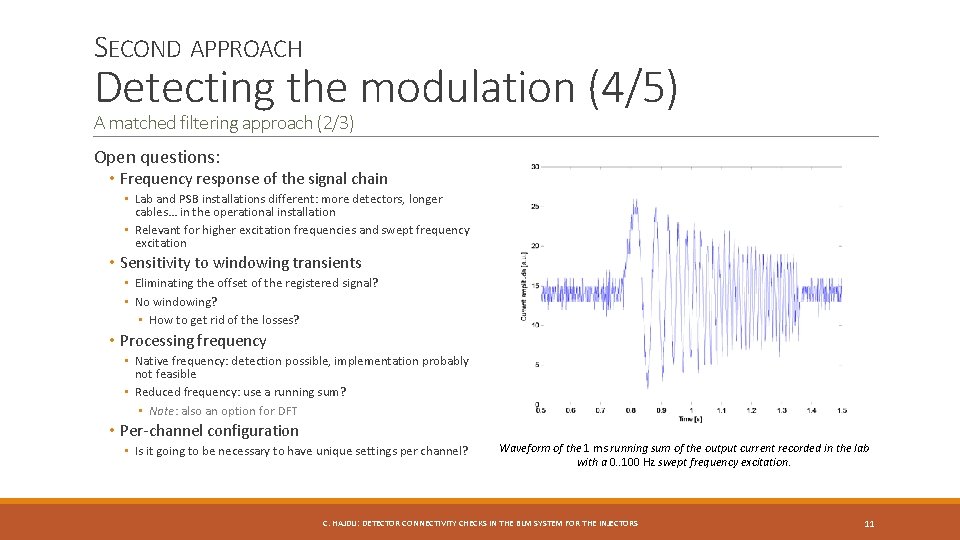
SECOND APPROACH Detecting the modulation (4/5) A matched filtering approach (2/3) Open questions: • Frequency response of the signal chain • Lab and PSB installations different: more detectors, longer cables… in the operational installation • Relevant for higher excitation frequencies and swept frequency excitation • Sensitivity to windowing transients • Eliminating the offset of the registered signal? • No windowing? • How to get rid of the losses? • Processing frequency • Native frequency: detection possible, implementation probably not feasible • Reduced frequency: use a running sum? • Note: also an option for DFT • Per-channel configuration • Is it going to be necessary to have unique settings per channel? Waveform of the 1 ms running sum of the output current recorded in the lab with a 0. . 100 Hz swept frequency excitation. C. HAJDU: DETECTOR CONNECTIVITY CHECKS IN THE BLM SYSTEM FOR THE INJECTORS 11
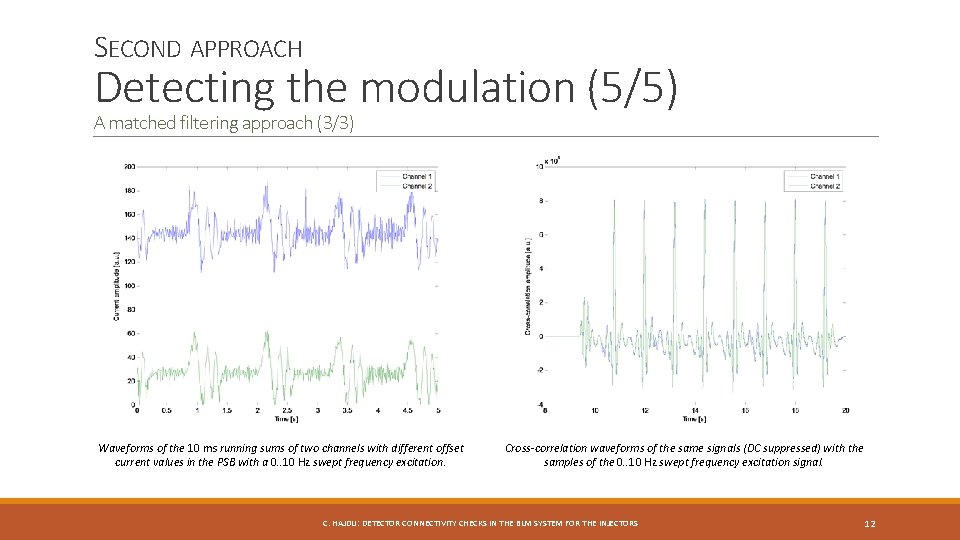
SECOND APPROACH Detecting the modulation (5/5) A matched filtering approach (3/3) Waveforms of the 10 ms running sums of two channels with different offset current values in the PSB with a 0. . 10 Hz swept frequency excitation. Cross-correlation waveforms of the same signals (DC suppressed) with the samples of the 0. . 10 Hz swept frequency excitation signal. C. HAJDU: DETECTOR CONNECTIVITY CHECKS IN THE BLM SYSTEM FOR THE INJECTORS 12
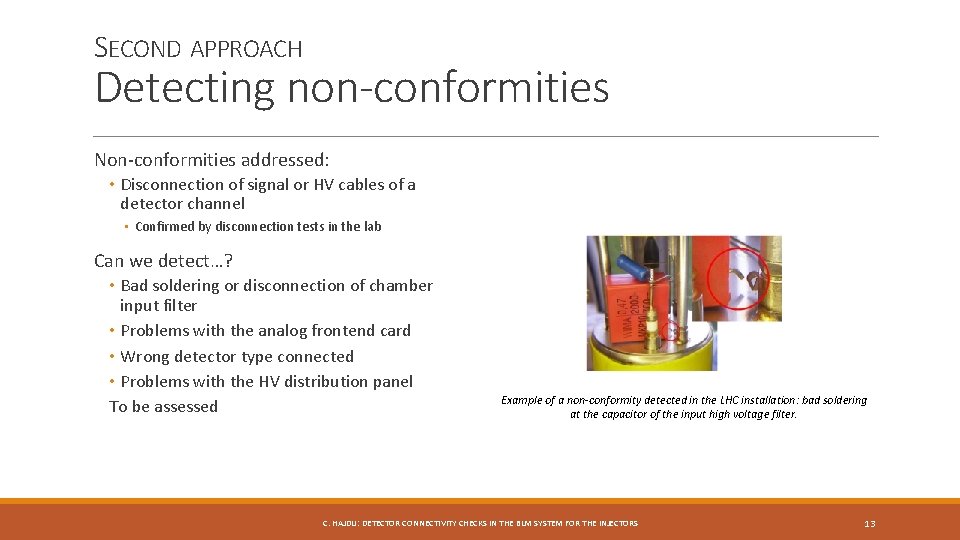
SECOND APPROACH Detecting non-conformities Non-conformities addressed: • Disconnection of signal or HV cables of a detector channel • Confirmed by disconnection tests in the lab Can we detect…? • Bad soldering or disconnection of chamber input filter • Problems with the analog frontend card • Wrong detector type connected • Problems with the HV distribution panel To be assessed Example of a non-conformity detected in the LHC installation: bad soldering at the capacitor of the input high voltage filter. C. HAJDU: DETECTOR CONNECTIVITY CHECKS IN THE BLM SYSTEM FOR THE INJECTORS 13

Thank you for your attention!
- Slides: 14