
Detection of Puccinia horiana the causal agent of
- Slides: 1
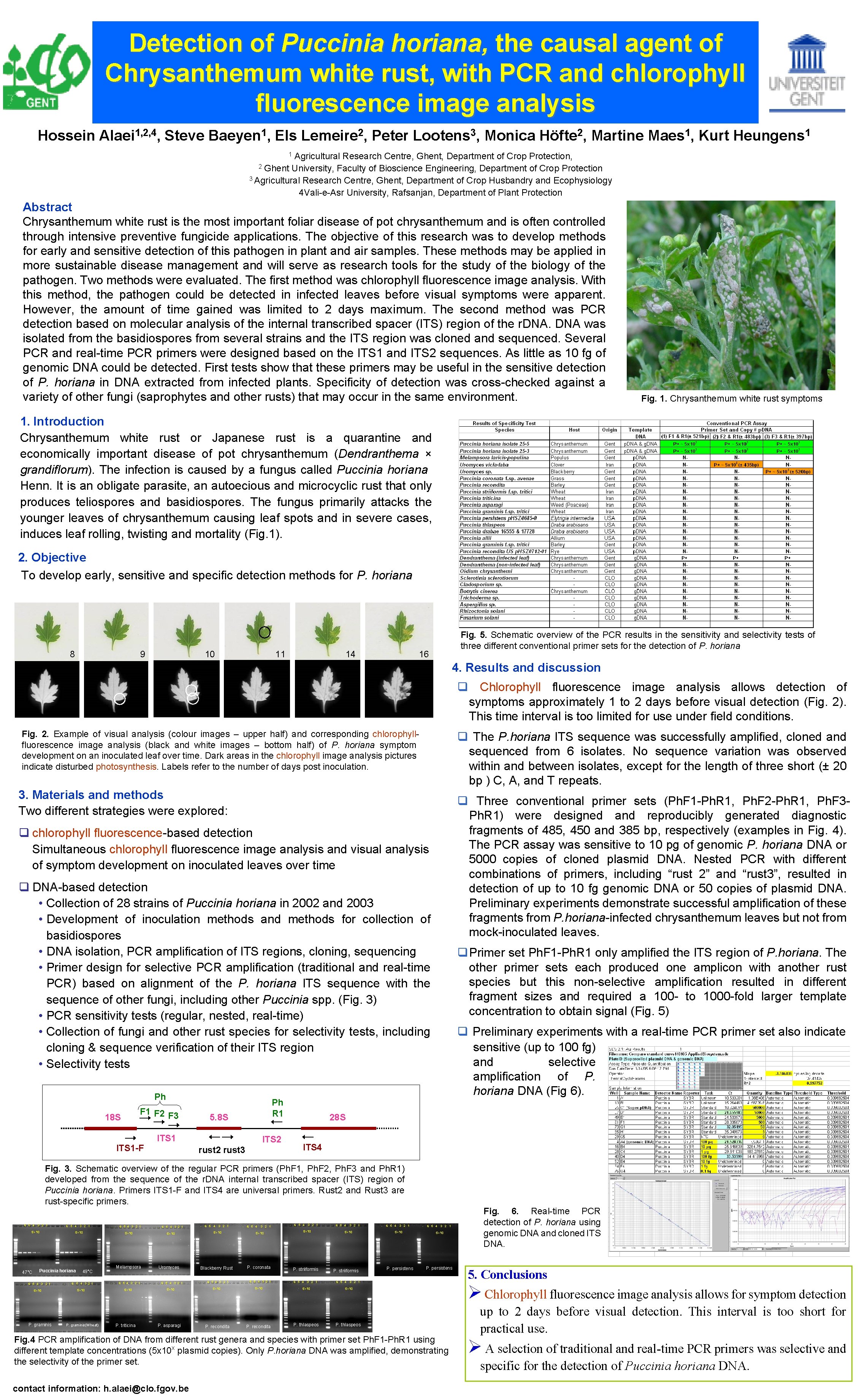
Detection of Puccinia horiana, the causal agent of Chrysanthemum white rust, with PCR and chlorophyll fluorescence image analysis Hossein Alaei 1, 2, 4, Steve Baeyen 1, Els Lemeire 2, Peter Lootens 3, Monica Höfte 2, Martine Maes 1, Kurt Heungens 1 Agricultural Research Centre, Ghent, Department of Crop Protection, 2 Ghent University, Faculty of Bioscience Engineering, Department of Crop Protection 3 Agricultural Research Centre, Ghent, Department of Crop Husbandry and Ecophysiology 4 Vali-e-Asr University, Rafsanjan, Department of Plant Protection 1 Abstract Chrysanthemum white rust is the most important foliar disease of pot chrysanthemum and is often controlled through intensive preventive fungicide applications. The objective of this research was to develop methods for early and sensitive detection of this pathogen in plant and air samples. These methods may be applied in more sustainable disease management and will serve as research tools for the study of the biology of the pathogen. Two methods were evaluated. The first method was chlorophyll fluorescence image analysis. With this method, the pathogen could be detected in infected leaves before visual symptoms were apparent. However, the amount of time gained was limited to 2 days maximum. The second method was PCR detection based on molecular analysis of the internal transcribed spacer (ITS) region of the r. DNA was isolated from the basidiospores from several strains and the ITS region was cloned and sequenced. Several PCR and real-time PCR primers were designed based on the ITS 1 and ITS 2 sequences. As little as 10 fg of genomic DNA could be detected. First tests show that these primers may be useful in the sensitive detection of P. horiana in DNA extracted from infected plants. Specificity of detection was cross-checked against a variety of other fungi (saprophytes and other rusts) that may occur in the same environment. Fig. 1. Chrysanthemum white rust symptoms 1. Introduction Chrysanthemum white rust or Japanese rust is a quarantine and economically important disease of pot chrysanthemum (Dendranthema × grandiflorum). The infection is caused by a fungus called Puccinia horiana Henn. It is an obligate parasite, an autoecious and microcyclic rust that only produces teliospores and basidiospores. The fungus primarily attacks the younger leaves of chrysanthemum causing leaf spots and in severe cases, induces leaf rolling, twisting and mortality (Fig. 1). 2. Objective To develop early, sensitive and specific detection methods for P. horiana 8 9 10 11 14 Fig. 5. Schematic overview of the PCR results in the sensitivity and selectivity tests of three different conventional primer sets for the detection of P. horiana 16 4. Results and discussion q Chlorophyll fluorescence image analysis allows detection of symptoms approximately 1 to 2 days before visual detection (Fig. 2). This time interval is too limited for use under field conditions. Fig. 2. Example of visual analysis (colour images – upper half) and corresponding chlorophyllfluorescence image analysis (black and white images – bottom half) of P. horiana symptom development on an inoculated leaf over time. Dark areas in the chlorophyll image analysis pictures indicate disturbed photosynthesis. Labels refer to the number of days post inoculation. q The P. horiana ITS sequence was successfully amplified, cloned and sequenced from 6 isolates. No sequence variation was observed within and between isolates, except for the length of three short (± 20 bp ) C, A, and T repeats. 3. Materials and methods Two different strategies were explored: q Three conventional primer sets (Ph. F 1 -Ph. R 1, Ph. F 2 -Ph. R 1, Ph. F 3 Ph. R 1) were designed and reproducibly generated diagnostic fragments of 485, 450 and 385 bp, respectively (examples in Fig. 4). The PCR assay was sensitive to 10 pg of genomic P. horiana DNA or 5000 copies of cloned plasmid DNA. Nested PCR with different combinations of primers, including “rust 2” and “rust 3”, resulted in detection of up to 10 fg genomic DNA or 50 copies of plasmid DNA. Preliminary experiments demonstrate successful amplification of these fragments from P. horiana-infected chrysanthemum leaves but not from mock-inoculated leaves. q chlorophyll fluorescence-based detection Simultaneous chlorophyll fluorescence image analysis and visual analysis of symptom development on inoculated leaves over time q DNA-based detection • Collection of 28 strains of Puccinia horiana in 2002 and 2003 • Development of inoculation methods and methods for collection of basidiospores • DNA isolation, PCR amplification of ITS regions, cloning, sequencing • Primer design for selective PCR amplification (traditional and real-time PCR) based on alignment of the P. horiana ITS sequence with the sequence of other fungi, including other Puccinia spp. (Fig. 3) • PCR sensitivity tests (regular, nested, real-time) • Collection of fungi and other rust species for selectivity tests, including cloning & sequence verification of their ITS region • Selectivity tests Ph F 1 F 2 F 3 18 S Ph R 1 5. 8 S ITS 1 -F q Primer set Ph. F 1 -Ph. R 1 only amplified the ITS region of P. horiana. The other primer sets each produced one amplicon with another rust species but this non-selective amplification resulted in different fragment sizes and required a 100 - to 1000 -fold larger template concentration to obtain signal (Fig. 5) q Preliminary experiments with a real-time PCR primer set also indicate sensitive (up to 100 fg) and selective amplification of P. horiana DNA (Fig 6). 28 S ITS 2 ITS 4 rust 2 rust 3 Fig. 3. Schematic overview of the regular PCR primers (Ph. F 1, Ph. F 2, Ph. F 3 and Ph. R 1) developed from the sequence of the r. DNA internal transcribed spacer (ITS) region of Puccinia horiana. Primers ITS 1 -F and ITS 4 are universal primers. Rust 2 and Rust 3 are rust-specific primers. - 6 5 4 3 2 1 - 6 5 4 5× 10 47°C - - 3 2 1 - - 5× 10 Puccinia horiana 6 5 4 3 2 1 5× 10 P. graminis - 5× 10 P. graminis(Wheat) - 5× 10 - - 6 5 4 3 2 1 5× 10 P. triticina - 6 5 4 3 2 1 - - 6 5 4 3 2 1 Uromyces Blackberry Rust - 6 5 4 3 2 1 - - 5× 10 P. asparagi - 5× 10 Melampsora 49°C - 6 5 4 3 2 1 5× 10 P. recondita 6 5 4 3 2 1 - P. coronata - 6 5 4 3 2 1 5× 10 P. recondita 3 2 1 - 5× 10 - 6 5 4 3 2 1 5× 10 P. thlaspeos 3 2 1 5× 10 P. striiformis - 6 5 4 3 2 1 5× 10 P. persistens 3 2 1 5× 10 P. thlaspeos Fig. 4 PCR amplification of DNA from different rust genera and species with primer set Ph. F 1 -Ph. R 1 using different template concentrations (5 x 10 x plasmid copies). Only P. horiana DNA was amplified, demonstrating the selectivity of the primer set. contact information: h. alaei@clo. fgov. be Fig. 6. Real-time PCR detection of P. horiana using genomic DNA and cloned ITS DNA. 5. Conclusions Ø Chlorophyll fluorescence image analysis allows for symptom detection up to 2 days before visual detection. This interval is too short for practical use. Ø A selection of traditional and real-time PCR primers was selective and specific for the detection of Puccinia horiana DNA.