
Detection of Particles in a high energy beam
Detection of Particles in a high energy beam C 1 C Daniel Franz C 1 C Barry Crawford Jr.

Presentation Overview Synopsis of Technical Paper n Defining terms n Initial Experimentation/Problems n Equipment n Latest Experimentation/Problems n Future n Questions n
Technical Paper n Intense High-Energy Beams from Petawatt. Laser Irradiation of solids n R. A. Snavely, M. H. Key, S. P. Hatchett, T. E. Cowan, M. Roth, T. W. Phillips, M. A. Stoyer, E. A. Henry, T. C. Sangster, M. S. Singh, S. C. Wilks, A. Mac. Kinnon, A. Offenberger, D. M. Pennington, K. Yasuike, A. B. Langdon, B. F. Lasinski, J. Johnson, M. . D. Perry, E. M. Campbell n A Nuclear-Powered Laser-Accelerated Plasma Propulsion System n Terry Kammash, University of Michigan n NASA Breakthrough Propulsion Physics
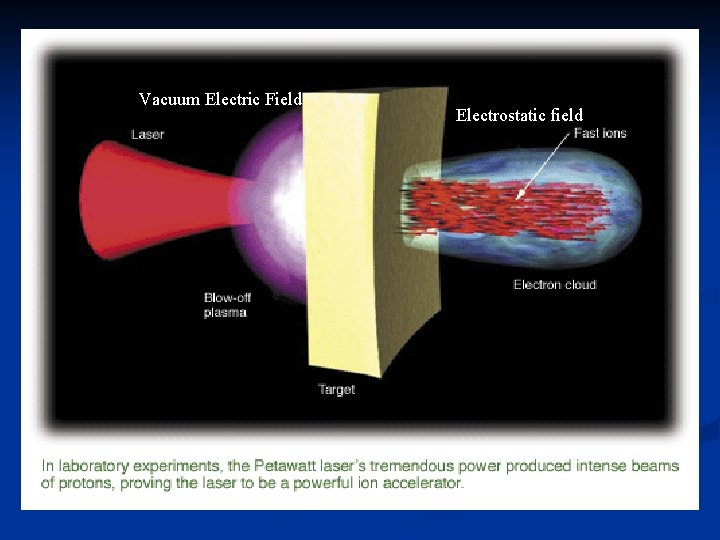
Vacuum Electric Field Electrostatic field

Technical Paper LLNL UM Laser peak power 1 Peta. Watt (10^15) 10 Tera. Watt (10^12) Spot size 9 m 5 m Intensity 3 x 10^20 W/cm^2 3 x 10^18 W/cm^2 Foil material Gold (125 m thick ) Aluminum Particle population 6 x 10^14 1 x 10^10 Mean energy 6 Me. V 1 Me. V Cut off energy 58 Me. V

Defining Terms n Repetition rate: number of pulses a second n i. e. 10 Hz repetition rate means that the laser will pulse 10 x’s in one second Pulse Width: length of pulse n Focal Point/ Waist: spot where lasers’ intensity is at it greatest after going through a lens n

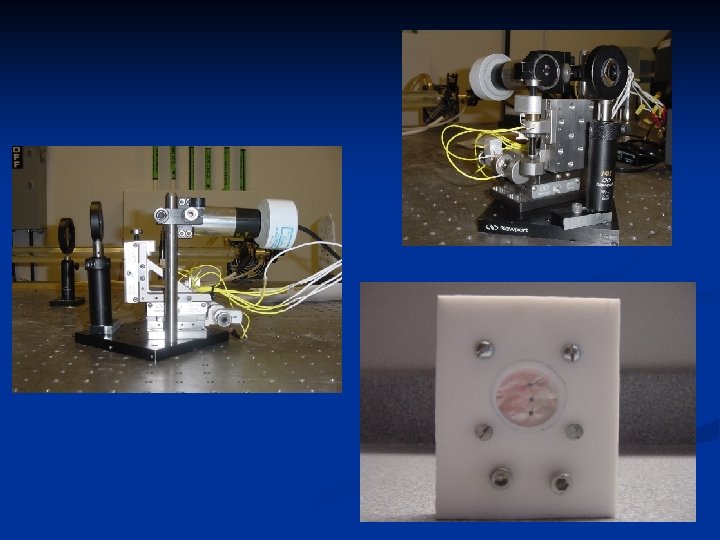
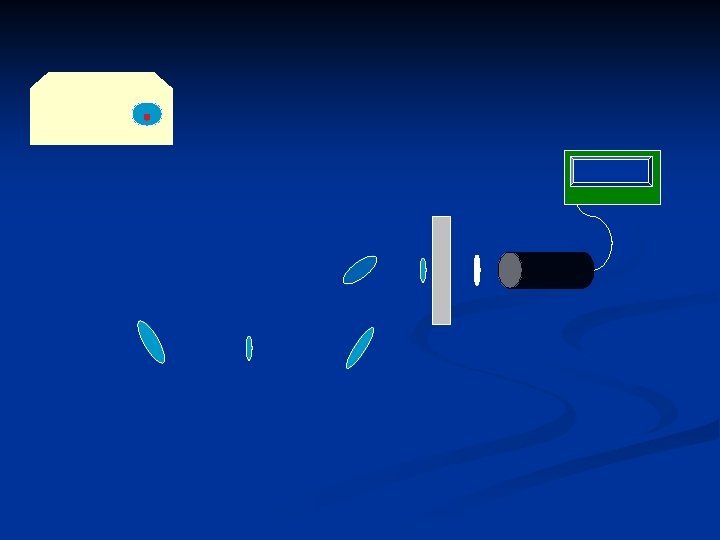
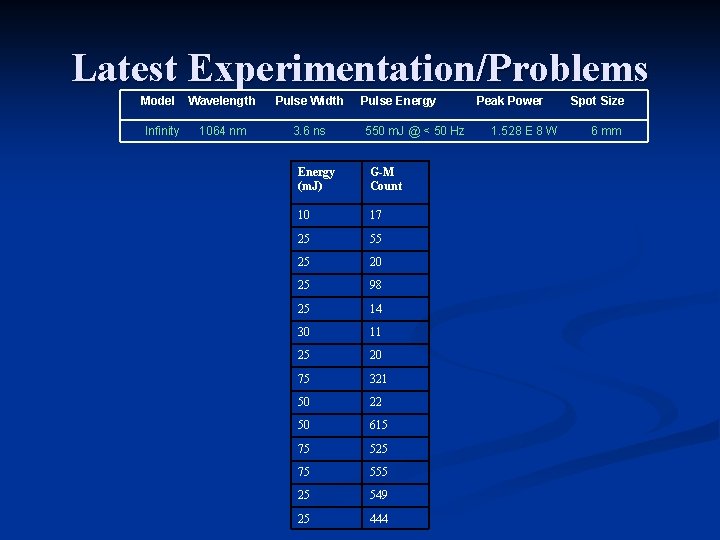
Initial Experimentation n Issues with target and detection n n Foils (Al) Determining depth of focus Movable platform Detection equipment (Brass Plate)
Equipment
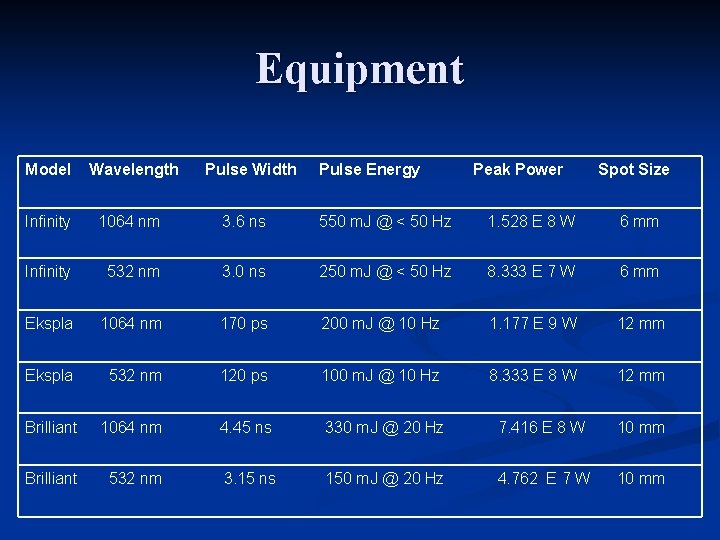
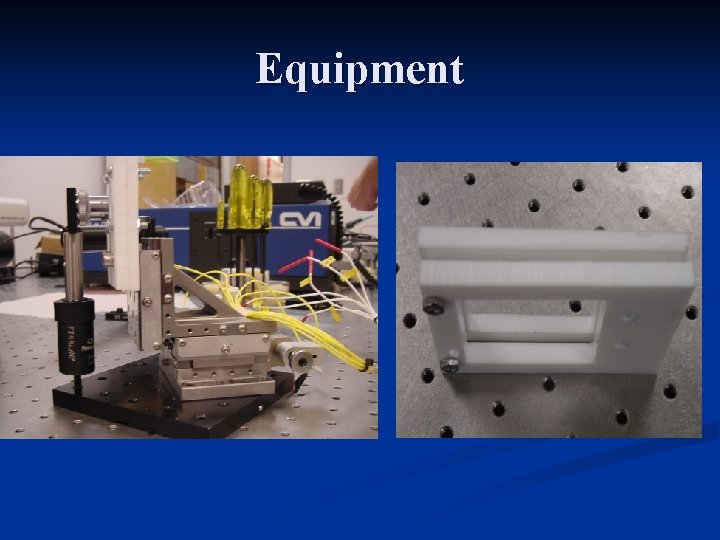
Equipment Model Wavelength Pulse Width Pulse Energy Peak Power Spot Size Infinity 1064 nm 3. 6 ns 550 m. J @ < 50 Hz 1. 528 E 8 W 6 mm Infinity 532 nm 3. 0 ns 250 m. J @ < 50 Hz 8. 333 E 7 W 6 mm Ekspla 1064 nm 170 ps 200 m. J @ 10 Hz 1. 177 E 9 W 12 mm Ekspla 532 nm 120 ps 100 m. J @ 10 Hz 8. 333 E 8 W 12 mm Brilliant 1064 nm 4. 45 ns 330 m. J @ 20 Hz 7. 416 E 8 W 10 mm Brilliant 532 nm 3. 15 ns 150 m. J @ 20 Hz 4. 762 E 7 W 10 mm
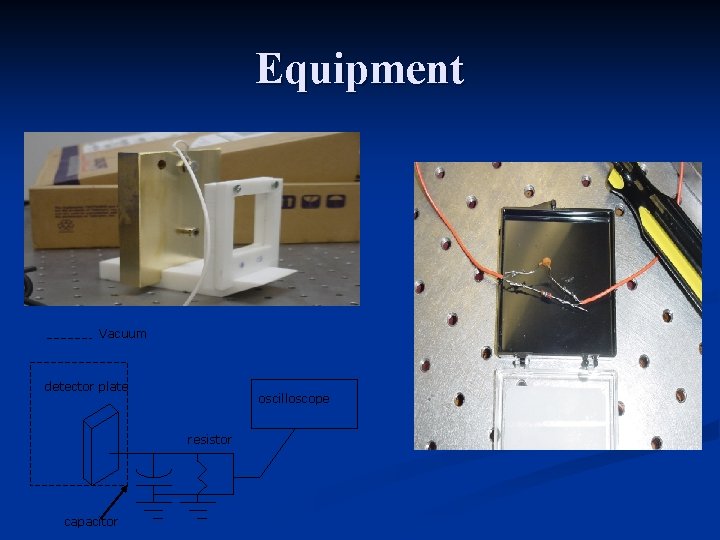
Equipment Vacuum detector plate oscilloscope resistor capacitor
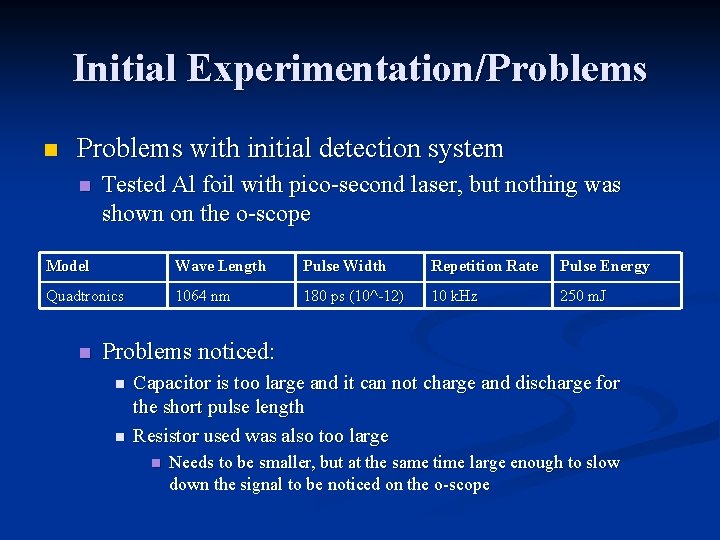
Initial Experimentation/Problems n Problems with initial detection system n Tested Al foil with pico-second laser, but nothing was shown on the o-scope Model Wave Length Pulse Width Repetition Rate Pulse Energy Quadtronics 1064 nm 180 ps (10^-12) 10 k. Hz 250 m. J n Problems noticed: n n Capacitor is too large and it can not charge and discharge for the short pulse length Resistor used was also too large n Needs to be smaller, but at the same time large enough to slow down the signal to be noticed on the o-scope
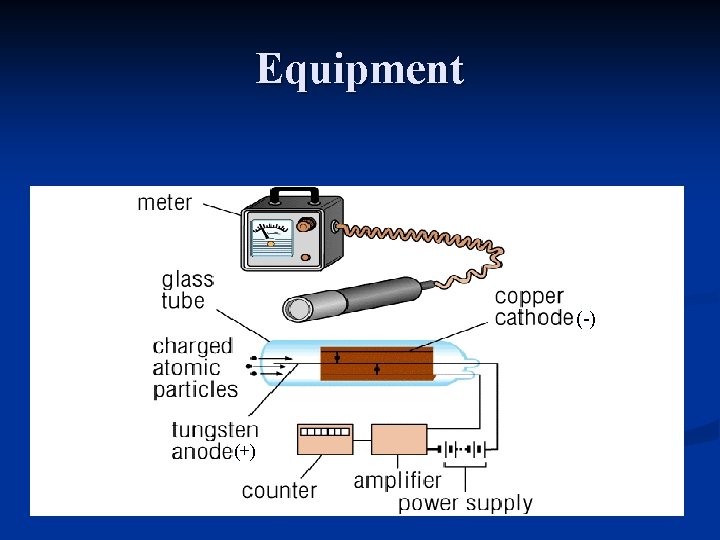
Equipment n Geiger-Mueller Counter (-) (+)
Latest Experimentation/Problems Model Infinity Wavelength Pulse Width 1064 nm 3. 6 ns Pulse Energy 550 m. J @ < 50 Hz Energy (m. J) G-M Count 10 17 25 55 25 20 25 98 25 14 30 11 25 20 75 321 50 22 50 615 75 525 75 555 25 549 25 444 Peak Power 1. 528 E 8 W Spot Size 6 mm
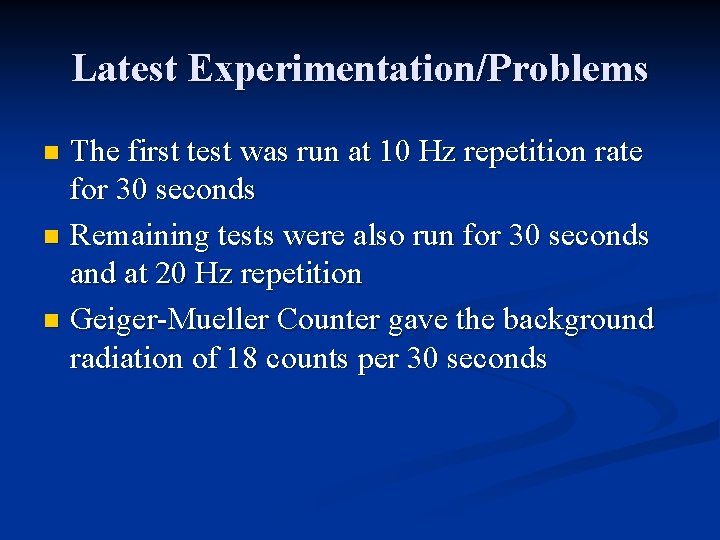
Latest Experimentation/Problems The first test was run at 10 Hz repetition rate for 30 seconds n Remaining tests were also run for 30 seconds and at 20 Hz repetition n Geiger-Mueller Counter gave the background radiation of 18 counts per 30 seconds n
Latest Experimentation/Problems n Main Points: n Considerable Geiger-Mueller counts above background radiation were noticed only when laser broke through foil n Increasing laser power showed no effect on the count number n Looked like there might be a correlation between count number and laser pulse number. n Blow back was noticed on foil n Count number did not change even though laser was fired at same spot numerous times n Took numerous firings to create hole as large as the laser spot size
Experimentation Re-ran the experiment with the focal point of the laser on the foil n Ran the laser at the foil for a longer period of time to see if time has an effect on counts n Try to have one pulse of the laser both break through the foil and create the full spot size of the laser n
Experimentation n Interpolating data with theory n We tried to answer the question: Is the Geiger-Mueller count and number of laser pulses related either by causation or by some other relationship?
Experimentation n Conclusions from this set of experiments Geiger-Mueller counter provided no useful information to either back up or disprove the data found in other research papers on this topic n Need to recreate exactly the experiments from the research papers to either prove or disprove data n
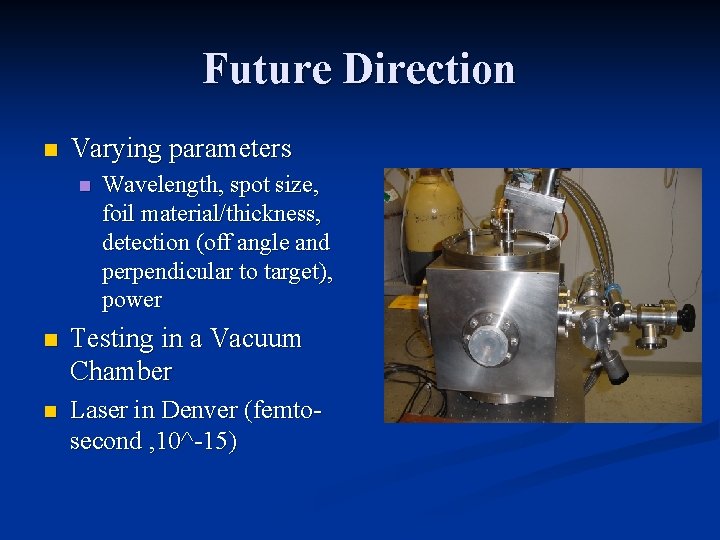
Future Direction n Varying parameters n Wavelength, spot size, foil material/thickness, detection (off angle and perpendicular to target), power n Testing in a Vacuum Chamber n Laser in Denver (femtosecond , 10^-15)
Future Direction n Presently working with the GEX Corporation in Denver to acquire radio chromic film n Will re run experiments using radio chromic film, then will have the film analyzed by the GEX Corp to receive the concentrations of high energy particles

n. Questions? ?
- Slides: 23