
Detection of Cosmic Ray Protons by Radio Recombination
Detection of Cosmic Ray Protons by Radio Recombination Lines of Hydrogen G. T. Smirnov, R. L. Sorochenko Pushchino Radio Astronomy Observatory
Cosmic rays in the Galaxy Cosmic rays (CR) play an important role in physical and chemical processes taking place in the cold ISM outside HII regions. This is related to hydrogen ionization by CR protons which influences the temperature and dynamics of the ISM as well as its chemical composition. Chemical reactions with ions take place more rapidly than reactions between neutral particles. For this reason abundance of some molecules containing hydrogen and oxygen depends on abundance of Н+ ions and accordingly on rate of ionization of hydrogen. The cross sections for hydrogen ionization by protons decrease with increasing energy. At the same time low-energy protons are more strongly absorbed in the ISM. As a result the main contribution to ISM ionization is due to protons with energies 1 <E < 10 Me. V.
Ionization rate of interstellar hydrogen by CR CR with such low energies cannot be detected on the Earth because they are deflected by the solar wind associated magnetic field. Their intensity and accordingly the rate of ISM ionization by CR, ζH, has been estimated using various indirect methods: – – – Extrapolation of the CR spectrum E > 1 Ge. V observed on Earth to Me. V energies. Extrapolation to Me. V energies of the CR spectrum E > 70 Me. V measured on the Pioneer and Voyager spacecrafts moved to a distance of 60 AU from the Sun. On abundance of the molecules formed with participation of Н+ and Н 2+. The values of ζH obtained by these methods strongly differ up to 1 or 2 orders of magnitude. It seams promising to use for determination of ζH radio recombination lines (RRL) which represent an effective tool for investigating the ISM.
Cosmic rays and RRL When H+ ions recombine with electrons highly excited atoms of hydrogen are formed and radio recombination lines are emitted. Detection of hydrogen RRL from cold ISM would testify on proton component of CR and would allow a direct derivation of ionization rate of interstellar hydrogen ζН. However numerous attempts to detect RRL of hydrogen from cold ISM made for a number of lines from H 300α to H 540α were unsuccessful. Liszt (2003) claimed that the hydrogen RRL could never been observed since H+ ions would be neutralized by negatively charged molecules of polycyclic aromatic hydrocarbon (PAH). We made a new attempt to receive RRL of hydrogen having improved significantly sensitivity and observing technique.
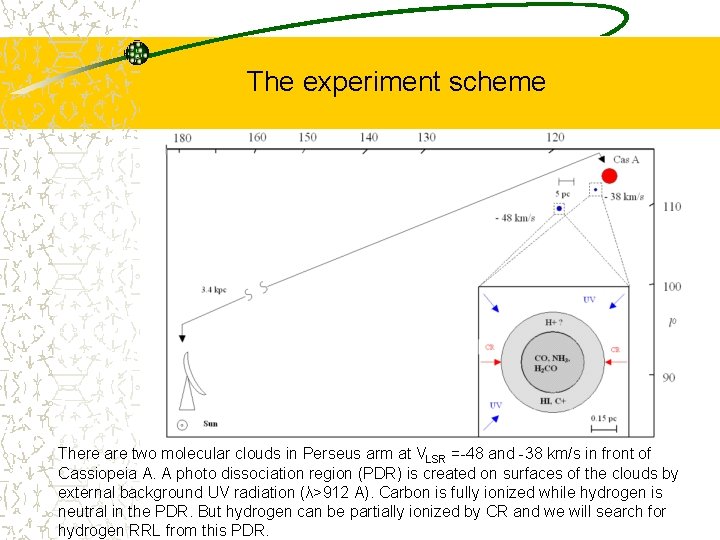
The experiment scheme There are two molecular clouds in Perseus arm at VLSR =-48 and -38 km/s in front of Cassiopeia A. A photo dissociation region (PDR) is created on surfaces of the clouds by external background UV radiation (λ>912 A). Carbon is fully ionized while hydrogen is neutral in the PDR. But hydrogen can be partially ionized by CR and we will search for hydrogen RRL from this PDR.
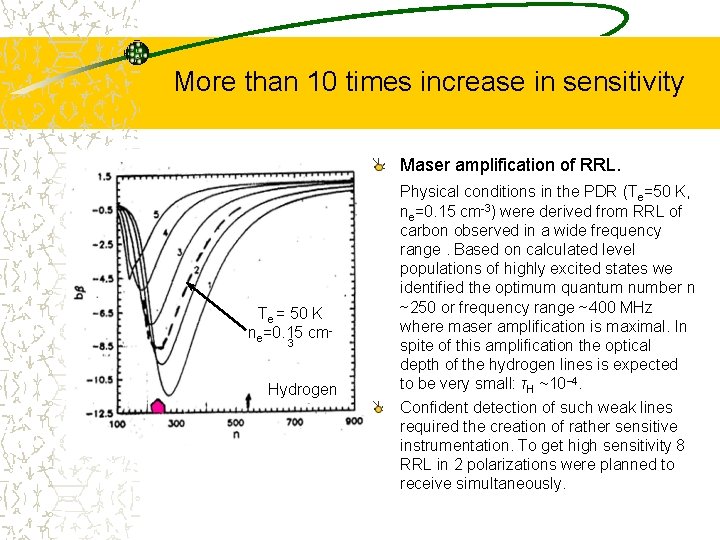
More than 10 times increase in sensitivity Maser amplification of RRL. Te = 50 K ne=0. 15 cm 3 Hydrogen Physical conditions in the PDR (Te=50 K, ne=0. 15 cm-3) were derived from RRL of carbon observed in a wide frequency range. Based on calculated level populations of highly excited states we identified the optimum quantum number n ~250 or frequency range ~400 MHz where maser amplification is maximal. In spite of this amplification the optical depth of the hydrogen lines is expected to be very small: τH ~10− 4. Confident detection of such weak lines required the creation of rather sensitive instrumentation. To get high sensitivity 8 RRL in 2 polarizations were planned to receive simultaneously.
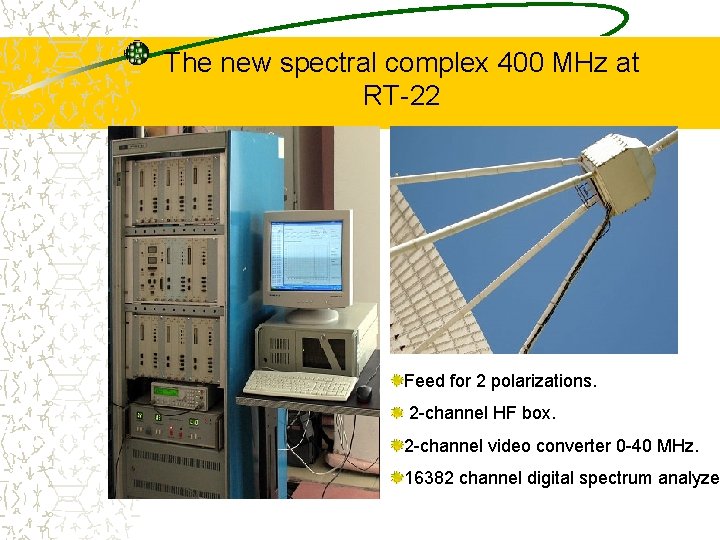
The new spectral complex 400 MHz at RT-22 Feed for 2 polarizations. 2 -channel HF box. 2 -channel video converter 0 -40 MHz. 16382 channel digital spectrum analyzer
Basic specifications of the new spectral complex Input frequency range 400 -440 MHz Simultaneous reception of 2 polarizations Eight independent 500 k. Hz bands Spectral resolution 1 k. Hz On-line cleaning of interferences with linear frequency modulation
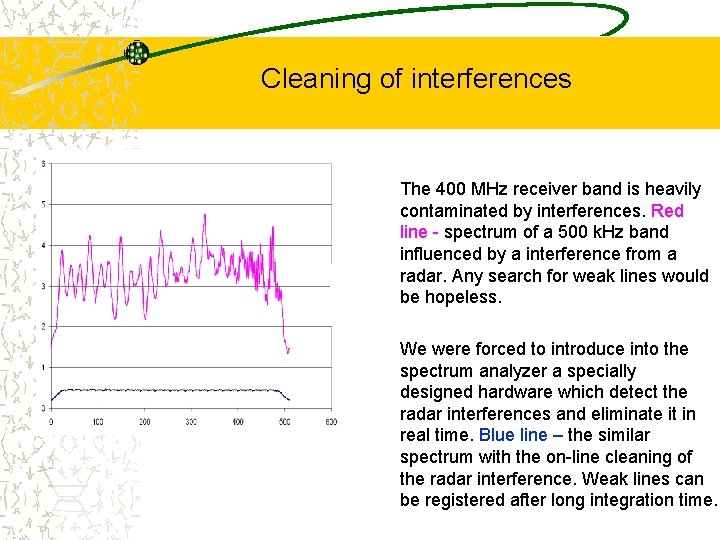
Cleaning of interferences The 400 MHz receiver band is heavily contaminated by interferences. Red line - spectrum of a 500 k. Hz band influenced by a interference from a radar. Any search for weak lines would be hopeless. We were forced to introduce into the spectrum analyzer a specially designed hardware which detect the radar interferences and eliminate it in real time. Blue line – the similar spectrum with the on-line cleaning of the radar interference. Weak lines can be registered after long integration time.
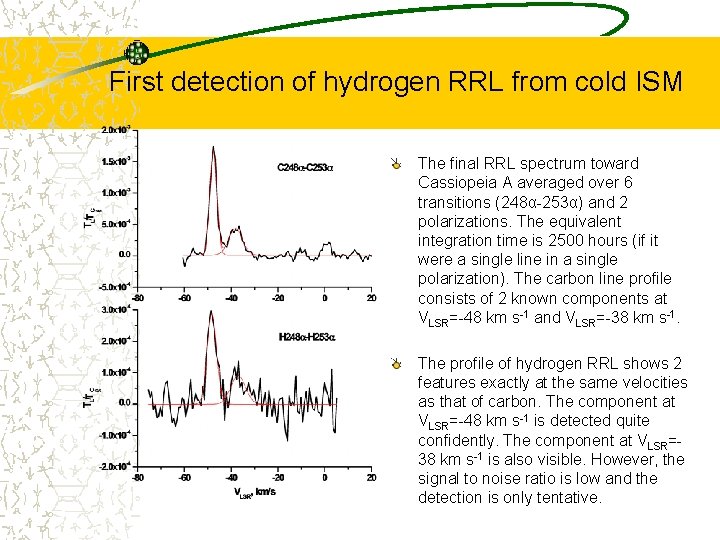
First detection of hydrogen RRL from cold ISM The final RRL spectrum toward Cassiopeia A averaged over 6 transitions (248α-253α) and 2 polarizations. The equivalent integration time is 2500 hours (if it were a single line in a single polarization). The carbon line profile consists of 2 known components at VLSR=-48 km s-1 and VLSR=-38 km s-1. The profile of hydrogen RRL shows 2 features exactly at the same velocities as that of carbon. The component at VLSR=-48 km s-1 is detected quite confidently. The component at VLSR=38 km s-1 is also visible. However, the signal to noise ratio is low and the detection is only tentative.
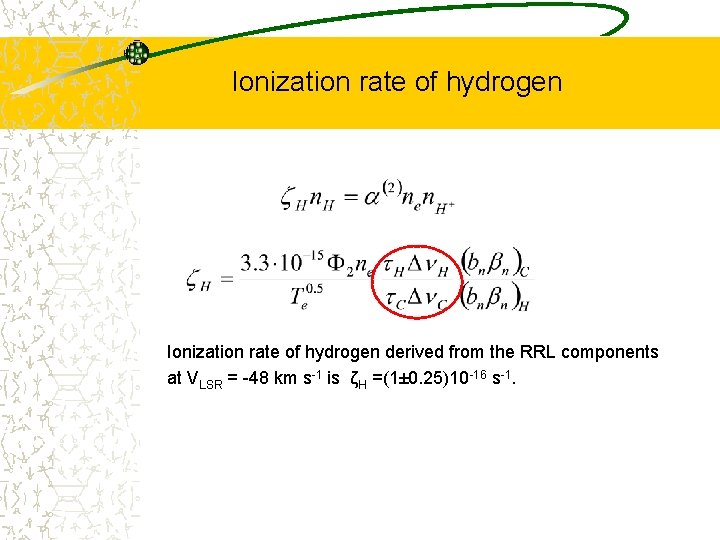
Ionization rate of hydrogen derived from the RRL components at VLSR = -48 km s-1 is ζH =(1± 0. 25)10 -16 s-1.
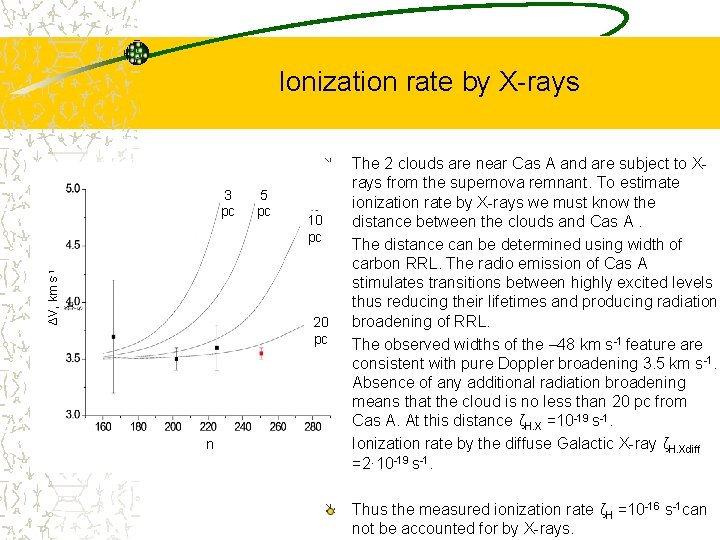
Ionization rate by X-rays ΔV, km s-1 3 pc 5 pc 10 pc 20 pc n The 2 clouds are near Cas A and are subject to Xrays from the supernova remnant. To estimate ionization rate by X-rays we must know the distance between the clouds and Cas A. The distance can be determined using width of carbon RRL. The radio emission of Cas A stimulates transitions between highly excited levels thus reducing their lifetimes and producing radiation broadening of RRL. The observed widths of the – 48 km s-1 feature are consistent with pure Doppler broadening 3. 5 km s-1. Absence of any additional radiation broadening means that the cloud is no less than 20 pc from Cas A. At this distance ζH. X =10 -19 s-1. Ionization rate by the diffuse Galactic X-ray ζH. Xdiff =2· 10 -19 s-1. Thus the measured ionization rate ζH =10 -16 s-1 can not be accounted for by X-rays.
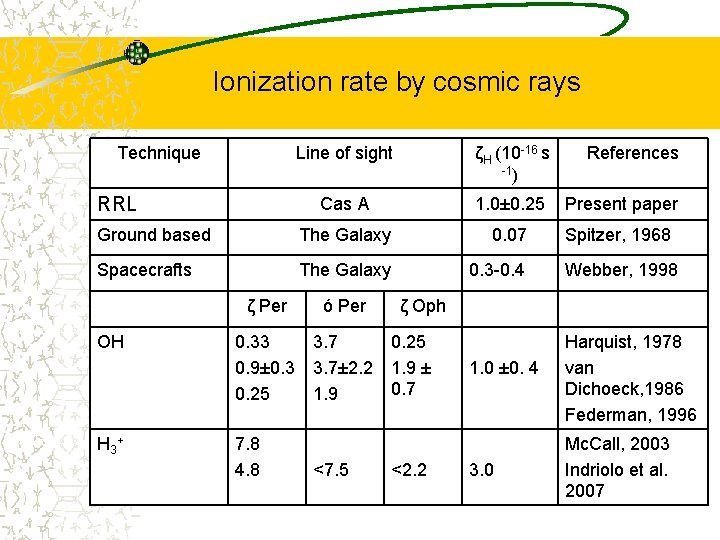
Ionization rate by cosmic rays Technique Line of sight ζН (10 -16 s -1) References Cas A 1. 0± 0. 25 Present paper Ground based The Galaxy 0. 07 Spitzer, 1968 Spacecrafts The Galaxy 0. 3 -0. 4 RRL OH Н 3 + ζ Per ό Per 0. 33 0. 9± 0. 3 0. 25 3. 7± 2. 2 1. 9 7. 8 4. 8 <7. 5 Webber, 1998 ζ Oph 0. 25 1. 9 ± 0. 7 <2. 2 1. 0 ± 0. 4 3. 0 Harquist, 1978 van Dichoeck, 1986 Federman, 1996 Mc. Call, 2003 Indriolo et al. 2007
CR from Cassiopeia A For a long time it has been considered that supernovae produce CR. The production of relativistic electrons has been clearly established from the non-thermal radio and X-ray emission observed from supernova remnants (SNR). However, evidences, which prove that SNR are sources of relativistic protons, the main constituent of cosmic rays, are not still reliable. Can the ionization rate we measured be due to protons from Cas A? Protons with energies of 1 -10 Me. V, which make the main contribution to the hydrogen ionization, cannot reach the cloud (VLSR=-48 km s-1) in 330 years (the age of the supernova remnant) since it is more than 20 pc away from Cas A. Thus Cas A can not contribute to the measured value. We conclude that the measured value is due to background CR protons. Keohane et al, (1996) suggested that the cloud at – 38 km s-1 is very close to Cas A. If the distance is <10 pc the higher value of ζH may be expected due to contribution from supernova. This is a task for future more sensitive RRL observations.
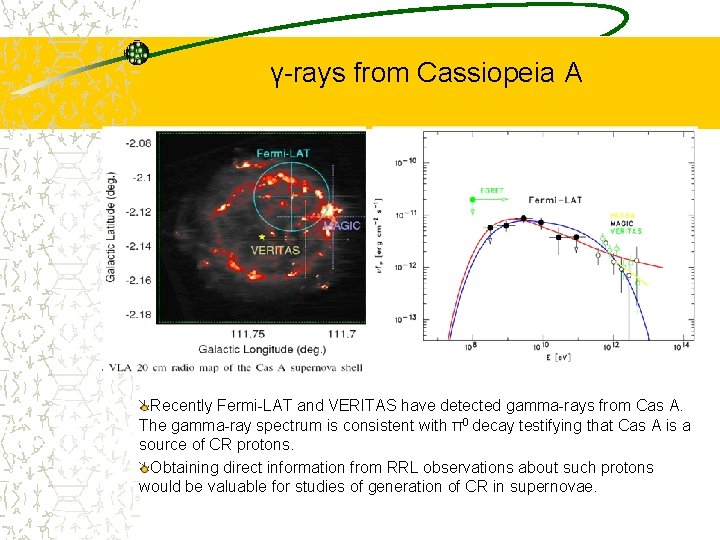
γ-rays from Cassiopeia A Recently Fermi-LAT and VERITAS have detected gamma-rays from Cas A. The gamma-ray spectrum is consistent with π0 decay testifying that Cas A is a source of CR protons. Obtaining direct information from RRL observations about such protons would be valuable for studies of generation of CR in supernovae.
Conclusions The first detection of hydrogen RRL from the cool ISM demonstrates the possibility of determining the ionization rate of hydrogen by CR employing this direct method. The value ζH = (1 ± 0. 25) • 10− 16 s− 1 derived from RRL observations toward Cassiopeia A is the ionization rate of interstellar hydrogen by background CR protons. It would be of considerable interest to observe carbon and hydrogen RRL in the cloud at − 38 km/s.
- Slides: 16