
Detection Classification and Tracking of Targets in Distributed

Detection, Classification and Tracking of Targets in Distributed Sensor Networks Dan Li, Kerry Wong, Yu. H. Hu, and Akbar M. Sayeed Presented by: Prabal Dutta prabal@eecs Nov 4, 2003 1
Outline of the Talk • • • Introduction Signal Processing Primitives Tracking Target Classification Issues and Challenges Future Research Conclusions Remarks Discussion Nov 4, 2003 2
Introduction • This paper – Outlines a framework for Collaborative Signal Processing (CSP) in WSN – Proposes detection and tracking algorithms – Implements and validates classification algorithms – Argues that CSP can address challenges with classification and tracking – Suggests CSP algorithms can benefit from • Distributive processing: compute and transmit summary statistics • Goal-oriented, on-demand processing: Only perform signal processing when a query is present • Information fusion: “The farther I am, the fewer details I need to know” • Multi-resolution processing: Different tasks require different rates of sampling in space-time Nov 4, 2003 3
Signal Processing Primitives • Detection – Computes running average of signal power over some window – Assumes noise is Gaussian – Calculates a CFAR threshold based on mean and variance – Event occurs when signal > CFAR threshold Nov 4, 2003 4

Signal Processing Primitives (2) • Target Localization – Assumes isotropic, constant exponent signal attenuation model – Uses energy-based source localization techniques – Given 4 or more energy readings, uses non-linear least squares to find best fit (target location that minimizes error) • Observation: Implicitly assumes calibrated and localized sensors Nov 4, 2003 5
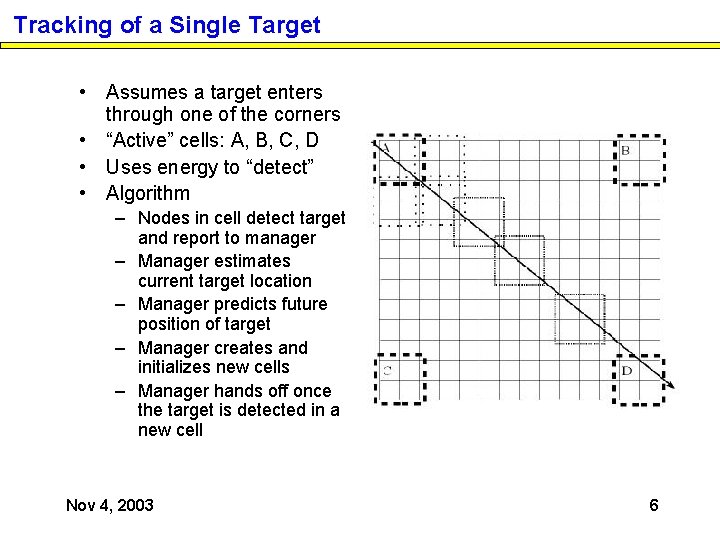
Tracking of a Single Target • Assumes a target enters through one of the corners • “Active” cells: A, B, C, D • Uses energy to “detect” • Algorithm – Nodes in cell detect target and report to manager – Manager estimates current target location – Manager predicts future position of target – Manager creates and initializes new cells – Manager hands off once the target is detected in a new cell Nov 4, 2003 6
Tracking of Multiple Targets • In the simple case – Targets occupy distinct space-time cells – Multiple instances of algorithm can be used in parallel • In general case – Multiple tracks may cross (simultaneously occupy the same space-time cell) – Data association (which track to associate data with? ) – Classification is required to disentangle tracks • Observation: Depending on what the tracks are used for, and whether it is permissible to discard old state, classification may not be required at all. Nov 4, 2003 7

Target Classification • Focuses on classification at a single node • Uses acoustic and seismic spectra of wheeled and tracked targets as feature vectors • Extracts feature vectors from time series data using FFT • Elements of the feature vectors are the Fourier coefficients (corresponding to the signal power at that frequency) • Acoustic: Down-sampled to fs = 5 k. Hz, 1000 point FFT, only used 0 -1 k. Hz BW, then compressed by 4 x and 10 x to obtain 50 and 20 element feature vectors • Seismic: fs = 256 Hz, 256 point FFT using 64 samples and zero padded data segments Nov 4, 2003 8
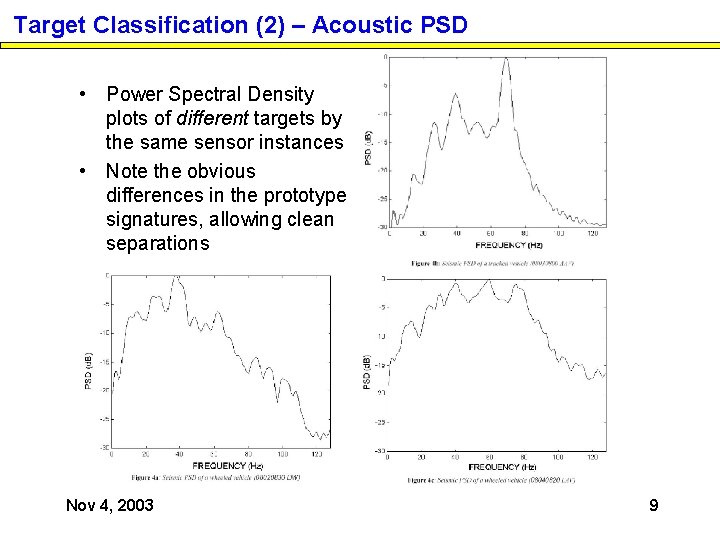
Target Classification (2) – Acoustic PSD • Power Spectral Density plots of different targets by the same sensor instances • Note the obvious differences in the prototype signatures, allowing clean separations Nov 4, 2003 9
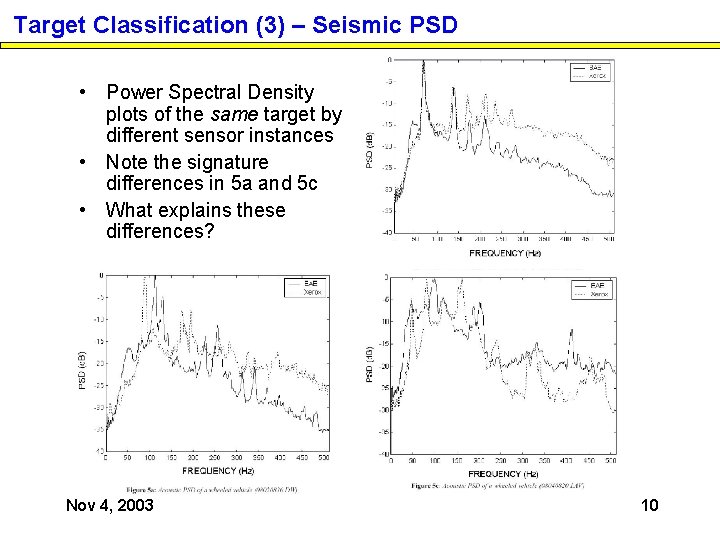
Target Classification (3) – Seismic PSD • Power Spectral Density plots of the same target by different sensor instances • Note the signature differences in 5 a and 5 c • What explains these differences? Nov 4, 2003 10

Target Classification (4) – Algorithms and Validation • Three classification algorithms were tested – k-Nearest Neighbor – Maximum Likelihood Classifier – Support Vector Machine • Details of the classifiers not discussed here • To cross-validate the performance of the classifiers – Available data divided into three sets: F 1, F 2, F 3 – Take two sets at a time for training and one for testing: • Experiment A – Training: F 1+F 2 training; Testing: F 3 • Experiment B – Training: F 2+F 3 training; Testing: F 1 • Experiment C – Training: F 1+F 3 training; Testing: F 2 Nov 4, 2003 11
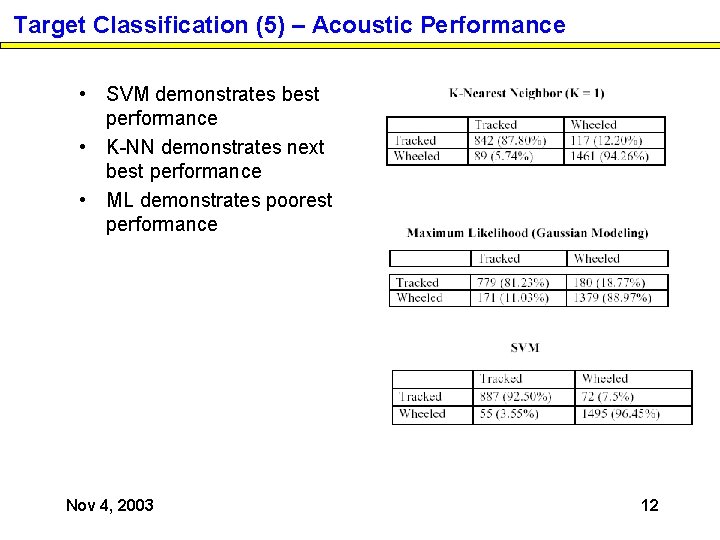
Target Classification (5) – Acoustic Performance • SVM demonstrates best performance • K-NN demonstrates next best performance • ML demonstrates poorest performance Nov 4, 2003 12
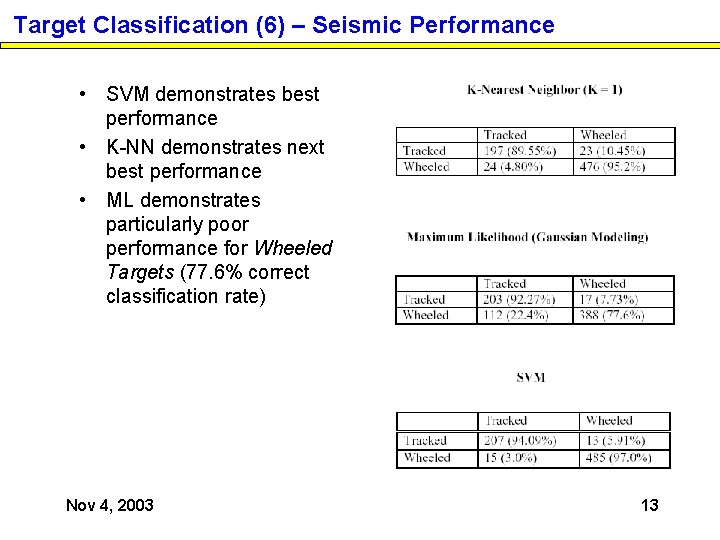
Target Classification (6) – Seismic Performance • SVM demonstrates best performance • K-NN demonstrates next best performance • ML demonstrates particularly poor performance for Wheeled Targets (77. 6% correct classification rate) Nov 4, 2003 13
Issues and Challenges • Collaborative Signal Processing faces many realworld hurdles – Uncertainty in temporal and spatial measurements • Depends on accuracy of time synchronization • Depends on accuracy of network node localization – Variability in experimental conditions • Classifications assumes that target signatures are relatively invariant • Node locations and orientations may results in signature variations • Environmental factors may alter signals • These nuisance parameters and be included in a higher dimension feature vectors at cost of increased processing Nov 4, 2003 14
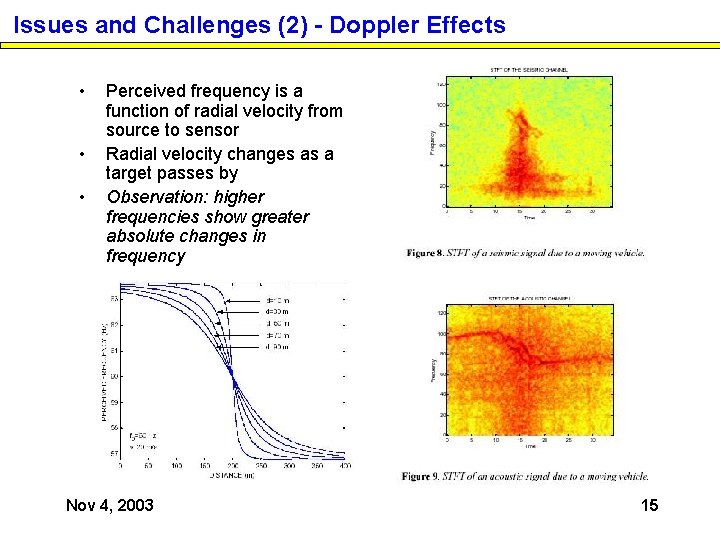
Issues and Challenges (2) - Doppler Effects • • • Perceived frequency is a function of radial velocity from source to sensor Radial velocity changes as a target passes by Observation: higher frequencies show greater absolute changes in frequency Nov 4, 2003 15
Future Research • Key directions – Move toward more collaborative algorithms – Extend feature space to higher dimensions • Intra-sensor collaboration: modal fusion – Combine information from multiple sensors in single node • Inter-sensor collaboration: centralized processing – Report raw time series data or statistics to a “central” node • Doppler-based composite hypothesis testing – Incorporate target velocity, CPA distance, and angle between secant and radius (vertex is target’s position) Nov 4, 2003 16
Conclusions • Outlined a framework for Collaborative Signal Processing in Wireless Sensor Networks • Proposed detection and tracking algorithms • Implemented and validated classification algorithms • Discovered that signal or sensor variation cause problems with classification and tracking • Suggested that CSP can address some of these challenges Nov 4, 2003 17
Remarks • No simulations or empirical evidence supporting single or multiple target tracking • Target models not provided and cell shape and creation strategy unclear • Target tracking algorithm is purely conceptual – Target tracking is simply the motivating scenario for studying classification • Since multi-target tracking with crossing tracks is the motivating scenario, classifier performance for superimposed signatures would be a good idea • Only tracking uses CSP • Max signal does not always occur at CPA • Interesting mix of “position” and “results” paper Nov 4, 2003 18

Discussion Nov 4, 2003 19
- Slides: 19