
Detecting Weapons of Mass Destruction Forensic Sciences Role
- Slides: 14
Detecting Weapons of Mass Destruction Forensic Science’s Role in Preventing and Understanding WMD Terrorism Blake Douglas
Basics: What is a WMD? • Weapon that can kill or bring significant harm to large number of humans and other life and/or cause great damage to man-made structures, natural structures, etc. • Divided into four types: • Chemical, Biological, Radiological, and Nuclear (CBRN) • Definition made wider, fuzzier by United States Gov’t
How does this relate to terrorism? • Al-Qaeda, other groups openly seek nuclear weapons • CIA: Al-Qaeda’s “end goal” • This may seem implausible; however, • Made a very real possibility by the acquisition of nuclear capabilities by rogue states (N. Korea, Iran, etc. ) • More likely is terrorist acquisition of a “dirty bomb: ” uses conventional explosives to spread radioactive material • Beyond nuclear WMD, even easier/more possible for terrorist groups to use chemical or biological WMD • Anthrax attack of 2001
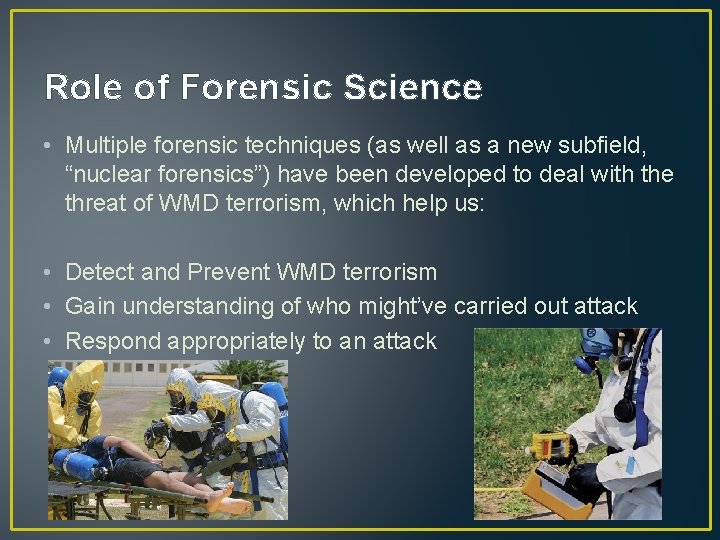
Role of Forensic Science • Multiple forensic techniques (as well as a new subfield, “nuclear forensics”) have been developed to deal with the threat of WMD terrorism, which help us: • Detect and Prevent WMD terrorism • Gain understanding of who might’ve carried out attack • Respond appropriately to an attack
Chemical WMD • Perhaps has greatest potential for terrorist use • Six categories of chemical warfare agents (CWAs): • Choking, blister, blood, irritating, incapacitating, and nerve agents • Have been commonly used in war (now banned) • Examples: chlorine gas, tabun gas, sarin gas
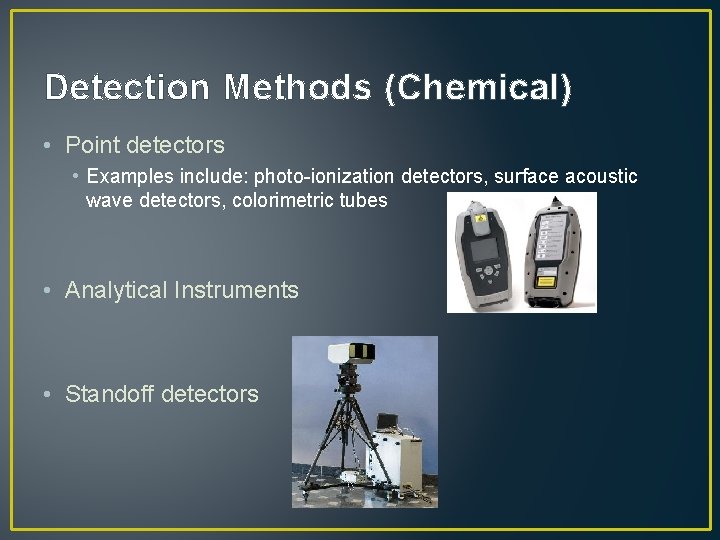
Detection Methods (Chemical) • Point detectors • Examples include: photo-ionization detectors, surface acoustic wave detectors, colorimetric tubes • Analytical Instruments • Standoff detectors
Biological WMD • Also great potential for terrorist use (and has already happened with Anthrax attack of 2001) • Biological weapons (BWs) attempt to disperse diseaseproducing biological agents into population • Examples: anthrax and other viral agents
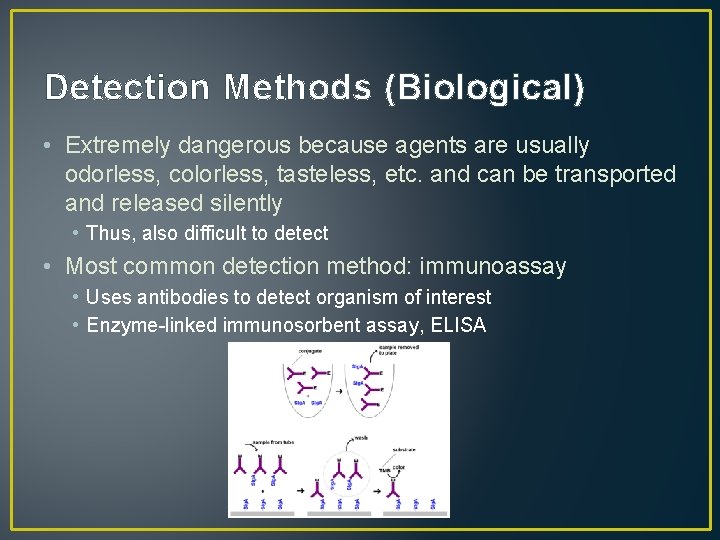
Detection Methods (Biological) • Extremely dangerous because agents are usually odorless, colorless, tasteless, etc. and can be transported and released silently • Thus, also difficult to detect • Most common detection method: immunoassay • Uses antibodies to detect organism of interest • Enzyme-linked immunosorbent assay, ELISA
Radiological/Nuclear WMD • Least potential for terrorist use, yet most dangerous • Use nuclear reaction to produce immense, extremely destructive explosion (a “typical” nuclear weapon) • Or use regular explosives to spread radiation/radioactive material (a radiological dispersal device, “dirty bomb”) • Very dangerous not only because of nuclear reaction • Also dangerous due to spread of radiation, which causes deformation and creates abnormalities in human cells
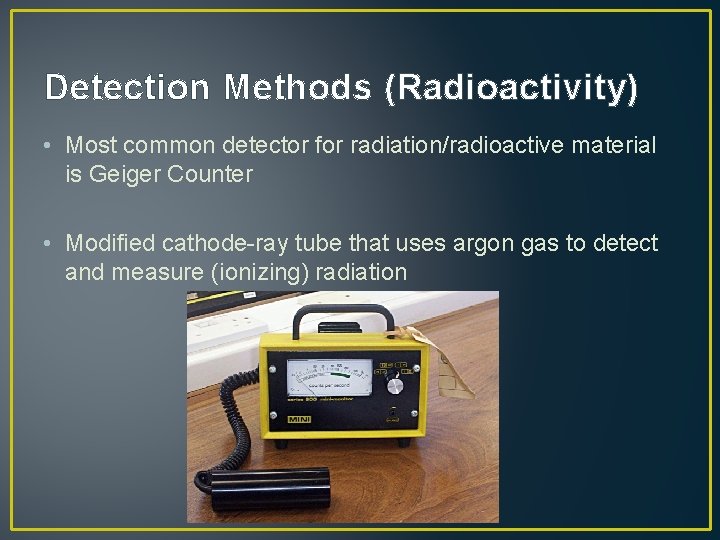
Detection Methods (Radioactivity) • Most common detector for radiation/radioactive material is Geiger Counter • Modified cathode-ray tube that uses argon gas to detect and measure (ionizing) radiation
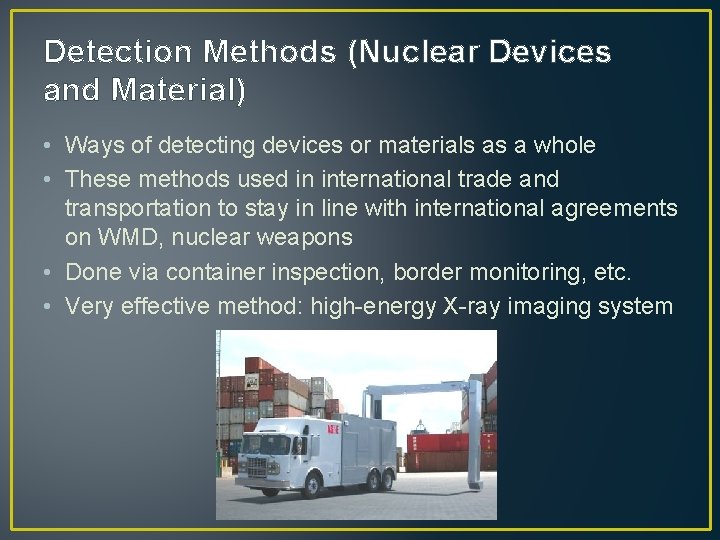
Detection Methods (Nuclear Devices and Material) • Ways of detecting devices or materials as a whole • These methods used in international trade and transportation to stay in line with international agreements on WMD, nuclear weapons • Done via container inspection, border monitoring, etc. • Very effective method: high-energy X-ray imaging system
Nuclear Forensics • Using detection methods, determine what nuclear materials present and the state of origin of the material • “Nuclear attribution” • Very important for monitoring proliferation of nuclear weapons/weapons-grade material • Even more important with rise of nuclear proliferation from N. Korea, possibly Iran, and other non-signatories of the Nuclear Non -Proliferation Treaty • Like fingerprints, DNA, etc. , nuclear databases of materials and origin are kept in several countries
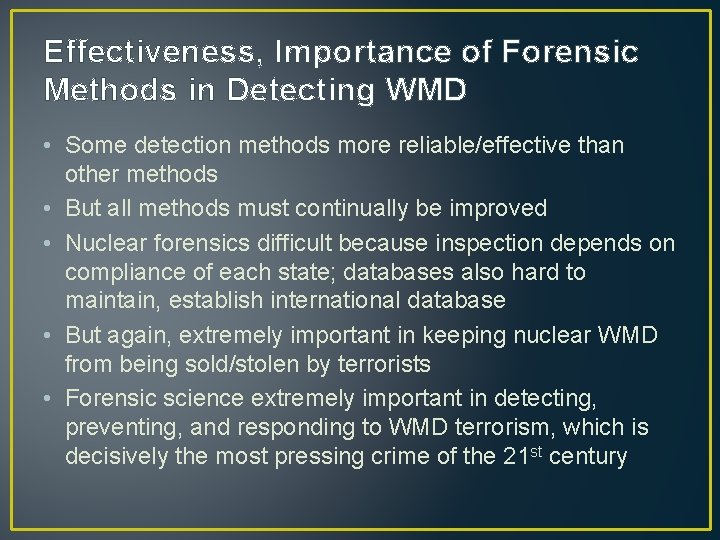
Effectiveness, Importance of Forensic Methods in Detecting WMD • Some detection methods more reliable/effective than other methods • But all methods must continually be improved • Nuclear forensics difficult because inspection depends on compliance of each state; databases also hard to maintain, establish international database • But again, extremely important in keeping nuclear WMD from being sold/stolen by terrorists • Forensic science extremely important in detecting, preventing, and responding to WMD terrorism, which is decisively the most pressing crime of the 21 st century
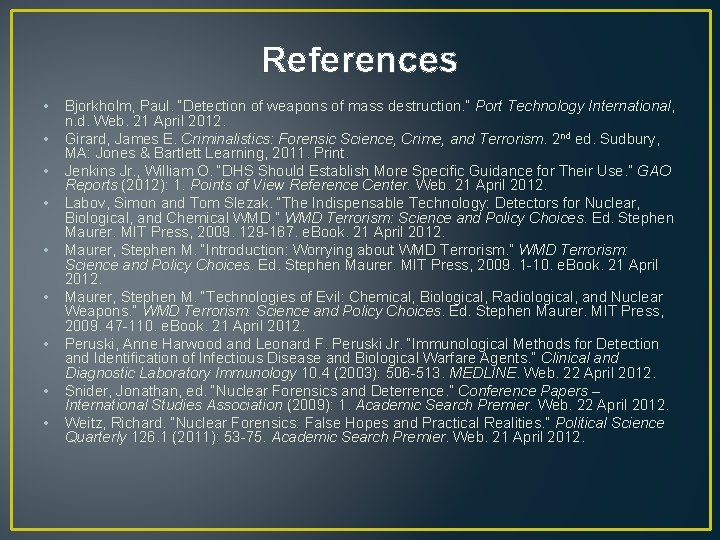
References • • • Bjorkholm, Paul. “Detection of weapons of mass destruction. ” Port Technology International, n. d. Web. 21 April 2012. Girard, James E. Criminalistics: Forensic Science, Crime, and Terrorism. 2 nd ed. Sudbury, MA: Jones & Bartlett Learning, 2011. Print. Jenkins Jr. , William O. “DHS Should Establish More Specific Guidance for Their Use. ” GAO Reports (2012): 1. Points of View Reference Center. Web. 21 April 2012. Labov, Simon and Tom Slezak. “The Indispensable Technology: Detectors for Nuclear, Biological, and Chemical WMD. ” WMD Terrorism: Science and Policy Choices. Ed. Stephen Maurer. MIT Press, 2009. 129 -167. e. Book. 21 April 2012. Maurer, Stephen M. “Introduction: Worrying about WMD Terrorism. ” WMD Terrorism: Science and Policy Choices. Ed. Stephen Maurer. MIT Press, 2009. 1 -10. e. Book. 21 April 2012. Maurer, Stephen M. “Technologies of Evil: Chemical, Biological, Radiological, and Nuclear Weapons. ” WMD Terrorism: Science and Policy Choices. Ed. Stephen Maurer. MIT Press, 2009. 47 -110. e. Book. 21 April 2012. Peruski, Anne Harwood and Leonard F. Peruski Jr. “Immunological Methods for Detection and Identification of Infectious Disease and Biological Warfare Agents. ” Clinical and Diagnostic Laboratory Immunology 10. 4 (2003): 506 -513. MEDLINE. Web. 22 April 2012. Snider, Jonathan, ed. “Nuclear Forensics and Deterrence. ” Conference Papers – International Studies Association (2009): 1. Academic Search Premier. Web. 22 April 2012. Weitz, Richard. “Nuclear Forensics: False Hopes and Practical Realities. ” Political Science Quarterly 126. 1 (2011): 53 -75. Academic Search Premier. Web. 21 April 2012.