
Detecting Hardware Trojans A Tale of Two Techniques

![Library Matching [FMCAD ‘ 14] c B A A B Candidate module Library module](https://slidetodoc.com/presentation_image_h/ad202fb6c832ffddd8cbfea903fec578/image-18.jpg "Library Matching [FMCAD ‘ 14] c B A A B Candidate module Library module")
![Library Matching as QBF [FMCAD ‘ 14] k Control signals c M Permutation p](https://slidetodoc.com/presentation_image_h/ad202fb6c832ffddd8cbfea903fec578/image-19.jpg "Library Matching as QBF [FMCAD ‘ 14] k Control signals c M Permutation p")
![Identifying Read Logic dataout addr[2] addr[1] addr[0] FF FF Insight: look for trees of](https://slidetodoc.com/presentation_image_h/ad202fb6c832ffddd8cbfea903fec578/image-22.jpg "Identifying Read Logic dataout addr[2] addr[1] addr[0] FF FF Insight: look for trees of")
![Verifying Identified Read Logic dataout addr[2] addr[1] addr[0] FF FF • Verify there exists](https://slidetodoc.com/presentation_image_h/ad202fb6c832ffddd8cbfea903fec578/image-23.jpg "Verifying Identified Read Logic dataout addr[2] addr[1] addr[0] FF FF • Verify there exists")
![Problem: Inferred Modules Overlap dataout addr[2] addr[1] 4 -bit MUX addr[0] FF FF Inferred](https://slidetodoc.com/presentation_image_h/ad202fb6c832ffddd8cbfea903fec578/image-26.jpg "Problem: Inferred Modules Overlap dataout addr[2] addr[1] 4 -bit MUX addr[0] FF FF Inferred")

- Slides: 49
Detecting Hardware Trojans: A Tale of Two Techniques Sharad Malik sharad@princeton. edu FMCAD 2015
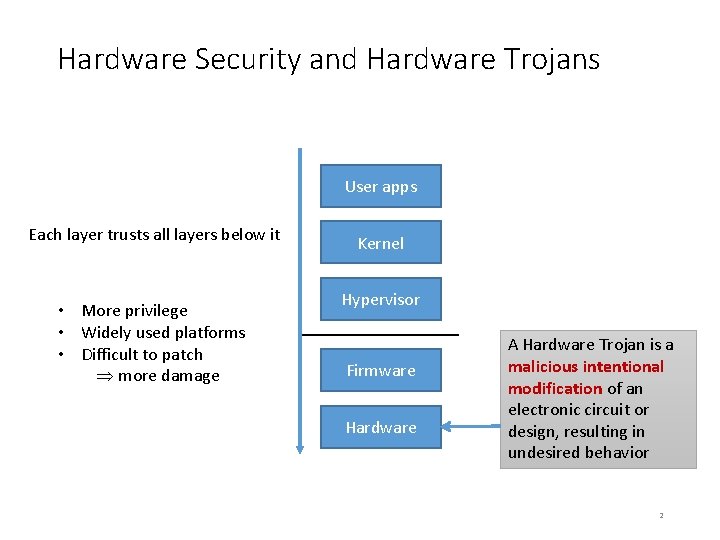
Hardware Security and Hardware Trojans User apps Each layer trusts all layers below it • More privilege • Widely used platforms • Difficult to patch more damage Kernel Hypervisor Firmware Hardware A Hardware Trojan is a malicious intentional modification of an electronic circuit or design, resulting in undesired behavior 2
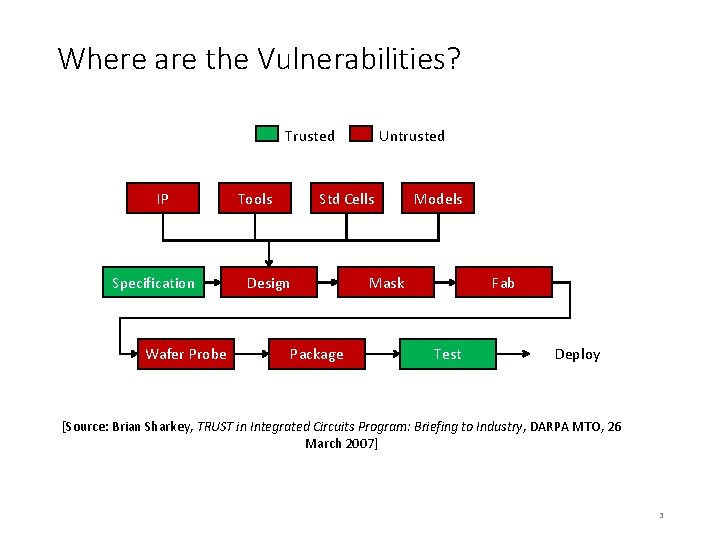
Where are the Vulnerabilities? Trusted IP Specification Wafer Probe Tools Untrusted Std Cells Design Package Models Mask Fab Test Deploy [Source: Brian Sharkey, TRUST in Integrated Circuits Program: Briefing to Industry, DARPA MTO, 26 March 2007] 3
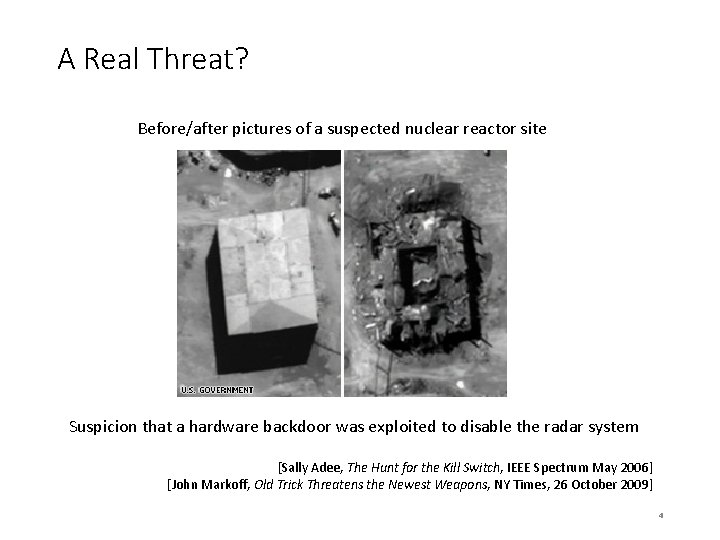
A Real Threat? Before/after pictures of a suspected nuclear reactor site Suspicion that a hardware backdoor was exploited to disable the radar system [Sally Adee, The Hunt for the Kill Switch, IEEE Spectrum May 2006] [John Markoff, Old Trick Threatens the Newest Weapons, NY Times, 26 October 2009] 4
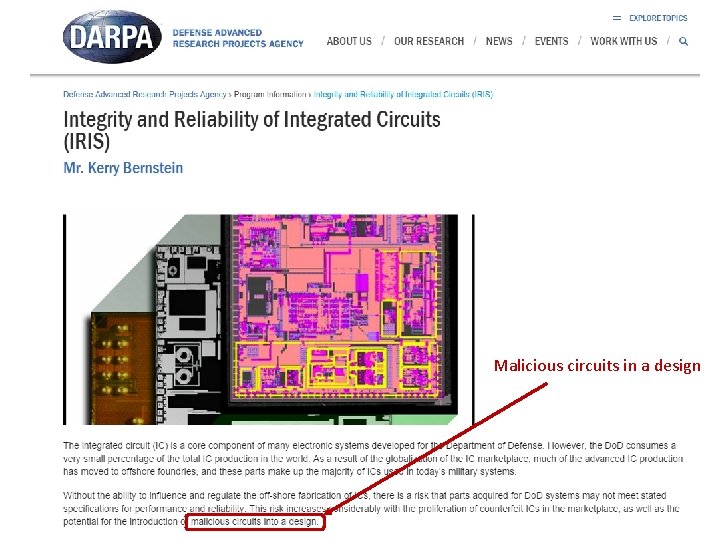
Malicious circuits in a design 5
Acknowledgements DARPA IRIS Project • Bruno Dutertre • Adria Gascon • Dejan Jovanovic • Maheen Samad • Natarajan Shankar • Ashish Tiwari • Burcin Cakir • Kanika Pasricha • Dillon Reisman • Pramod Subramanyan • Adriana Susnea • Nestan Tsiskaridze SRI Princeton • Wenchao Li • Sanjit Seshia • Wei Yang Tan UC Berkeley Center for Future Architectures Research (C-FAR) • Burcin Cakir • Pramod Subramanyan 6
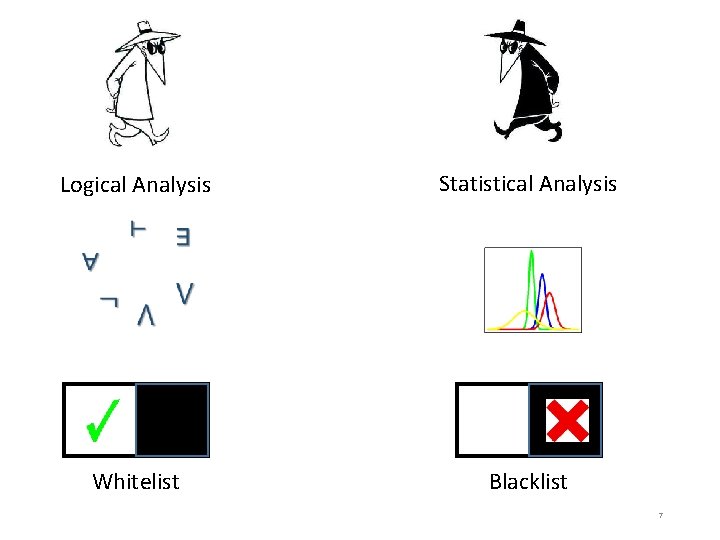
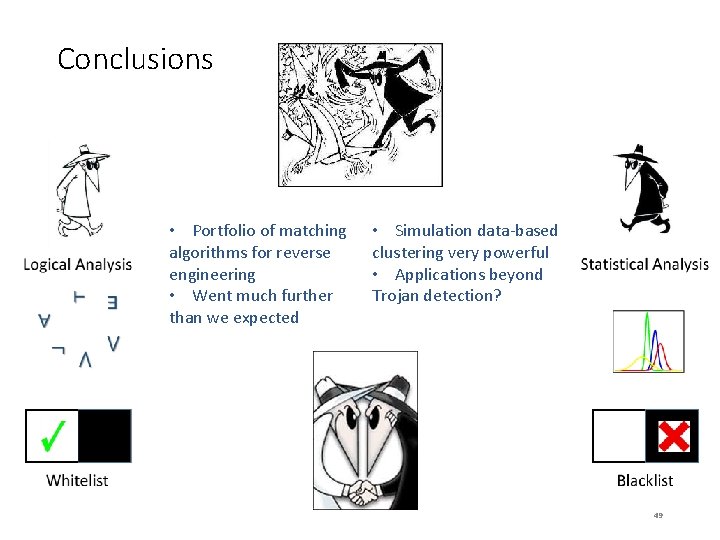
Logical Analysis Statistical Analysis Whitelist Blacklist 7
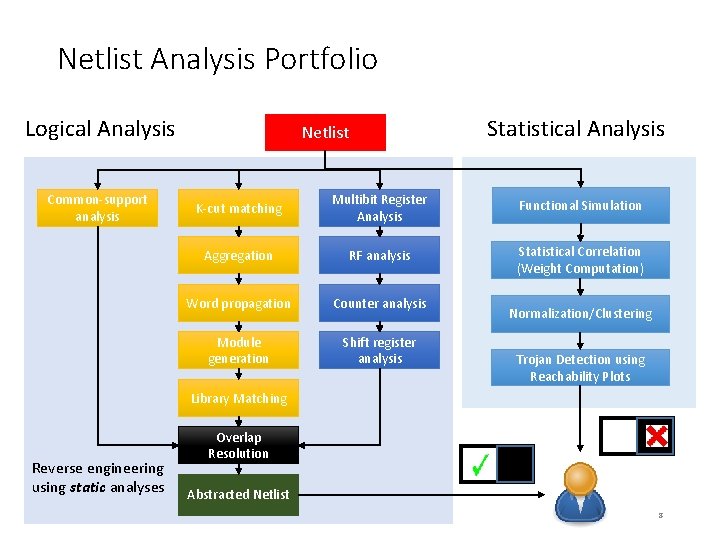
Netlist Analysis Portfolio Logical Analysis Common-support analysis Netlist Statistical Analysis K-cut matching Multibit Register Analysis Functional Simulation Aggregation RF analysis Statistical Correlation (Weight Computation) Word propagation Counter analysis Module generation Shift register analysis Normalization/Clustering Trojan Detection using Reachability Plots Library Matching Reverse engineering using static analyses Overlap Resolution Abstracted Netlist 8
Logical Analysis for Reverse Engineering 9
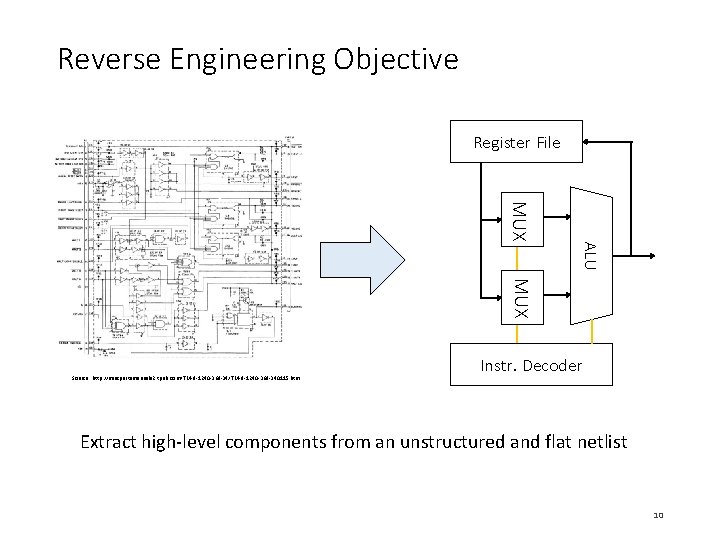
Reverse Engineering Objective Register File MUX ALU MUX Source: http: //miscpartsmanuals 2. tpub. com/TM-9 -1240 -369 -340115. htm Instr. Decoder Extract high-level components from an unstructured and flat netlist 10
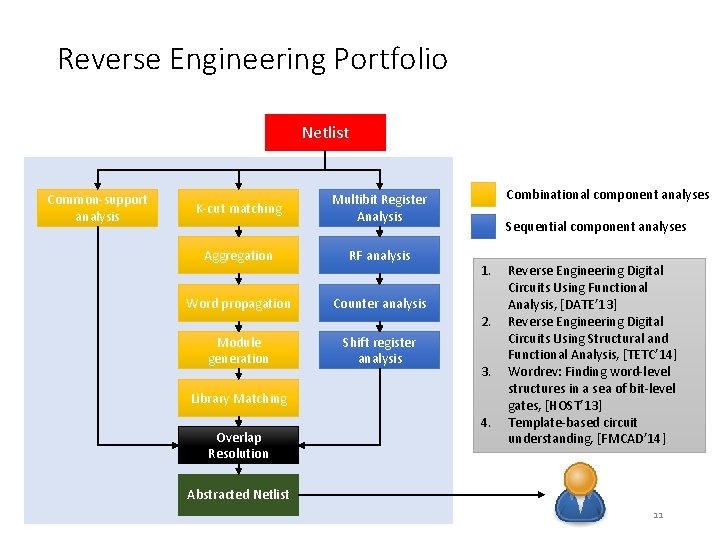
Reverse Engineering Portfolio Netlist Common-support analysis K-cut matching Combinational component analyses Multibit Register Analysis Aggregation RF analysis Word propagation Counter analysis Sequential component analyses 1. 2. Module generation Shift register analysis 3. Library Matching Overlap Resolution 4. Reverse Engineering Digital Circuits Using Functional Analysis, [DATE’ 13] Reverse Engineering Digital Circuits Using Structural and Functional Analysis, [TETC’ 14] Wordrev: Finding word-level structures in a sea of bit-level gates, [HOST’ 13] Template-based circuit understanding, [FMCAD’ 14] Abstracted Netlist 11
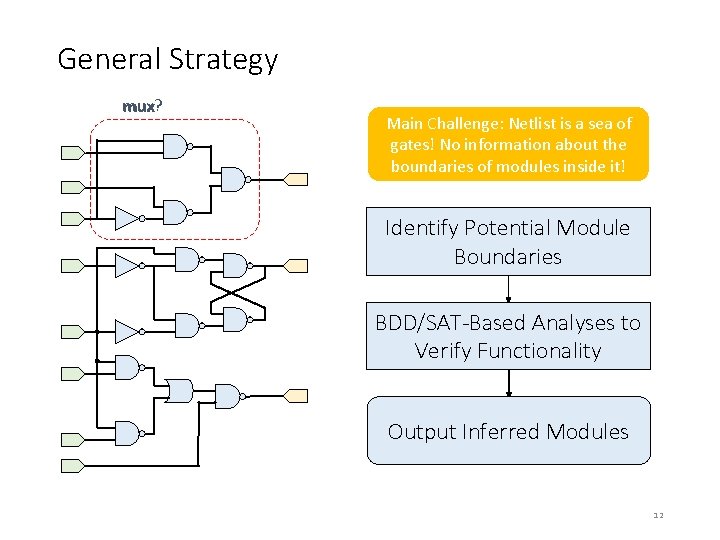
General Strategy mux? mux Main Challenge: Netlist is a sea of gates! No information about the boundaries of modules inside it! Identify Potential Module Boundaries BDD/SAT-Based Analyses to Verify Functionality Output Inferred Modules 12
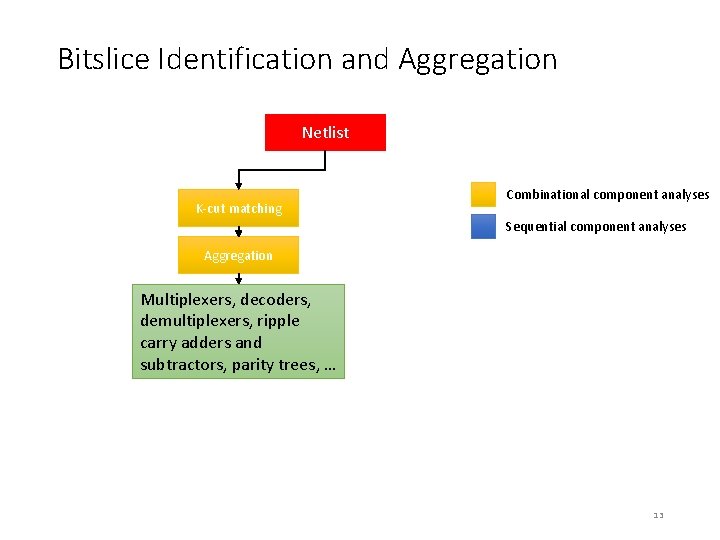
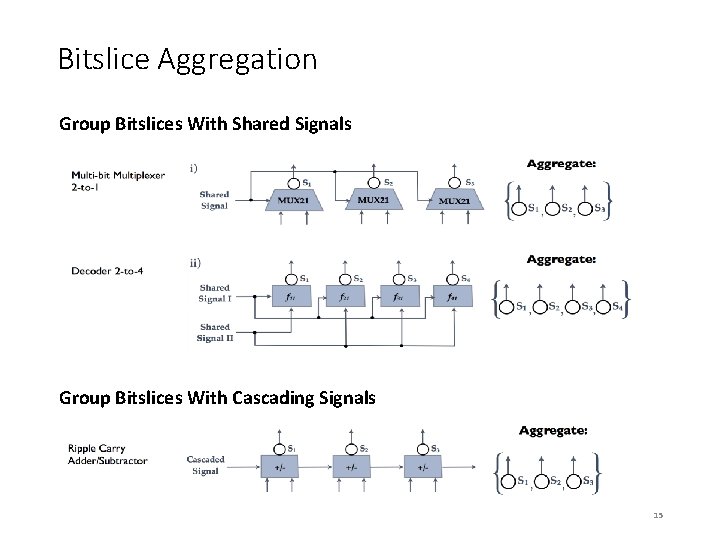
Bitslice Identification and Aggregation Netlist K-cut matching Combinational component analyses Sequential component analyses Aggregation Multiplexers, decoders, demultiplexers, ripple carry adders and subtractors, parity trees, … 13
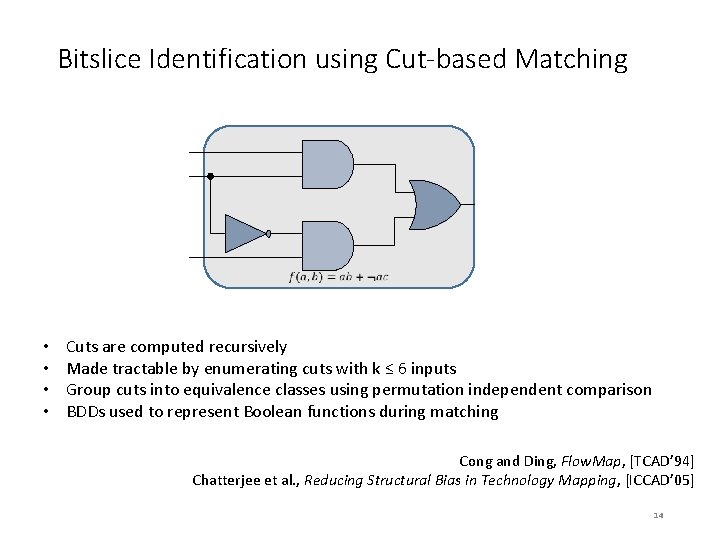
Bitslice Identification using Cut-based Matching • • Cuts are computed recursively Made tractable by enumerating cuts with k ≤ 6 inputs Group cuts into equivalence classes using permutation independent comparison BDDs used to represent Boolean functions during matching Cong and Ding, Flow. Map, [TCAD’ 94] Chatterjee et al. , Reducing Structural Bias in Technology Mapping, [ICCAD’ 05] 14
Bitslice Aggregation Group Bitslices With Shared Signals Group Bitslices With Cascading Signals 15
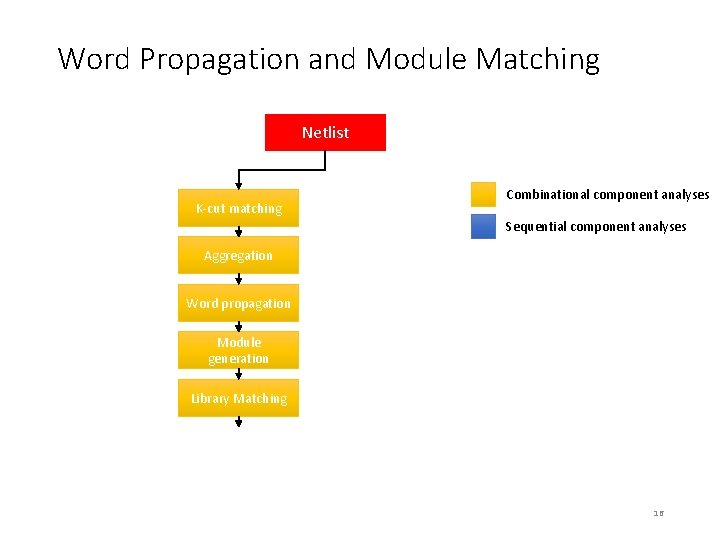
Word Propagation and Module Matching Netlist K-cut matching Combinational component analyses Sequential component analyses Aggregation Word propagation Module generation Library Matching 16
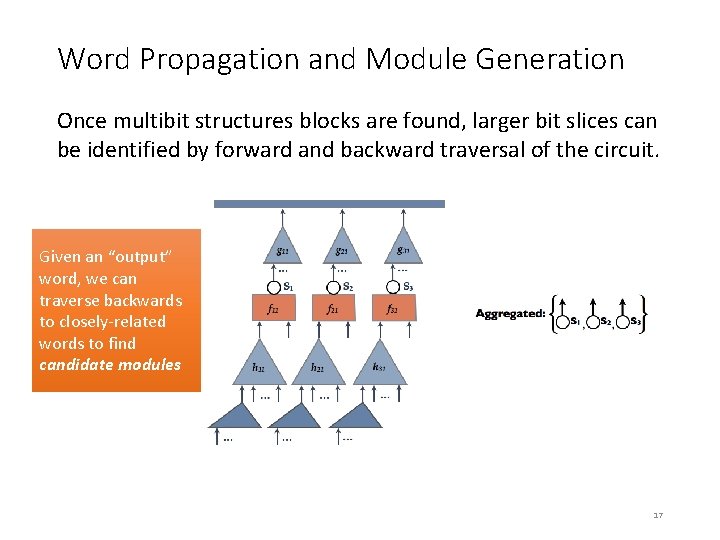
Word Propagation and Module Generation Once multibit structures blocks are found, larger bit slices can be identified by forward and backward traversal of the circuit. Given an “output” word, we can traverse backwards to closely-related words to find candidate modules 17
Library Matching [FMCAD ‘ 14] c B A A B Candidate module Library module Match candidate modules against a library of common modules such as adders, ALUs, … Challenges • Permutation and polarity of inputs • Setting of control inputs QBF Formulation: Does there exist some setting of the control inputs, and some ordering of the inputs such that for all input values, the candidate and the library module produce the same outputs? 18
Library Matching as QBF [FMCAD ‘ 14] k Control signals c M Permutation p Data inputs X n Permutation Network m n n L m Signatures are used to restrict the search space for the permutations Mohnke and Malik, Permutation and Phase Independent Boolean Comparison, [Integration ‘ 93] 19
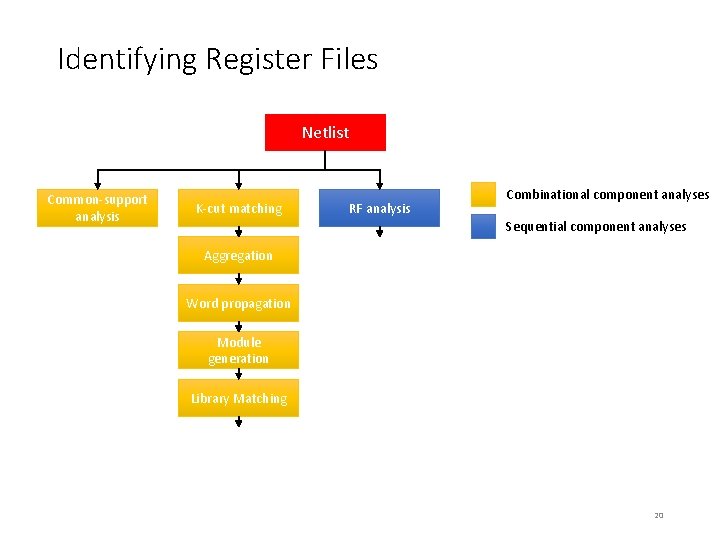
Identifying Register Files Netlist Common-support analysis K-cut matching RF analysis Combinational component analyses Sequential component analyses Aggregation Word propagation Module generation Library Matching 20
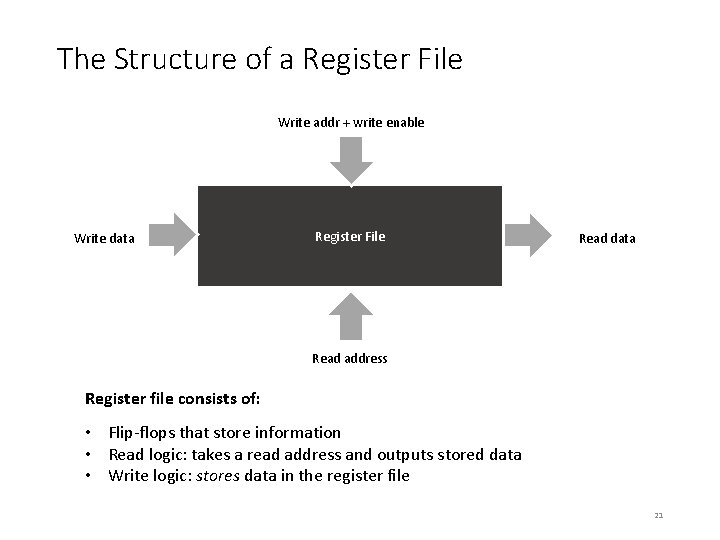
The Structure of a Register File Write addr + write enable Write data Register File Read data Read address Register file consists of: • Flip-flops that store information • Read logic: takes a read address and outputs stored data • Write logic: stores data in the register file 21
Identifying Read Logic dataout addr[2] addr[1] addr[0] FF FF Insight: look for trees of logic where the leaves of the tree are flip-flops 22
Verifying Identified Read Logic dataout addr[2] addr[1] addr[0] FF FF • Verify there exists some address which propagates each flip-flop output to the data output • This is done using a BDD-based analysis 23
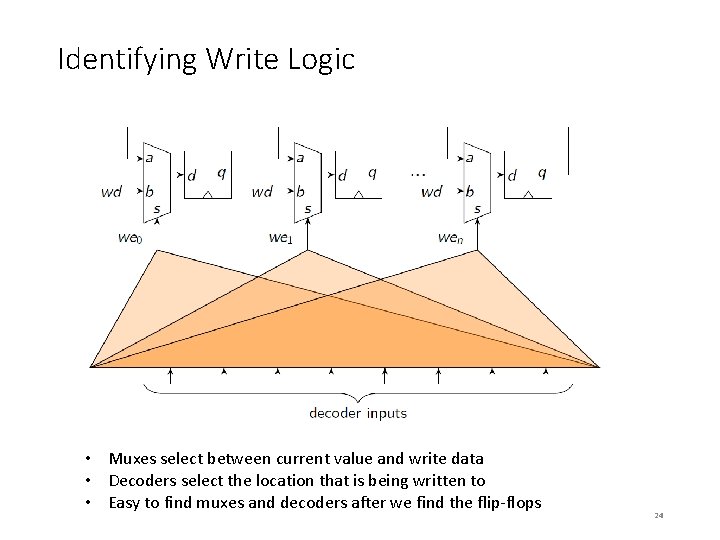
Identifying Write Logic • Muxes select between current value and write data • Decoders select the location that is being written to • Easy to find muxes and decoders after we find the flip-flops 24
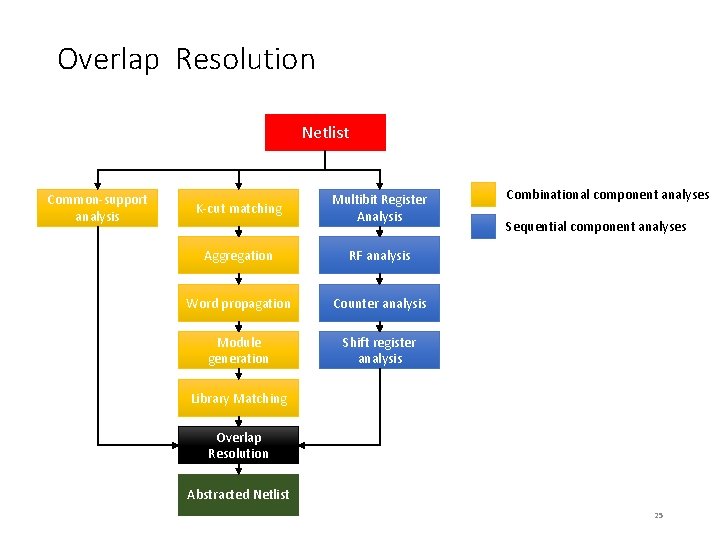
Overlap Resolution Netlist Common-support analysis K-cut matching Multibit Register Analysis Aggregation RF analysis Word propagation Counter analysis Module generation Shift register analysis Combinational component analyses Sequential component analyses Library Matching Overlap Resolution Abstracted Netlist 25
Problem: Inferred Modules Overlap dataout addr[2] addr[1] 4 -bit MUX addr[0] FF FF Inferred register file 26
Resolving Overlaps Formulate an Integer-Linear Program 1. Constraints specify that modules must not overlap 2. Objective is one of the following • Maximize the number of covered gates OR • Minimize the number of modules given a coverage target 27
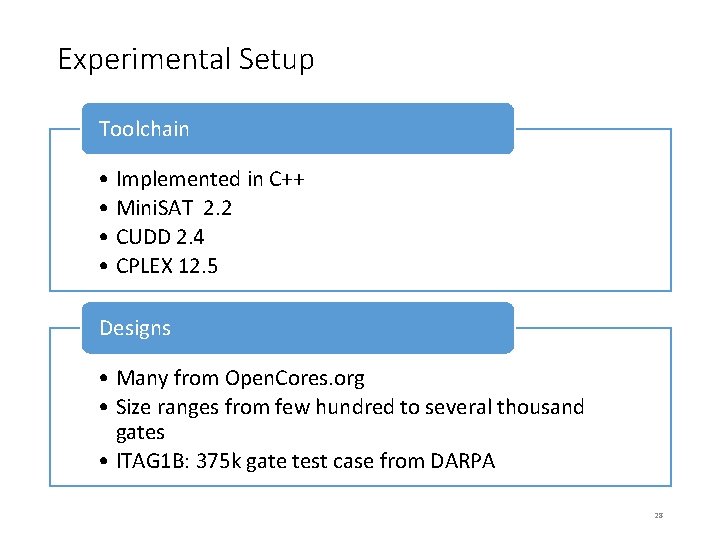
Experimental Setup Toolchain • Implemented in C++ • Mini. SAT 2. 2 • CUDD 2. 4 • CPLEX 12. 5 Designs • Many from Open. Cores. org • Size ranges from few hundred to several thousand gates • ITAG 1 B: 375 k gate test case from DARPA 28
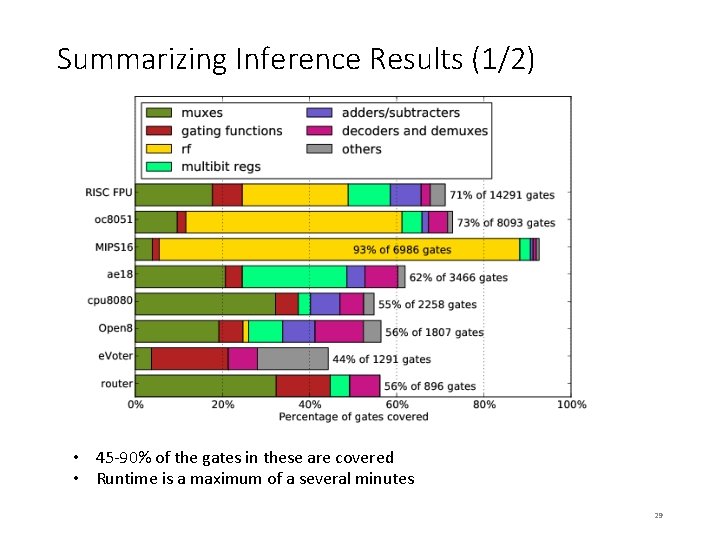
Summarizing Inference Results (1/2) • 45 -90% of the gates in these are covered • Runtime is a maximum of a several minutes 29
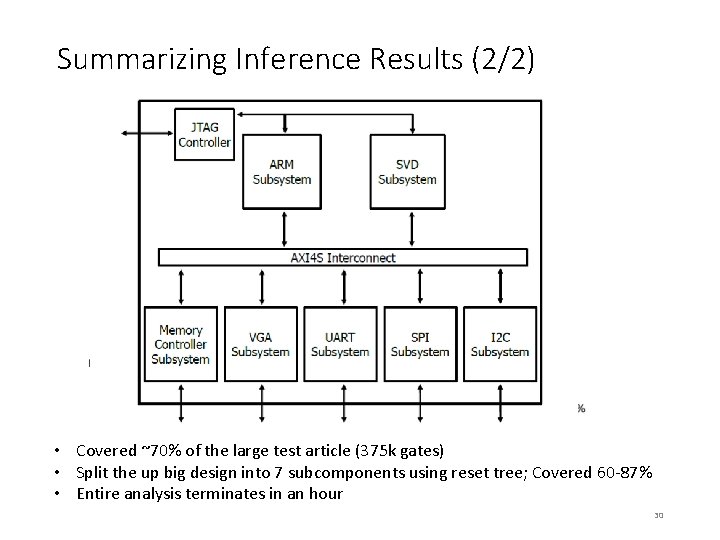
Summarizing Inference Results (2/2) • Covered ~70% of the large test article (375 k gates) • Split the up big design into 7 subcomponents using reset tree; Covered 60 -87% • Entire analysis terminates in an hour 30
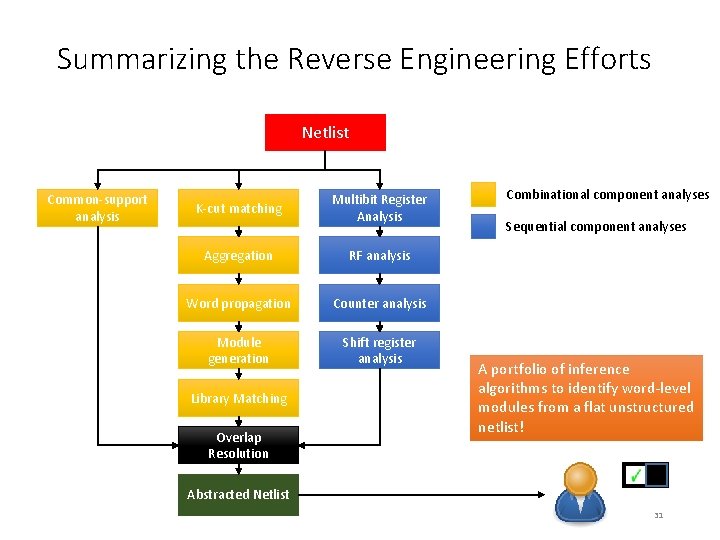
Summarizing the Reverse Engineering Efforts Netlist Common-support analysis K-cut matching Multibit Register Analysis Aggregation RF analysis Word propagation Counter analysis Module generation Shift register analysis Library Matching Overlap Resolution Combinational component analyses Sequential component analyses A portfolio of inference algorithms to identify word-level modules from a flat unstructured netlist! Abstracted Netlist 31
Statistical Analysis of Suspicious Logic 32
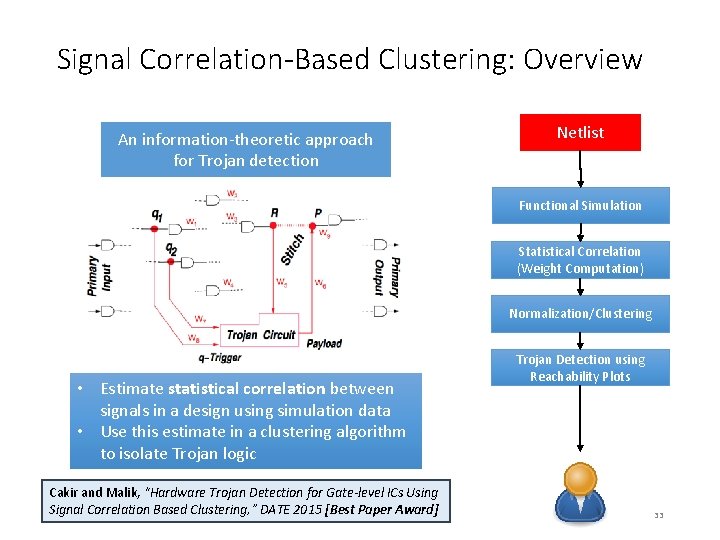
Signal Correlation-Based Clustering: Overview An information-theoretic approach for Trojan detection Netlist Functional Simulation Statistical Correlation (Weight Computation) Normalization/Clustering • Estimate statistical correlation between signals in a design using simulation data • Use this estimate in a clustering algorithm to isolate Trojan logic Cakir and Malik, “Hardware Trojan Detection for Gate-level ICs Using Signal Correlation Based Clustering, ” DATE 2015 [Best Paper Award] Trojan Detection using Reachability Plots 33
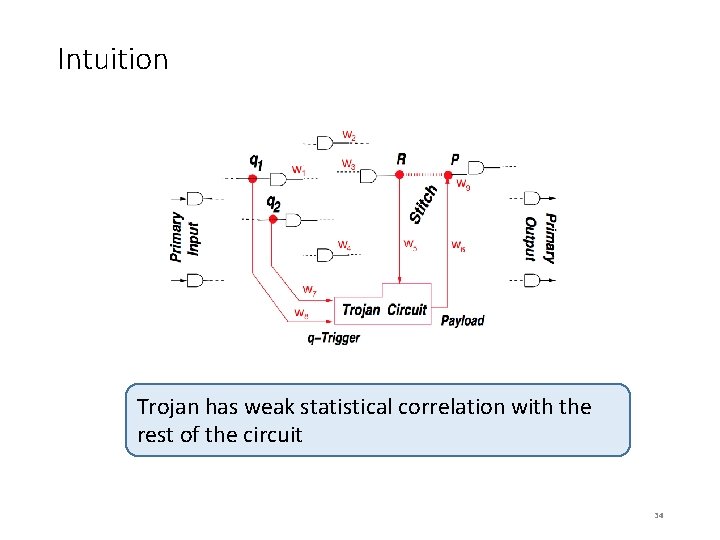
Intuition Trojan has weak statistical correlation with the rest of the circuit 34
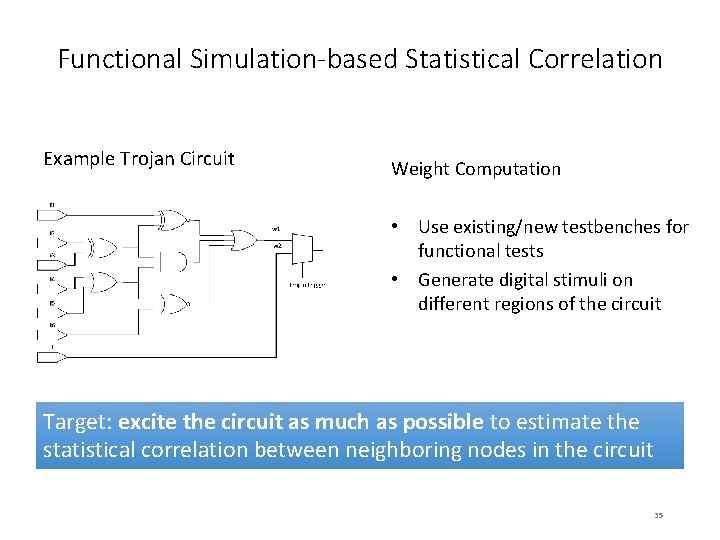
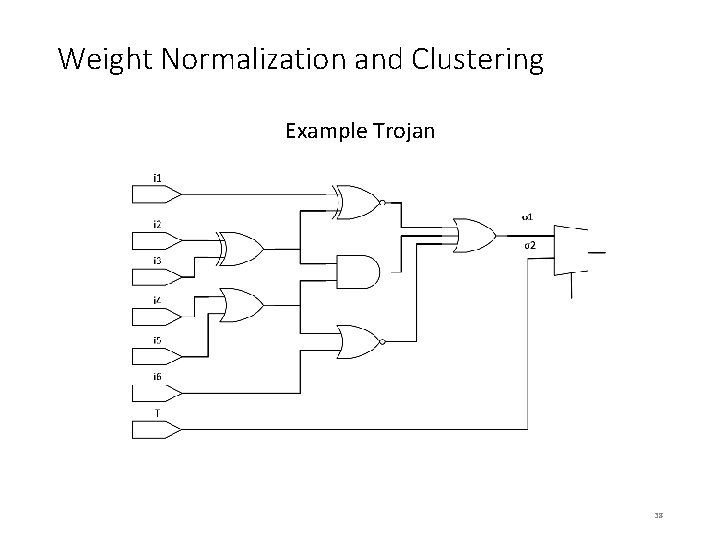
Functional Simulation-based Statistical Correlation Example Trojan Circuit Weight Computation • Use existing/new testbenches for functional tests • Generate digital stimuli on different regions of the circuit Target: excite the circuit as much as possible to estimate the statistical correlation between neighboring nodes in the circuit 35
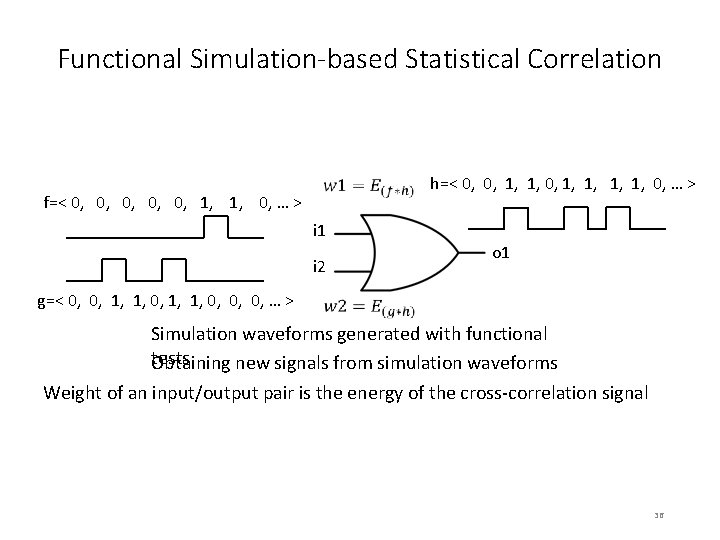
Functional Simulation-based Statistical Correlation f=< 0, 0, 0, 1, 1, 0, … > i 1 i 2 g=< 0, 1, 1, 0, 0, … > h=< 0, 1, 0, 1, 1, 0, … > o 1 Simulation waveforms generated with functional tests Obtaining new signals from simulation waveforms Weight of an input/output pair is the energy of the cross-correlation signal 36
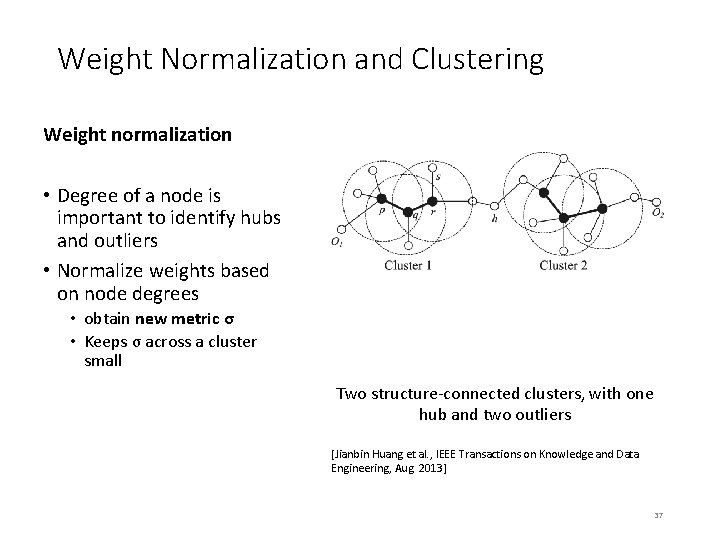
Weight Normalization and Clustering Weight normalization • Degree of a node is important to identify hubs and outliers • Normalize weights based on node degrees • obtain new metric σ • Keeps σ across a cluster small Two structure-connected clusters, with one hub and two outliers [Jianbin Huang et al. , IEEE Transactions on Knowledge and Data Engineering, Aug. 2013] 37
Weight Normalization and Clustering Example Trojan 38
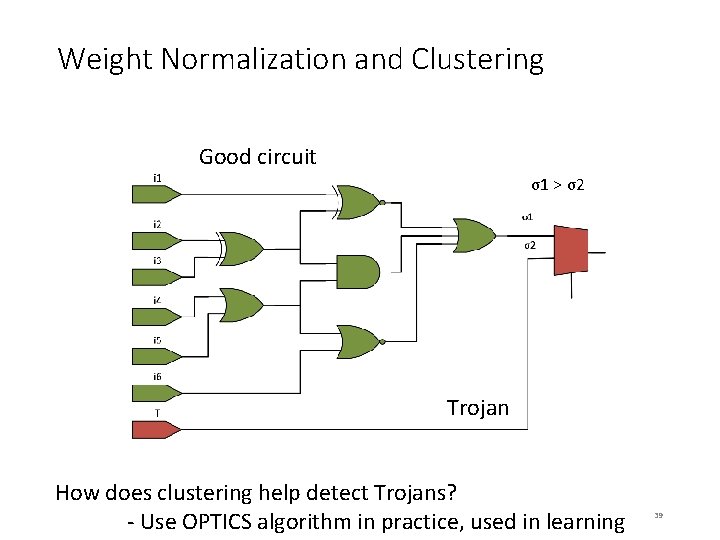
Weight Normalization and Clustering Good circuit σ1 > σ2 Trojan How does clustering help detect Trojans? - Use OPTICS algorithm in practice, used in learning 39
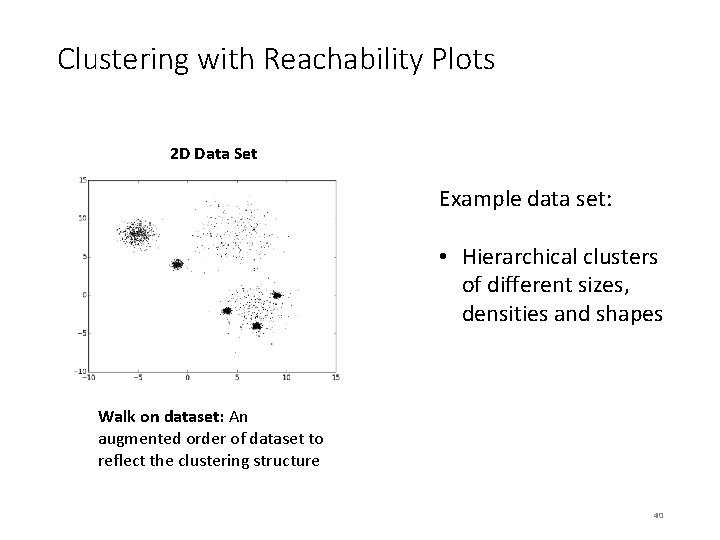
Clustering with Reachability Plots 2 D Data Set Example data set: • Hierarchical clusters of different sizes, densities and shapes Walk on dataset: An augmented order of dataset to reflect the clustering structure 40
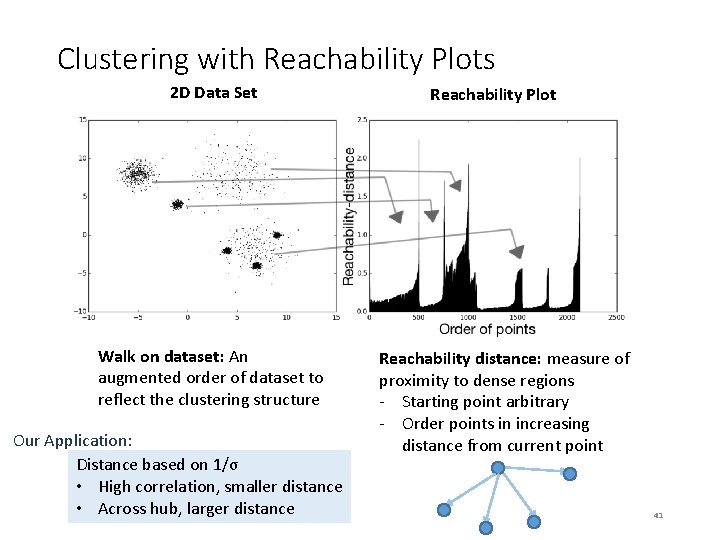
Clustering with Reachability Plots 2 D Data Set Walk on dataset: An augmented order of dataset to reflect the clustering structure Our Application: Distance based on 1/σ • High correlation, smaller distance • Across hub, larger distance Reachability Plot Reachability distance: measure of proximity to dense regions - Starting point arbitrary - Order points in increasing distance from current point 41
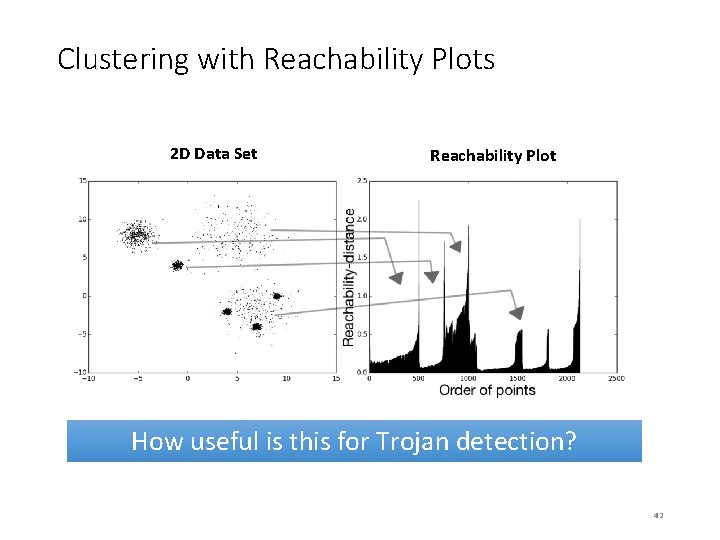
Clustering with Reachability Plots 2 D Data Set Reachability Plot How useful is this for Trojan detection? 42
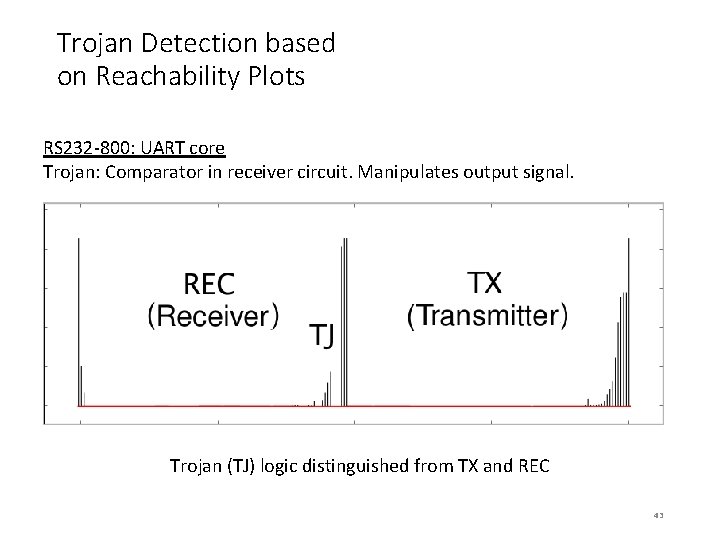
Trojan Detection based on Reachability Plots RS 232 -800: UART core Trojan: Comparator in receiver circuit. Manipulates output signal. Trojan (TJ) logic distinguished from TX and REC 43
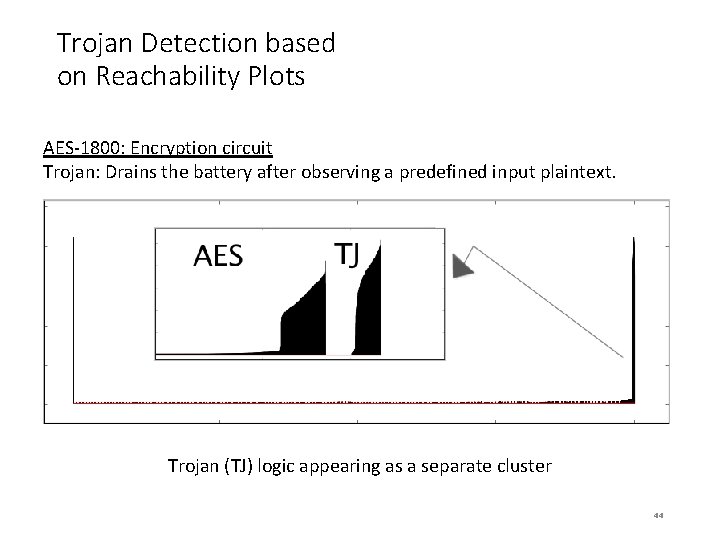
Trojan Detection based on Reachability Plots AES-1800: Encryption circuit Trojan: Drains the battery after observing a predefined input plaintext. Trojan (TJ) logic appearing as a separate cluster 44
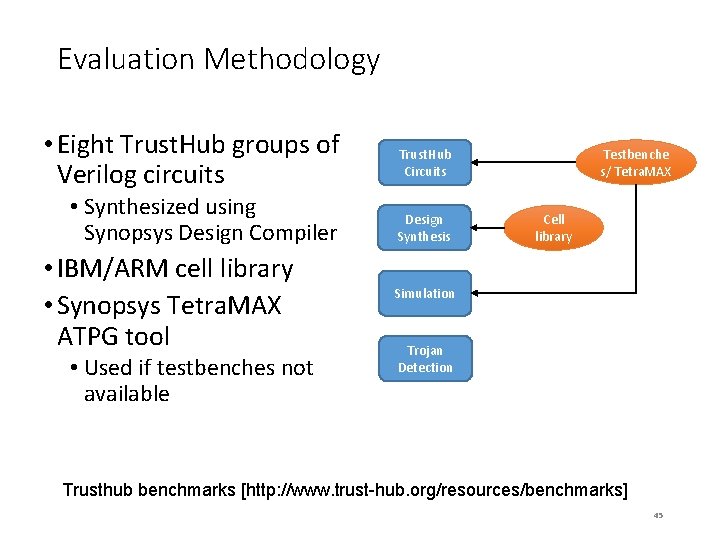
Evaluation Methodology • Eight Trust. Hub groups of Verilog circuits • Synthesized using Synopsys Design Compiler • IBM/ARM cell library • Synopsys Tetra. MAX ATPG tool • Used if testbenches not available Trust. Hub Circuits Design Synthesis Testbenche s/ Tetra. MAX Cell library Simulation Trojan Detection Trusthub benchmarks [http: //www. trust-hub. org/resources/benchmarks] 45
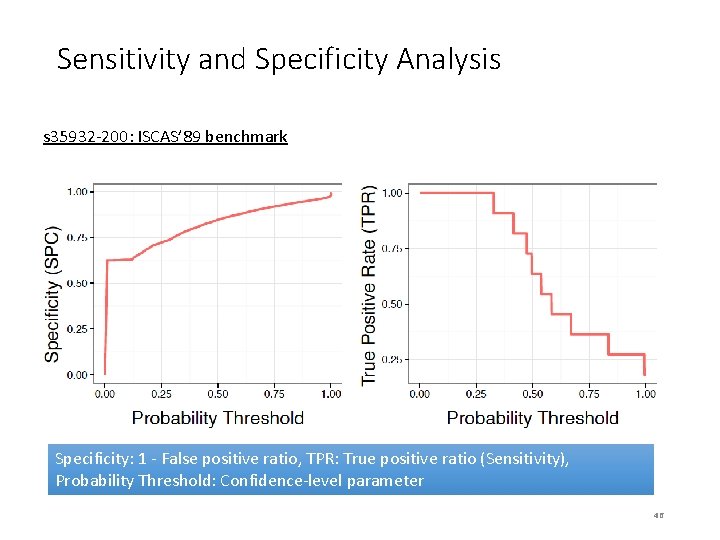
Sensitivity and Specificity Analysis s 35932 -200: ISCAS’ 89 benchmark Specificity: 1 - False positive ratio, TPR: True positive ratio (Sensitivity), Probability Threshold: Confidence-level parameter 46
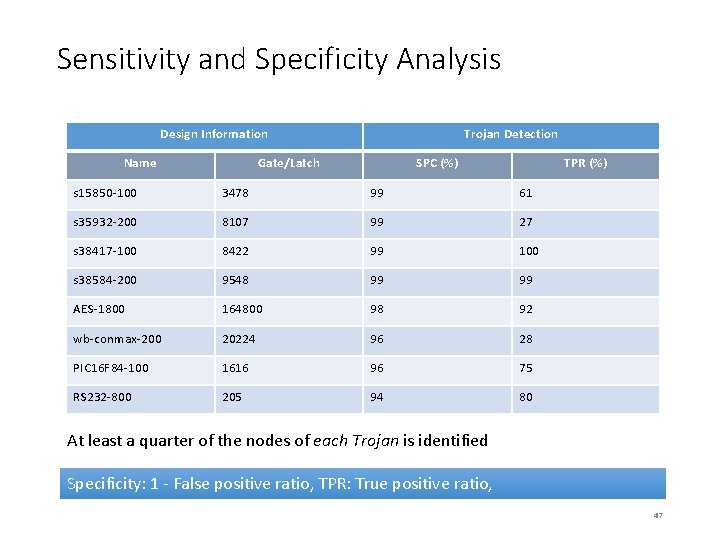
Sensitivity and Specificity Analysis Design Information Name Trojan Detection Gate/Latch SPC (%) TPR (%) s 15850 -100 3478 99 61 s 35932 -200 8107 99 27 s 38417 -100 8422 99 100 s 38584 -200 9548 99 99 AES-1800 164800 98 92 wb-conmax-200 20224 96 28 PIC 16 F 84 -100 1616 96 75 RS 232 -800 205 94 80 At least a quarter of the nodes of each Trojan is identified Specificity: 1 - False positive ratio, TPR: True positive ratio, 47
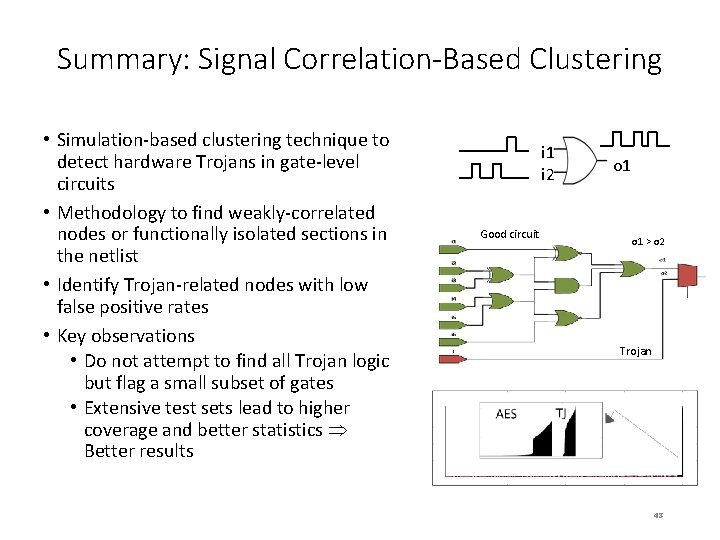
Summary: Signal Correlation-Based Clustering • Simulation-based clustering technique to detect hardware Trojans in gate-level circuits • Methodology to find weakly-correlated nodes or functionally isolated sections in the netlist • Identify Trojan-related nodes with low false positive rates • Key observations • Do not attempt to find all Trojan logic but flag a small subset of gates • Extensive test sets lead to higher coverage and better statistics Better results i 1 i 2 Good circuit o 1 σ1 > σ2 Trojan 48
Conclusions • Portfolio of matching algorithms for reverse engineering • Went much further than we expected • Simulation data-based clustering very powerful • Applications beyond Trojan detection? 49