
Detecting Common Types of Abuses of Dominance Experience
Detecting Common Types of Abuses of Dominance – Experience from Taiwan Lin Gin-Lan Section chief of TFTC
Abuse of dominance (Misuse of market power;Monopolisation) Common Types(1) 1. Excessive pricing 2. Predatory pricing selling at below cost for the purpose of driving out competitors 3. Refusals to deal

Common Types(2) 4. Price discrimination a practice where by a firm charges different customers or classes of customers different prices for the same good for reasons unrelated to costs 5. Exclusive dealing requiring a retailer or distributor not to sell products competing with the supplier's products 6. Tie-ins
Common Types(3) 7. Third line forcing requiring purchasers of one product to purchase other products from named suppliers 8. Territorial restrictions the retailer or distributor may not resell outside of a defined territory 9. Customer restrictions the retailer or distributor may only deal with specified customers 10. Resale price maintenance minimum price at which the product may be resold to customers

Analysis of abusing dominance • Determining the status of firm • Evaluating the behavior : Economic analysis
A case of economic analysis with game theory • CPC 70% FPCC 30% • Abusing of joint dominance of duopoly gasoline market • mechanism of joint dominance - price leadership - price meeting contract - advance announcement of a price change • Static game vs. dynamic game
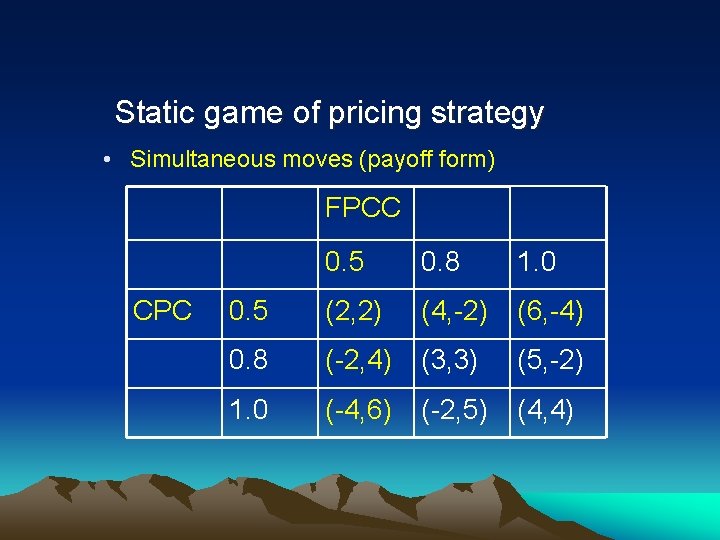
Static game of pricing strategy • Simultaneous moves (payoff form) FPCC CPC 0. 5 0. 8 1. 0 0. 5 (2, 2) (4, -2) (6, -4) 0. 8 (-2, 4) (3, 3) (5, -2) 1. 0 (-4, 6) (-2, 5) (4, 4)

Dynamic game of pricing strategy • sequential moves (game tree) • CPC( first mover ), FPCC( new comer of gasoline market)

Newly types of abusing dominance • market power evolving from distribution orientation • upstream anti-competition from industry organization perspective
A case of newly type of abusing dominance : So. Go department store vs. branded product suppliers which operate outlet store in So. Go 1. 2. Restriction of outlet stores location on branded product suppliers (outside a radius of 2000 meters of So. Go) To create an entry barrier and intend to prevent potential competitors from entering the same geographic market
3. Relative market position - 29. 54 % market share in Taipei Metropolis - NT$19. 20 billion of sales in 2001 - Superb business location - 739 of the 766 ( 96. 40% )outlets signed the disputed restrictive clause 4. Guidelines on trade practices between department store and branded products suppliers
Developing Trends in retailing sector (1) 1. scale of chain-store retailing grow rapidly and strengthen its relative dominant position compared to supplier (low costs low sales prices) 2. satisfy consumers with the need of “one-stop shopping”
Developing Trends in retailing sector (2) 3. various promotional programs to stimulate consumption 4. utilize industrialized information technology e-commerce supply chain management customer relations management 5. increasing spot promotional programs in the outlet to stimulate consumption 6. supplier being over-reliant to single retailer

Relevant market in retailing sector 1. supermarkets - Wellcome - Fressay 2. volume retailers - Carrefour - Costo 3. convenience stores - 7 -11 - Hi-life 4. department stores(shopping center) - Sogo Department - Breeze shopping center
Types of abuse of an relative dominance in retailing sector(1) • Improperly charging suppliers additional fees • Demanding the "most favored" price • Restricting the business area of trading counterpart • Failing to attribute liability of inventory shortfall and improperly calculating penalty damage for inventory shortfall
Types of abuse of relative dominance in retailing sector(2) • Failing to articulate the conditions or standards of products return and improperly returning products : 1. return a product without due reasons 2. return a product where the pollution, damage or expiry is non-fault to the trading counterpart 3. purchase large amount of products with low price for the promotion, and return at a normal price after the promotion
Additional Fees (Slotting allowance) charged by chain- store retailer being relative dominant position 1. any kind of fee charged to supplier - secret rebate - business premises rent subsidy - promotion fee - minimum guarantee amount fee 2. any direct deduction from payment account for goods according to supplier agreement
Improperly Charging Additional Fees • Fees are not directly related to promoting the sale of the goods • Amount exceeding the benefit that suppliers may reasonably expect to derive from sale • Fees are only for the retailers purpose of achieving its own performance target • Demanding a reduction of purchasing price for already-delivered goods when the supplier is under no obligation
Carrefour case in the year of 2000 1. The case Complants alleging Carrefour Corporation‘s collection of addition slotting allowance, rebates and patronage grants. 2. Dominace position of carrefour a. Carefour was established in 1987 and had 23 outlets at that time the alleged disputes occurred. b. Carrefour had revenues of NT$ 39. 77 million in 1999 accounting for 30. 75% of the domestic market
Case summery(1) 1. When suppliers negotiated annual agreements with Carrefour, the completed agreement consisted of the document drafted unilaterally by Carrefour, including a national agreement with addendum 1 to 3, and a national supplementary agreement. Under the documents, Carrefour was entitled to collect various additional fees from suppliers. 2. A “supplementary fixed rebate” (referred to in the industry as a “secret rebate”) introduced by Carrefour in 1997 is an example of such additional fees ; and it did not directly benefit sales.
Case summery(2) 3. The additional fees collected by Carrefour over 1998 and 1999 amounted to NT$280 million. Hence the dispute clearly involved not just a small but large number of Carrefour’s trading counterparts. 4. Carrefour’s reliance on its relative market position to deny its trading counterparts the freedom to decide whether they would like to accept the additional fees were culpable in terms of commercial ethics, and were sufficient to affect trading order.
Case summery(3) 5. When Carrefour introduced the “supplementary fixed rebate transaction clause” into the standard national supplementary agreement drafted unilaterally by Carrefour, as most of the small and medium-sized suppliers were under the pressure to maintain their existing commercial relationship with Carrefour, it had used its relative market power to force the suppiers to accept the additional fees. 6. Carrefour’s conduct was clearly unfair and sufficient to affect trading order in violation of the FTA. Therefore, the commission imposed an administrative fine of NT$4 million on Carrefour.
Fair Trade Commission Guidelines on Additional Fees Charged by Distribution Businesses Prescribed by the 470 th Commissioners' Meeting on November 9, 2000 1. Purpose of these Principles These Principles have been specially adopted to prevent distribution businesses from abusing advantageous positions in the market by improperly charging suppliers additional fees, and thereby to maintain the market trading order and ensure fair competition.
2. Definition of distribution business The term "distribution business" as used in these Principles refers to volume retailers, convenience stores, super/hyper markets, department stores, cooperative stores, and all other businesses engaging in the retail sale of assorted goods.
3. Definition of additional fees The term "additional fees" as used in these Principles, with the exception of amounts payable for goods by the distribution businesses, refers to fees charged to suppliers by distribution businesses, or to deductions made from amounts payable for goods, or to all kinds of fees demanded of suppliers by distribution businesses by other means.
4. Factors to be considered in determination of advantageous market position In determining whether a distribution business holds an advantageous position in the market, the following factors must be considered: the comparative scales and market shares of the distribution business and supplier; the supplier's degree of dependence on the distribution business; the supplier's ability to change its sales channel; and supply of and demand for the goods.
5. Entering into written agreements When a distribution business asks a supplier to bear additional fees, it should first negotiate with the supplier with respect to the type of additional fee, its use, and the amount of the fee (or the method of its calculation), and enter into a written agreement with the supplier.
6. Provision of information for direct debiting of additional fee When a distribution business charges its supplier additional fees by directly debiting its account payable for goods purchased, it must provide information regarding the deduction prior to deducting the additional fees.
7. Practices constituting improper charging of additional fees(1) Under anyone of the following circumstances, a distribution business shall be deemed to be improperly charging additional fees: (1) the fees charged are not directly related to promoting the sale of the goods; (2) the fees charged are contributions to equipment, research and development, or promotional activities, and while of benefit to the supplier in promoting sale of goods or reducing operating costs, the amount of the fees exceeds in value the tangible benefit that the supplier may reasonably expect to derive from paying such contributions;
7. Practices constituting improper charging of additional fees(2) (3) the fees charged are for the sole purpose of achieving target figures or other accounting measures at the end of a fiscal year; (4) when, despite the supplier being under no obligation, a reduction in the purchase price is demanded by the distributor for already-delivered goods; or (5) fees are charged in a manner contrary to normal trading principles or commercial ethics.
8. Violation of these Principles If a distribution business having an advantageous market position charges suppliers additional fees in a manner not in accordance with Points 5 and 6 of these Principles or is found to be in violation of Point 7 such that the distribution business market order is impacted, the distribution business shall possibly deemed to be in violation of Article 19(1)(vi) or Article 24 of the Fair Trade Law.

Thank You
- Slides: 32