
Detecting Agerelated Cognitive Decline using a Visual Gist
- Slides: 16
Detecting Age-related Cognitive Decline using a Visual Gist Task Mudit Vashist Dr. Mark Bahr
Introduction Declining cognition has been associated with a number of detrimental consequences for ageing individuals Early detection is extremely helpful in intervention and prevention of future decline Current intervention strategies used: Pharmacological interventions (e. g. , cholinesterase inhibitors) Behavioural interventions (e. g. , reading books, exercising)
Onset of Cognitive Decline Previously thought to occur in late adulthood (65+) Recent studies have shown earlier onsets Salthouse (2004) proposed decline beginning before 65 years of age Decline in visuospatial memory from 18 (Hartshorne & Germine, 2015) Decline in emotion recognition in faces occur as early as 50 (Sullivan & Ruffman, 2004)
Theories of Cognitive Decline Generalised Decline Theory (Salthouse, 1996) Age-related decline occurs by the overall slowing of the brain Modular Decline Theory (Delaloye et al. , 2009) Various brain regions are differentially susceptible to decline
Gist Memory An area of memory functioning older adults have difficulty is processing the fine details of an object (Hudson et al. , 2006) Results in remembering general, abstract details or “gist” of an object (Alexander, Bahr, & Hicks, 2015) More gist errors may indicate changes in memory
Previous Research on Gist Memory Deese/Roediger-Mc. Dermott (DRM; Roediger & Mc. Dermott, 1995) Measured gist-based errors using words (e. g. , bed, rest, awake) Found individuals were more likely to falsely recognise critical lure (e. g. , sleep) than unrelated lures (e. g. , snow) Visual Gist Task (VGT; Alexander et al. , 2015) Used a computerised picture recognition task Found older adults were unable to encode a specific trace of a stimulus and more likely to rely on gist memory
The Current Study Investigated decline using a measure of visual gist developed by Alexander et al. (2015) Systematically replicated Alexander et al. (2015). However, reduced the contrast of coloured images Reducing overall image can decrease ancillary information that helps discriminate items (Spence et al. , 2006) Therefore, the current study decreased the image salience by desaturating the visual stimuli to a monochrome set of images
Aim and Hypotheses Examine whether the onset of age-related cognitive decline occurred earlier than the recognised age from previous studies Investigate the potential of the visual gist task, which measured accuracy and response latency to recognise stimuli and detect age related changes in cognition Hypotheses As age increases, the accuracy to recognise item-specific memory (target items) will decrease As age increases, the latency to recognise target items will increase
Method Participants N = 66 (43 females, 23 males) Young Cohort (n =23) 18 to 25 years old (M =22. 70, SD = 1. 82) Middle-aged Cohort (n = 21) 26 to 52 years old (M = 38. 10, SD = 8. 26) Older Cohort (n = 22) 53 to 78 years old (M = 61. 73, SD = 7. 36) Exclusion Criteria Screened for visual and memory impairments (medication)
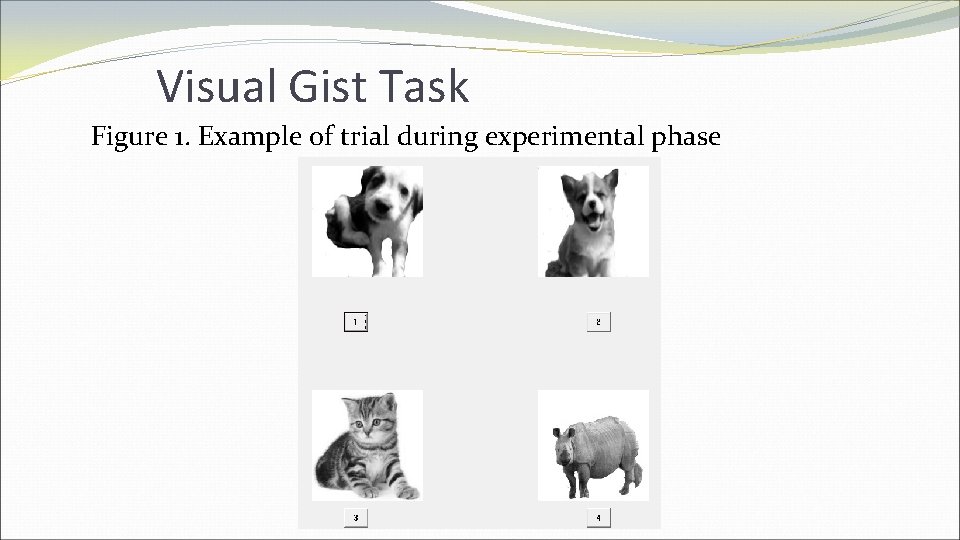
Method Measures Visual Gist Task (VGT) Based on Alexander et al. (2015) picture recognition task. The learning phase presented monochrome pictorial stimuli from 27 categories (e. g. , a basketball was an exemplar for the ball category). During the experimental phase, participants were shown 27 trials. For each trial, four pictures were presented (Figure 1)
Visual Gist Task Figure 1. Example of trial during experimental phase
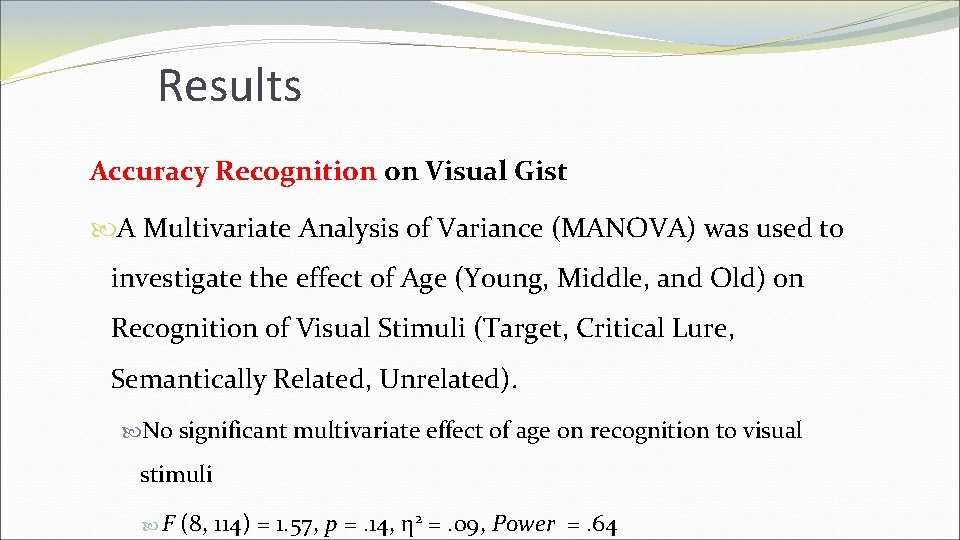
Results Accuracy Recognition on Visual Gist A Multivariate Analysis of Variance (MANOVA) was used to investigate the effect of Age (Young, Middle, and Old) on Recognition of Visual Stimuli (Target, Critical Lure, Semantically Related, Unrelated). No significant multivariate effect of age on recognition to visual stimuli F (8, 114) = 1. 57, p =. 14, η 2 =. 09, Power =. 64
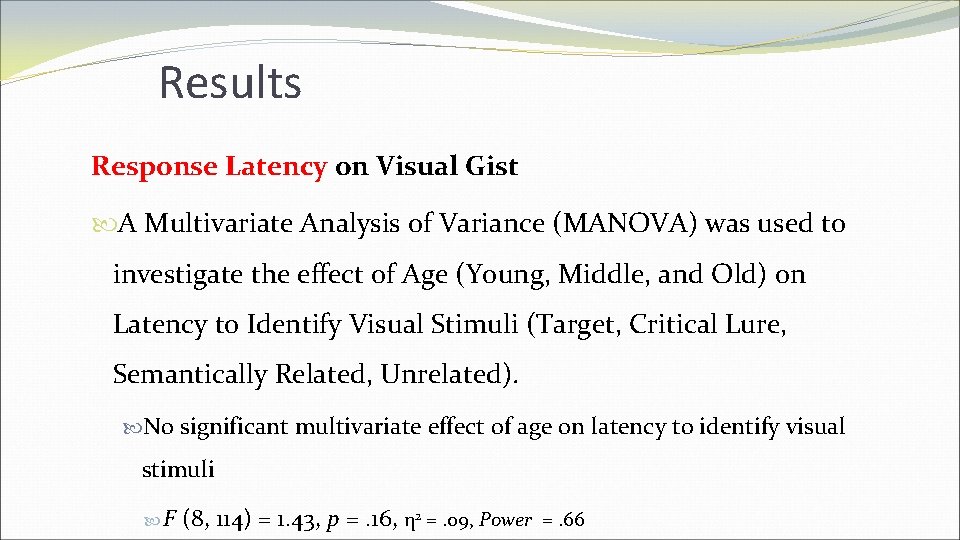
Results Response Latency on Visual Gist A Multivariate Analysis of Variance (MANOVA) was used to investigate the effect of Age (Young, Middle, and Old) on Latency to Identify Visual Stimuli (Target, Critical Lure, Semantically Related, Unrelated). No significant multivariate effect of age on latency to identify visual stimuli F (8, 114) = 1. 43, p =. 16, η 2 =. 09, Power =. 66
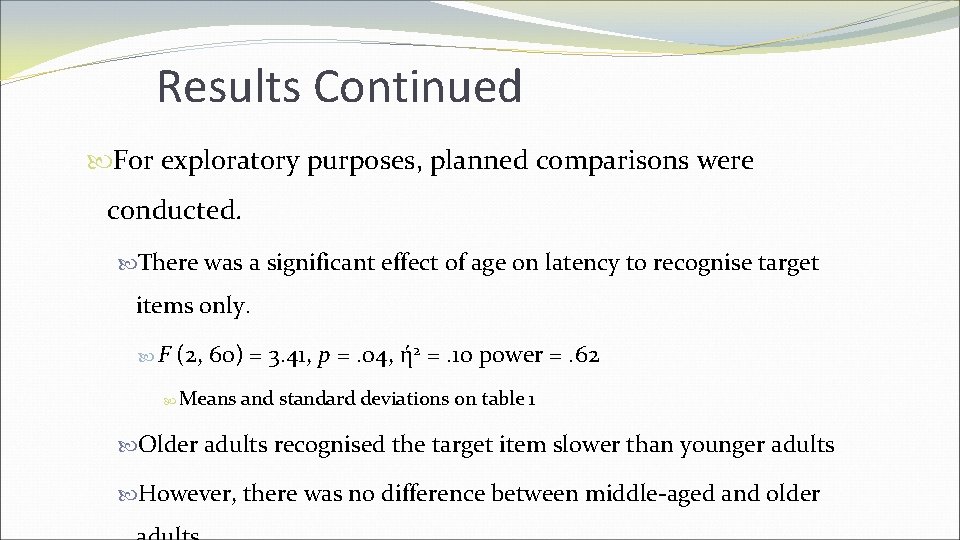
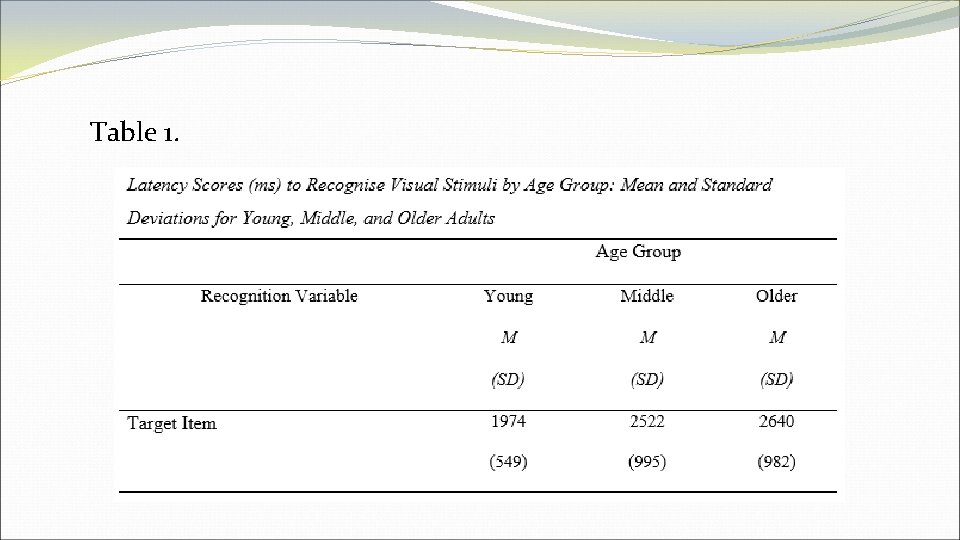
Results Continued For exploratory purposes, planned comparisons were conducted. There was a significant effect of age on latency to recognise target items only. F (2, 60) = 3. 41, p =. 04, ή 2 =. 10 power =. 62 Means and standard deviations on table 1 Older adults recognised the target item slower than younger adults However, there was no difference between middle-aged and older
Table 1.
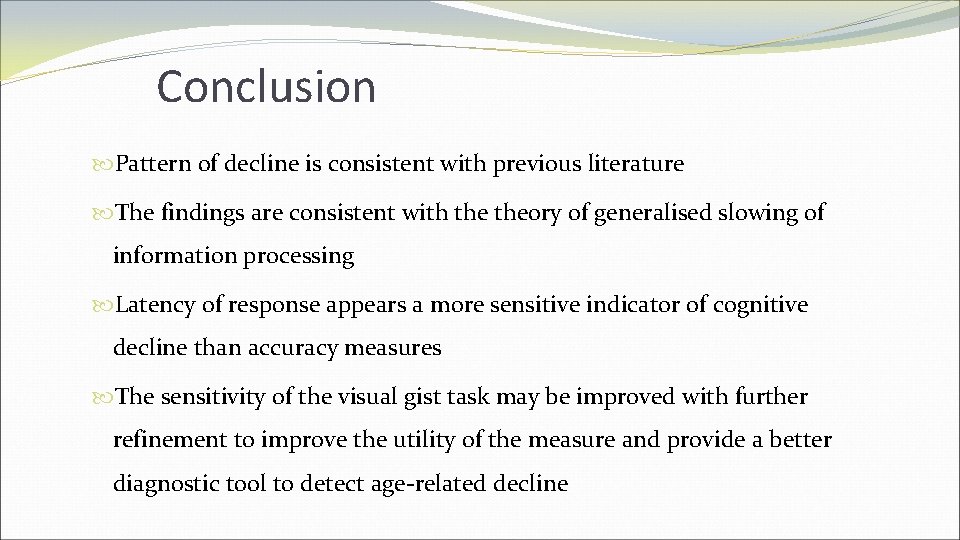
Conclusion Pattern of decline is consistent with previous literature The findings are consistent with theory of generalised slowing of information processing Latency of response appears a more sensitive indicator of cognitive decline than accuracy measures The sensitivity of the visual gist task may be improved with further refinement to improve the utility of the measure and provide a better diagnostic tool to detect age-related decline