
Details for Families By Elizabeth Shields Topics Covered
Details for Families By: Elizabeth Shields
Topics Covered • Individuals with Disabilities Education Act (IDEA) • Americans with Disabilities Act (ADA) • Response to Interventions (RTI) • Three-tiered response-to-intervention model • Individualized Education Program (IEP) • Individualized Family Service Plan (IFSP) • Least Restrictive Environment (LRE)
Individuals with Disabilities Education Act (IDEA) • In 1975, it was called the Education for All Handicapped Children Act • 1990 - they amended it and the name changed to IDEA • 1997 – amended, again, but the name did not change • 2004 – reauthorized as Individuals with Disabilities Education Improvement Act (IDEIA); referred to as IDEA 2004 • This act ensures that all children and youth with disabilities have the right to a free, appropriate public education. (Hallahan, 2015)
Americans with Disabilities Act (ADA) The ADA ensures ‘the right of individuals with disabilities to non-discriminating treatment (employment, transportation, public accommodation, state and local government and telecommunication); grants equal opportunities to people with disabilities”. (Hallahan, 2015)
Response to Interventions (RTI) • Refers to a student’s change, or lack therefor, in academic performance or behavior as a result of instruction • Teachers gather data to determine whether the student is benefitting from that instruction • RTI is usually associated with learning disabilities and academic learning (Hallahan, 2015)
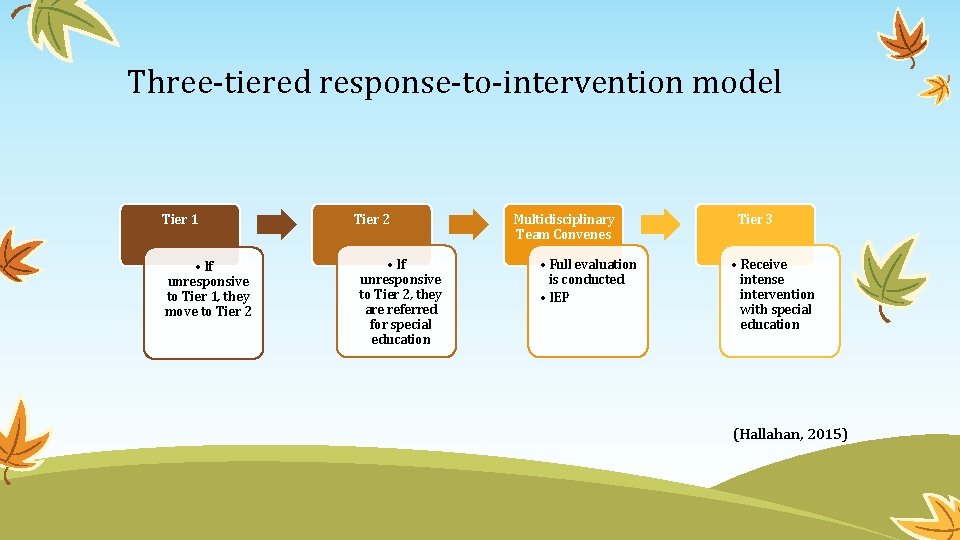
Three-tiered response-to-intervention model Tier 1 • If unresponsive to Tier 1, they move to Tier 2 • If unresponsive to Tier 2, they are referred for special education Multidisciplinary Team Convenes • Full evaluation is conducted • IEP Tier 3 • Receive intense intervention with special education (Hallahan, 2015)
Individualized Education Program (IEP) • Legal document that describes the educational services a student receives • IEP team • The parents of the child with a disability • Minimum of one regular educator • Minimum of one special education teacher or provider of the child • A representative of the local educational agency • An individual who can interpret the instructional implications of evaluation results • Other individuals who have knowledge or special expertise regarding the child • The child with a disability, whenever appropriate (Hallahan, 2015)
Individualized Education Program (IEP) (continued… • IEP’s are often written at the wrong time and for the wrong reasons • When the IEP is prepared as intended by Law: • Student’s needs have been carefully assessed • A team of professional and the parents have worked together to design a program of education to best meet the students’ needs • Goals and Objectives are stated clearly so that progress in reaching them can be evaluated (Hallahan, 2015)
Individualized Family Service Plan(IFSP) • Similar to IEP but it broadens to include the family, as well as for the child • Most common for Infants to 3 years old • IFSP must include a statement of : • The child’s present level of development in theses areas: physical (including) vision, hearing, and health status), cognitive, communication, psychosocial, and adaptive behaviors • Family strengths, resources, concerns, and priorities related to the child’s development • The major outcomes expected to be achieved from the child and family • Frequency, intensity, and method of delivering the early intervention • The natural environments where services will provided or a statement explaining why services will not be provided in natural environments (Hallman, 2015)
Individualized Family Service Plan(IFSP) (Continued…) • IFSP must include: • Projected dates for the initiation of services and anticipated duration of services • The name of a service coordinator responsible for implementation of the IFSP and coordination with other agencies/professionals • Steps to be implemented to ensure successful transition (a transition plan) to preschool services provided by the public schools • Written consent from the parents or legal guardian (Hallman, 2015)
Least Restrictive Environment (LRE) • Means the student should be separated from nondisabled classmates and from home, family, and community as little as possible • Student’s life should be as normal as possible • Sometimes greater restriction is bad • “It is conceivable that some students could be more restricted in the long run in a general education class where they are rejected by others and fail to learn necessary skills than in a special class or day school where they learn happily and well. ” • Inclusion – describes teaching students with disability in same environment as their age peers who do not have disabilities (Hallahan, 2015)
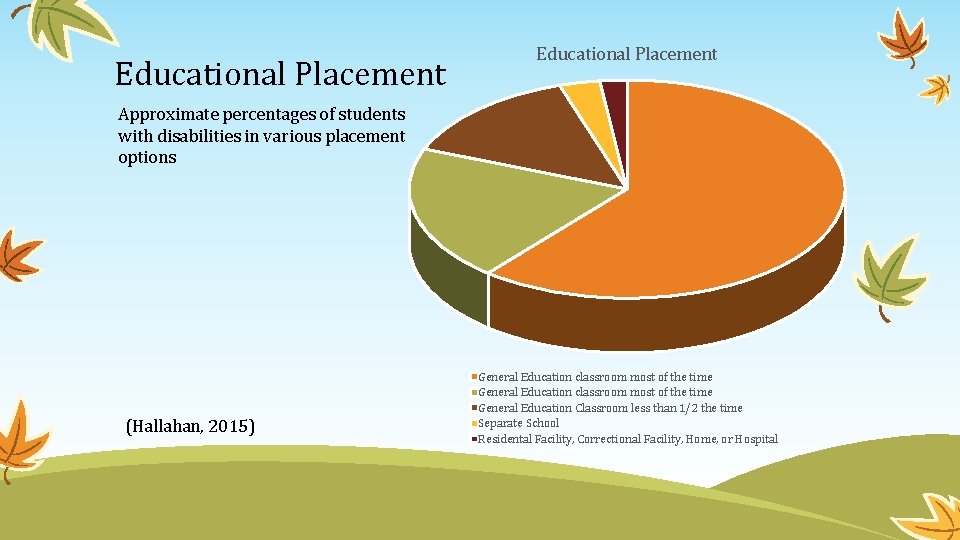
Educational Placement Approximate percentages of students with disabilities in various placement options (Hallahan, 2015) General Education classroom most of the time General Education Classroom less than 1/2 the time Separate School Residental Facility, Correctional Facility, Home, or Hospital
Sources for support outside the classroom • Insource – Special Education parent support • There are two information fairs coming up • Friday, July 15, 2016; 10 a. m. -4 p. m. • Sunday, September 11, 2016; 10 a. m. -4 p. m. • Insource provides opportunities to raise awareness among the families, parents, students and those who are working with people who have disabilities. • www. insource. org • South Bend, Indiana • www. doe. in. gov/specialed • Special Educator director and local administrator contact list • Special Education FAQ • Miscellaneous information
Sources for support outside the classroom • How and where to obtain a Diagnosis/Assessment in Indiana • https: //www. iidc. indiana. edu/styles/iidc/defiles/IRCA/How. Where. Obain 2016. pdf • To obtain a copy of the current diagnostic criteria outlined in the DSM can be obtained from the Indiana Resource Center for Autism • https: //www. iidc. indiana. edu/pages/Diagnostic-Criteria-for-Autism-Spectrum. Disorder
Summary • The main goal is to always give the student the education in a way that is best for them. • State standards are not the main goal, but the student’s full potential. • It is important to make sure that IEP’s are given according to the law, so the student can receive the education that is best for them.
Reflection I chose to talk about the Individuals with Disabilities Education Act and Americans with Disabilities Act because I think it is important that the students and parents know that they have certain rights. Secondly, I chose to talk about the Response to Interventions and the Three-tiered response-to-intervention model because it is so important that the parents know which steps lie ahead and that they know there is plan to diagnose their child. I went specifically into the three-tiered response-tointervention model because it is important that they make sure each step in the model is happening. The individualized education program is presented because the parents need to have full understanding of this step. This is the step in which their student is being placed into a special education program. The Individualized Family Service Plan is important for the parents to know because this plan is specifically centered around them and their other children and how their lives might change. The least Restrictive Environment is so important for the parents to understand. This is important because the parents need to know and understand that their child is not going to be placed in any environment that is not in their best interest and where they cannot meet their full potential.
Resources Hallahan, D. , Kauffman, J. , Pullen, P. (2015). Exceptional learners: An introduction to special education. United States: Pearson Education, Inc. Indiana Departrment of Education. (2016). Office of special education. Retrieved from www. doe. in. gov/specialed Indiana University Bloomington. (2016). Diagnostice criteria for austim spectrum disorder. Retrieved from https: //www. iidc. indiana. edu/pages/Diagnostic-Criteriafor-Autism-Spectrum-Disorder Insource Special Education Parent and Support. (nd). Parents helping parents. Retrieved from www. insource. org Lowery, K. , Merrill, A. , Pratt, C. , & Wheeler, M. (2016). How and where to obtain a diagnosis/assessment in Indiana. Retrieved from https: //www. iidc. indiana. edu/styles/iidc/defiles/IRCA/How. Where. Obain 2016. pd f
- Slides: 17