
Detachable Percutaneous Endoscopic Gastrostomy Tube PEG Tube Michael
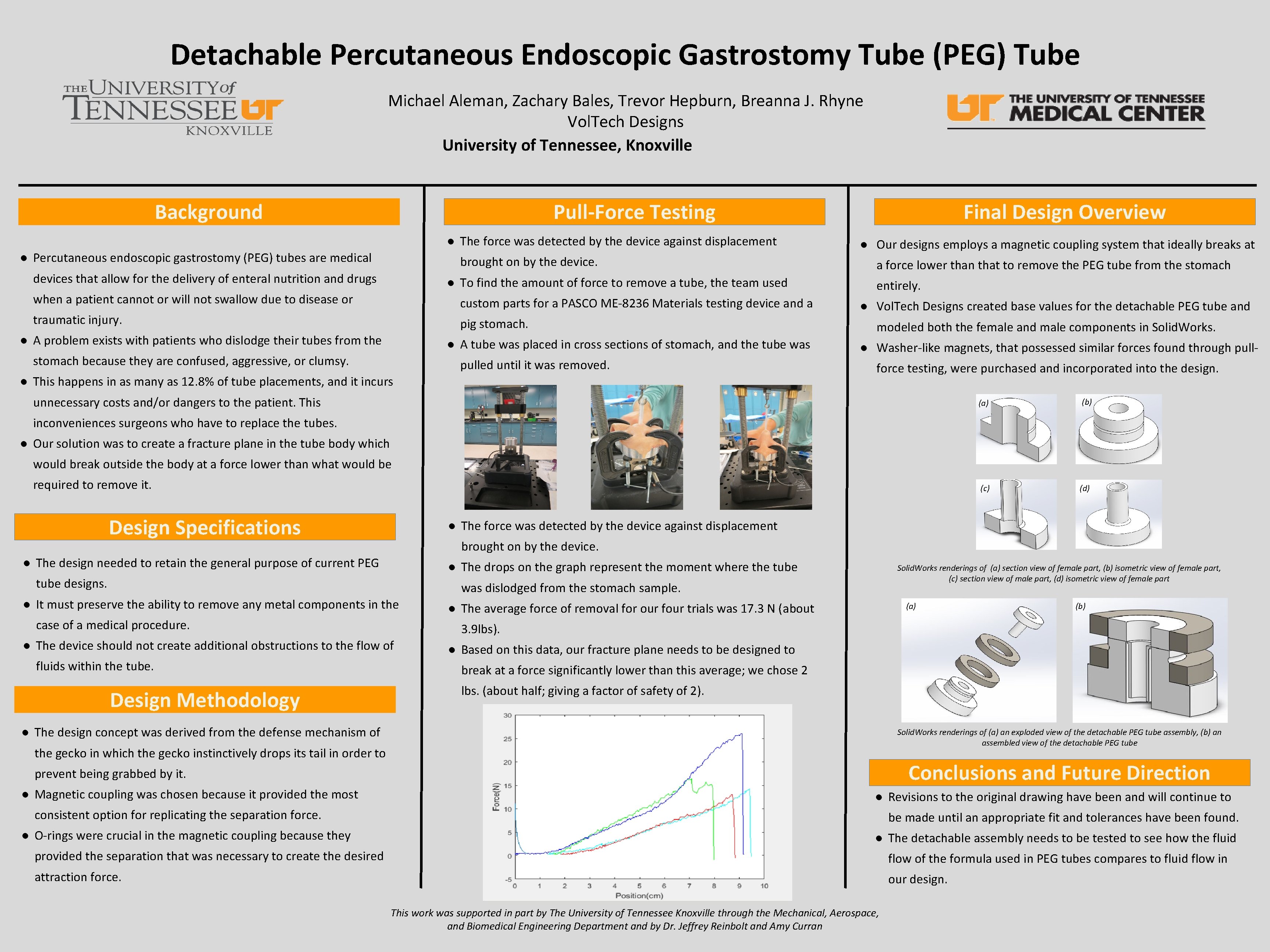
Detachable Percutaneous Endoscopic Gastrostomy Tube (PEG) Tube Michael Aleman, Zachary Bales, Trevor Hepburn, Breanna J. Rhyne Vol. Tech Designs University of Tennessee, Knoxville Pull-Force Testing Background ● The force was detected by the device against displacement ● Percutaneous endoscopic gastrostomy (PEG) tubes are medical brought on by the devices that allow for the delivery of enteral nutrition and drugs ● To find the amount of force to remove a tube, the team used when a patient cannot or will not swallow due to disease or custom parts for a PASCO ME-8236 Materials testing device and a traumatic injury. pig stomach. ● A problem exists with patients who dislodge their tubes from the ● A tube was placed in cross sections of stomach, and the tube was stomach because they are confused, aggressive, or clumsy. pulled until it was removed. ● This happens in as many as 12. 8% of tube placements, and it incurs Final Design Overview ● Our designs employs a magnetic coupling system that ideally breaks at a force lower than that to remove the PEG tube from the stomach entirely. ● Vol. Tech Designs created base values for the detachable PEG tube and modeled both the female and male components in Solid. Works. ● Washer-like magnets, that possessed similar forces found through pullforce testing, were purchased and incorporated into the design. unnecessary costs and/or dangers to the patient. This (a) (b) (c) (d) inconveniences surgeons who have to replace the tubes. ● Our solution was to create a fracture plane in the tube body which would break outside the body at a force lower than what would be required to remove it. Design Specifications ● The force was detected by the device against displacement brought on by the device. ● The design needed to retain the general purpose of current PEG ● The drops on the graph represent the moment where the tube designs. Solid. Works renderings of (a) section view of female part, (b) isometric view of female part, (c) section view of male part, (d) isometric view of female part was dislodged from the stomach sample. ● It must preserve the ability to remove any metal components in the case of a medical procedure. Design Methodology (a) ● Based on this data, our fracture plane needs to be designed to break at a force significantly lower than this average; we chose 2 lbs. (about half; giving a factor of safety of 2). ● The design concept was derived from the defense mechanism of Solid. Works renderings of (a) an exploded view of the detachable PEG tube assembly, (b) an assembled view of the detachable PEG tube the gecko in which the gecko instinctively drops its tail in order to Conclusions and Future Direction prevent being grabbed by it. ● Magnetic coupling was chosen because it provided the most ● Revisions to the original drawing have been and will continue to consistent option for replicating the separation force. ● O-rings were crucial in the magnetic coupling because they (b) 3. 9 lbs). ● The device should not create additional obstructions to the flow of fluids within the tube. ● The average force of removal for our four trials was 17. 3 N (about be made until an appropriate fit and tolerances have been found. ● The detachable assembly needs to be tested to see how the fluid provided the separation that was necessary to create the desired flow of the formula used in PEG tubes compares to fluid flow in attraction force. our design. This work was supported in part by The University of Tennessee Knoxville through the Mechanical, Aerospace, and Biomedical Engineering Department and by Dr. Jeffrey Reinbolt and Amy Curran
- Slides: 1