
DESY From High Energy Physics to Synchrotron Radiation
- Slides: 20
DESY: From High Energy Physics to Synchrotron Radiation Accelerator Operation in a changing Environment Michael Bieler DESY: From High Energy Physics to Synchrotron Radiation WAO 2012, SLAC, Aug. 7, 2012
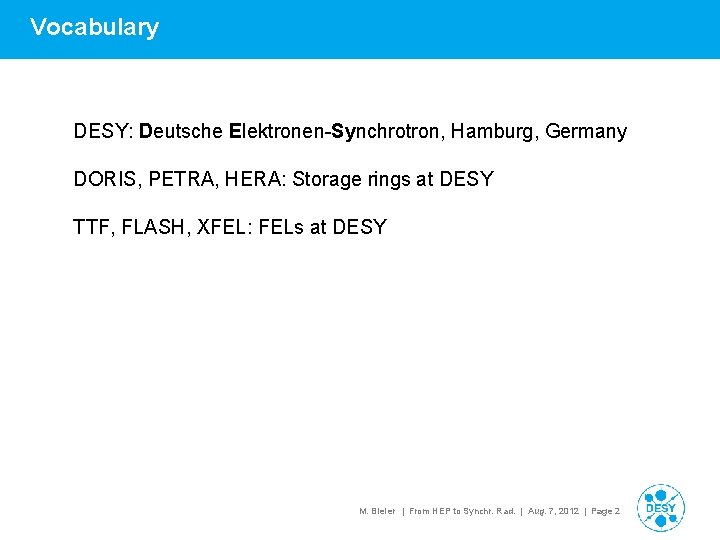
Vocabulary DESY: Deutsche Elektronen-Synchrotron, Hamburg, Germany DORIS, PETRA, HERA: Storage rings at DESY TTF, FLASH, XFEL: FELs at DESY M. Bieler | From HEP to Synchr. Rad. | Aug. 7, 2012 | Page 2
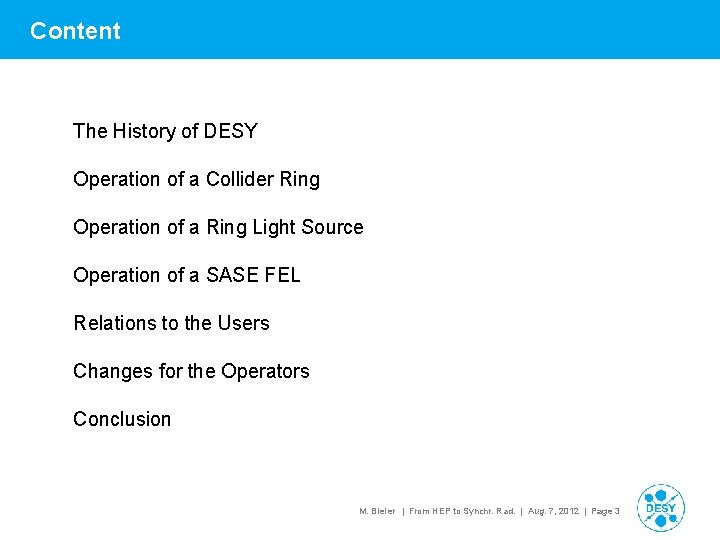
Content The History of DESY Operation of a Collider Ring Operation of a Ring Light Source Operation of a SASE FEL Relations to the Users Changes for the Operators Conclusion M. Bieler | From HEP to Synchr. Rad. | Aug. 7, 2012 | Page 3
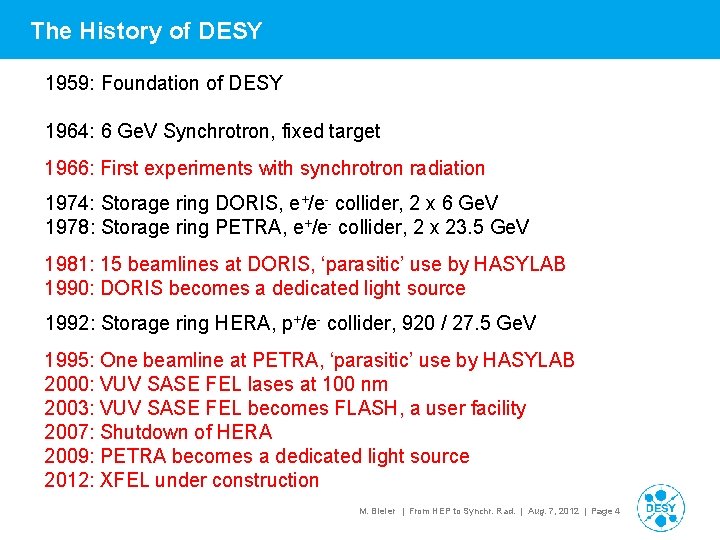
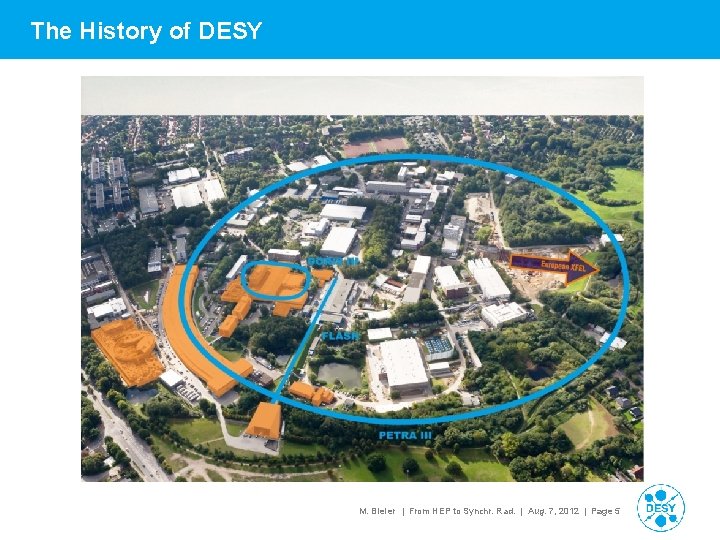
The History of DESY 1959: Foundation of DESY 1964: 6 Ge. V Synchrotron, fixed target 1966: First experiments with synchrotron radiation 1974: Storage ring DORIS, e+/e- collider, 2 x 6 Ge. V 1978: Storage ring PETRA, e+/e- collider, 2 x 23. 5 Ge. V 1981: 15 beamlines at DORIS, ‘parasitic’ use by HASYLAB 1990: DORIS becomes a dedicated light source 1992: Storage ring HERA, p+/e- collider, 920 / 27. 5 Ge. V 1995: One beamline at PETRA, ‘parasitic’ use by HASYLAB 2000: VUV SASE FEL lases at 100 nm 2003: VUV SASE FEL becomes FLASH, a user facility 2007: Shutdown of HERA 2009: PETRA becomes a dedicated light source 2012: XFEL under construction M. Bieler | From HEP to Synchr. Rad. | Aug. 7, 2012 | Page 4
The History of DESY M. Bieler | From HEP to Synchr. Rad. | Aug. 7, 2012 | Page 5
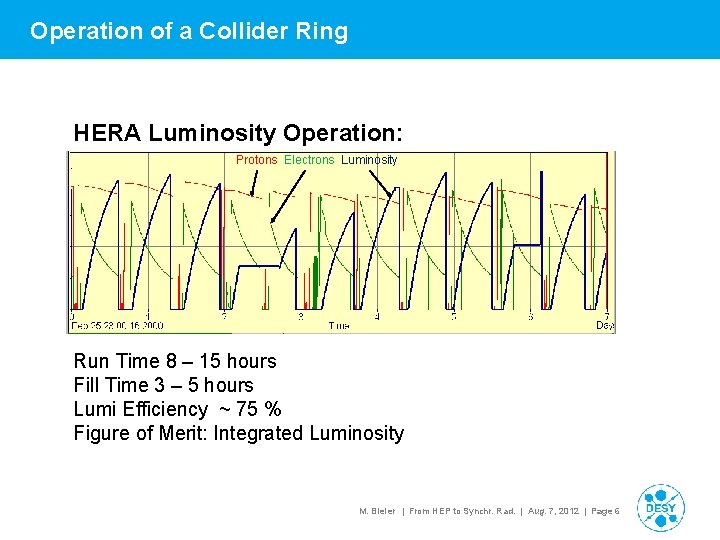
Operation of a Collider Ring HERA Luminosity Operation: Protons Electrons Luminosity Run Time 8 – 15 hours Fill Time 3 – 5 hours Lumi Efficiency ~ 75 % Figure of Merit: Integrated Luminosity M. Bieler | From HEP to Synchr. Rad. | Aug. 7, 2012 | Page 6
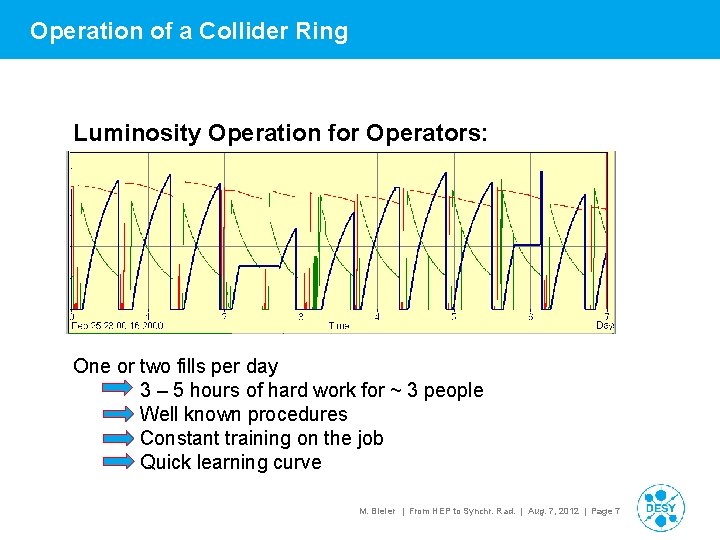
Operation of a Collider Ring Luminosity Operation for Operators: One or two fills per day 3 – 5 hours of hard work for ~ 3 people Well known procedures Constant training on the job Quick learning curve M. Bieler | From HEP to Synchr. Rad. | Aug. 7, 2012 | Page 7
- bad coup - bad - huge - side in th - coas - bad - sync - off e - man Operation of a Collider Ring Constant struggle: Luminosity vs. Background HERA Luminosity Operation: M. Bieler | From HEP to Synchr. Rad. | Aug. 7, 2012 | Page 8
- bad coup - bad - huge - side in th - coas - bad - sync - off e - man Operation of a Collider Ring Luminosity Operation for Operators: One or two fills per day Constant attention required Quick learning curve Shifts are never boring M. Bieler | From HEP to Synchr. Rad. | Aug. 7, 2012 | Page 9
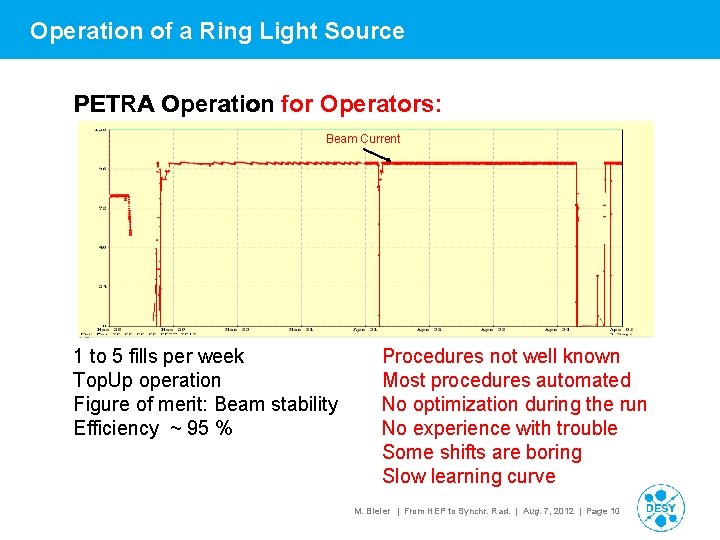
Operation of a Ring Light Source PETRA Operation for Operators: Beam Current 1 to 5 fills per week Top. Up operation Figure of merit: Beam stability Efficiency ~ 95 % Procedures not well known Most procedures automated No optimization during the run No experience with trouble Some shifts are boring Slow learning curve M. Bieler | From HEP to Synchr. Rad. | Aug. 7, 2012 | Page 10
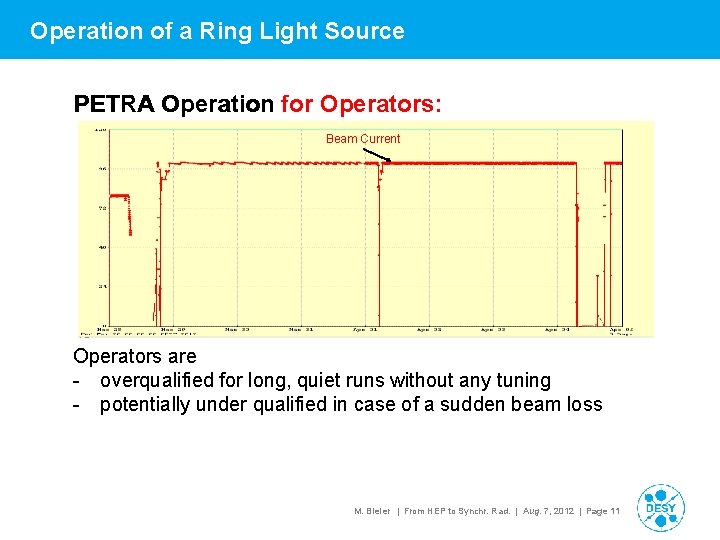
Operation of a Ring Light Source PETRA Operation for Operators: Beam Current Operators are - overqualified for long, quiet runs without any tuning - potentially under qualified in case of a sudden beam loss M. Bieler | From HEP to Synchr. Rad. | Aug. 7, 2012 | Page 11
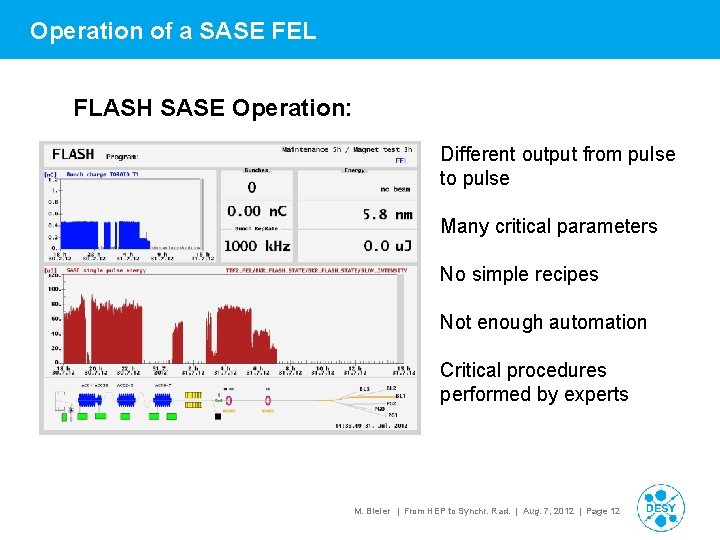
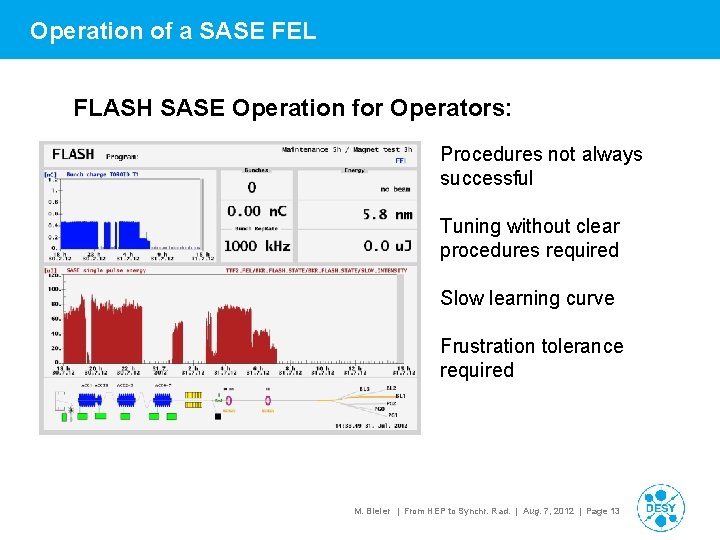
Operation of a SASE FEL FLASH SASE Operation: Different output from pulse to pulse Many critical parameters No simple recipes Not enough automation Critical procedures performed by experts M. Bieler | From HEP to Synchr. Rad. | Aug. 7, 2012 | Page 12
Operation of a SASE FEL FLASH SASE Operation for Operators: Procedures not always successful Tuning without clear procedures required Slow learning curve Frustration tolerance required M. Bieler | From HEP to Synchr. Rad. | Aug. 7, 2012 | Page 13
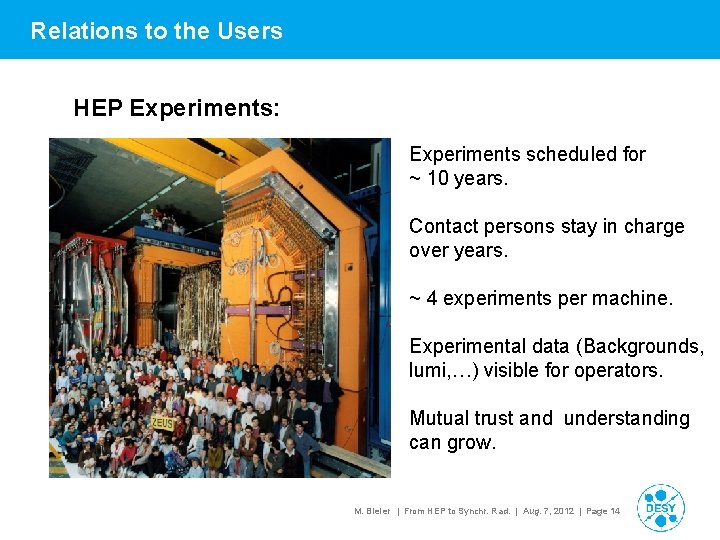
Relations to the Users HEP Experiments: Experiments scheduled for ~ 10 years. Contact persons stay in charge over years. ~ 4 experiments per machine. Experimental data (Backgrounds, lumi, …) visible for operators. Mutual trust and understanding can grow. M. Bieler | From HEP to Synchr. Rad. | Aug. 7, 2012 | Page 14
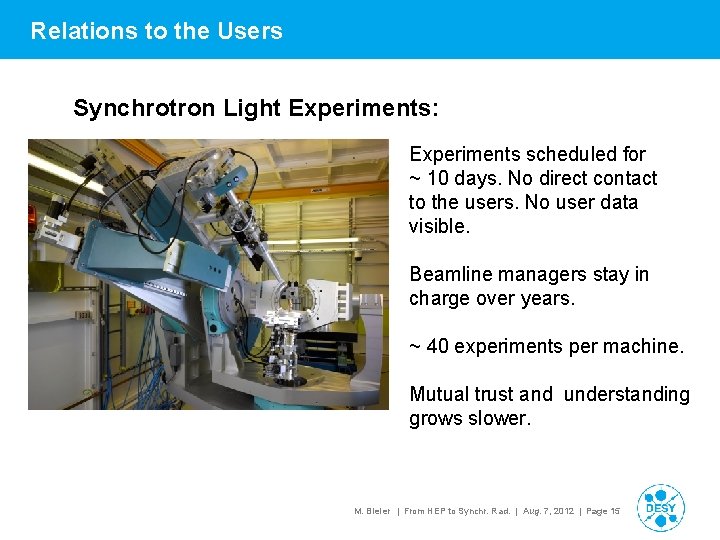
Relations to the Users Synchrotron Light Experiments: Experiments scheduled for ~ 10 days. No direct contact to the users. No user data visible. Beamline managers stay in charge over years. ~ 40 experiments per machine. Mutual trust and understanding grows slower. M. Bieler | From HEP to Synchr. Rad. | Aug. 7, 2012 | Page 15
Operator Satisfaction Collider Rings: A shift was good if the experiment has another X nanobarn on tape. The operator has - tuned the luminosity to a maximum - tuned the background to a minimum The operator has contributed to these X nanobarn. Synchrotron Light Sources: A shift was good if there has been no beam loss. The operator goes home. M. Bieler | From HEP to Synchr. Rad. | Aug. 7, 2012 | Page 16
Changes for the Operators Light sources were introduced over many years at DESY. The operators learned to handle ring light sources, but preferred collider rings. The operators hesitated to operate FLASH, our SASE FEL, because that was done by experts. The end of HERA came not unexpected, but it came nevertheless suddenly. A lot of experience and knowledge became totally useless from one day to the other. Now motivation is a problem, as PETRA is not a challenge and FLASH is too much of a challenge. M. Bieler | From HEP to Synchr. Rad. | Aug. 7, 2012 | Page 17
Changes for the Operators What changes were introduced in the control room? Ring Light Sorces: - More documentation for rare events - During quiet runs side jobs are supported SASE FEL: - More operator training, more theoretical background - Better procedures and more automation - Integration of operators in machine coordination teams M. Bieler | From HEP to Synchr. Rad. | Aug. 7, 2012 | Page 18
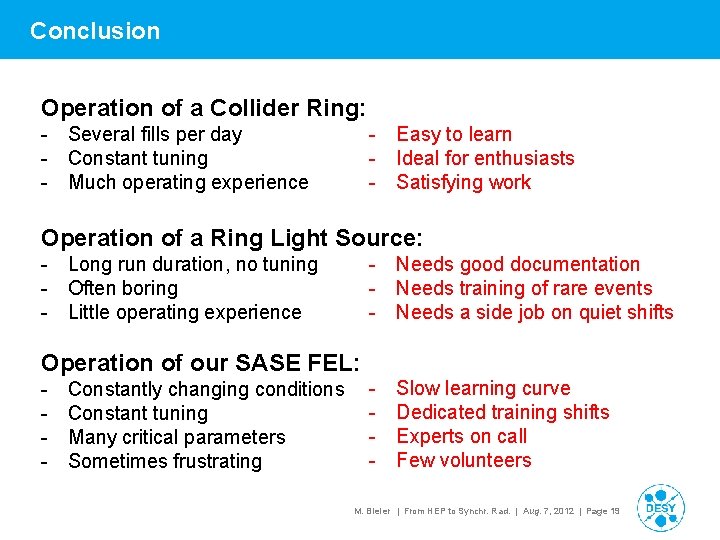
Conclusion Operation of a Collider Ring: - Easy to learn - Ideal for enthusiasts - Satisfying work - Several fills per day - Constant tuning - Much operating experience Operation of a Ring Light Source: - Needs good documentation - Needs training of rare events - Needs a side job on quiet shifts - Long run duration, no tuning - Often boring - Little operating experience Operation of our SASE FEL: - Constantly changing conditions Constant tuning Many critical parameters Sometimes frustrating - Slow learning curve Dedicated training shifts Experts on call Few volunteers M. Bieler | From HEP to Synchr. Rad. | Aug. 7, 2012 | Page 19
Conclusion For DESY in total the transition from HEP to Photon Science went rather well. (Photon Science grew slowly over many years, HEP is still very active at LHC) Work in the control room has changed: From routine operation with much tuning to - waiting for a beam loss - tuning without guaranteed success Some operators are missing the good old days. M. Bieler | From HEP to Synchr. Rad. | Aug. 7, 2012 | Page 20