
DESTIN The Peer Review Process How will the


- Slides: 23
DESTIN The Peer Review Process
How will the peer reviews work? Work to be done before peer review? David Quin, Programme Co-Chair, Lecturer, Department of Film and Media, National Film School, IADT
Three DESTIN peer review panels in March 2020. . . - Our DESTIN Application document says that we will form three peer-review panels that will study the documentation provided by each CDT, conduct site visits to each Ukrainian university, and produce a report on the findings. Although we should expect each panel to be quite formal in the way that it operates (as if it were an official validating/course-approval panel), it is important to remember that the purpose of the panel is developmental (to give advice about what has been achieved and what enhancements can be made) rather than judgemental.
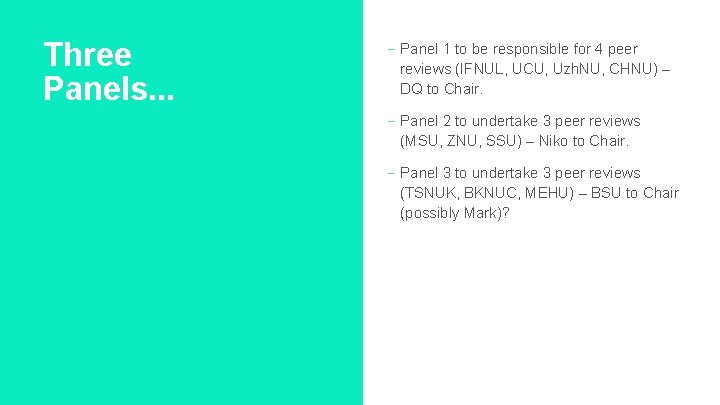
Three Panels. . . - Panel 1 to be responsible for 4 peer reviews (IFNUL, UCU, Uzh. NU, CHNU) – DQ to Chair. - Panel 2 to undertake 3 peer reviews (MSU, ZNU, SSU) – Niko to Chair. - Panel 3 to undertake 3 peer reviews (TSNUK, BKNUC, MEHU) – BSU to Chair (possibly Mark)?
Peer Review Panels. . . - IADT is unique. Ireland’s only institute of art, design and technology - Focus on creative, cultural and technological sectors - Campus is alive with ideas, innovation and entrepreneurial activity - Students work with fantastic staff, many of whom are internationally acclaimed - Home to the National Film School - Fresh, modern campus with lively friendly atmosphere
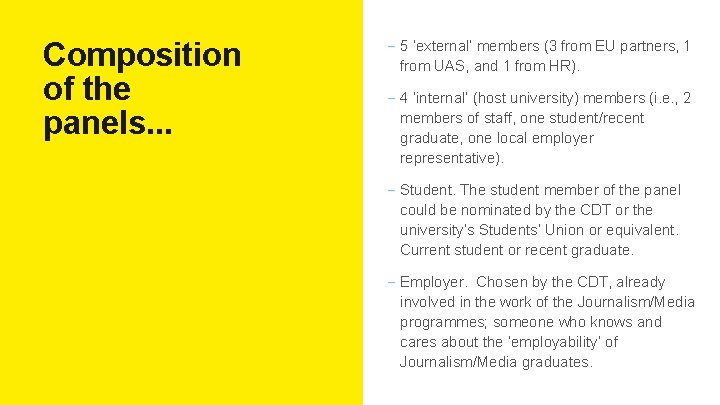
Composition of the panels. . . - 5 ‘external’ members (3 from EU partners, 1 from UAS, and 1 from HR). - 4 ’internal’ (host university) members (i. e. , 2 members of staff, one student/recent graduate, one local employer representative). - Student. The student member of the panel could be nominated by the CDT or the university’s Students’ Union or equivalent. Current student or recent graduate. - Employer. Chosen by the CDT, already involved in the work of the Journalism/Media programmes; someone who knows and cares about the ‘employability’ of Journalism/Media graduates.
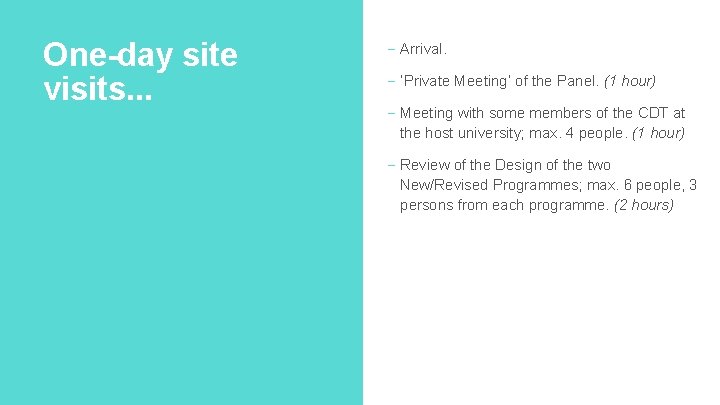
One-day site visits. . . - Arrival. - ‘Private Meeting’ of the Panel. (1 hour) - Meeting with some members of the CDT at the host university; max. 4 people. (1 hour) - Review of the Design of the two New/Revised Programmes; max. 6 people, 3 persons from each programme. (2 hours)
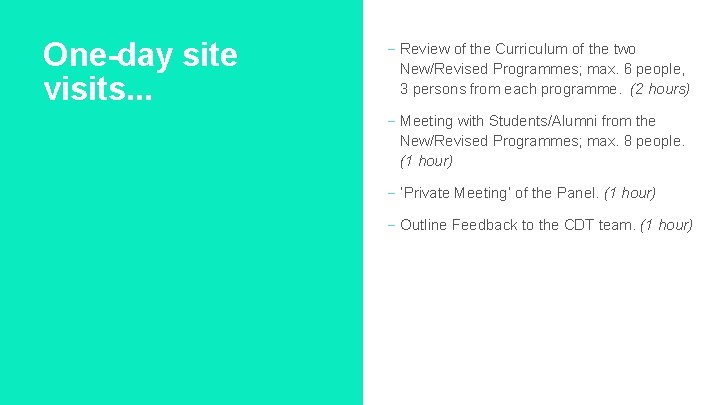
One-day site visits. . . - Review of the Curriculum of the two New/Revised Programmes; max. 6 people, 3 persons from each programme. (2 hours) - Meeting with Students/Alumni from the New/Revised Programmes; max. 8 people. (1 hour) - ‘Private Meeting’ of the Panel. (1 hour) - Outline Feedback to the CDT team. (1 hour)
UKR Agency criteria. . .
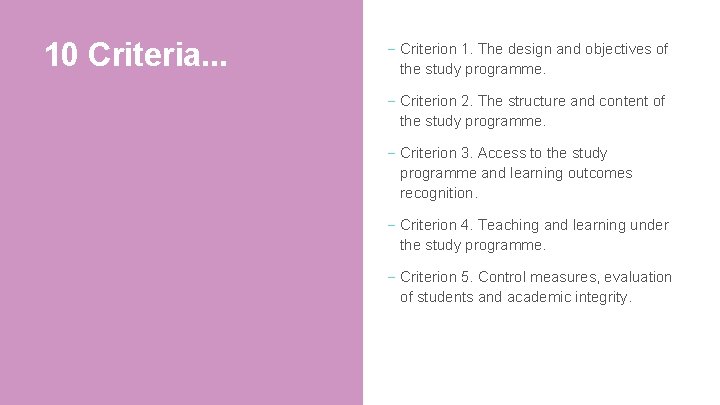
10 Criteria. . . - Criterion 1. The design and objectives of the study programme. - Criterion 2. The structure and content of the study programme. - Criterion 3. Access to the study programme and learning outcomes recognition. - Criterion 4. Teaching and learning under the study programme. - Criterion 5. Control measures, evaluation of students and academic integrity.
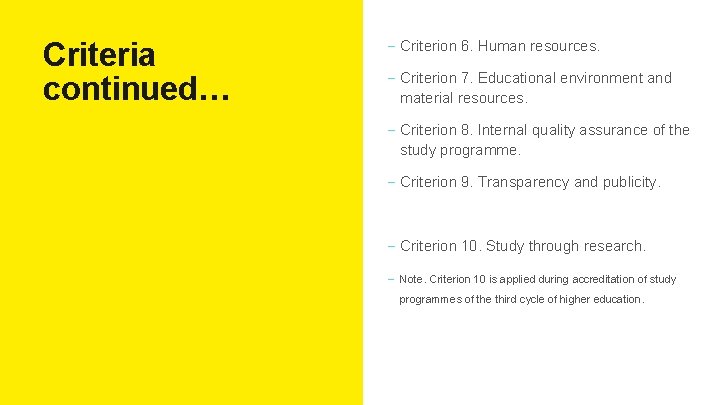
Criteria continued… - Criterion 6. Human resources. - Criterion 7. Educational environment and material resources. - Criterion 8. Internal quality assurance of the study programme. - Criterion 9. Transparency and publicity. - Criterion 10. Study through research. - Note. Criterion 10 is applied during accreditation of study programmes of the third cycle of higher education.
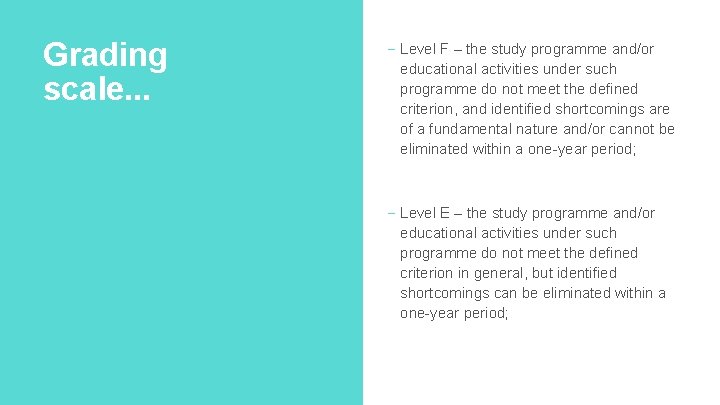
Grading scale. . . - Level F – the study programme and/or educational activities under such programme do not meet the defined criterion, and identified shortcomings are of a fundamental nature and/or cannot be eliminated within a one-year period; - Level E – the study programme and/or educational activities under such programme do not meet the defined criterion in general, but identified shortcomings can be eliminated within a one-year period;
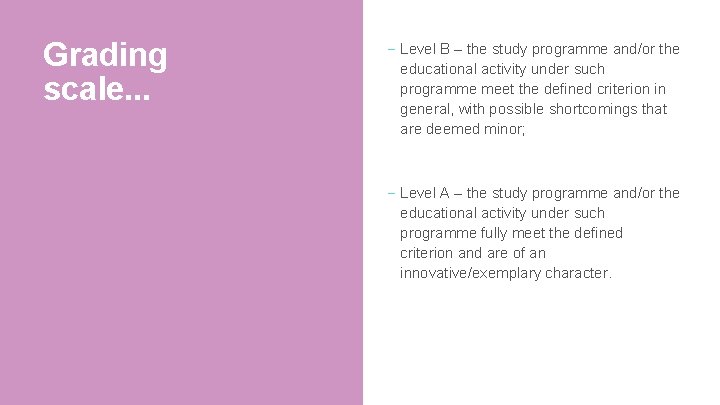
Grading scale. . . - Level B – the study programme and/or the educational activity under such programme meet the defined criterion in general, with possible shortcomings that are deemed minor; - Level A – the study programme and/or the educational activity under such programme fully meet the defined criterion and are of an innovative/exemplary character.
Peer Review Panels. . . - IADT is unique. Ireland’s only institute of art, design and technology - Focus on creative, cultural and technological sectors - Campus is alive with ideas, innovation and entrepreneurial activity - Students work with fantastic staff, many of whom are internationally acclaimed - Home to the National Film School - Fresh, modern campus with lively friendly atmosphere
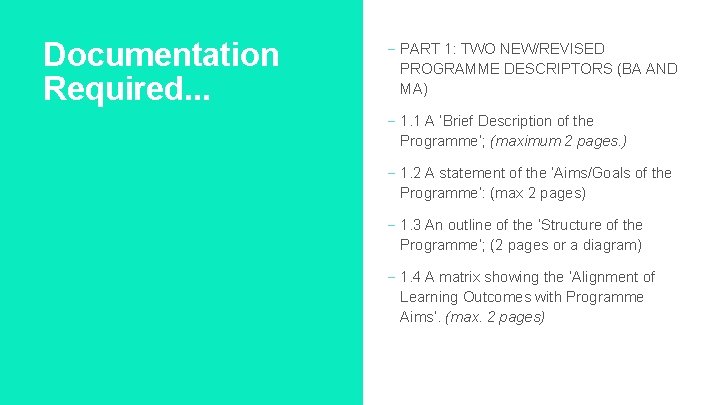
Documentation Required. . . - PART 1: TWO NEW/REVISED PROGRAMME DESCRIPTORS (BA AND MA) - 1. 1 A ‘Brief Description of the Programme’; (maximum 2 pages. ) - 1. 2 A statement of the ‘Aims/Goals of the Programme’: (max 2 pages) - 1. 3 An outline of the ‘Structure of the Programme’; (2 pages or a diagram) - 1. 4 A matrix showing the ‘Alignment of Learning Outcomes with Programme Aims’. (max. 2 pages)
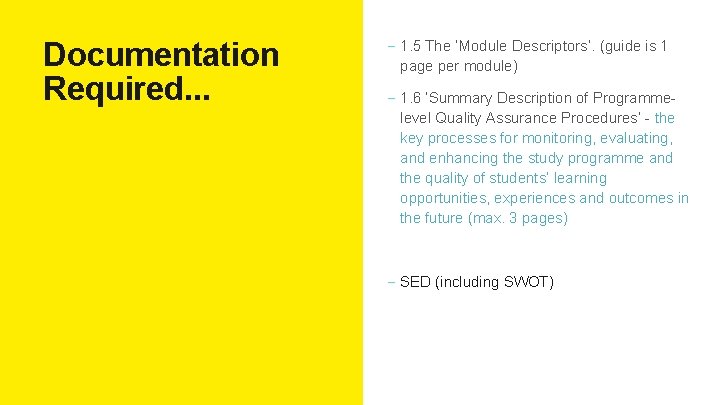
Documentation Required. . . - 1. 5 The ‘Module Descriptors’. (guide is 1 page per module) - 1. 6 ‘Summary Description of Programmelevel Quality Assurance Procedures’ - the key processes for monitoring, evaluating, and enhancing the study programme and the quality of students’ learning opportunities, experiences and outcomes in the future (max. 3 pages) - SED (including SWOT)
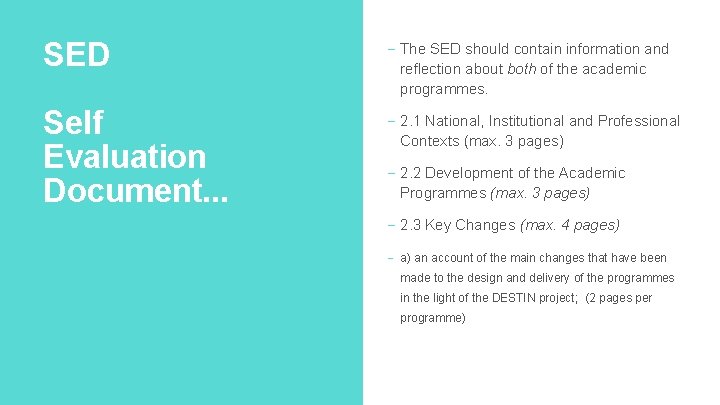
SED - The SED should contain information and reflection about both of the academic programmes. Self Evaluation Document. . . - 2. 1 National, Institutional and Professional Contexts (max. 3 pages) - 2. 2 Development of the Academic Programmes (max. 3 pages) - 2. 3 Key Changes (max. 4 pages) - a) an account of the main changes that have been made to the design and delivery of the programmes in the light of the DESTIN project; (2 pages per programme)
SED Self Evaluation Document. . . continued… - 2. 4 Information about Students (max. 3 pages) - a) quantitative data on the two academic programmes: e. g. , current student numbers, demographic data (ethnicity, gender, disability, age), entry standards, enrolments, course/study choices, progression rates, mobility, academic performance, post-award employment, international students. - b) qualitative data, in the form of short statements that would help panel members to understand how the design and content of the two academic programmes have been revised to provide learning opportunities, experiences and outcomes (employability)that address the nature and variety of future students’ needs and aspirations.
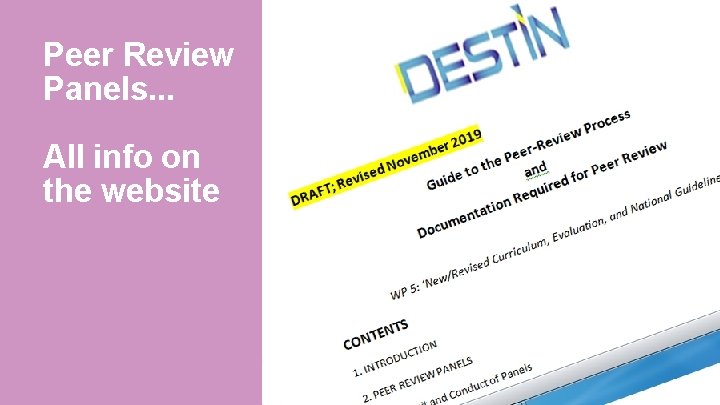
Peer Review Panels. . . - IADT is unique. Ireland’s only institute of art, design and technology All info on the website - Campus is alive with ideas, innovation and entrepreneurial activity - Focus on creative, cultural and technological sectors - Students work with fantastic staff, many of whom are internationally acclaimed - Home to the National Film School - Fresh, modern campus with lively friendly atmosphere
Possible DRAFT DESTIN KYIV Training for Trainers and TFT Toolkit training… day one - 09: 00 to 11: 00 - Peer Review Process… How it works. Why are we doing this? - 11: 30 to 13: 00 - The university SWOTs and SERs - 14: 00 to 15: 30 – How to use TOOLs in the TFT TOOLKIT! - Ronan’s Study Programme Document - 16: 00 to 17: 30 - Aligning with Qualifications Frameworks and National Standards – EQF, NFQ and educational standards – WHY? HOW?
Possible DRAFT DESTIN KYIV Training for Trainers and TFT Toolkit training… - 09: 00 to 11: 00 - A MOCK peer review panel – one university presents itself for review in front of the whole group (we did this on ALIGN and it worked well!) - 11: 30 to 13: 00 – feedback from the MOCK peer review panel (and group discussion) - 14: 00 to 15: 30 - Back to your university’s SWOT and SER – what changes do you think you now NEED to make? - 16: 00 to 17: 30 day two - What next – sequencing – updated Action Plans – HOW to start writing – What help you’ll need from mentors etc…
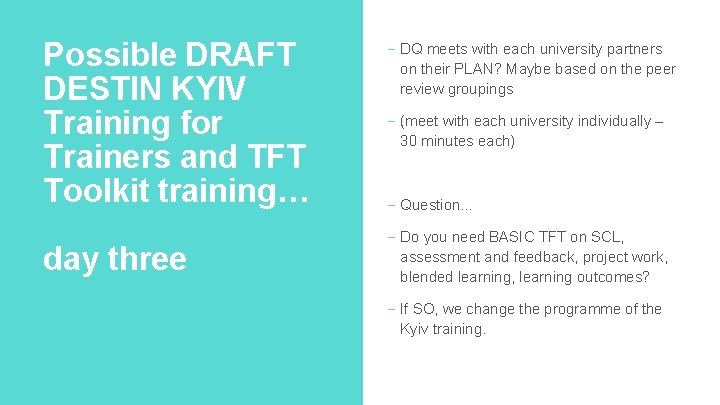
Possible DRAFT DESTIN KYIV Training for Trainers and TFT Toolkit training… day three - DQ meets with each university partners on their PLAN? Maybe based on the peer review groupings - (meet with each university individually – 30 minutes each) - Question… - Do you need BASIC TFT on SCL, assessment and feedback, project work, blended learning, learning outcomes? - If SO, we change the programme of the Kyiv training.
end. questions? David. Quin@iadt. ie @my. IADT