
Designing VariationTolerance in MixedSignal Components of a SystemonChip

- Slides: 14
Designing Variation-Tolerance in Mixed-Signal Components of a System-on-Chip Wei Jiang and Vishwani D. Agrawal Electrical and Computer Engineering Auburn University, Auburn, AL 36849 weijiang@auburn. edu, vagrawal@eng. auburn. edu 2009 IEEE International Symposium on Circuits and Systems
Motivation • Process variation in nanoscale technology – Catastrophic faults – Parametric faults, more than before, cause • Degraded performance • Yield reduction • Built-in self-test and self-calibration – Test and diagnosis – Device calibration • Characteristics measurement • On-chip error correction ISCAS'09 2
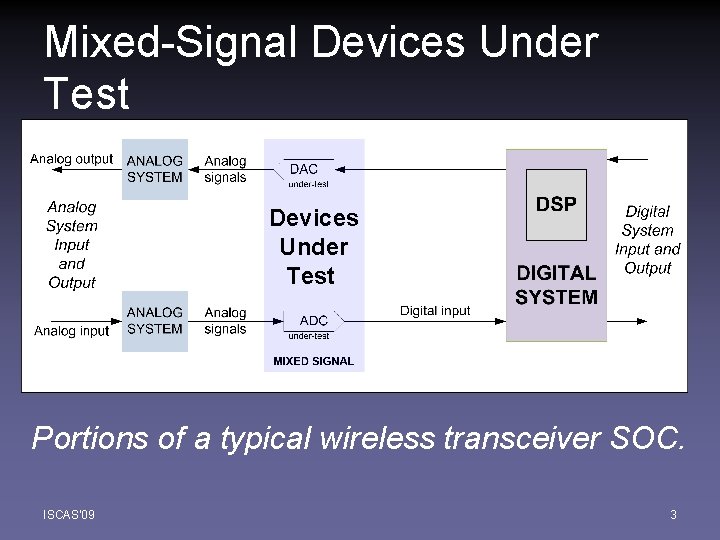
Mixed-Signal Devices Under Test Portions of a typical wireless transceiver SOC. ISCAS'09 3
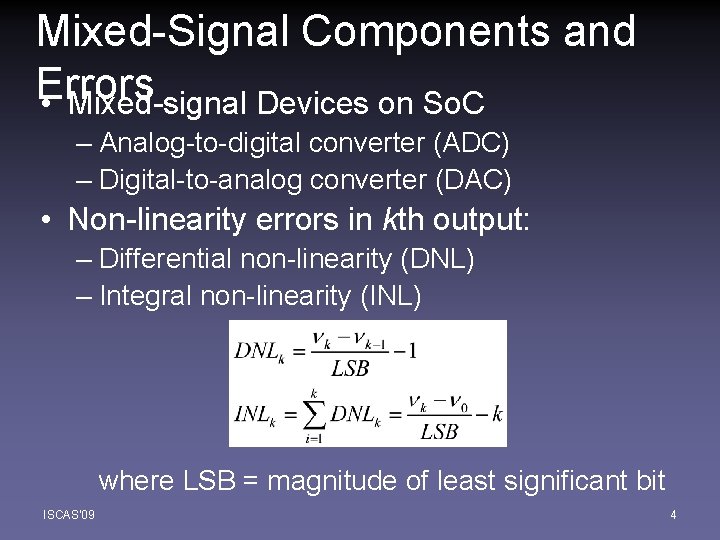
Mixed-Signal Components and Errors • Mixed-signal Devices on So. C – Analog-to-digital converter (ADC) – Digital-to-analog converter (DAC) • Non-linearity errors in kth output: – Differential non-linearity (DNL) – Integral non-linearity (INL) where LSB = magnitude of least significant bit ISCAS'09 4
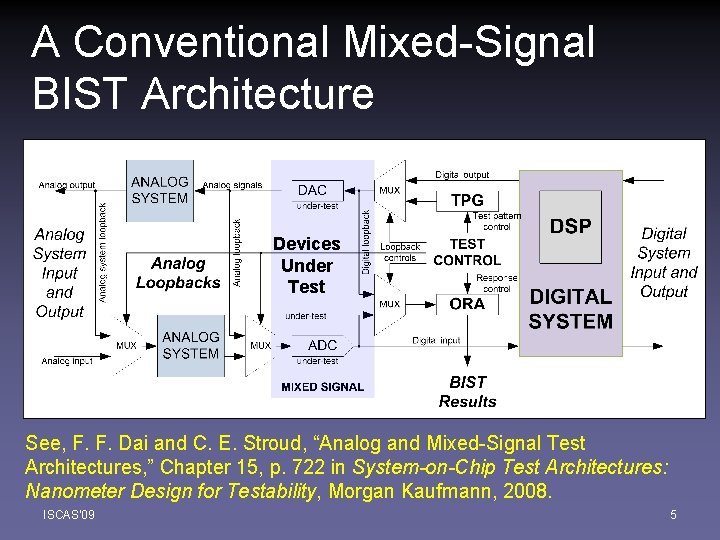
A Conventional Mixed-Signal BIST Architecture Devices Under Test See, F. F. Dai and C. E. Stroud, “Analog and Mixed-Signal Test Architectures, ” Chapter 15, p. 722 in System-on-Chip Test Architectures: Nanometer Design for Testability, Morgan Kaufmann, 2008. ISCAS'09 5
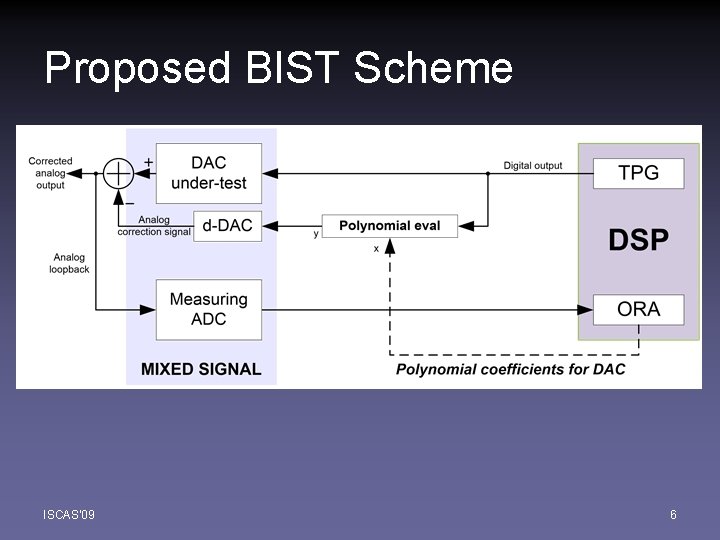
Proposed BIST Scheme ISCAS'09 6
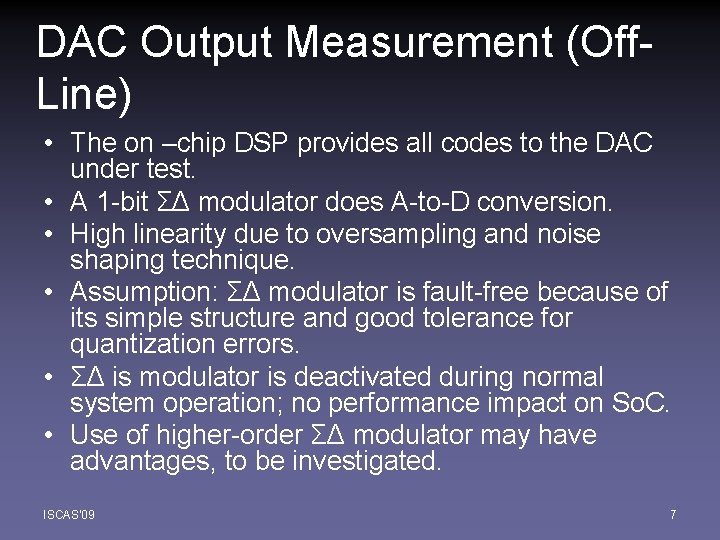
DAC Output Measurement (Off. Line) • The on –chip DSP provides all codes to the DAC under test. • A 1 -bit ΣΔ modulator does A-to-D conversion. • High linearity due to oversampling and noise shaping technique. • Assumption: ΣΔ modulator is fault-free because of its simple structure and good tolerance for quantization errors. • ΣΔ is modulator is deactivated during normal system operation; no performance impact on So. C. • Use of higher-order ΣΔ modulator may have advantages, to be investigated. ISCAS'09 7
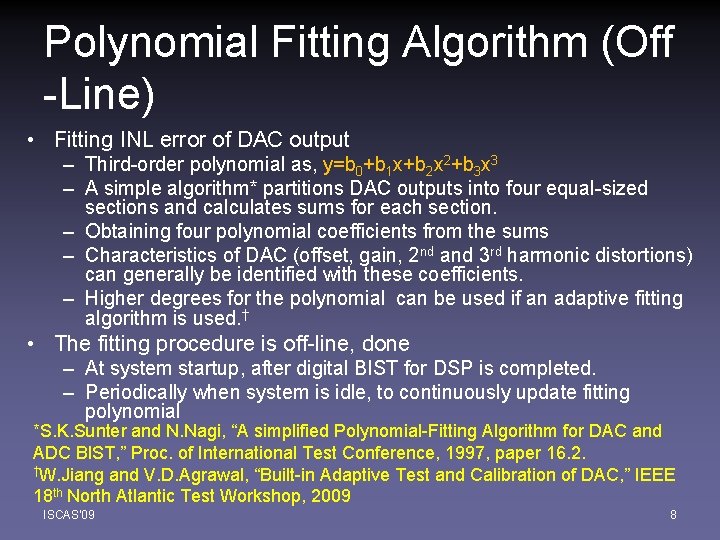
Polynomial Fitting Algorithm (Off -Line) • Fitting INL error of DAC output – Third-order polynomial as, y=b 0+b 1 x+b 2 x 2+b 3 x 3 – A simple algorithm* partitions DAC outputs into four equal-sized sections and calculates sums for each section. – Obtaining four polynomial coefficients from the sums – Characteristics of DAC (offset, gain, 2 nd and 3 rd harmonic distortions) can generally be identified with these coefficients. – Higher degrees for the polynomial can be used if an adaptive fitting algorithm is used. † • The fitting procedure is off-line, done – At system startup, after digital BIST for DSP is completed. – Periodically when system is idle, to continuously update fitting polynomial *S. K. Sunter and N. Nagi, “A simplified Polynomial-Fitting Algorithm for DAC and ADC BIST, ” Proc. of International Test Conference, 1997, paper 16. 2. †W. Jiang and V. D. Agrawal, “Built-in Adaptive Test and Calibration of DAC, ” IEEE 18 th North Atlantic Test Workshop, 2009 ISCAS'09 8
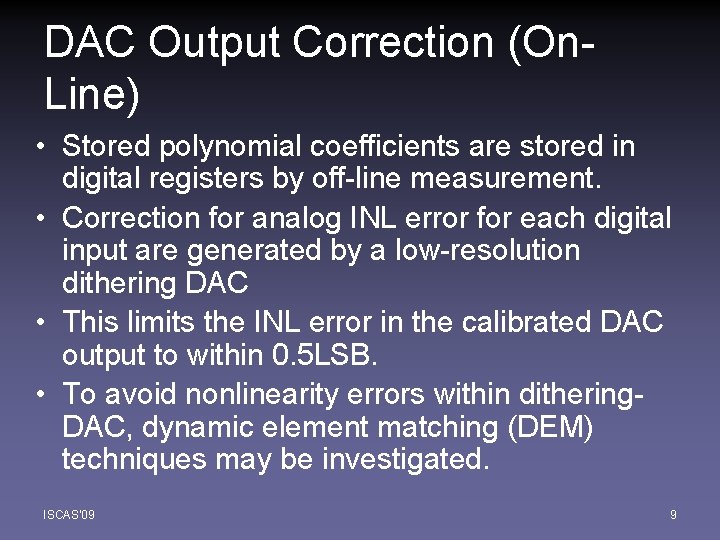
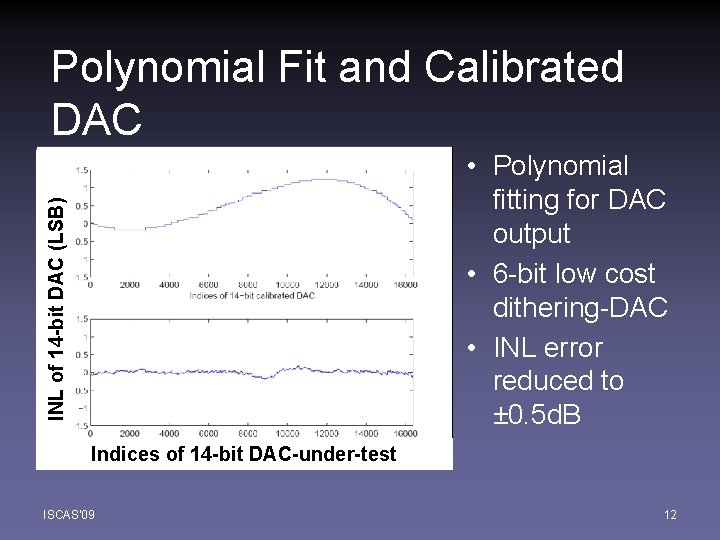
DAC Output Correction (On. Line) • Stored polynomial coefficients are stored in digital registers by off-line measurement. • Correction for analog INL error for each digital input are generated by a low-resolution dithering DAC • This limits the INL error in the calibrated DAC output to within 0. 5 LSB. • To avoid nonlinearity errors within dithering. DAC, dynamic element matching (DEM) techniques may be investigated. ISCAS'09 9
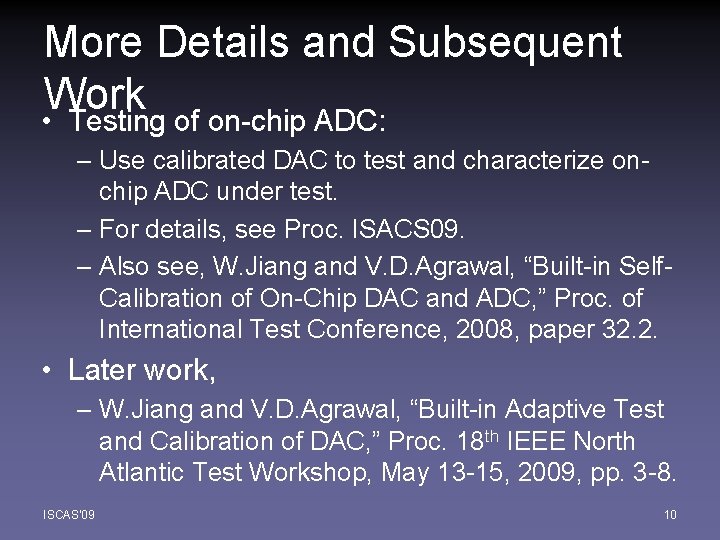
More Details and Subsequent Work • Testing of on-chip ADC: – Use calibrated DAC to test and characterize onchip ADC under test. – For details, see Proc. ISACS 09. – Also see, W. Jiang and V. D. Agrawal, “Built-in Self. Calibration of On-Chip DAC and ADC, ” Proc. of International Test Conference, 2008, paper 32. 2. • Later work, – W. Jiang and V. D. Agrawal, “Built-in Adaptive Test and Calibration of DAC, ” Proc. 18 th IEEE North Atlantic Test Workshop, May 13 -15, 2009, pp. 3 -8. ISCAS'09 10
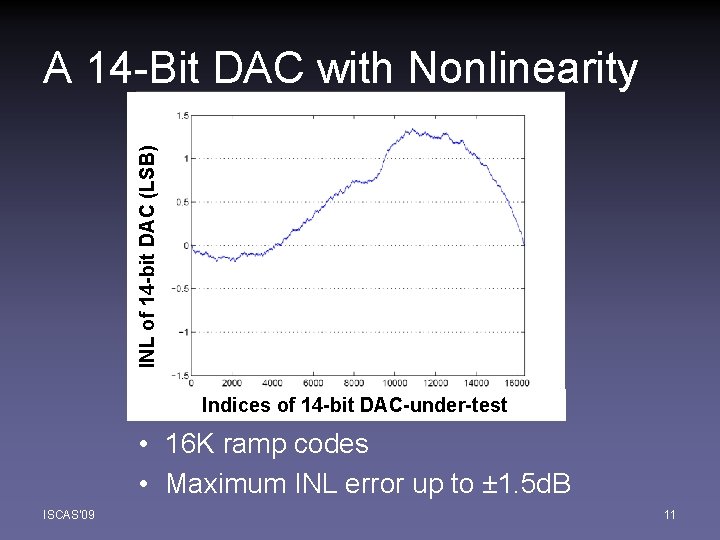
INL of 14 -bit DAC (LSB) A 14 -Bit DAC with Nonlinearity Indices of 14 -bit DAC-under-test • 16 K ramp codes • Maximum INL error up to ± 1. 5 d. B ISCAS'09 11
Polynomial Fit and Calibrated DAC INL of 14 -bit DAC (LSB) • Polynomial fitting for DAC output • 6 -bit low cost dithering-DAC • INL error reduced to ± 0. 5 d. B Indices of 14 -bit DAC-under-test ISCAS'09 12
Conclusion and Future Work • Proposed technique – Uses simple devices for a post-fabrication technique to improve system reliability against process-variation. – Off-line built-in fault-detection and parameter characterization. – On-line at-speed self-correction for nonlinearity errors. • Future Work – Reliable self-test for test and calibration circuitry (sigma-delta modulator, dithering DAC, etc. ) – Generalize the polynomial interpolation of INL to higher degree polynomials. ISCAS'09 13
Thank you • Authors will appreciate your questions or comments. • Please write to: – Wei Jiang, weijiang@auburn. edu – Vishwani D. Agrawal vagrawal@eng. auburn. edu ISCAS'09 14