
Designing TriplePlay Apps Using DSP Resource Boards Amir

Designing Triple-Play Apps Using DSP Resource Boards Amir Zmora VP Marketing & Product Management Surf Communication Solutions
Agenda • • • Voice and Video Market Trends Operators Needs Triple-Play in Action Optimal Hardware System Architecture Optimal Software System Architecture Summary

Voice and Video Market Trends
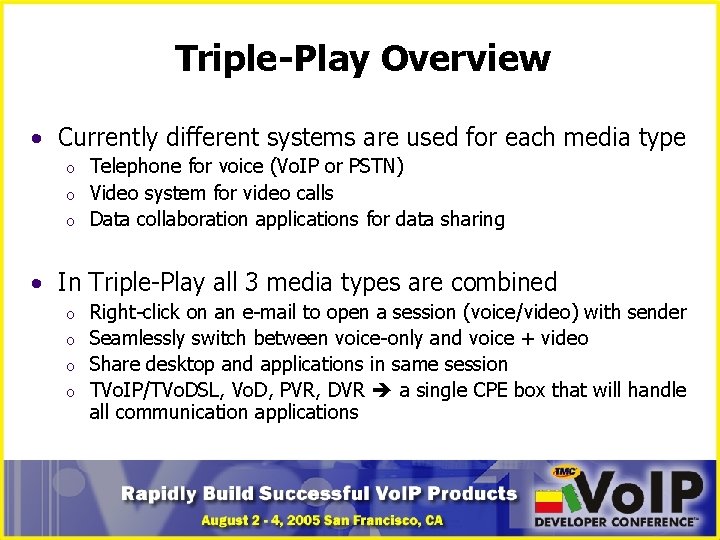
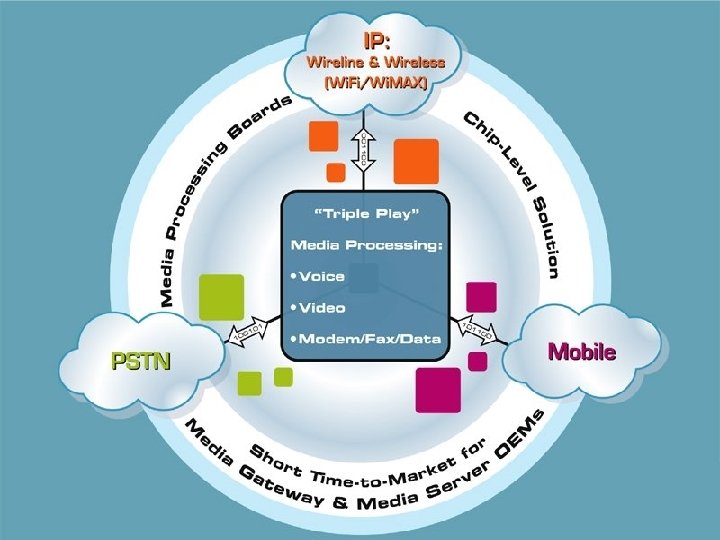
Triple-Play Overview • Currently different systems are used for each media type o o o Telephone for voice (Vo. IP or PSTN) Video system for video calls Data collaboration applications for data sharing • In Triple-Play all 3 media types are combined o o Right-click on an e-mail to open a session (voice/video) with sender Seamlessly switch between voice-only and voice + video Share desktop and applications in same session TVo. IP/TVo. DSL, Vo. D, PVR, DVR a single CPE box that will handle all communication applications
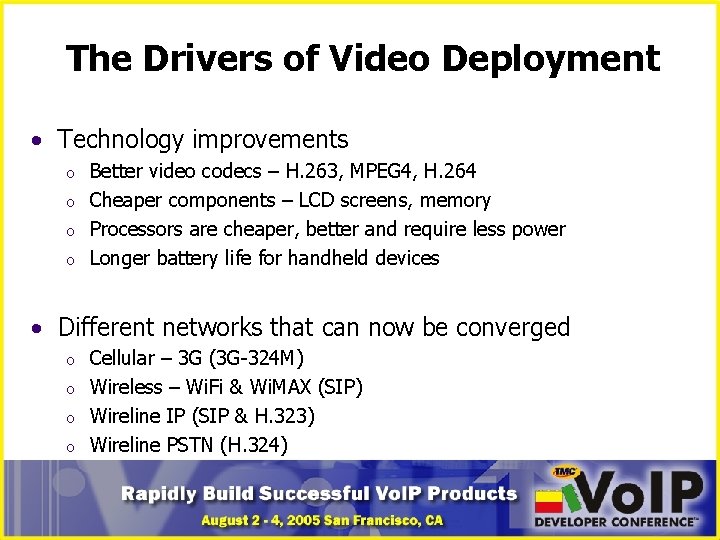
The Drivers of Video Deployment • Technology improvements o o Better video codecs – H. 263, MPEG 4, H. 264 Cheaper components – LCD screens, memory Processors are cheaper, better and require less power Longer battery life for handheld devices • Different networks that can now be converged o o Cellular – 3 G (3 G-324 M) Wireless – Wi. Fi & Wi. MAX (SIP) Wireline IP (SIP & H. 323) Wireline PSTN (H. 324)
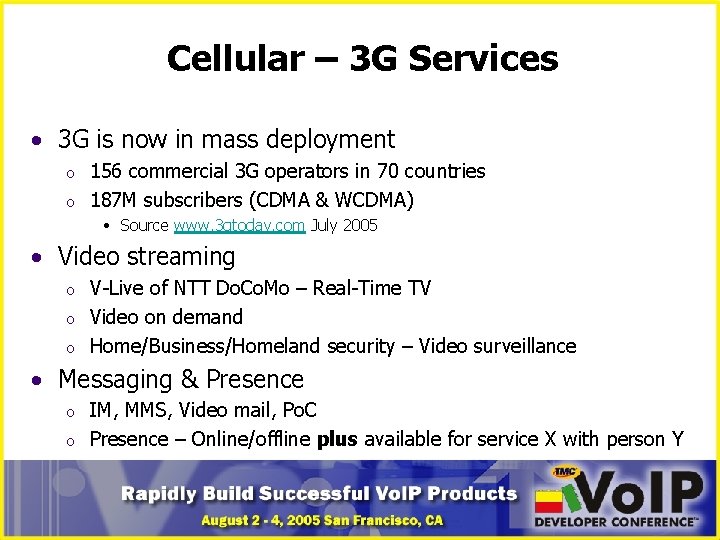
Cellular – 3 G Services • 3 G is now in mass deployment o o 156 commercial 3 G operators in 70 countries 187 M subscribers (CDMA & WCDMA) • Source www. 3 gtoday. com July 2005 • Video streaming o o o V-Live of NTT Do. Co. Mo – Real-Time TV Video on demand Home/Business/Homeland security – Video surveillance • Messaging & Presence o o IM, MMS, Video mail, Po. C Presence – Online/offline plus available for service X with person Y
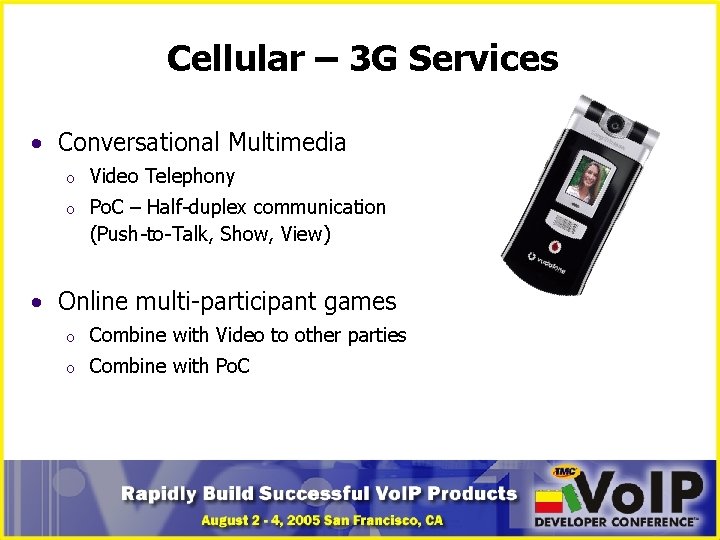
Cellular – 3 G Services • Conversational Multimedia o Video Telephony o Po. C – Half-duplex communication (Push-to-Talk, Show, View) • Online multi-participant games o Combine with Video to other parties o Combine with Po. C
Wireless IP - Wi. Fi & Wi. MAX • Wi. Fi (and Wi. MAX, in the future) will be integrated into mobile devices • A mobile device will roam seamlessly between networks o o o In the office – Use Wi. Fi as a terminal in office PBX In the city – Use Wi. MAX if available for higher bandwidth at lower price On the go – Use 3 G cellular network • Hence all services in cellular network will need to be available also in Wireless
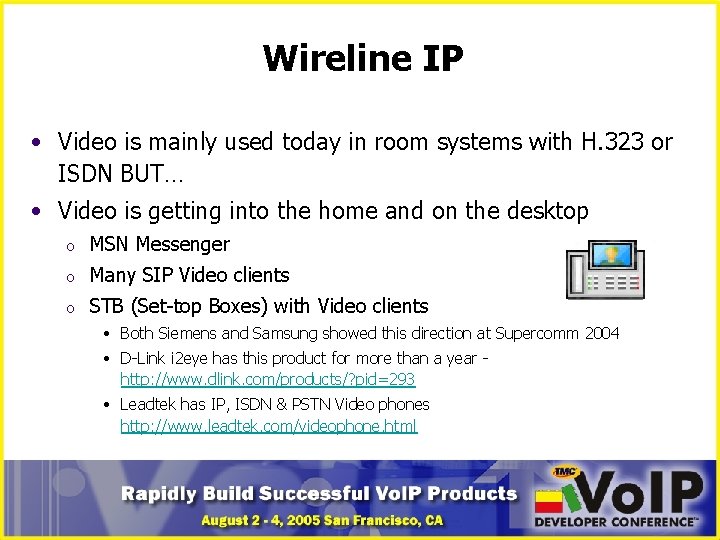
Wireline IP • Video is mainly used today in room systems with H. 323 or ISDN BUT… • Video is getting into the home and on the desktop o MSN Messenger o Many SIP Video clients o STB (Set-top Boxes) with Video clients • Both Siemens and Samsung showed this direction at Supercomm 2004 • D-Link i 2 eye has this product for more than a year http: //www. dlink. com/products/? pid=293 • Leadtek has IP, ISDN & PSTN Video phones http: //www. leadtek. com/videophone. html
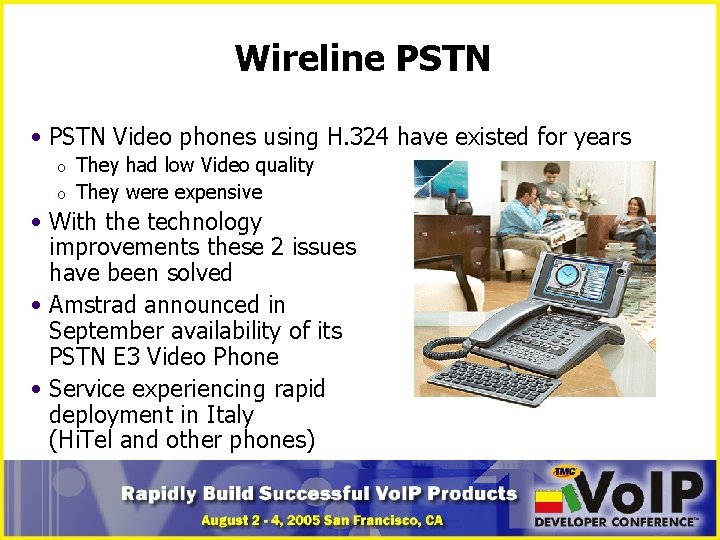
Wireline PSTN • PSTN Video phones using H. 324 have existed for years o o They had low Video quality They were expensive • With the technology improvements these 2 issues have been solved • Amstrad announced in September availability of its PSTN E 3 Video Phone • Service experiencing rapid deployment in Italy (Hi. Tel and other phones)
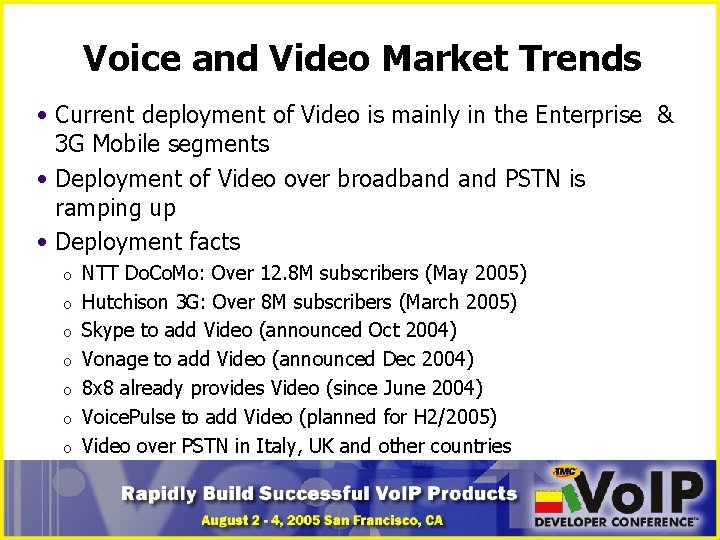
Voice and Video Market Trends • Current deployment of Video is mainly in the Enterprise & 3 G Mobile segments • Deployment of Video over broadband PSTN is ramping up • Deployment facts o o o o NTT Do. Co. Mo: Over 12. 8 M subscribers (May 2005) Hutchison 3 G: Over 8 M subscribers (March 2005) Skype to add Video (announced Oct 2004) Vonage to add Video (announced Dec 2004) 8 x 8 already provides Video (since June 2004) Voice. Pulse to add Video (planned for H 2/2005) Video over PSTN in Italy, UK and other countries
Operators Needs
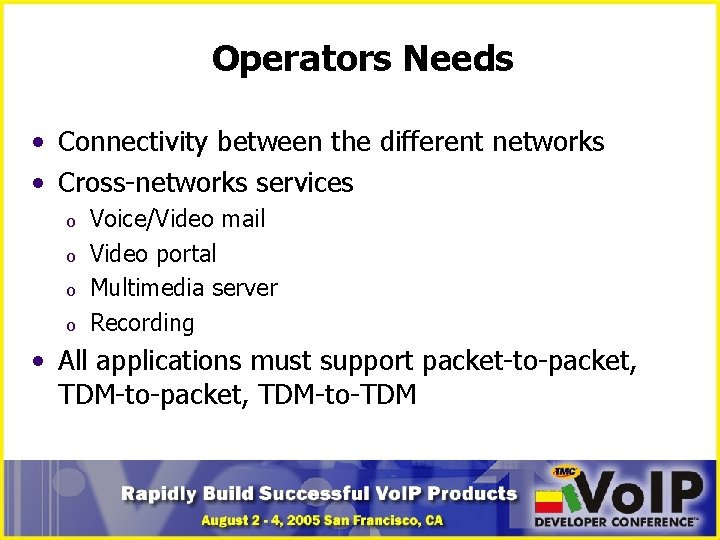
Operators Needs • Connectivity between the different networks • Cross-networks services o o Voice/Video mail Video portal Multimedia server Recording • All applications must support packet-to-packet, TDM-to-TDM
Operators Needs cont’d • Since Video deployment demands are still relatively small compared to Voice deployment, flexible channel type assignment is required • Price, Price! o o Smooth and flexible migration from Voice systems to Voice and Video systems Simple, synchronized, and balanced systems
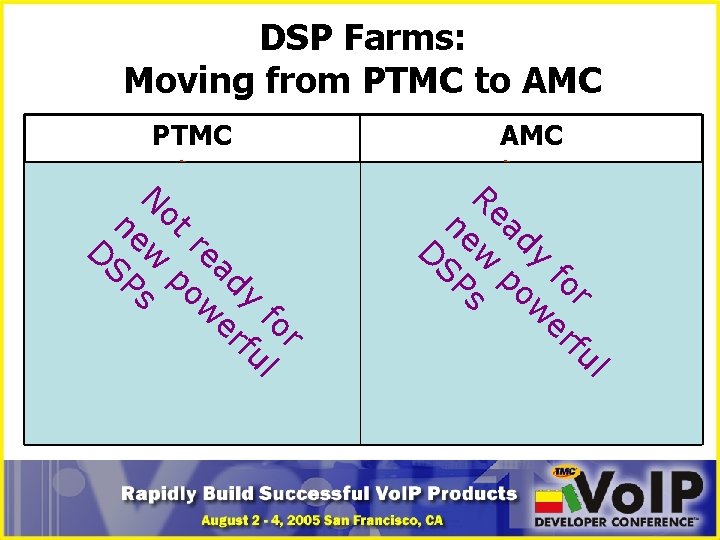
DSP Farms: Moving from PTMC to AMC PTMC PCI TDM 10 s of Megs in back plane PCI Express Gigs of traffic r fu fo er y w ad po Re w s ne SP D GB Ethernet Rapid I/O Non hot swap Hot swap Up to 15 Watt Up to 30 Watt 10 Gig per AMC in back plane No defined control mechanism Well-defined control mechanism in spec l r fo l y rfu ad e re ow ot p N w s ne SP D MII Megs of traffic AMC
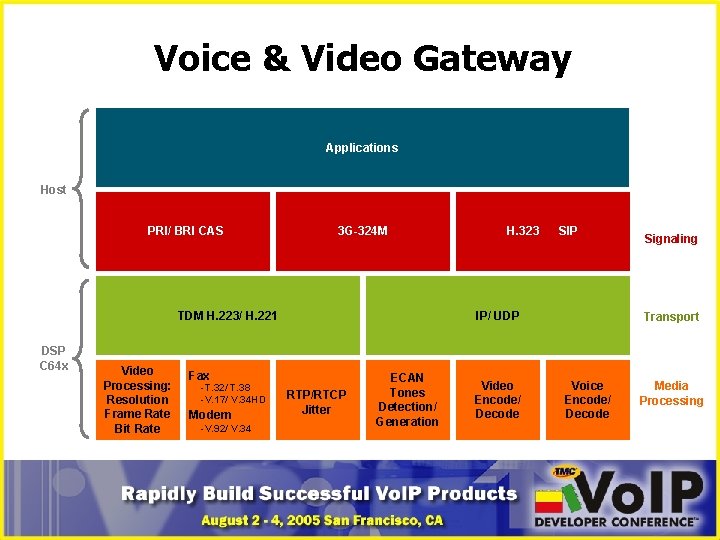
Voice & Video Gateway Applications Host PRI/ BRI CAS 3 G-324 M TDM H. 223/ H. 221 DSP C 64 x Video Processing: Resolution Frame Rate Bit Rate Modem -V. 92/ V. 34 SIP IP/ UDP Fax -T. 32/ T. 38 -V. 17/ V. 34 HD H. 323 RTP/RTCP Jitter ECAN Tones Detection/ Generation Video Encode/ Decode Signaling Transport Voice Encode/ Decode Media Processing
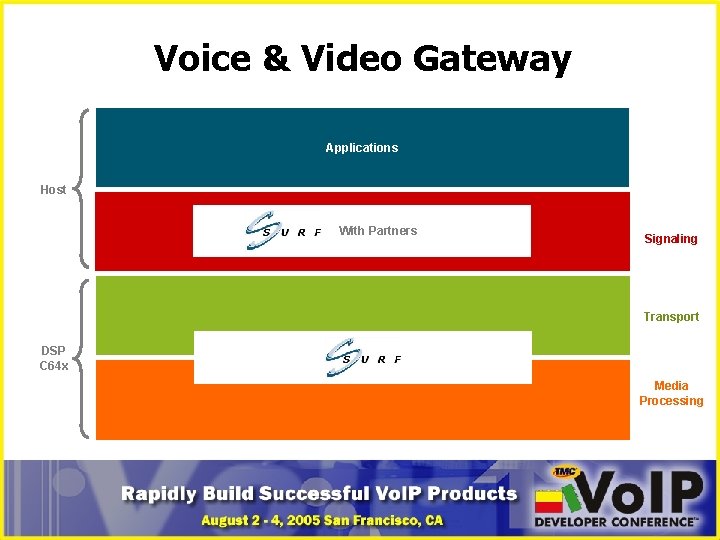
Voice & Video Gateway Applications Host PRI/ BRI CAS With Partners 3 G-324 M TDM H. 223/ H. 221 DSP C 64 x Video Processing: Resolution Frame Rate Bit Rate Modem -V. 92/ V. 34 SIP IP/ UDP Fax -T. 32/ T. 38 -V. 17/ V. 34 HD H. 323 RTP/RTCP Jitter ECAN Tones Detection/ Generation Video Encode/ Decode Signaling Transport Voice Encode/ Decode Media Processing

Triple-Play in Action
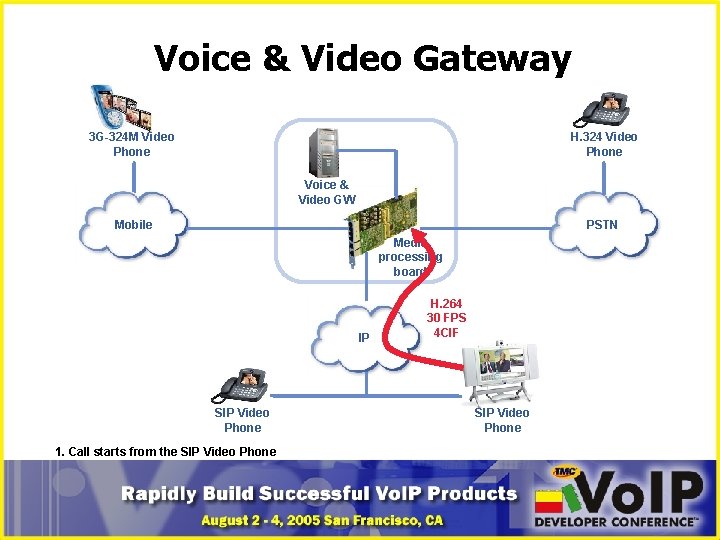
Voice & Video Gateway 3 G-324 M Video Phone H. 324 Video Phone Voice & Video GW Mobile PSTN Media processing board IP SIP Video Phone 1. Call starts from the SIP Video Phone H. 264 30 FPS 4 CIF SIP Video Phone
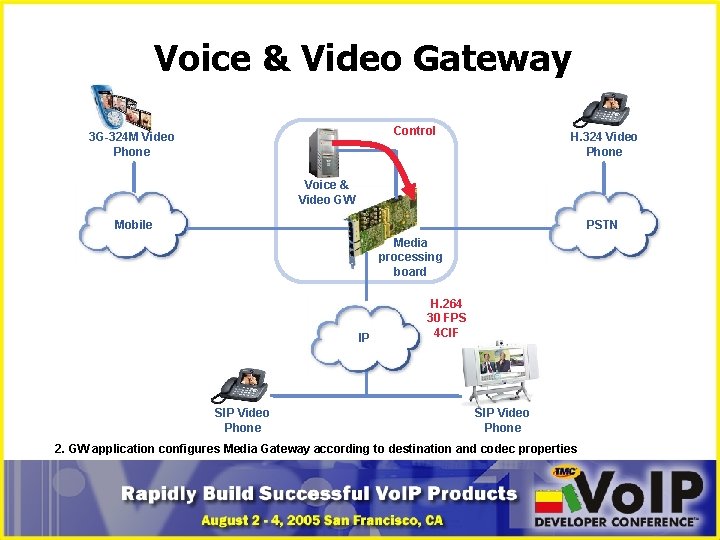
Voice & Video Gateway Control 3 G-324 M Video Phone H. 324 Video Phone Voice & Video GW Mobile PSTN Media processing board IP SIP Video Phone H. 264 30 FPS 4 CIF SIP Video Phone 2. GW application configures Media Gateway according to destination and codec properties
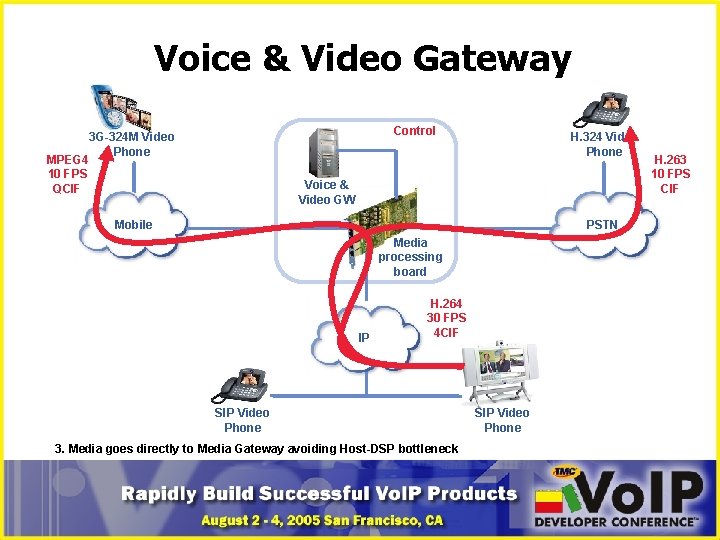
Voice & Video Gateway MPEG 4 10 FPS QCIF Control 3 G-324 M Video Phone H. 324 Video Phone Voice & Video GW Mobile PSTN Media processing board IP H. 264 30 FPS 4 CIF SIP Video Phone 3. Media goes directly to Media Gateway avoiding Host-DSP bottleneck SIP Video Phone H. 263 10 FPS CIF
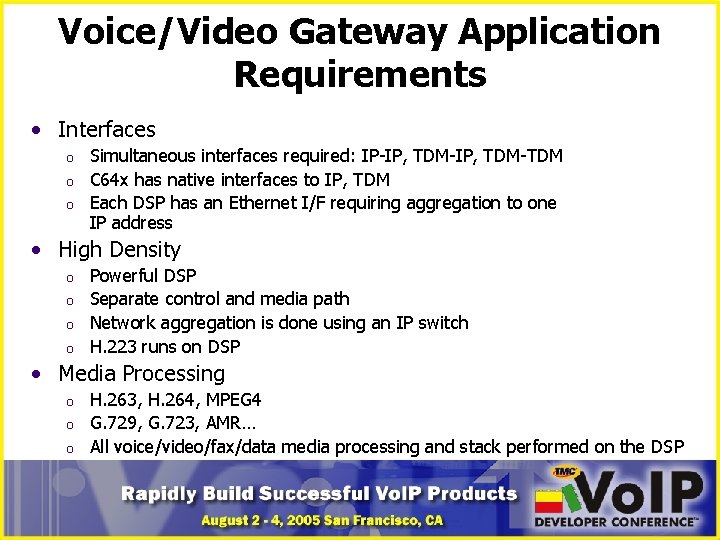
Voice/Video Gateway Application Requirements • Interfaces o o o Simultaneous interfaces required: IP-IP, TDM-TDM C 64 x has native interfaces to IP, TDM Each DSP has an Ethernet I/F requiring aggregation to one IP address • High Density o o Powerful DSP Separate control and media path Network aggregation is done using an IP switch H. 223 runs on DSP • Media Processing o o o H. 263, H. 264, MPEG 4 G. 729, G. 723, AMR… All voice/video/fax/data media processing and stack performed on the DSP
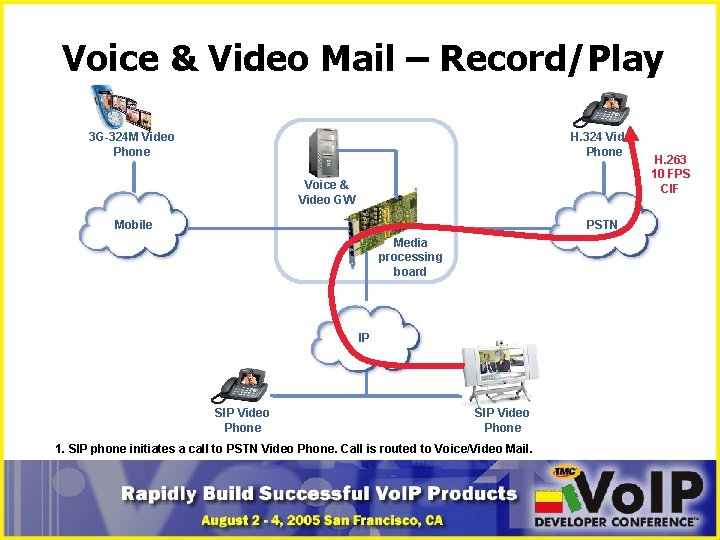
Voice & Video Mail – Record/Play 3 G-324 M Video Phone H. 324 Video Phone Voice & Video GW Mobile PSTN Media processing board IP SIP Video Phone 1. SIP phone initiates a call to PSTN Video Phone. Call is routed to Voice/Video Mail. H. 263 10 FPS CIF
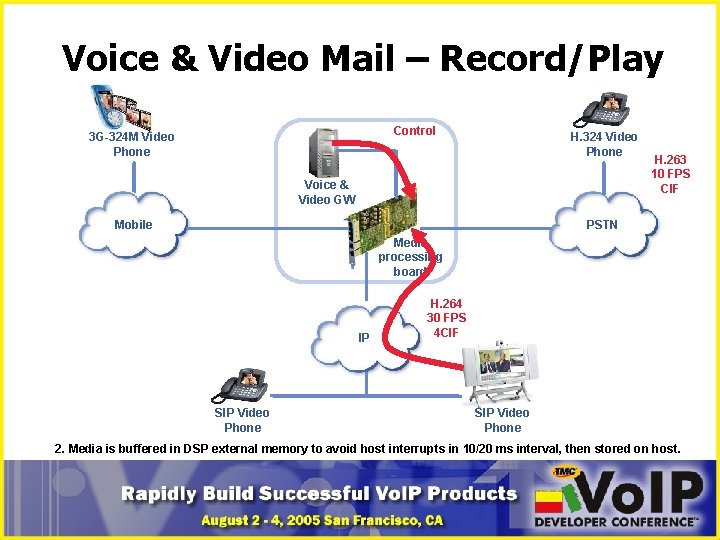
Voice & Video Mail – Record/Play Control 3 G-324 M Video Phone H. 324 Video Phone Voice & Video GW Mobile H. 263 10 FPS CIF PSTN Media processing board IP SIP Video Phone H. 264 30 FPS 4 CIF SIP Video Phone 2. Media is buffered in DSP external memory to avoid host interrupts in 10/20 ms interval, then stored on host.
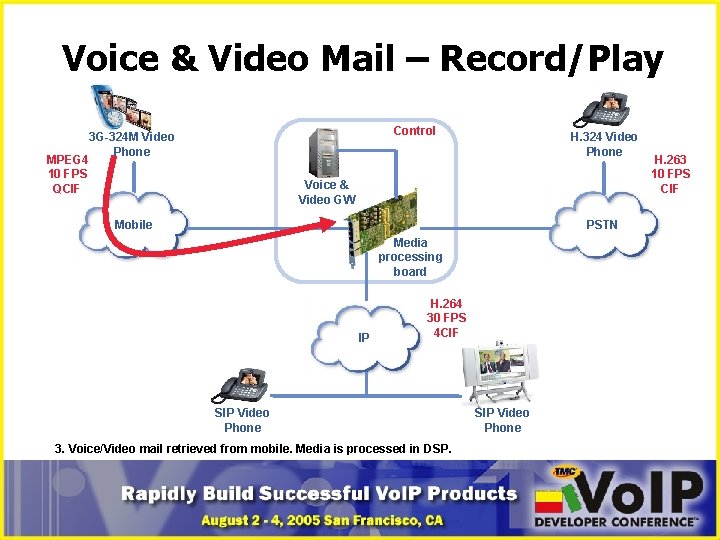
Voice & Video Mail – Record/Play MPEG 4 10 FPS QCIF Control 3 G-324 M Video Phone H. 324 Video Phone Voice & Video GW Mobile PSTN Media processing board IP H. 264 30 FPS 4 CIF SIP Video Phone 3. Voice/Video mail retrieved from mobile. Media is processed in DSP. SIP Video Phone H. 263 10 FPS CIF
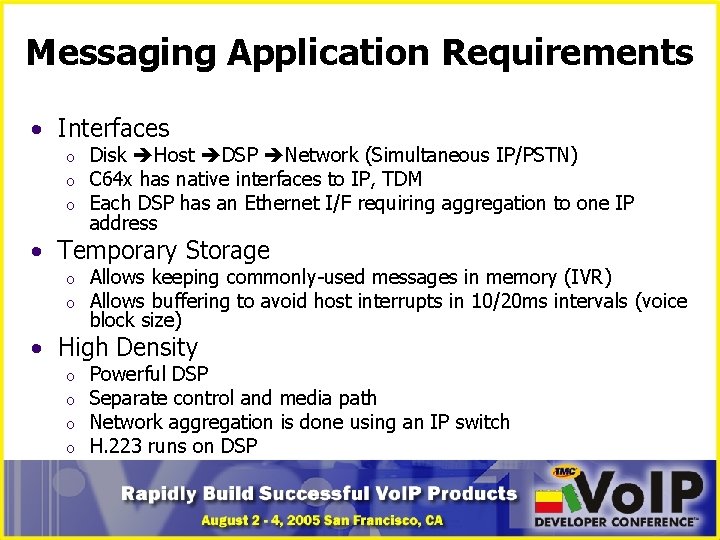
Messaging Application Requirements • Interfaces o o o Disk Host DSP Network (Simultaneous IP/PSTN) C 64 x has native interfaces to IP, TDM Each DSP has an Ethernet I/F requiring aggregation to one IP address • Temporary Storage o o Allows keeping commonly-used messages in memory (IVR) Allows buffering to avoid host interrupts in 10/20 ms intervals (voice block size) • High Density o o Powerful DSP Separate control and media path Network aggregation is done using an IP switch H. 223 runs on DSP
Messaging Application Requirements • Media Processing o o o H. 263, H. 264, MPEG 4 G. 729, G. 723, AMR… All voice/video/fax/data media processing and stack performed on the DSP • Transport o Reliable Host-DSP over UDP (“TCP light”)
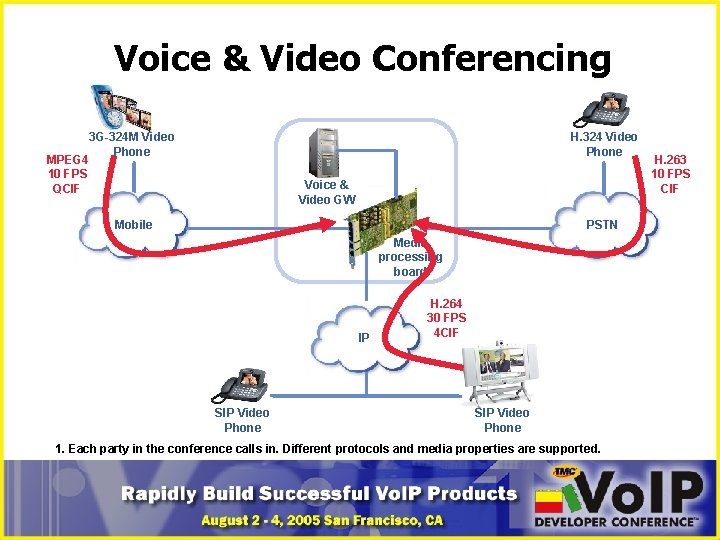
Voice & Video Conferencing MPEG 4 10 FPS QCIF 3 G-324 M Video Phone H. 324 Video Phone Voice & Video GW Mobile PSTN Media processing board IP SIP Video Phone H. 264 30 FPS 4 CIF SIP Video Phone 1. Each party in the conference calls in. Different protocols and media properties are supported. H. 263 10 FPS CIF
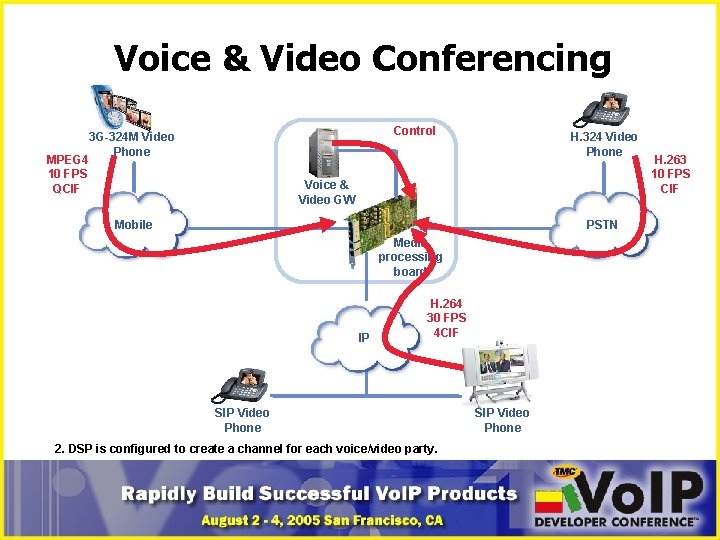
Voice & Video Conferencing MPEG 4 10 FPS QCIF Control 3 G-324 M Video Phone H. 324 Video Phone Voice & Video GW Mobile PSTN Media processing board IP H. 264 30 FPS 4 CIF SIP Video Phone 2. DSP is configured to create a channel for each voice/video party. SIP Video Phone H. 263 10 FPS CIF
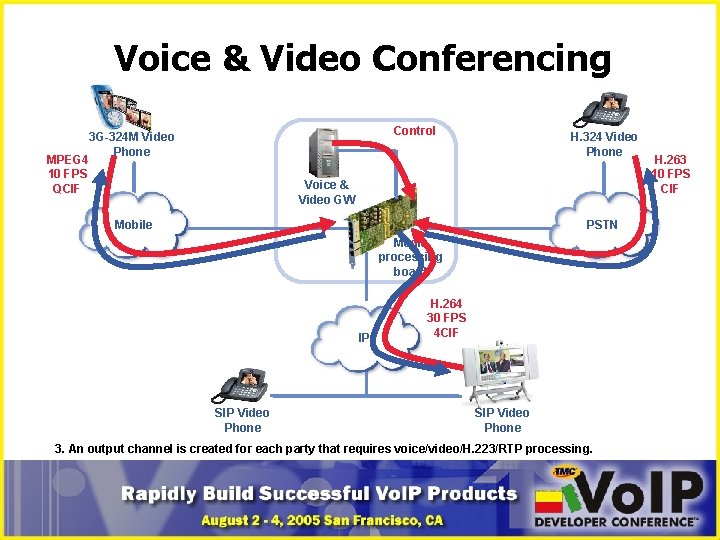
Voice & Video Conferencing MPEG 4 10 FPS QCIF Control 3 G-324 M Video Phone H. 324 Video Phone Voice & Video GW Mobile PSTN Media processing board IP SIP Video Phone H. 264 30 FPS 4 CIF SIP Video Phone 3. An output channel is created for each party that requires voice/video/H. 223/RTP processing. H. 263 10 FPS CIF
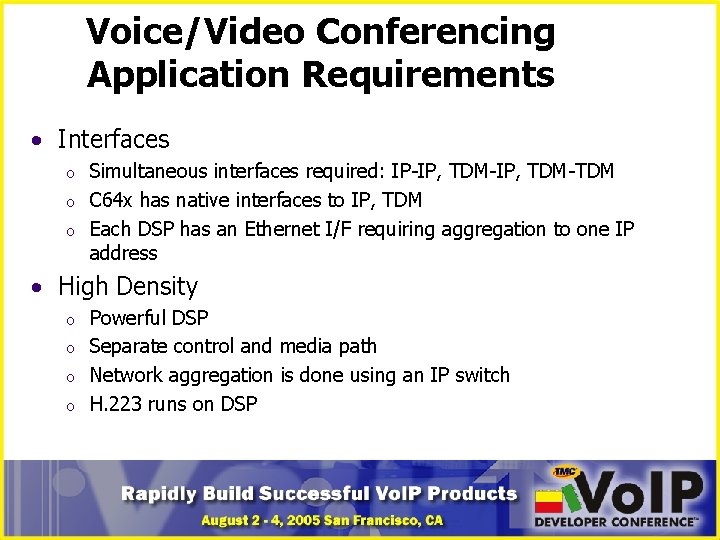
Voice/Video Conferencing Application Requirements • Interfaces o o o Simultaneous interfaces required: IP-IP, TDM-TDM C 64 x has native interfaces to IP, TDM Each DSP has an Ethernet I/F requiring aggregation to one IP address • High Density o o Powerful DSP Separate control and media path Network aggregation is done using an IP switch H. 223 runs on DSP
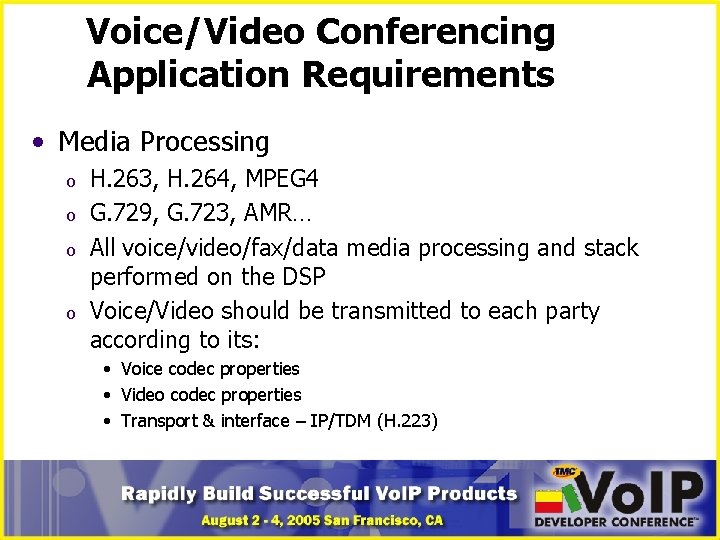
Voice/Video Conferencing Application Requirements • Media Processing o o H. 263, H. 264, MPEG 4 G. 729, G. 723, AMR… All voice/video/fax/data media processing and stack performed on the DSP Voice/Video should be transmitted to each party according to its: • Voice codec properties • Video codec properties • Transport & interface – IP/TDM (H. 223)

Optimal Hardware System Architecture
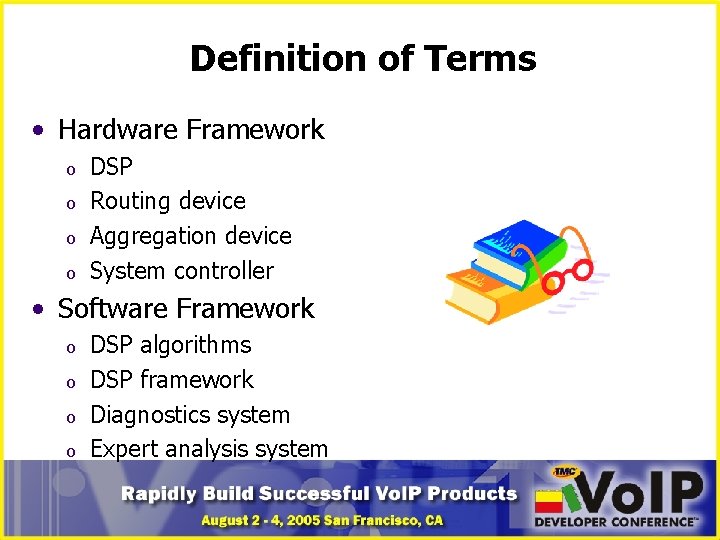
Definition of Terms • Hardware Framework o o DSP Routing device Aggregation device System controller • Software Framework o o DSP algorithms DSP framework Diagnostics system Expert analysis system
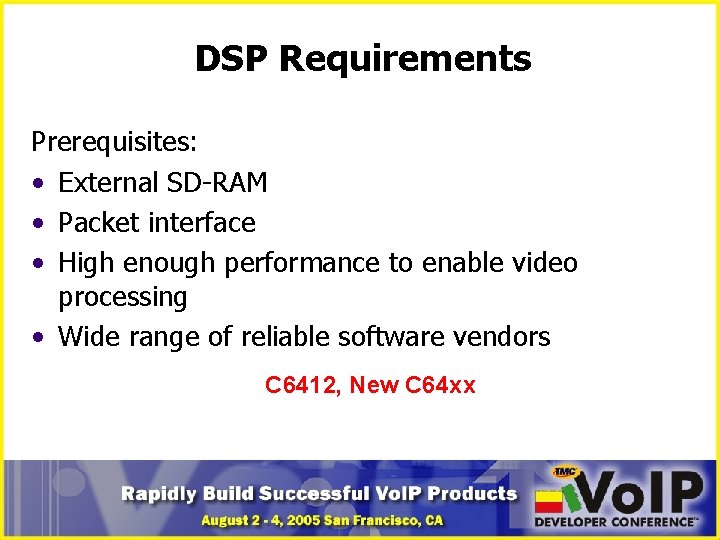
DSP Requirements Prerequisites: • External SD-RAM • Packet interface • High enough performance to enable video processing • Wide range of reliable software vendors C 6412, New C 64 xx
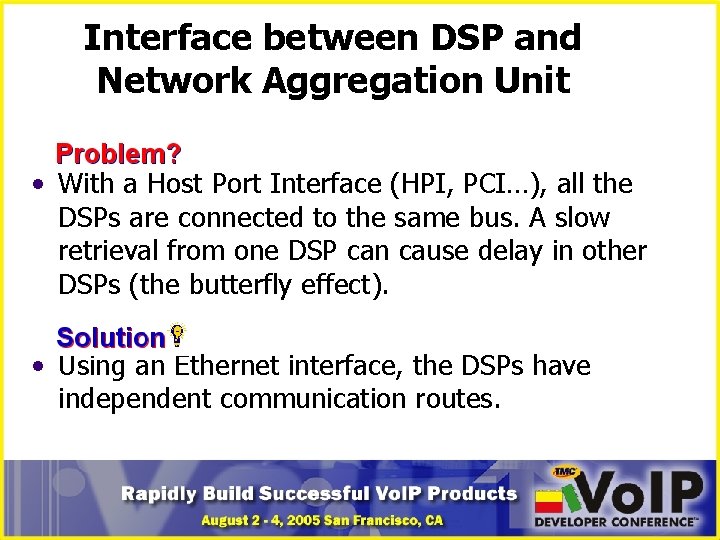
Interface between DSP and Network Aggregation Unit • With a Host Port Interface (HPI, PCI…), all the DSPs are connected to the same bus. A slow retrieval from one DSP can cause delay in other DSPs (the butterfly effect). • Using an Ethernet interface, the DSPs have independent communication routes.
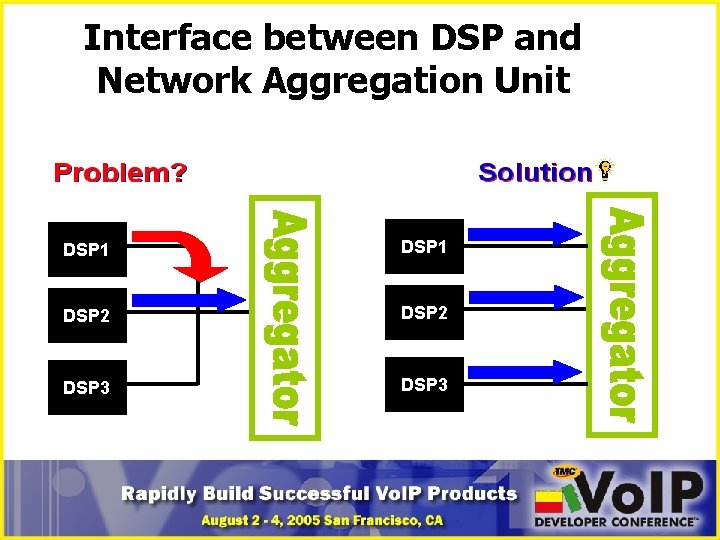
Interface between DSP and Network Aggregation Unit DSP 1 DSP 2 DSP 3
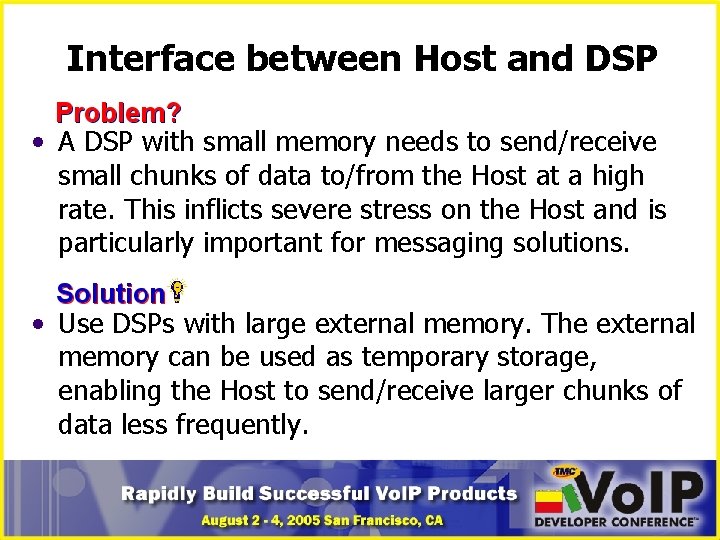
Interface between Host and DSP • A DSP with small memory needs to send/receive small chunks of data to/from the Host at a high rate. This inflicts severe stress on the Host and is particularly important for messaging solutions. • Use DSPs with large external memory. The external memory can be used as temporary storage, enabling the Host to send/receive larger chunks of data less frequently.
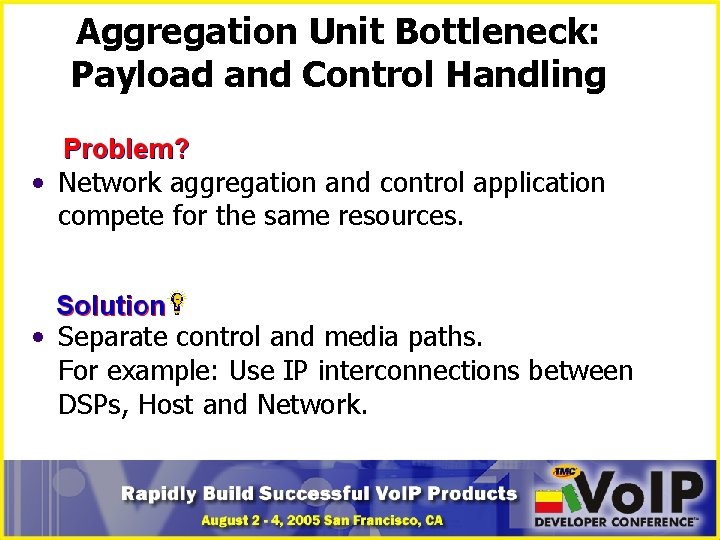
Aggregation Unit Bottleneck: Payload and Control Handling • Network aggregation and control application compete for the same resources. • Separate control and media paths. For example: Use IP interconnections between DSPs, Host and Network.

Optimal Software System Architecture
Optimizing the Software Framework • Interoperability/Testing • Open Framework • Flexible APIs • Remote diagnostics
Interoperability and Testing • Solution components must be field-hardened & interoperable (signaling interop is not enough) o o o Voice Codecs Video Codecs H. 223/H. 221 T. 38 Echo Canceller Modem • Critical components need constant support o o Echo Canceller Modem • Tools needed for diagnostics extraction from deployed systems
What is an Open Framework? • A solution that enables manufacturers to add media processing algorithms to their platforms simply and quickly o o A few basic APIs to “hook” the third party algorithm Algorithm can be • Proprietary Voice/Video codecs • New transport protocols • Density, performance and cost should not be compromised in order to provide an open solution.
Why Move to an Open Framework on Your DSP? • Be ready for the “killer application” • Support for new features • Allow multiple vendors to interface with your product technology • Differentiate your product • Reduce DSP maintenance and support fees from your software vendor
Flexible APIs • Full control over ALL media type parameters • Pre-set defaults • Video example o o o o User defined screen layout Logo insertion Background/Foreground manipulation Multiple layer picture Any resolution support Cropping & resizing Same stream can be encoded in different formats/bit rates/resolutions simultaneously
Remote Diagnostics • 75% of cost of solving issues in the field is related to the extraction of diagnostics • Need to be able to extract all the necessary diagnostics • Diagnostics should be part of the release version • Diagnostics should be enabled/disabled on a per-service/per -DSP/per-port basis • Minimize load on network interface by sending large packets • Predictable impact, of enabling diagnostics, on system performance
Summary
Technical Requirements • One media processing system for all media types o o Same HW (board & DSP) must run all media types Easier synchronization between Voice and Video More balanced system Less load on system bus • Must include a robust Voice solution • Powerful DSP that can handle Voice + Video. And: o o External SD-RAM Packet interface
Technical Requirements cont’d • Separate media and control path o o o Requires TDM and IP DSP interfaces Eliminates Host-DSP bottleneck Reduces load on host processor • Open Framework o Allows legacy/proprietary algorithms to be “plugged-in” to DSP • High capacity DSP farm • Support latest form factors o PTMC (c. PCI) AMC (ATCA/Micro. TCA)

Thank You amir@surf-com. com
- Slides: 51