
Designing the Classes Designing Classes 1 Once a
- Slides: 19
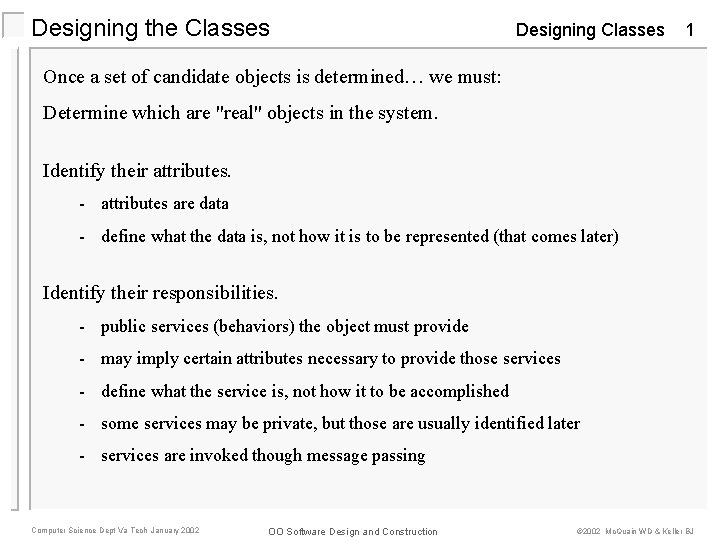
Designing the Classes Designing Classes 1 Once a set of candidate objects is determined… we must: Determine which are "real" objects in the system. Identify their attributes. - attributes are data - define what the data is, not how it is to be represented (that comes later) Identify their responsibilities. - public services (behaviors) the object must provide - may imply certain attributes necessary to provide those services - define what the service is, not how it to be accomplished - some services may be private, but those are usually identified later - services are invoked though message passing Computer Science Dept Va Tech January 2002 OO Software Design and Construction © 2002 Mc. Quain WD & Keller BJ
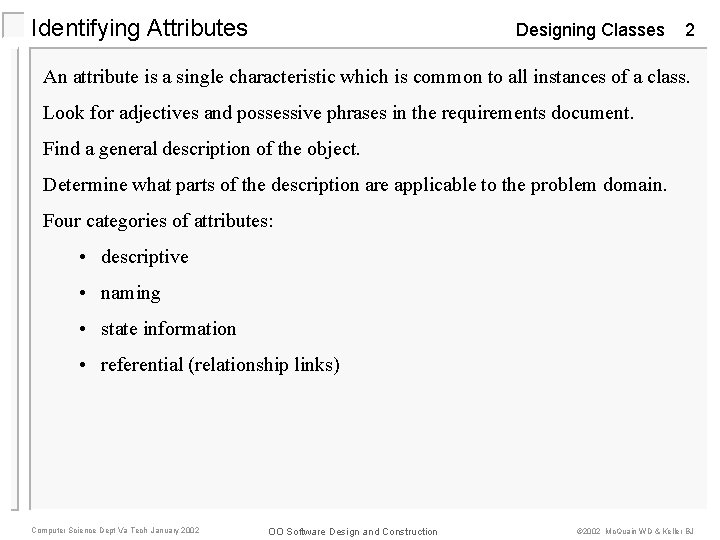
Identifying Attributes Designing Classes 2 An attribute is a single characteristic which is common to all instances of a class. Look for adjectives and possessive phrases in the requirements document. Find a general description of the object. Determine what parts of the description are applicable to the problem domain. Four categories of attributes: • descriptive • naming • state information • referential (relationship links) Computer Science Dept Va Tech January 2002 OO Software Design and Construction © 2002 Mc. Quain WD & Keller BJ
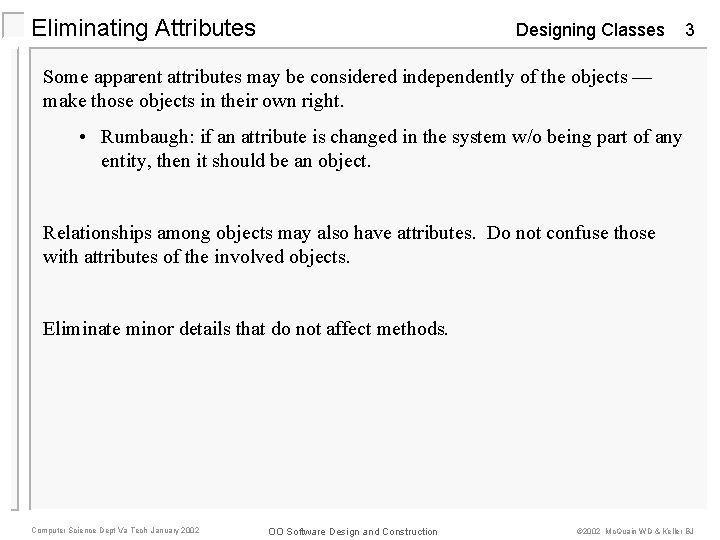
Eliminating Attributes Designing Classes 3 Some apparent attributes may be considered independently of the objects — make those objects in their own right. • Rumbaugh: if an attribute is changed in the system w/o being part of any entity, then it should be an object. Relationships among objects may also have attributes. Do not confuse those with attributes of the involved objects. Eliminate minor details that do not affect methods. Computer Science Dept Va Tech January 2002 OO Software Design and Construction © 2002 Mc. Quain WD & Keller BJ
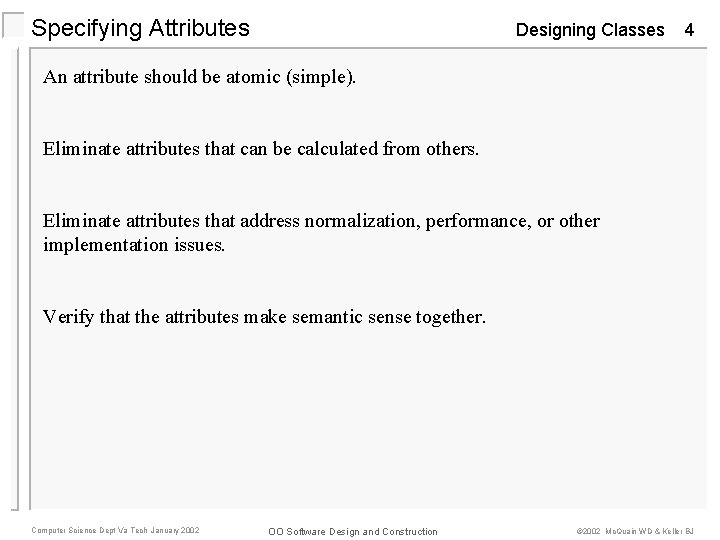
Specifying Attributes Designing Classes 4 An attribute should be atomic (simple). Eliminate attributes that can be calculated from others. Eliminate attributes that address normalization, performance, or other implementation issues. Verify that the attributes make semantic sense together. Computer Science Dept Va Tech January 2002 OO Software Design and Construction © 2002 Mc. Quain WD & Keller BJ
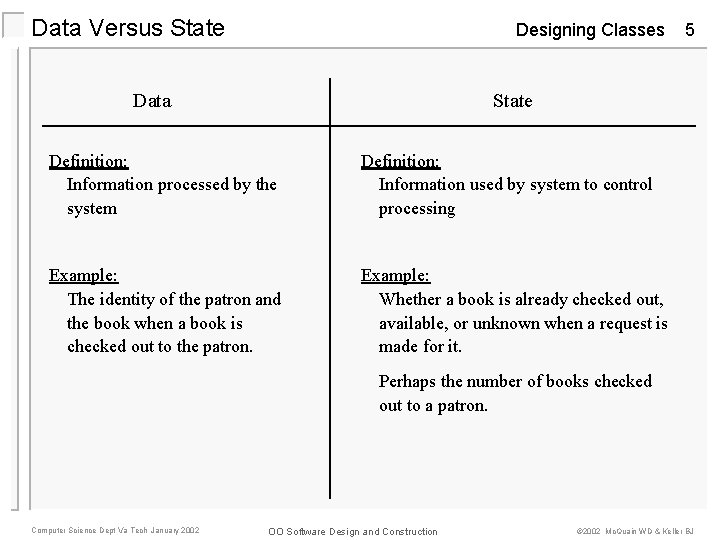
Data Versus State Designing Classes Data 5 State Definition: Information processed by the system Definition: Information used by system to control processing Example: The identity of the patron and the book when a book is checked out to the patron. Example: Whether a book is already checked out, available, or unknown when a request is made for it. Perhaps the number of books checked out to a patron. Computer Science Dept Va Tech January 2002 OO Software Design and Construction © 2002 Mc. Quain WD & Keller BJ
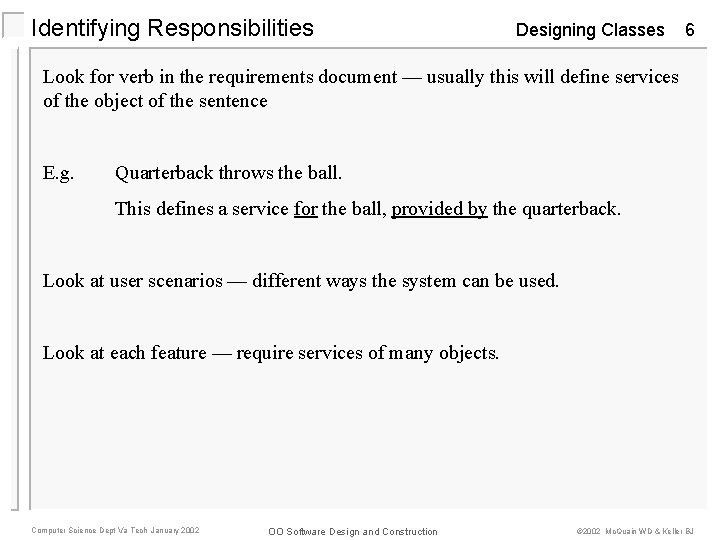
Identifying Responsibilities Designing Classes 6 Look for verb in the requirements document — usually this will define services of the object of the sentence E. g. Quarterback throws the ball. This defines a service for the ball, provided by the quarterback. Look at user scenarios — different ways the system can be used. Look at each feature — require services of many objects. Computer Science Dept Va Tech January 2002 OO Software Design and Construction © 2002 Mc. Quain WD & Keller BJ
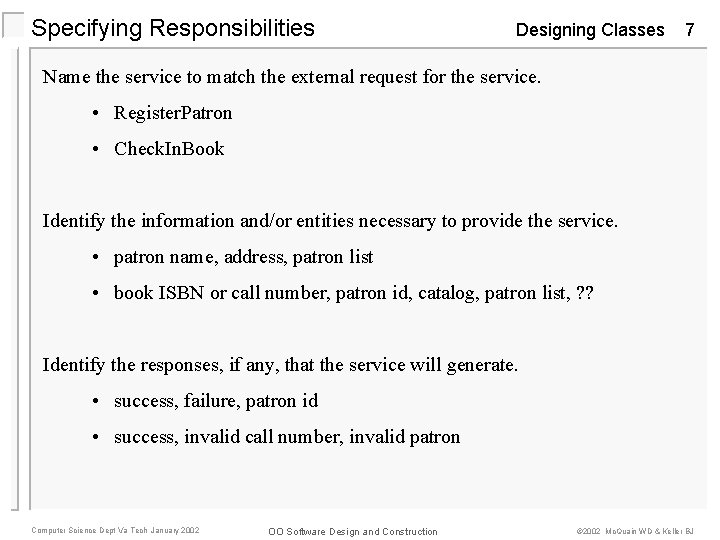
Specifying Responsibilities Designing Classes 7 Name the service to match the external request for the service. • Register. Patron • Check. In. Book Identify the information and/or entities necessary to provide the service. • patron name, address, patron list • book ISBN or call number, patron id, catalog, patron list, ? ? Identify the responses, if any, that the service will generate. • success, failure, patron id • success, invalid call number, invalid patron Computer Science Dept Va Tech January 2002 OO Software Design and Construction © 2002 Mc. Quain WD & Keller BJ
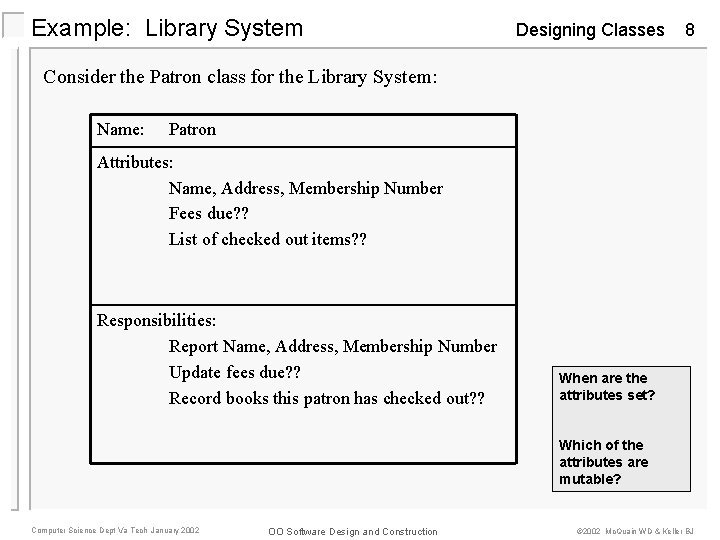
Example: Library System Designing Classes 8 Consider the Patron class for the Library System: Name: Patron Attributes: Name, Address, Membership Number Fees due? ? List of checked out items? ? Responsibilities: Report Name, Address, Membership Number Update fees due? ? Record books this patron has checked out? ? When are the attributes set? Which of the attributes are mutable? Computer Science Dept Va Tech January 2002 OO Software Design and Construction © 2002 Mc. Quain WD & Keller BJ
Guidelines for Designing the Classes Designing Classes 9 We need a systematic way of determining the attributes and responsibilities of a class. Otherwise, we run a large risk of missing essential features. To identify attributes and responsibilities the designer must ask the right questions regarding the system being designed. We can provide some guidance in choosing what questions to ask… Computer Science Dept Va Tech January 2002 OO Software Design and Construction © 2002 Mc. Quain WD & Keller BJ
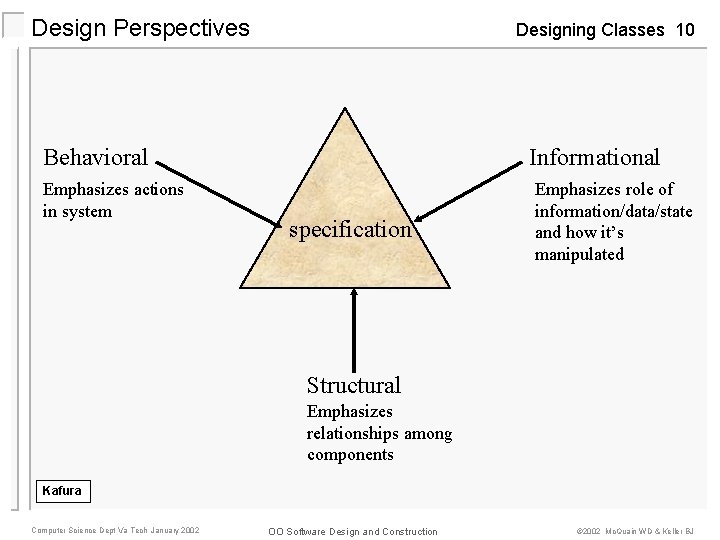
Design Perspectives Designing Classes 10 Behavioral Emphasizes actions in system Informational specification Emphasizes role of information/data/state and how it’s manipulated Structural Emphasizes relationships among components Kafura Computer Science Dept Va Tech January 2002 OO Software Design and Construction © 2002 Mc. Quain WD & Keller BJ
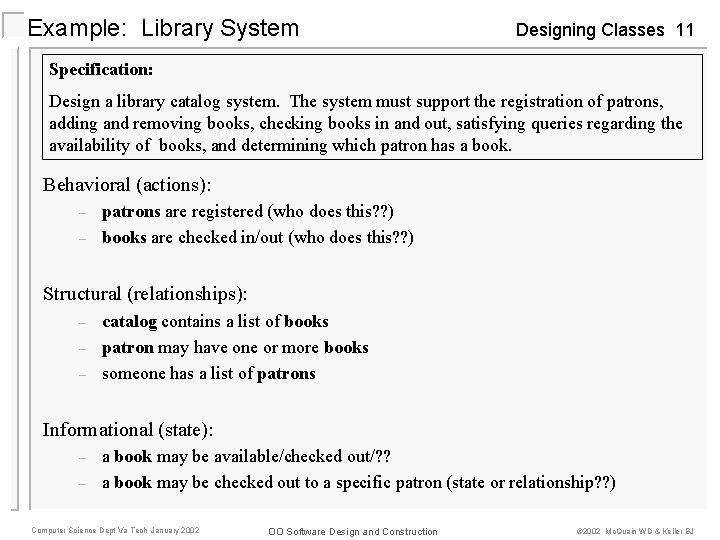
Example: Library System Designing Classes 11 Specification: Design a library catalog system. The system must support the registration of patrons, adding and removing books, checking books in and out, satisfying queries regarding the availability of books, and determining which patron has a book. Behavioral (actions): – – patrons are registered (who does this? ? ) books are checked in/out (who does this? ? ) Structural (relationships): – – – catalog contains a list of books patron may have one or more books someone has a list of patrons Informational (state): – – a book may be available/checked out/? ? a book may be checked out to a specific patron (state or relationship? ? ) Computer Science Dept Va Tech January 2002 OO Software Design and Construction © 2002 Mc. Quain WD & Keller BJ
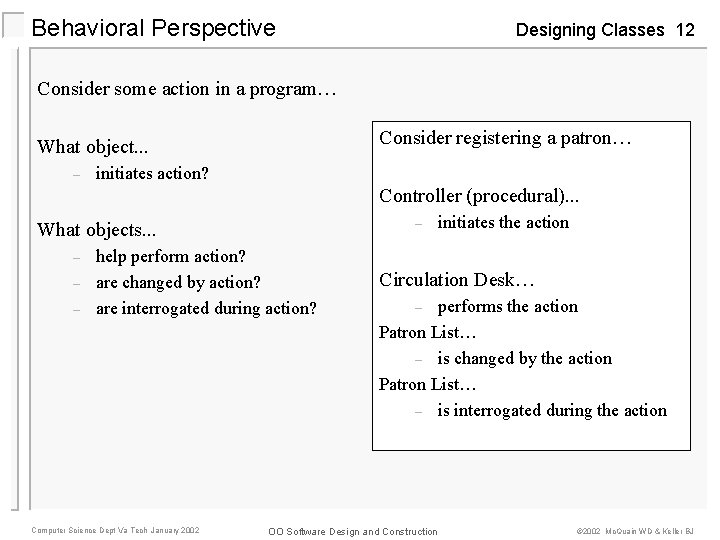
Behavioral Perspective Designing Classes 12 Consider some action in a program… Consider registering a patron… What object. . . – initiates action? Controller (procedural). . . – What objects. . . – – – help perform action? are changed by action? are interrogated during action? Computer Science Dept Va Tech January 2002 initiates the action Circulation Desk… performs the action Patron List… – is changed by the action Patron List… – is interrogated during the action – OO Software Design and Construction © 2002 Mc. Quain WD & Keller BJ
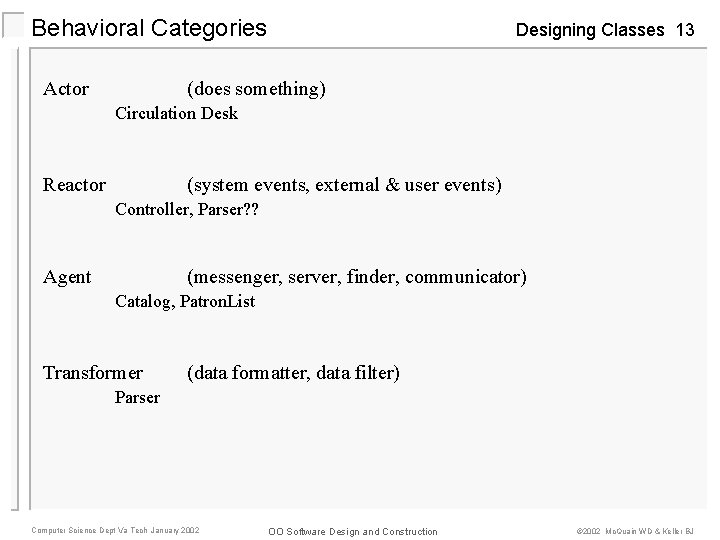
Behavioral Categories Actor Designing Classes 13 (does something) Circulation Desk Reactor (system events, external & user events) Controller, Parser? ? Agent (messenger, server, finder, communicator) Catalog, Patron. List Transformer (data formatter, data filter) Parser Computer Science Dept Va Tech January 2002 OO Software Design and Construction © 2002 Mc. Quain WD & Keller BJ
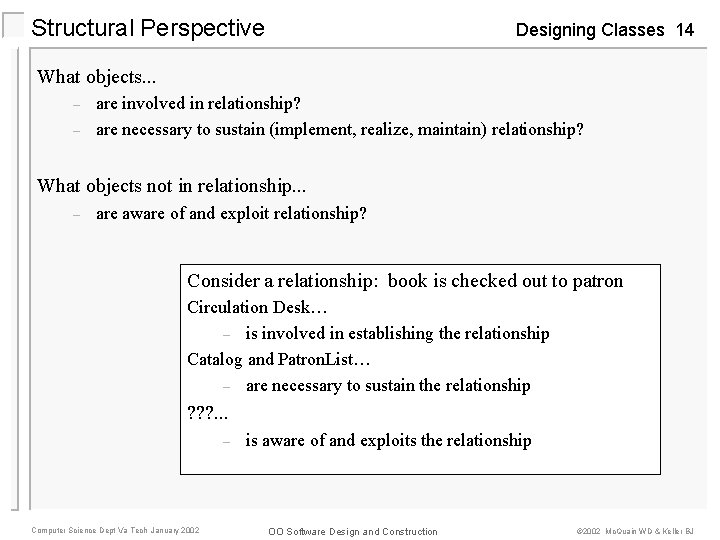
Structural Perspective Designing Classes 14 What objects. . . – – are involved in relationship? are necessary to sustain (implement, realize, maintain) relationship? What objects not in relationship. . . – are aware of and exploit relationship? Consider a relationship: book is checked out to patron Circulation Desk… – is involved in establishing the relationship Catalog and Patron. List… – are necessary to sustain the relationship ? ? ? . . . – Computer Science Dept Va Tech January 2002 is aware of and exploits the relationship OO Software Design and Construction © 2002 Mc. Quain WD & Keller BJ
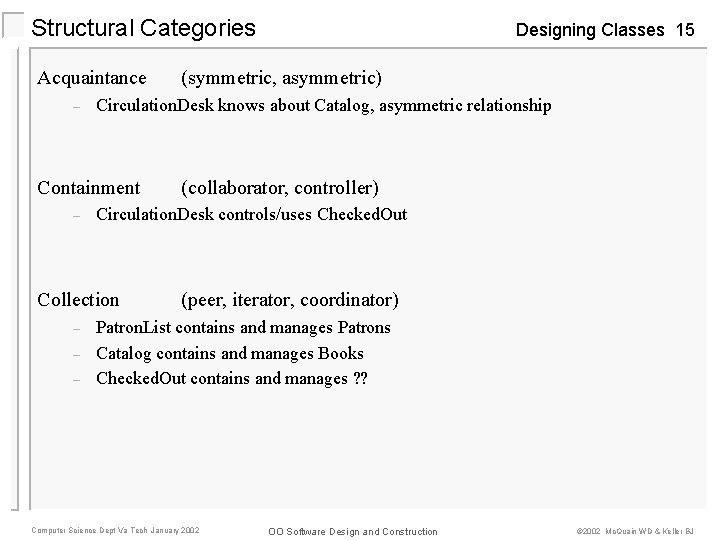
Structural Categories Acquaintance – – – (collaborator, controller) Circulation. Desk controls/uses Checked. Out Collection – (symmetric, asymmetric) Circulation. Desk knows about Catalog, asymmetric relationship Containment – Designing Classes 15 (peer, iterator, coordinator) Patron. List contains and manages Patrons Catalog contains and manages Books Checked. Out contains and manages ? ? Computer Science Dept Va Tech January 2002 OO Software Design and Construction © 2002 Mc. Quain WD & Keller BJ
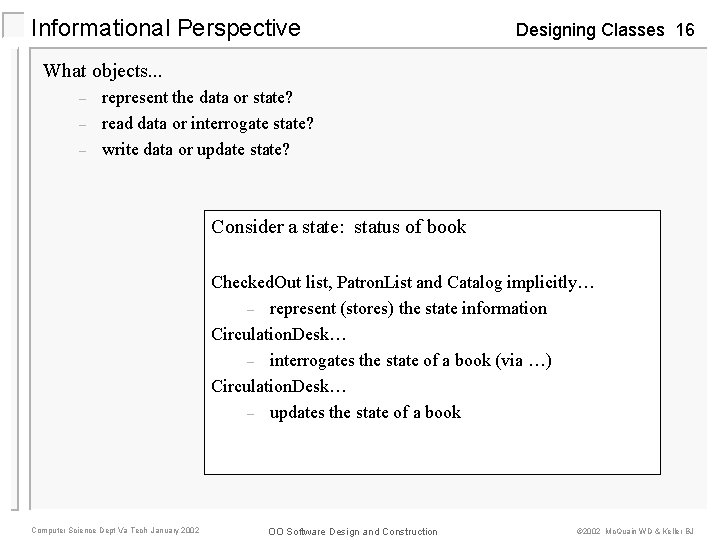
Informational Perspective Designing Classes 16 What objects. . . – – – represent the data or state? read data or interrogate state? write data or update state? Consider a state: status of book Checked. Out list, Patron. List and Catalog implicitly… – represent (stores) the state information Circulation. Desk… – interrogates the state of a book (via …) Circulation. Desk… – updates the state of a book Computer Science Dept Va Tech January 2002 OO Software Design and Construction © 2002 Mc. Quain WD & Keller BJ
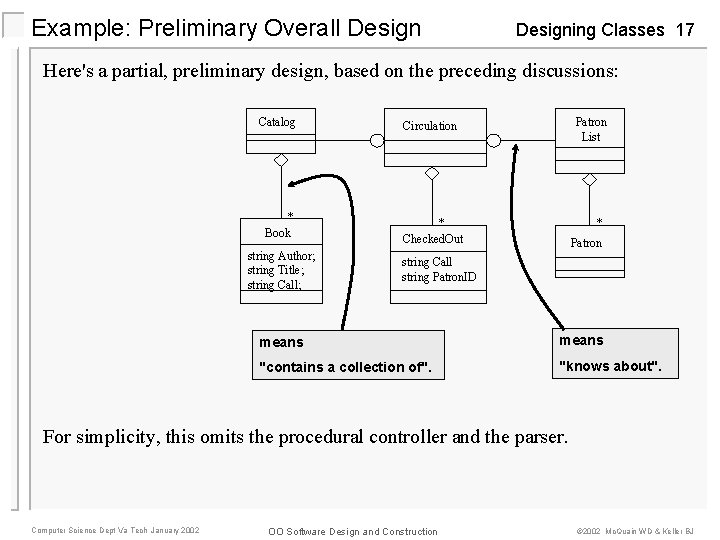
Example: Preliminary Overall Designing Classes 17 Here's a partial, preliminary design, based on the preceding discussions: Catalog * Book string Author; string Title; string Call; Patron List Circulation * Checked. Out * Patron string Call string Patron. ID means "contains a collection of". "knows about". For simplicity, this omits the procedural controller and the parser. Computer Science Dept Va Tech January 2002 OO Software Design and Construction © 2002 Mc. Quain WD & Keller BJ
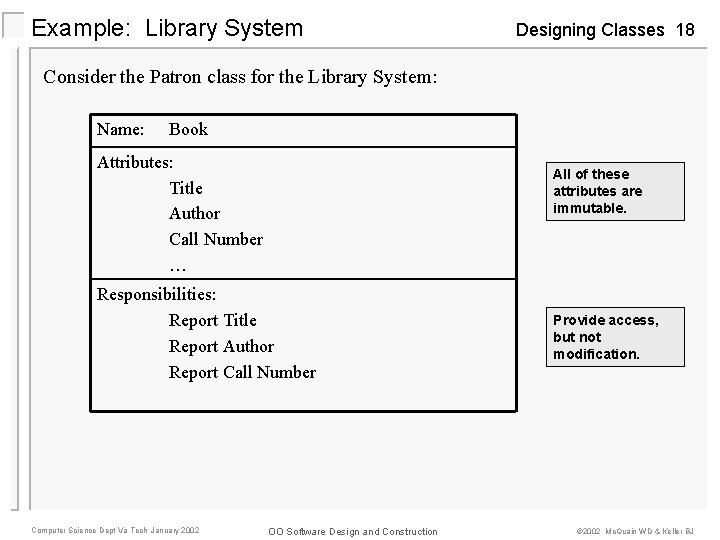
Example: Library System Designing Classes 18 Consider the Patron class for the Library System: Name: Book Attributes: Title Author Call Number … All of these attributes are immutable. Responsibilities: Report Title Report Author Report Call Number Computer Science Dept Va Tech January 2002 OO Software Design and Construction Provide access, but not modification. © 2002 Mc. Quain WD & Keller BJ
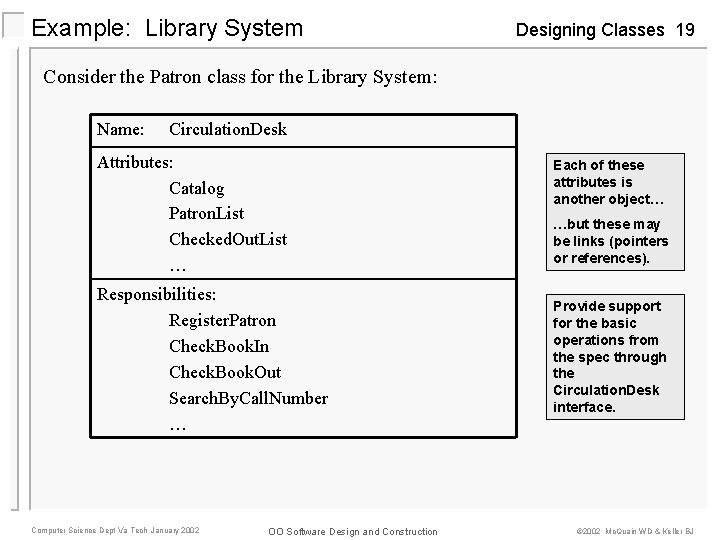
Example: Library System Designing Classes 19 Consider the Patron class for the Library System: Name: Circulation. Desk Attributes: Catalog Patron. List Checked. Out. List … Responsibilities: Register. Patron Check. Book. In Check. Book. Out Search. By. Call. Number … Computer Science Dept Va Tech January 2002 OO Software Design and Construction Each of these attributes is another object… …but these may be links (pointers or references). Provide support for the basic operations from the spec through the Circulation. Desk interface. © 2002 Mc. Quain WD & Keller BJ