
Designing Spaces for Effective Learning Ros Smith JISC
- Slides: 18
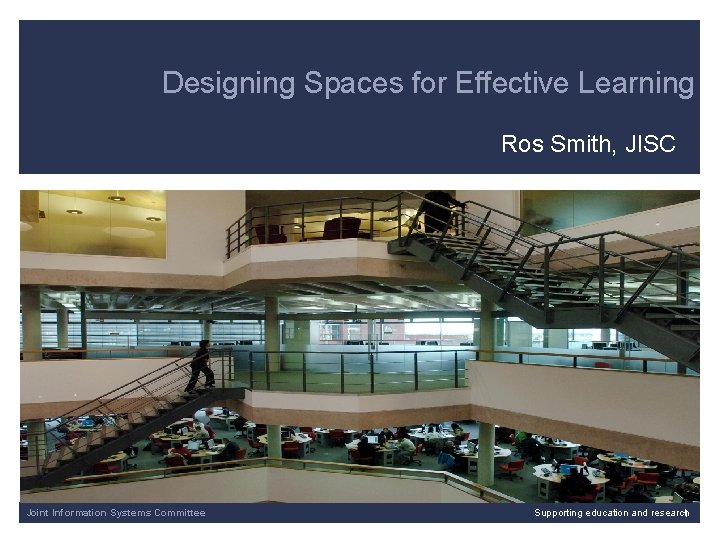
Designing Spaces for Effective Learning Ros Smith, JISC Joint Information Systems Committee Supporting education and research 1
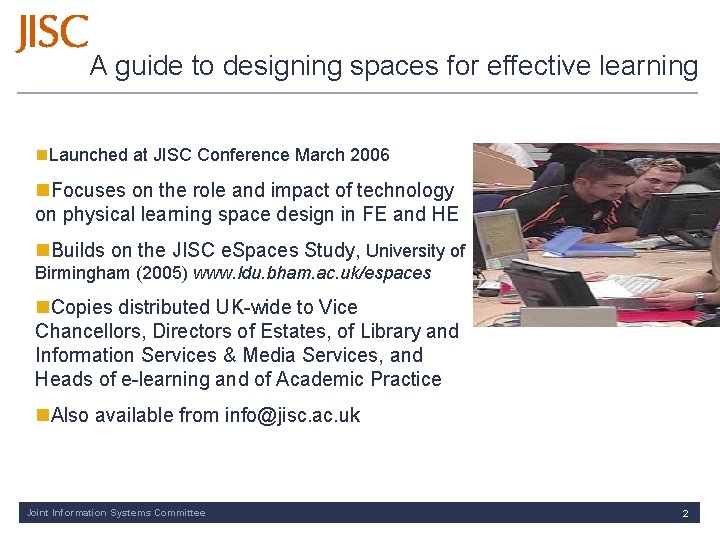
A guide to designing spaces for effective learning n. Launched at JISC Conference March 2006 n. Focuses on the role and impact of technology on physical learning space design in FE and HE n. Builds on the JISC e. Spaces Study, University of Birmingham (2005) www. ldu. bham. ac. uk/espaces n. Copies distributed UK-wide to Vice Chancellors, Directors of Estates, of Library and Information Services & Media Services, and Heads of e-learning and of Academic Practice n. Also available from info@jisc. ac. uk Joint Information Systems Committee 2
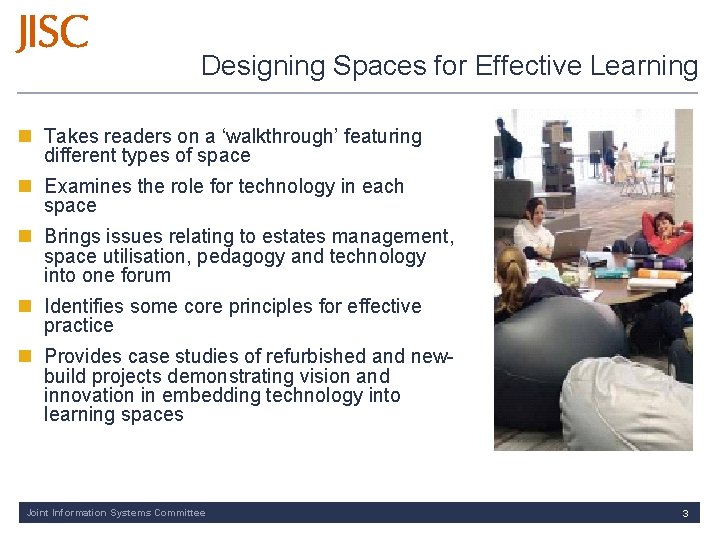
Designing Spaces for Effective Learning n Takes readers on a ‘walkthrough’ featuring different types of space n Examines the role for technology in each space n Brings issues relating to estates management, space utilisation, pedagogy and technology into one forum n Identifies some core principles for effective practice n Provides case studies of refurbished and newbuild projects demonstrating vision and innovation in embedding technology into learning spaces Joint Information Systems Committee 3
Designing Spaces for Effective Learning n Identifies what is innovative and emergent, and. . n Provides architects’ floor plans for three types of space based on current thinking: general teaching, vocational and learning centres n Explores the relationship between redesigned, technology-rich spaces and learning potential n. Concludes with a checklist of key points for senior managers “Spaces are themselves agents for change. Changed spaces will change practice. ” Image: AMA Alexi Marmot Associates Joint Information Systems Committee 4
Key messages from Designing Spaces for Effective Learning “Understanding what makes an effective design is important. The best are likely to assist all within the institution to work more productively and to produce learners who are confident, adaptable, and inspired to learn. ” Designing Spaces for Effective Learning, JISC 2006 Joint Information Systems Committee 5
Key messages from Designing Spaces for Effective Learning “Embedding technology into learning and teaching spaces is likely to be an evolutionary process rather than a revolutionary one. ” “Start by establishing your pedagogic aims, then review the design and the technological infrastructure in the whole institution. ” “To resolve what is the best way forward, effective dialogues are needed to establish what will be required from the spaces, what changes in pedagogic approach are desirable and why. ” Designing Spaces for Effective Learning, JISC 2006 Joint Information Systems Committee 6
Key messages from Designing Spaces for Effective Learning needs to be Pervasive Flexible And continuous Active Social Inclusive Joint Information Systems Committee 7
Key messages from Designing Spaces for Effective Learning There can be no one blueprint for the design of learning and teaching spaces… “The concept of the learning centre is still evolving , blending with other previously distinct spaces to absorb more of their functions. ” Designing Spaces for Effective Learning, JISC 2006 Joint Information Systems Committee 8
Key messages from Designing Spaces for Effective Learning Case studies show… n Increasing support for social, collaborative and blended models of learning n More availability of audio-visual technologies n Increasing hybridisation of spaces n Flexibility in design, fittings and furniture to ensure sustainability Joint Information Systems Committee 9
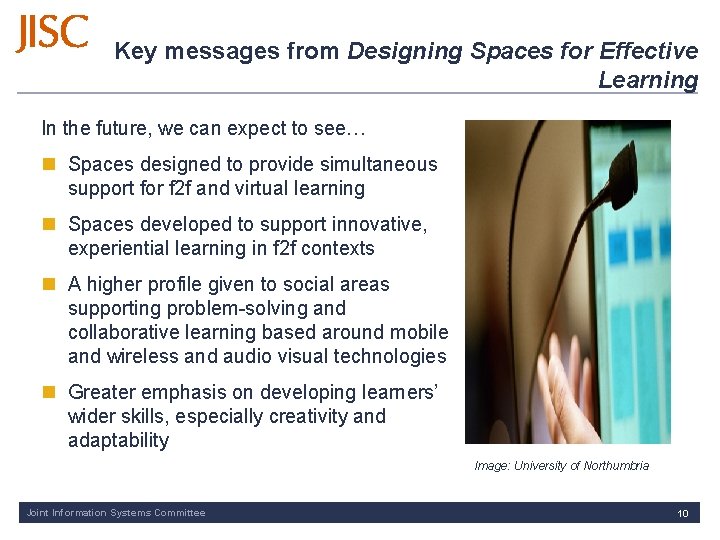
Key messages from Designing Spaces for Effective Learning In the future, we can expect to see… n Spaces designed to provide simultaneous support for f 2 f and virtual learning n Spaces developed to support innovative, experiential learning in f 2 f contexts n A higher profile given to social areas supporting problem-solving and collaborative learning based around mobile and wireless and audio visual technologies n Greater emphasis on developing learners’ wider skills, especially creativity and adaptability Image: University of Northumbria Joint Information Systems Committee 10
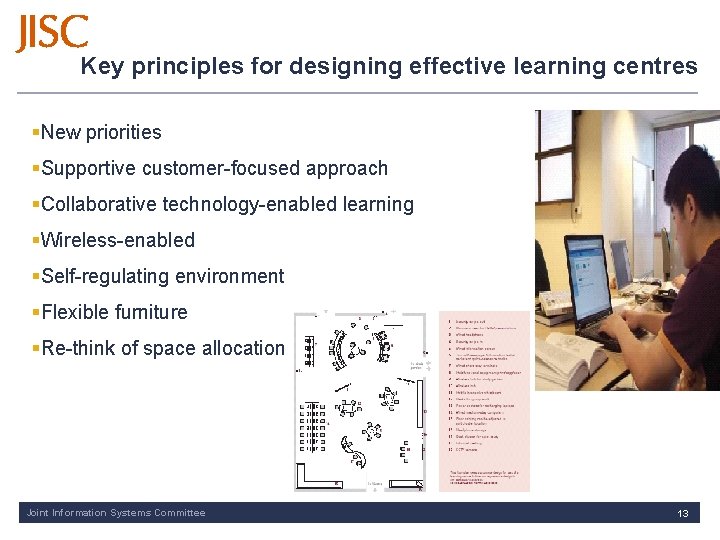
Key principles for designing effective learning centres n We now expect that learning will involve many different activities, each having different behaviours associated with it n These varied purposes demand a clear vision for each area provided for autonomous learning n The ultimate in flexibility – large open plan centres in which both learning and teaching take place – still presents challenges in management of sound, heat and student activity n One solution – the University of Warwick’s Learning Grid, a highly adaptable and highly resourced space for collaborative group learning with peer support Joint Information Systems Committee 11
An example of a high-tech learning centre Plan: AMA Alexi Marmot Associates, Designing Spaces for Effective Learning, JISC, 2006 Joint Information Systems Committee 12
Key principles for designing effective learning centres §New priorities §Supportive customer-focused approach §Collaborative technology-enabled learning §Wireless-enabled §Self-regulating environment §Flexible furniture §Re-think of space allocation Joint Information Systems Committee 13
Key principles for designing effective learning centres An educational building is an expensive long-term resource. The design of its individual spaces needs to be… Joint Information Systems Committee 14
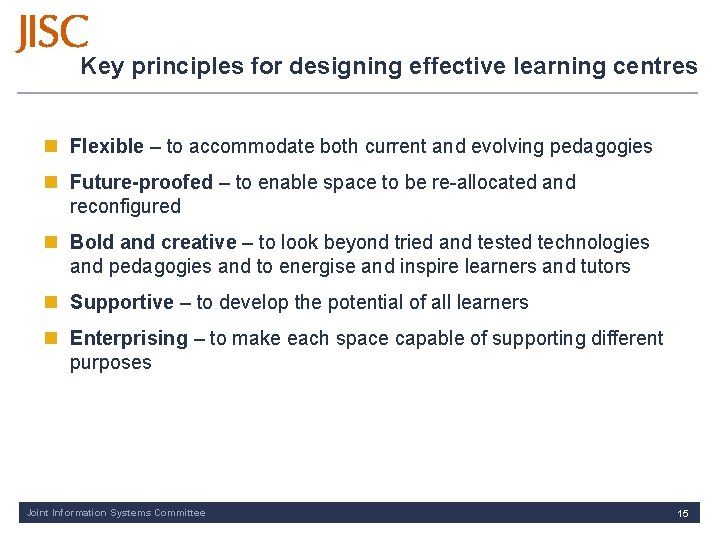
Key principles for designing effective learning centres n Flexible – to accommodate both current and evolving pedagogies n Future-proofed – to enable space to be re-allocated and reconfigured n Bold and creative – to look beyond tried and tested technologies and pedagogies and to energise and inspire learners and tutors n Supportive – to develop the potential of all learners n Enterprising – to make each space capable of supporting different purposes Joint Information Systems Committee 15
Final words “The design of our learning spaces should become a physical representation of the institution’s vision and strategy for learning – responsive, inclusive, and supportive of attainment by all. ” Designing Spaces for Effective Learning, JISC, 2006 Joint Information Systems Committee 16
Designing Spaces for Effective Learning n Give your comments on Designing Spaces for Effective Learning. A feedback form can be downloaded from www. jisc. ac. uk/eli_learningspaces. html n To order copies, email: info@jisc. ac. uk Joint Information Systems Committee 17
Further information n Email: – s. knight@jisc. ac. uk and ros. smith@gpisolutions. co. uk n Web: – e-Learning and Innovation www. jisc. ac. uk/elearning_innovation. html – Designing Spaces for Effective Learning www. jisc. ac. uk/eli_learningspaces. html – Designing Spaces for Effective Learning www. jiscinfonet. ac. uk/infokits/learning-space-design n Mailing List: – Pedagogy and Innovation mailing list - eped-info@jiscmail. ac. uk Joint Information Systems Committee 18