
Designing Software With Flowcharts And Pseudocode In this


- Slides: 23
Designing Software With Flowcharts And Pseudo-code In this section you will learn two different ways of laying out a computer algorithm independent of programming language James Tam
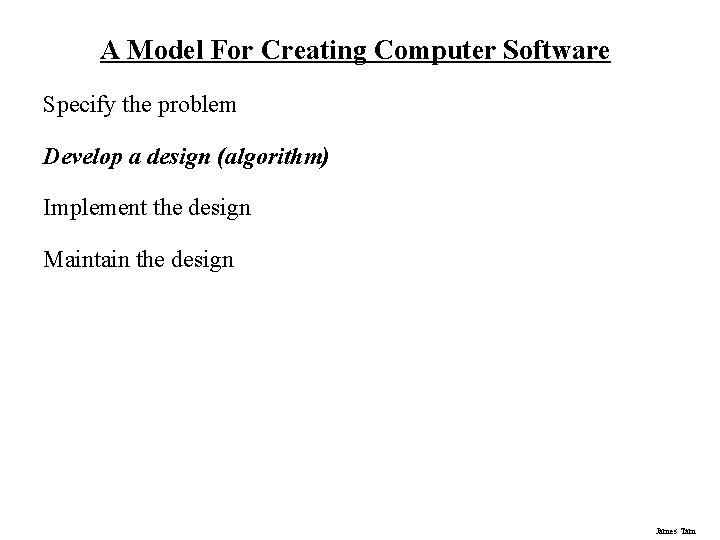
A Model For Creating Computer Software Specify the problem Develop a design (algorithm) Implement the design Maintain the design James Tam
What Is An Algorithm? The steps needed to solve a problem Characteristics • Specific • Unambiguous • Language independent James Tam
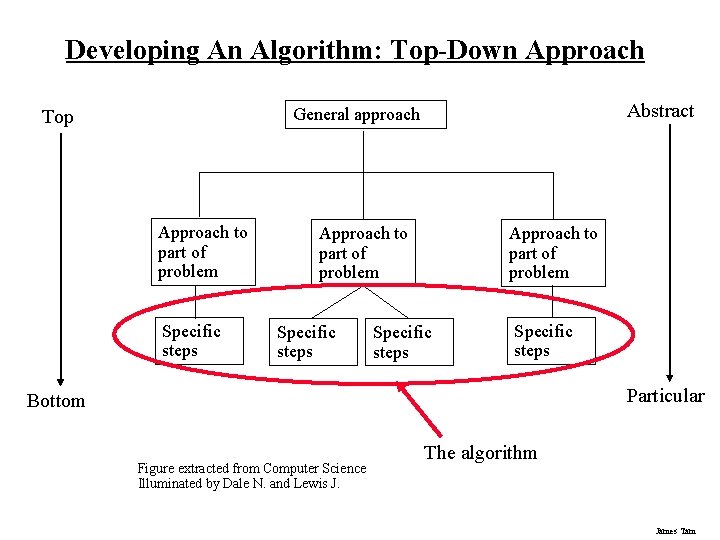
Developing An Algorithm: Top-Down Approach Abstract General approach Top Approach to part of problem Specific steps Particular Bottom Figure extracted from Computer Science Illuminated by Dale N. and Lewis J. The algorithm James Tam
Techniques For Laying Out An Algorithm Pseudo-code Flowcharts James Tam
Pseudo-Code Employs 'programming-like' statements to depict the algorithm No standard format (language independent) James Tam
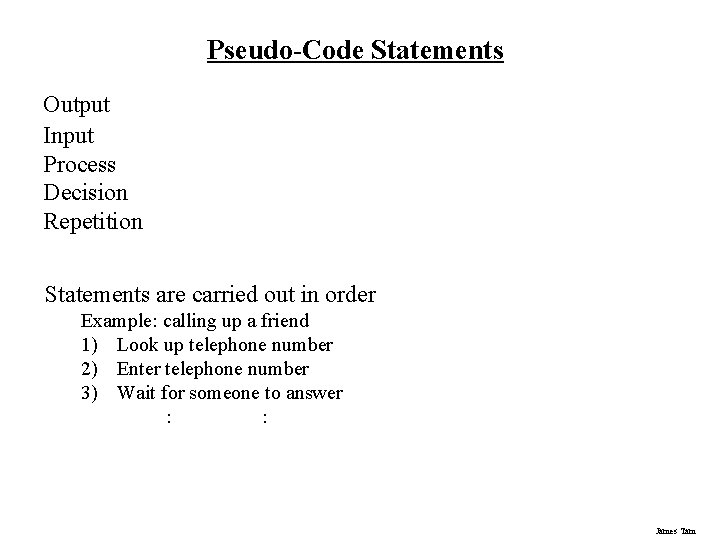
Pseudo-Code Statements Output Input Process Decision Repetition Statements are carried out in order Example: calling up a friend 1) Look up telephone number 2) Enter telephone number 3) Wait for someone to answer : : James Tam
Variables Are symbols used to store values The value stored can change during the algorithm James Tam
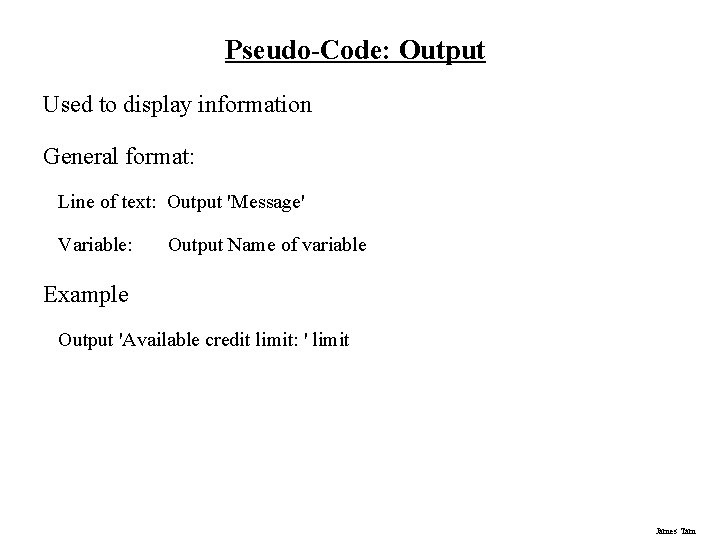
Pseudo-Code: Output Used to display information General format: Line of text: Output 'Message' Variable: Output Name of variable Example Output 'Available credit limit: ' limit James Tam
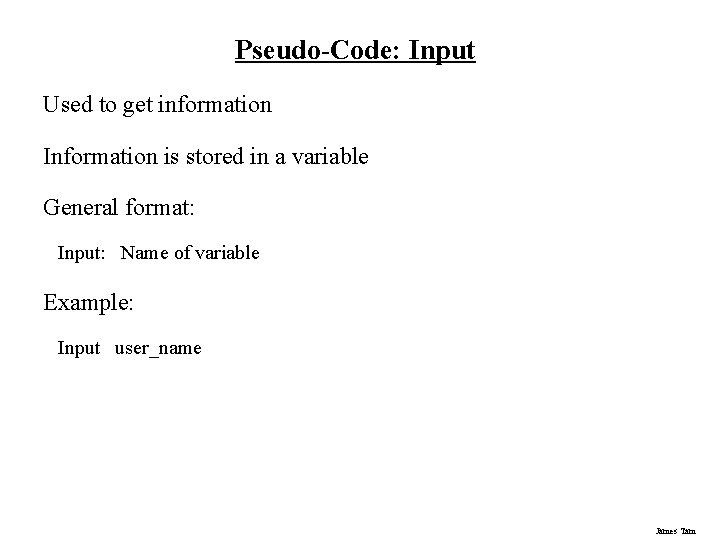
Pseudo-Code: Input Used to get information Information is stored in a variable General format: Input: Name of variable Example: Input user_name James Tam
Pseudo-Code: Process For computer programs it's usually an assignment statement (sets a variable to some value) General form: variable arithmetic expression Example: x 2 x x+1 a b*c James Tam
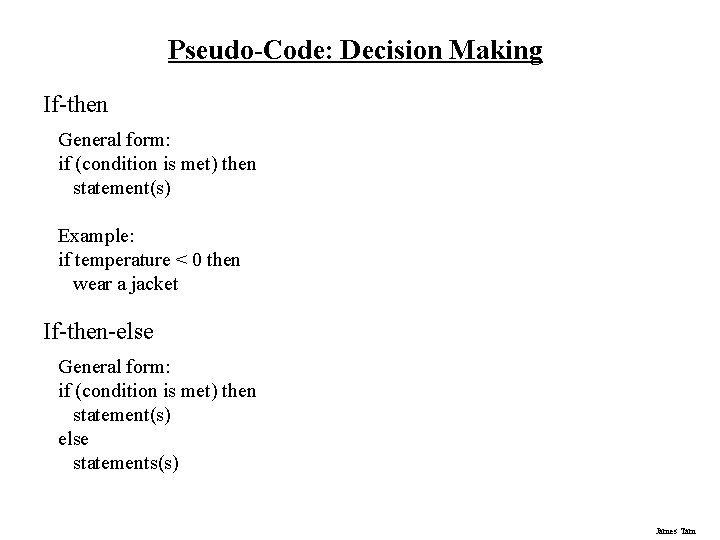
Pseudo-Code: Decision Making If-then General form: if (condition is met) then statement(s) Example: if temperature < 0 then wear a jacket If-then-else General form: if (condition is met) then statement(s) else statements(s) James Tam
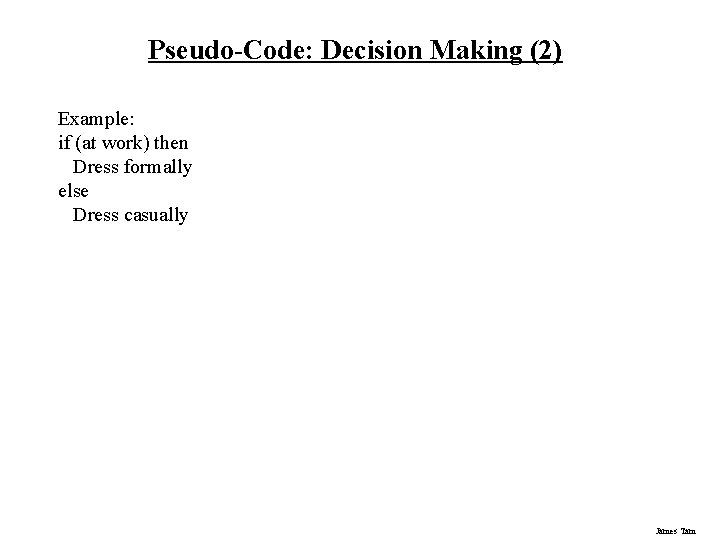
Pseudo-Code: Decision Making (2) Example: if (at work) then Dress formally else Dress casually James Tam
Pseudo-Code: Repetition repeat-until while-do James Tam
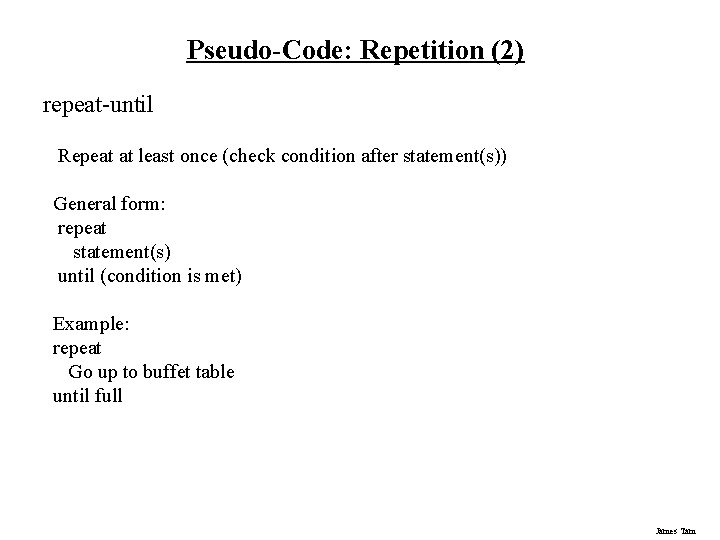
Pseudo-Code: Repetition (2) repeat-until Repeat at least once (check condition after statement(s)) General form: repeat statement(s) until (condition is met) Example: repeat Go up to buffet table until full James Tam
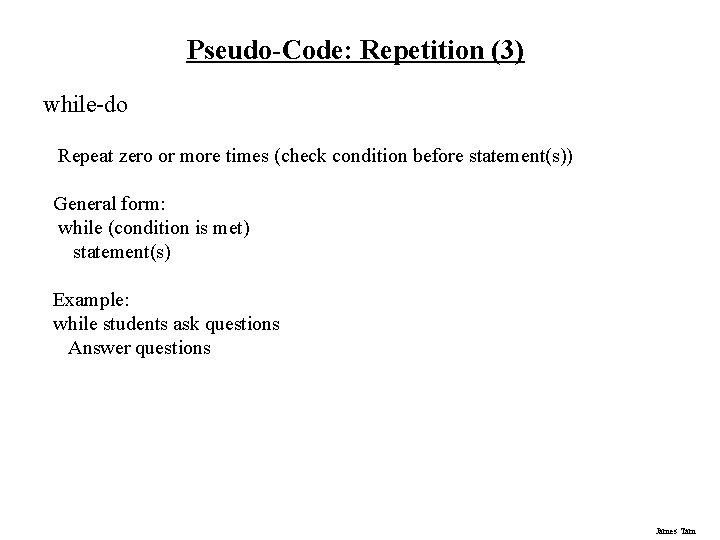
Pseudo-Code: Repetition (3) while-do Repeat zero or more times (check condition before statement(s)) General form: while (condition is met) statement(s) Example: while students ask questions Answer questions James Tam
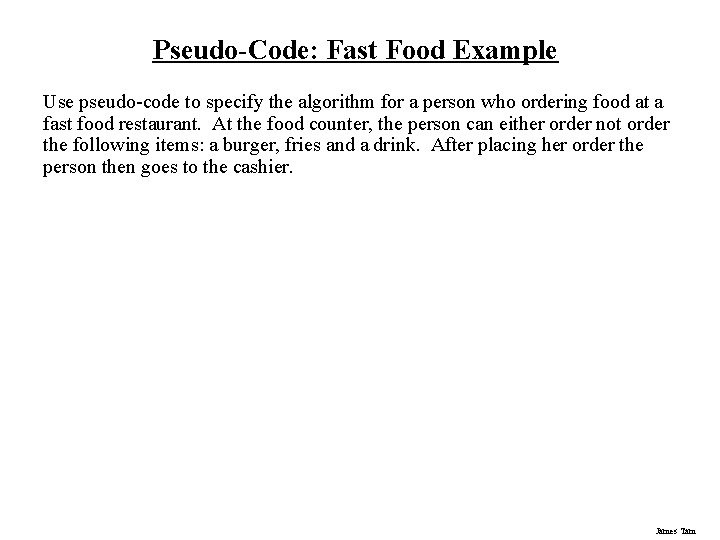
Pseudo-Code: Fast Food Example Use pseudo-code to specify the algorithm for a person who ordering food at a fast food restaurant. At the food counter, the person can either order not order the following items: a burger, fries and a drink. After placing her order the person then goes to the cashier. James Tam
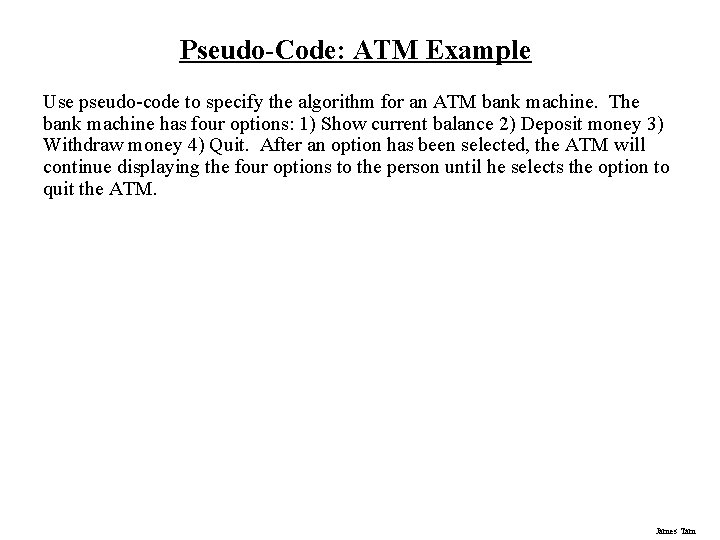
Pseudo-Code: ATM Example Use pseudo-code to specify the algorithm for an ATM bank machine. The bank machine has four options: 1) Show current balance 2) Deposit money 3) Withdraw money 4) Quit. After an option has been selected, the ATM will continue displaying the four options to the person until he selects the option to quit the ATM. James Tam
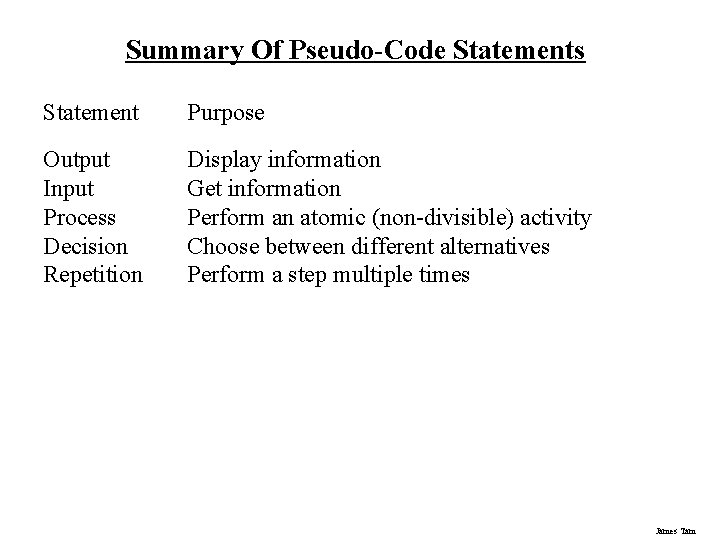
Summary Of Pseudo-Code Statements Statement Purpose Output Input Process Decision Repetition Display information Get information Perform an atomic (non-divisible) activity Choose between different alternatives Perform a step multiple times James Tam
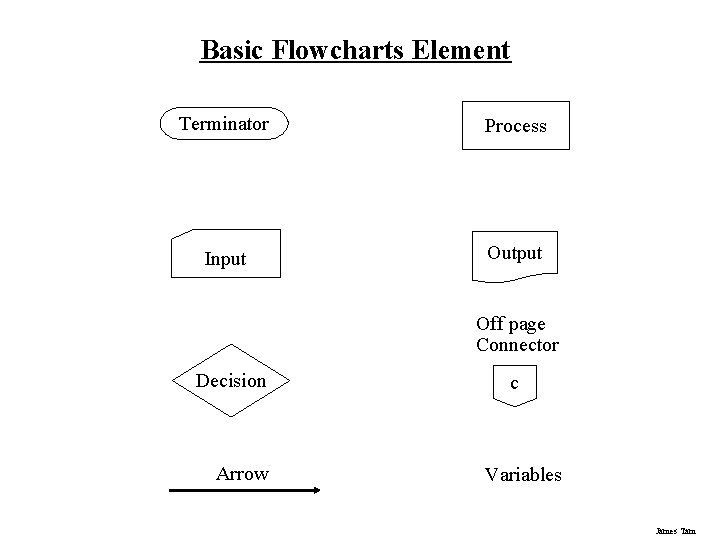
Basic Flowcharts Element Terminator Process Input Output Off page Connector Decision Arrow c Variables James Tam
Flowchart: Fast Food Example Draw a flowchart to outline the algorithm for a person who ordering food at a fast food restaurant. At the food counter, the person can either order not order the following items: a burger, fries and a drink. After placing her order the person then goes to the cashier. James Tam
Flowchart: ATM Example Draw a flowchart to outline the algorithm for an ATM bank machine. The bank machine has four options: 1) Show current balance 2) Deposit money 3) Withdraw money 4) Quit. After an option has been selected, the ATM will continue displaying the four options to the person until he selects the option to quit the ATM. James Tam
Summary Laying out an algorithm using flowcharts and pseudo-code Learning basic elements of algorithms: • • • Input Output Decision-Making Repetition Processes James Tam