
Designing Schools and Libraries for Efficiency and Safety
Designing Schools and Libraries for Efficiency and Safety
Trends in Education • Typical school spaces may change. • Instructional materials will continue to evolve. • Technology will dominate instructional delivery. • Technology will be available from multiple access points. • Libraries will need more people space and perhaps less collection (bookshelf) space.
Trends in Education • “Electronic Village” • school activities include – communication among teachers, – communication between teachers and administrators, – communication between school and community members, – communication between teachers and parents, and – collaborative learning among students and community mentors
Characteristics essential to a successful "electronic village" • focusing on interactions between people rather than focusing on particular technologies • providing applications tailored for each type of user
Characteristics essential to a successful "electronic village" • implementing new services on a timely basis, so that community networking becomes a fundamental consideration in the vision and planning of the networking infrastructure • providing access to multiple technologies, esp. Web 2. 0 (and beyond? )
Design schools and libraries for… • Growth and program development • Continued and future infusion of technology • Flexible use of space Specifically for libraries: • Expanded hours • Staff changes • More users
Focus should be on future learning needs that result from curricular changes, emerging technologies, and new organizational patterns. Form should follow function.
General Design Considerations • 3 -D textbook • Support all learning styles (students and teachers) • Grade range (e. g. , K-5, 6 -8, K-12) • Sharing space for extended grade ranges • HVAC – Climate controlled year-round – Zones
General Design Considerations • • Sharing space with the community Security Accessibility/User-friendly ADA requirements – Entrances/Exits – Tables – Computer workstations
CPTED: Crime Prevention Through Environmental Design • http: //www. cpted-watch. com Strategies of CPTED • Natural Surveillance • Territorial Reinforcement • Natural Access Control
General Design Considerations • Floor Covering – Location – Carpet – Tile • Lighting – Task lighting – Windows/Natural light – Outside lighting • Acoustics • Gallery/Display Space
General Design Considerations • Visual Control • Physical arrangement – Flexibility of space – More people space – Less collection space – Zones – Conducive to inquiry, study, independent use • Infrastructure
3 key factors • People – Students – Adults • Place – Ambiance – Atmosphere – Lifelong learning ethos • Program – Instruction – ICTs – Collection – Literary/cultural events
An Information Resources Center in the 21 st Century - is a central resource which supports the total school curriculum and ethos, in which a spirit of inquiry is encouraged to engender lifelong interests and passions - is an integral part of teaching and learning and other activities in the school - is a focus of information/learning skills development throughout the school Source: Tilke, A. (ed. ), Library Association guidelines for secondary school libraries, London, 1998
An Information Resources Center in the 21 st Century - provides opportunities for the individual to read more widely and think more deeply - is an important resource in the school for leisure and recreational needs - is an essential partner in the development of lifelong learning skills Source: Tilke, A. (ed. ), Library Association guidelines for secondary school libraries, London, 1998
Purpose of an LIC • To support the implemented curriculum of the school by providing resources that will expand enhance student learning beyond the textbook • To support the recreational reading needs of all members of the learning community • To support the information needs of all members of the learning community • To serve as the information resource center for the school
Core Missions of the LIC • Library as physical space • Library as information resource center • Library as instructional delivery center • Library as service provider
Physical Spaces • • Technology Areas Instructional Areas Recreational Reading Area Equipment/AV Storage Workroom Offices Professional Room/Conference Room Restroom(s)

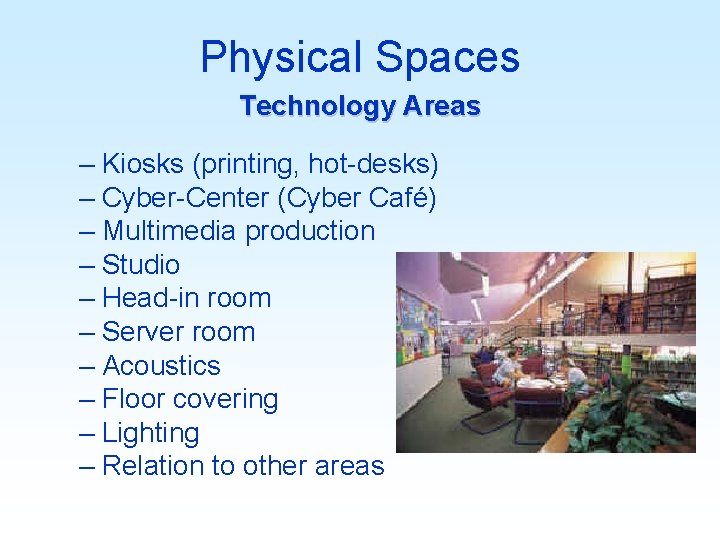
Physical Spaces Technology Areas – Kiosks (printing, hot-desks) – Cyber-Center (Cyber Café) – Multimedia production – Studio – Head-in room – Server room – Acoustics – Floor covering – Lighting – Relation to other areas
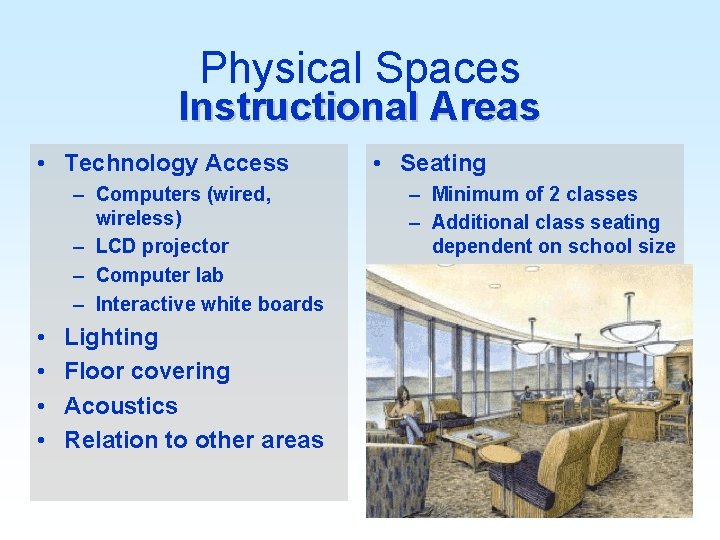
Physical Spaces Instructional Areas • Technology Access – Computers (wired, wireless) – LCD projector – Computer lab – Interactive white boards • • Lighting Floor covering Acoustics Relation to other areas • Seating – Minimum of 2 classes – Additional class seating dependent on school size
General Design Considerations • Keep the room as square as possible. • Keep circulation desk as square as possible • Keep circulation desk near library entrance/exits • Shelving finish should be durable for minimum of 30 years • Do not use particleboard shelving
General Design Considerations • Use clerestory windows as much as possible. • Use tinted glass for windows or equip with blinds • Use adjustable shelving • Use slanted shelving for magazines/periodicals • Ensure adequate number of electrical outlets in main room and in workroom.
General Design Considerations • Ensure adequate number of data connections • Shelving height recommendations • Secure storage for highend equipment (e. g. , MP 3 players, digital cameras) • Plan storage appropriate for materials
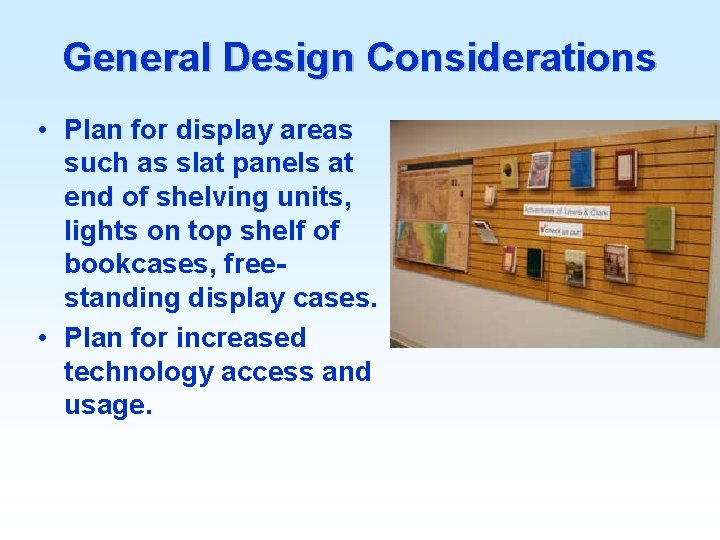
General Design Considerations • Plan for display areas such as slat panels at end of shelving units, lights on top shelf of bookcases, freestanding display cases. • Plan for increased technology access and usage.
General Design Considerations • Involve the media center staff in planning new facility • Ensure that media center professional staff are involved in all walkthrough visits during construction • FORM FOLLOWS FUNCTION! • Sample Floor Plans
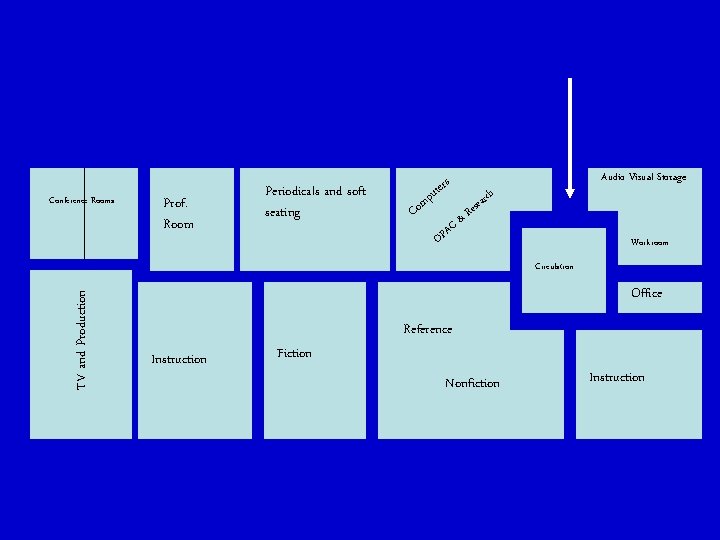
Conference Rooms Prof. Room Periodicals and soft seating s m Co er t u p AC OP Audio Visual Storage rch & ea Res Workroom TV and Production Circulation Office Instruction Fiction Reference Nonfiction Instruction
Martha Alewine Consultant, School Library Media Services Office of Instructional Promising Practices 725 Marshall Road Greenwood, SC 29646 864 -229 -4230 malewine@ed. sc. gov http: //martha. alewine. googlepages. com
Lt. Mark Mc. Colman School Resource Officer Program Richland County Sheriff’s Department 5623 Two Notch Road Columbia, SC 29223 803 -419 -4879 mmccolman@rcsd. net http: //www. rcsd. net/sro-list. htm http: //www. scasro. org/
- Slides: 29