
Designing Learner Centric MOOCs Sridhar Iyer Jayakrishnan M
- Slides: 53
Designing Learner Centric MOOCs Sridhar Iyer | Jayakrishnan M | Sahana Murthy | Sameer Sahasrabudhe Indian Institute of Technology Bombay | Indian Institute of Technology Madras This presentation is released under Creative Commons-Attribution 4. 0 License. You are free to use, distribute and modify it , including for commercial purposes, provided you acknowledge the source. Learner Centric MOOC
Warm-up: Differentiate between Scenario 1 : Consider a class in the 20 th century. Scenario 2 : Consider a class in the 21 st century. Come up with one difference between these scenarios wrt: 1) Students’ access to information. 2) Role of teachers. 2
Differences between 20 th and 21 st century classrooms Note Audience Responses here : Google, Wikipedia, Youtube versus Notebook Access Distractions NPTEL vs 3
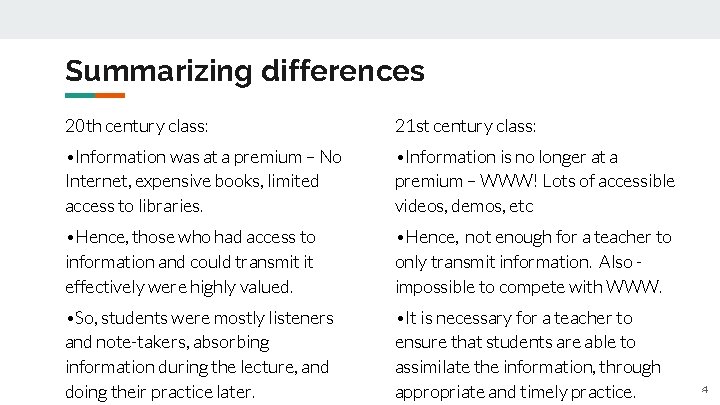
Summarizing differences 20 th century class: 21 st century class: • Information was at a premium – No Internet, expensive books, limited access to libraries. • Information is no longer at a premium – WWW! Lots of accessible videos, demos, etc • Hence, those who had access to information and could transmit it effectively were highly valued. • Hence, not enough for a teacher to only transmit information. Also impossible to compete with WWW. • So, students were mostly listeners and note-takers, absorbing information during the lecture, and doing their practice later. • It is necessary for a teacher to ensure that students are able to assimilate the information, through appropriate and timely practice. 4
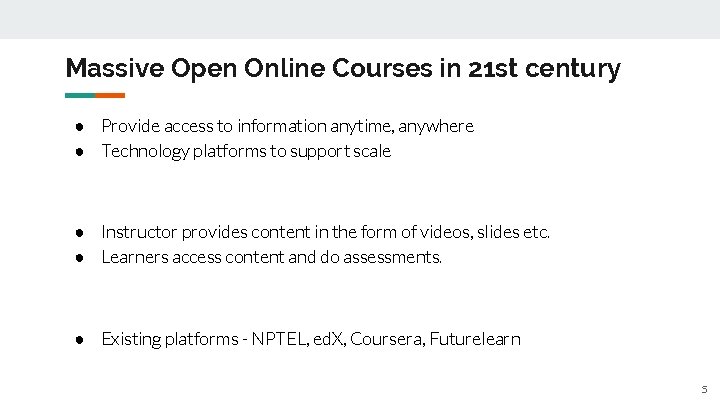
Massive Open Online Courses in 21 st century ● Provide access to information anytime, anywhere ● Technology platforms to support scale ● Instructor provides content in the form of videos, slides etc. ● Learners access content and do assessments. ● Existing platforms - NPTEL, ed. X, Coursera, Futurelearn 5
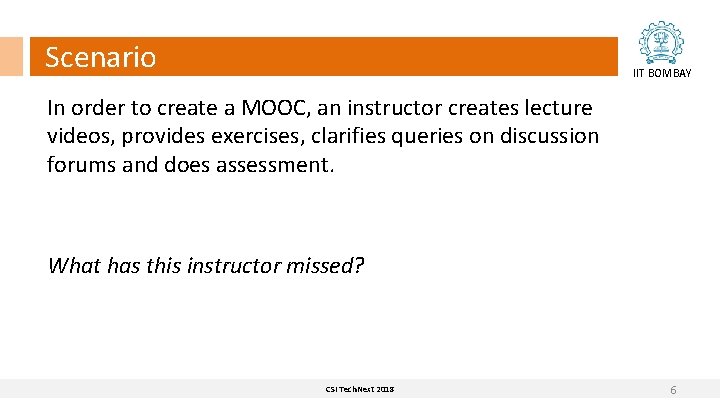
Scenario IIT BOMBAY In order to create a MOOC, an instructor creates lecture videos, provides exercises, clarifies queries on discussion forums and does assessment. What has this instructor missed? CSI Tech. Next 2018 6
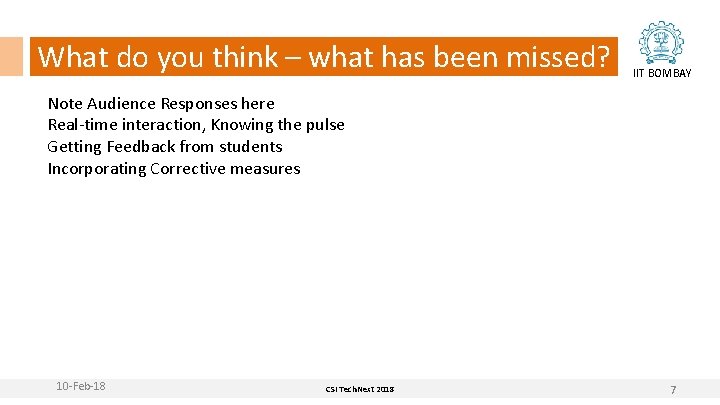
What do you think – what has been missed? IIT BOMBAY Note Audience Responses here Real-time interaction, Knowing the pulse Getting Feedback from students Incorporating Corrective measures 10 -Feb-18 CSI Tech. Next 2018 7
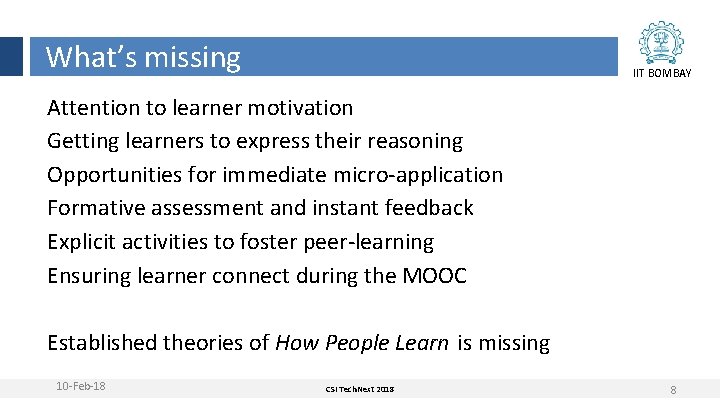
What’s missing IIT BOMBAY Attention to learner motivation Getting learners to express their reasoning Opportunities for immediate micro-application Formative assessment and instant feedback Explicit activities to foster peer-learning Ensuring learner connect during the MOOC Established theories of How People Learn is missing 10 -Feb-18 CSI Tech. Next 2018 8
Traditional MOOCs IIT BOMBAY Provide anytime anywhere access to learners for: ▪ Information – lectures, resources ▪ Assessment - activities and exercises ▪ Discussion – with peers and instructor(s) 10 -Feb-18 CSI Tech. Next 2018 9
Implications IIT BOMBAY ▪ Common MOOC problems may persist - low student engagement, low participation in discussion forums, low completion rates ▪ Problems of engagement worsen in a MOOC setting distance, scale and diversity of learners are all high 10 -Feb-18 CSI Tech. Next 2018 10
What might go wrong if we mimic a typical classroom ● In a typical classroom (recall teacher-centric class): ○ The standard 1 -hr lecture is not too engaging ○ Lecture + HW at the end is known to be not too effective ○ Even asking questions in between - did you understand, what doubts do you have - may only get a few students to respond ● Problems of engagement and effectiveness worsen in a MOOC setting distance, scale and diversity of learners are all high Takeaway: Do not attempt to mimic a typical classroom. Instead incorporate effective, learner-centric approaches. 11
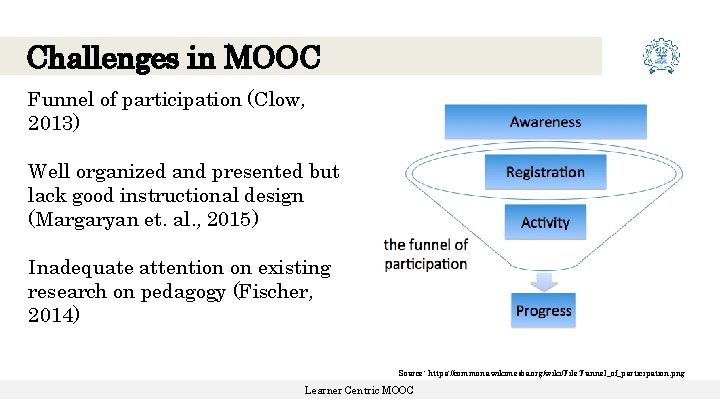
Challenges in MOOC Funnel of participation (Clow, 2013) Well organized and presented but lack good instructional design (Margaryan et. al. , 2015) Inadequate attention on existing research on pedagogy (Fischer, 2014) Source: https: //commons. wikimedia. org/wiki/File: Funnel_of_participation. png Learner Centric MOOC
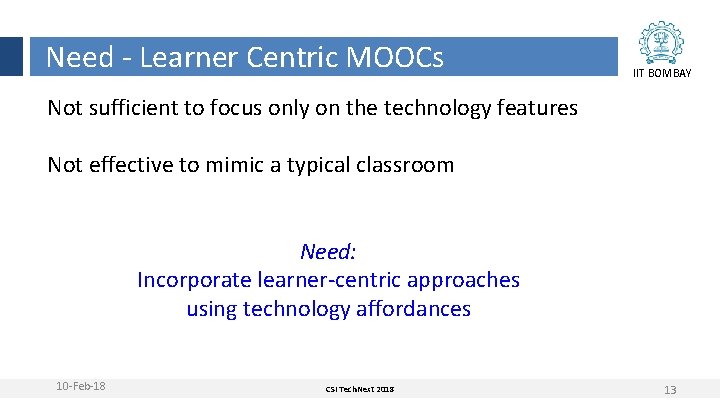
Need - Learner Centric MOOCs IIT BOMBAY Not sufficient to focus only on the technology features Not effective to mimic a typical classroom Need: Incorporate learner-centric approaches using technology affordances 10 -Feb-18 CSI Tech. Next 2018 13
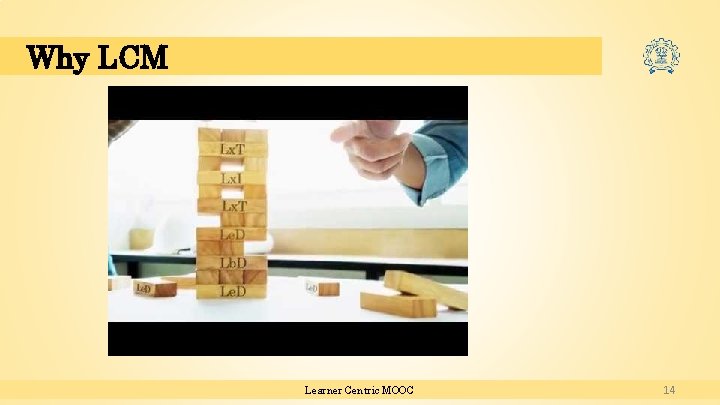
Why LCM Learner Centric MOOC 14
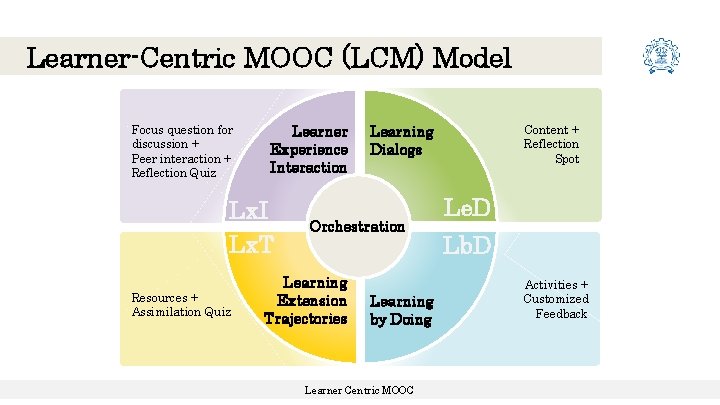
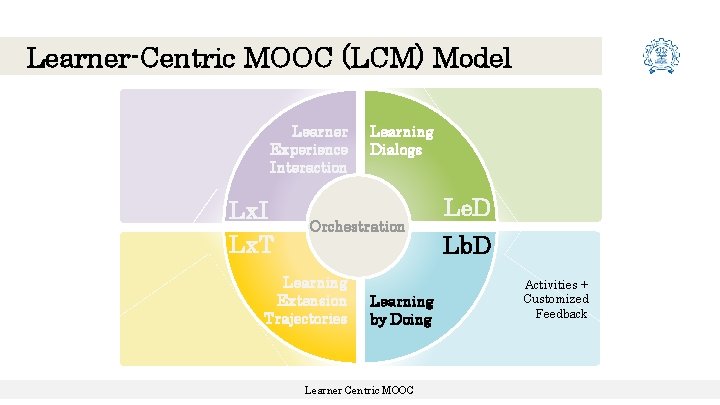
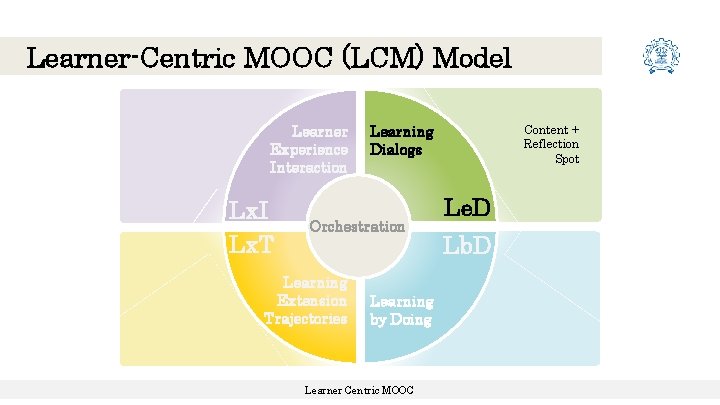
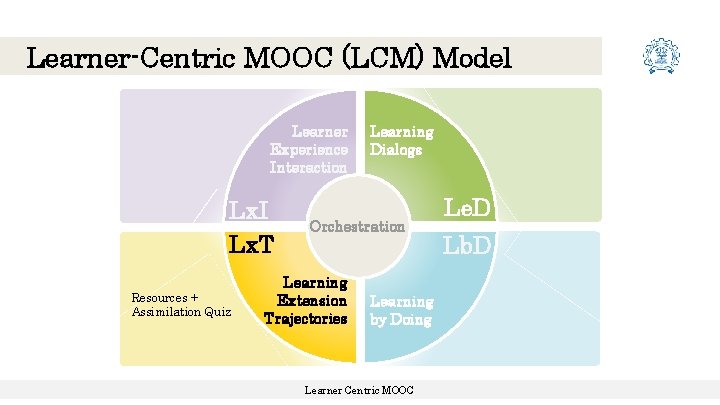
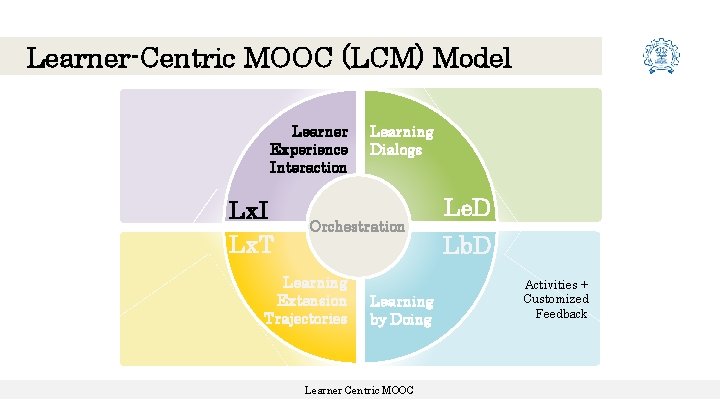
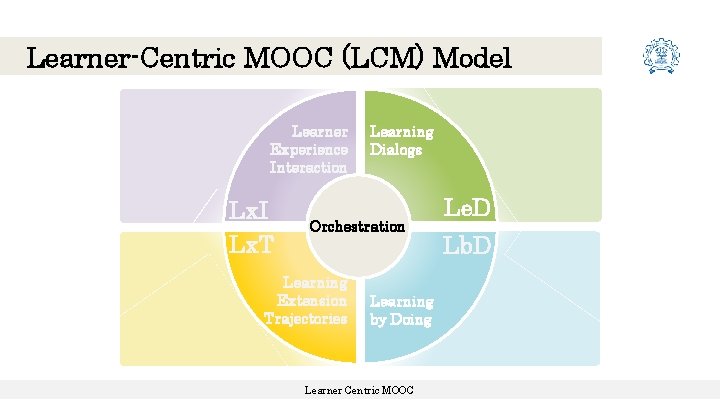
Learner-Centric MOOC (LCM) Model Focus question for discussion + Peer interaction + Reflection Quiz Learner Experience Interaction Lx. I Lx. T Resources + Assimilation Quiz Learning Dialogs Orchestration Learning Extension Trajectories Learning by Doing Learner Centric MOOC Content + Reflection Spot Le. D Lb. D Activities + Customized Feedback
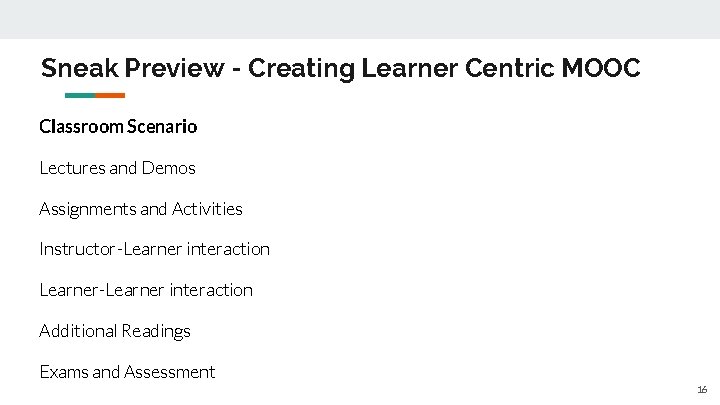
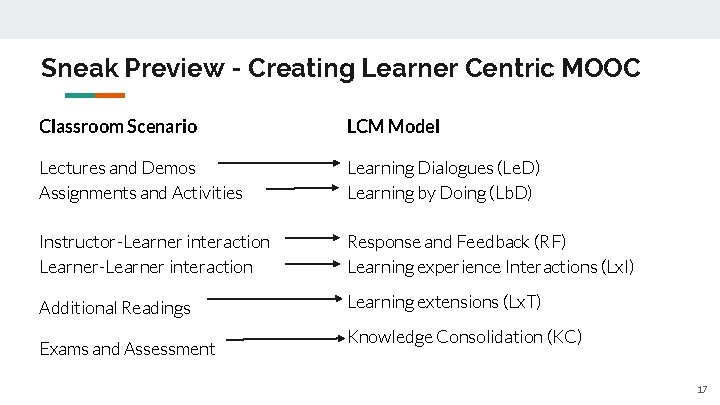
Sneak Preview - Creating Learner Centric MOOC Classroom Scenario Lectures and Demos Assignments and Activities Instructor-Learner interaction Learner-Learner interaction Additional Readings Exams and Assessment 16
Sneak Preview - Creating Learner Centric MOOC Classroom Scenario LCM Model Lectures and Demos Assignments and Activities Learning Dialogues (Le. D) Learning by Doing (Lb. D) Instructor-Learner interaction Learner-Learner interaction Response and Feedback (RF) Learning experience Interactions (Lx. I) Additional Readings Learning extensions (Lx. T) Exams and Assessment Knowledge Consolidation (KC) 17
Learner-Centric MOOC (LCM) Model Learner Experience Interaction Lx. I Lx. T Learning Dialogs Orchestration Learning Extension Trajectories Learning by Doing Learner Centric MOOC Le. D Lb. D Activities + Customized Feedback
Learner Centric MOOC
What is Learning by Doing? Learner Centric MOOC 20
Examples of Lb. D Learner Centric MOOC 21
Research Evidence “We estimate the learning benefit from extra doing (1 SD increase) to be more than six times that of extra watching or reading. ” (Koedinger et. al. , 2015) 91. 8% people found Lb. D activities useful [N=695] Learner Centric MOOC 22
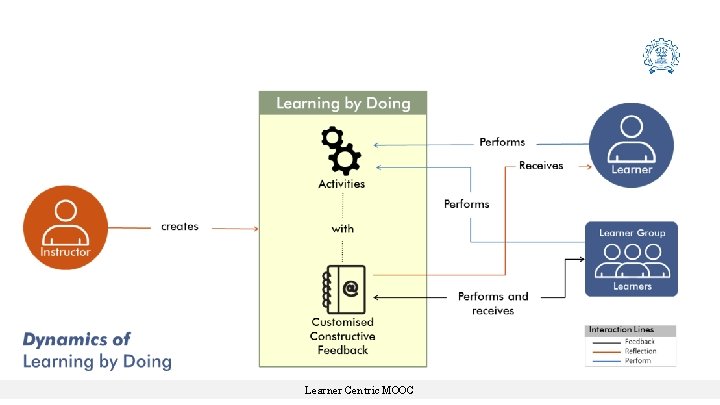
Lb. D Takeaway ▪ Intersperse videos with Learning by Doing activities ▪ Provide customized constructive feedback Learner Centric MOOC 23
Lb. D on creating your own Lb. D Write an Lb. D for one video in your NPTEL Course Learner Centric MOOC 24
Learner-Centric MOOC (LCM) Model Learner Experience Interaction Lx. I Lx. T Learning Dialogs Orchestration Learning Extension Trajectories Learning by Doing Learner Centric MOOC Content + Reflection Spot Le. D Lb. D
Learner Centric MOOC
What is Learning Dialog? Learner Centric MOOC 27
Examples of Le. D Learner Centric MOOC 28
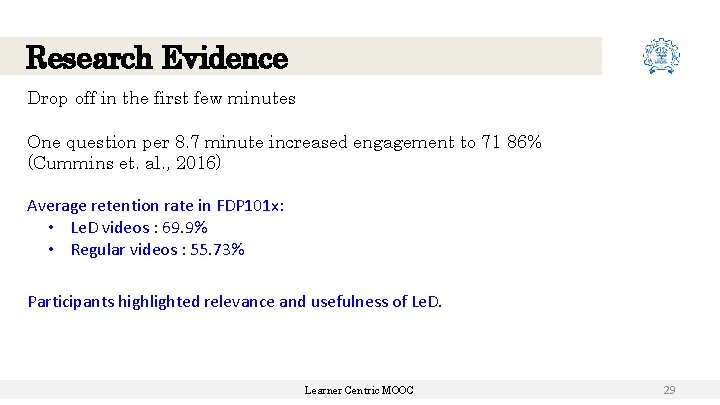
Research Evidence Drop-off in the first few minutes One question per 8. 7 minute increased engagement to 71 -86% (Cummins et. al. , 2016) Average retention rate in FDP 101 x: • Le. D videos : 69. 9% • Regular videos : 55. 73% Participants highlighted relevance and usefulness of Le. D. Learner Centric MOOC 29
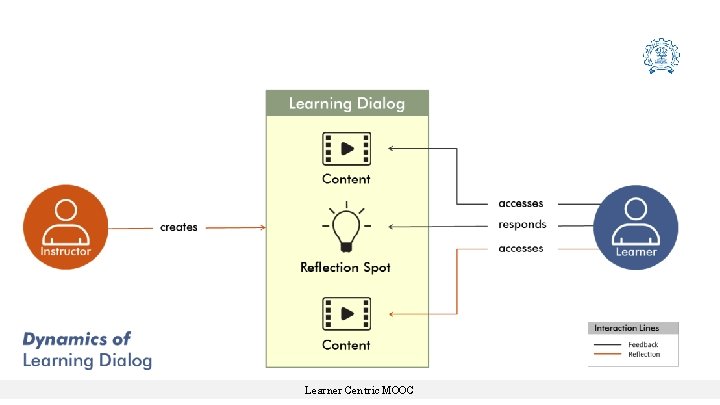
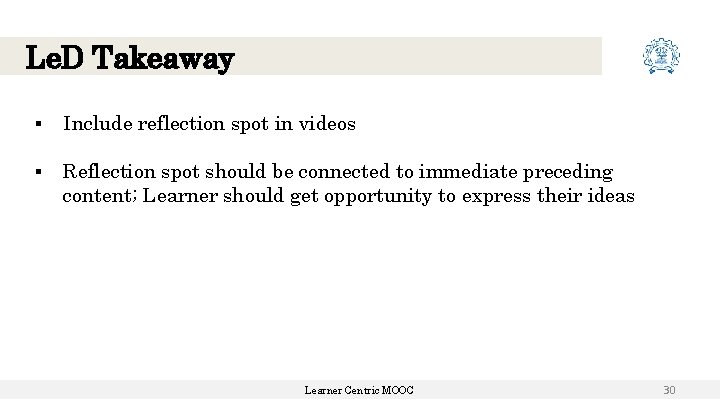
Le. D Takeaway ▪ Include reflection spot in videos ▪ Reflection spot should be connected to immediate preceding content; Learner should get opportunity to express their ideas Learner Centric MOOC 30
Lb. D on creating your own Le. D Write a Reflection Spot for one video in your NPTEL Course Learner Centric MOOC 31
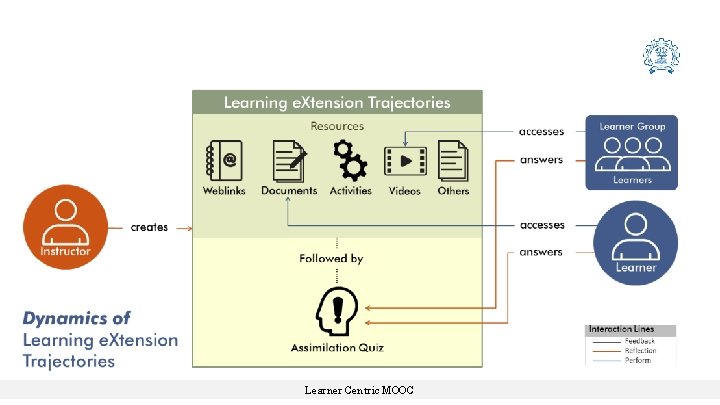
Learner-Centric MOOC (LCM) Model Learner Experience Interaction Lx. I Lx. T Resources + Assimilation Quiz Learning Dialogs Orchestration Learning Extension Trajectories Learning by Doing Learner Centric MOOC Le. D Lb. D
Learner Centric MOOC
What is Learning Extension Trajectory? Learner Centric MOOC 34
Examples of Lx. T Learner Centric MOOC 35
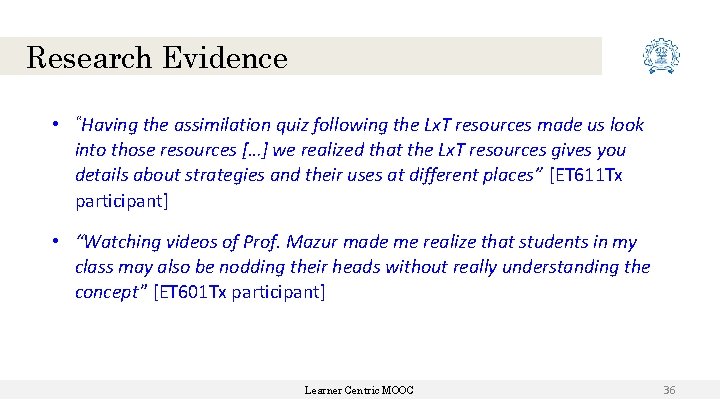
Research Evidence • “Having the assimilation quiz following the Lx. T resources made us look into those resources […] we realized that the Lx. T resources gives you details about strategies and their uses at different places” [ET 611 Tx participant] • “Watching videos of Prof. Mazur made me realize that students in my class may also be nodding their heads without really understanding the concept” [ET 601 Tx participant] Learner Centric MOOC 36
Lx. T Takeaway Cater to diverse learners and diverse learning levels Provide resources to increase depth and breadth Close the loop with Assimilation Quiz Learner Centric MOOC 37
Lb. D on creating your own Lx. T Identify Lx. T resources for one week in your NPTEL Course Write the Assimilation Quiz for the Lx. T Learner Centric MOOC 38
Learner-Centric MOOC (LCM) Model Learner Experience Interaction Lx. I Lx. T Learning Dialogs Orchestration Learning Extension Trajectories Learning by Doing Learner Centric MOOC Le. D Lb. D Activities + Customized Feedback
Learner Centric MOOC
What is Learner Experience Interaction? Learner Centric MOOC 41
Examples of Lx. I Learner Centric MOOC 42
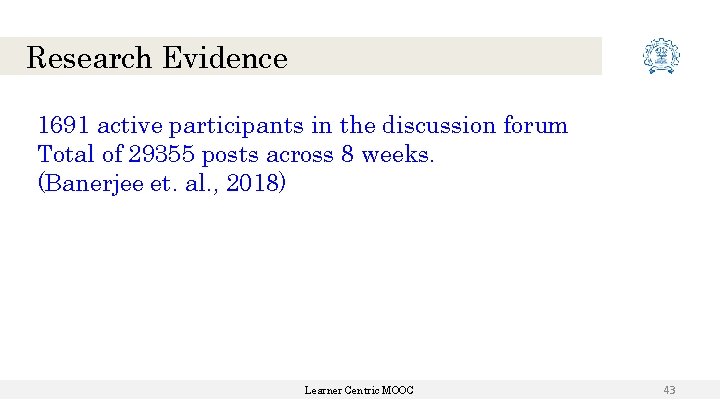
Research Evidence 1691 active participants in the discussion forum Total of 29355 posts across 8 weeks. (Banerjee et. al. , 2018) Learner Centric MOOC 43
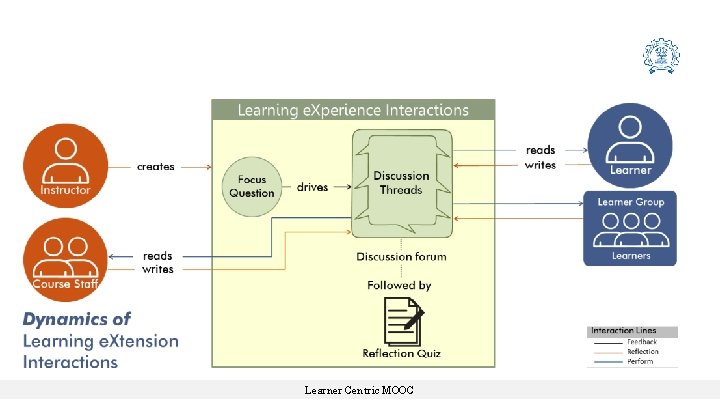
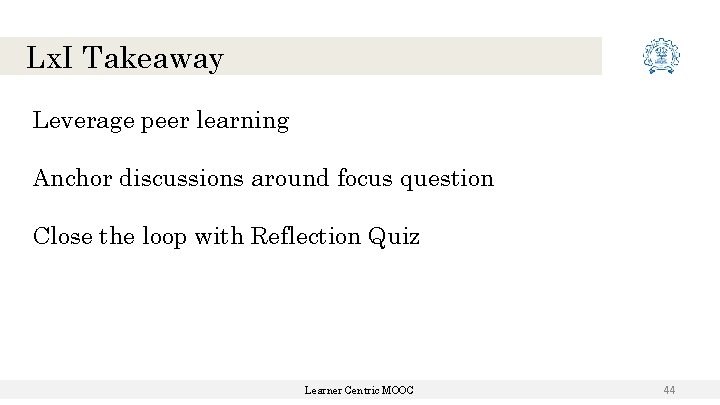
Lx. I Takeaway Leverage peer learning Anchor discussions around focus question Close the loop with Reflection Quiz Learner Centric MOOC 44
Learner-Centric MOOC (LCM) Model Learner Experience Interaction Lx. I Lx. T Learning Dialogs Orchestration Learning Extension Trajectories Learning by Doing Learner Centric MOOC Le. D Lb. D
Learner Centric MOOC
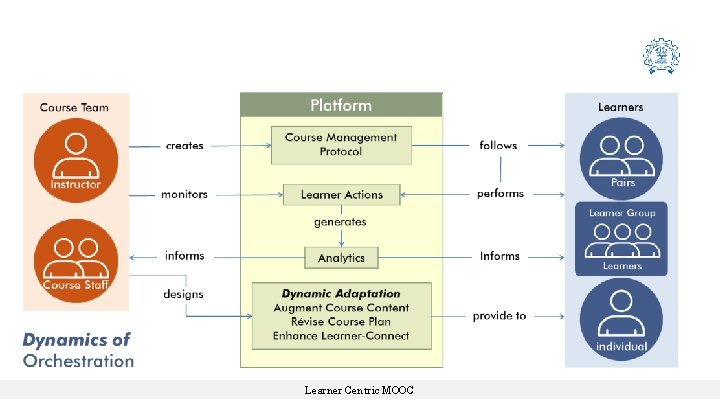
What is Orchestration Dynamics Learner Centric MOOC 47
Examples of Orchestration Learner Centric MOOC 48
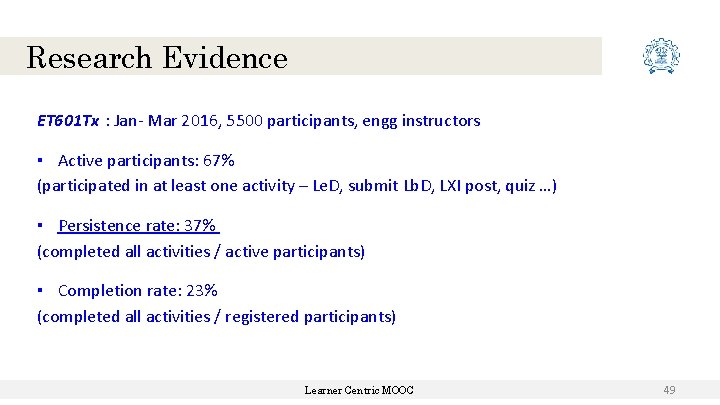
Research Evidence ET 601 Tx : Jan- Mar 2016, 5500 participants, engg instructors ▪ Active participants: 67% (participated in at least one activity – Le. D, submit Lb. D, LXI post, quiz …) ▪ Persistence rate: 37% (completed all activities / active participants) ▪ Completion rate: 23% (completed all activities / registered participants) Learner Centric MOOC 49
Orchestration Takeaway Exploit the power of analytics to Identify learner engagement Adapt the course content for the cohort Provide response to learner actions. Envisage different learner actions and design customised responses. Learner Centric MOOC 50
Closing A MOOC is a balanced combination of various learning activities using appropriate media, not just a collection of lecture videos and exercises. Use the LCM model to achieve the balance. Learner Centric MOOC 51
References MOOC Challenges Clow, D. (2013, April). MOOCs and the funnel of participation. In Proceedings of the Third International Conference on Learning Analytics and Knowledge (pp. 185 -189). ACM. Fischer, G. (2014). Beyond hype and underestimation: identifying research challenges for the future of MOOCs. Distance education, 35(2), 149 -158. Margaryan, A. , Bianco, M. , & Littlejohn, A. (2015). Instructional quality of massive open online courses (MOOCs). Computers & Education, 80, 77 -83. LCM Elements Cummins, S. , Beresford, A. , & Rice, A. (2016). Investigating engagement with in-video quiz questions in a programming course. IEEE Transactions on Learning Technologies, (1), 1 -1. Koedinger, K. R. , Kim, J. , Jia, J. Z. , Mc. Laughlin, E. A. , & Bier, N. L. (2015, March). Learning is not a spectator sport: Doing is better than watching for learning from a MOOC. In Proceedings of the second (2015) ACM conference on learning@ scale (pp. 111 -120). ACM. Banerjee, G. , Warriem, J. M. , & Mishra, S. (2018, December). Learning experience interaction (Lx. I): Pedagogy for peer connect in MOOCs. In Proceedings of 26 th International Conference on Computers in Education (ICCE 2018). in press. Learner Centric MOOC 52
Thank you Learner Centric MOOC 53