
Designing Great Presentations Overview Working Backward The Role
Designing Great Presentations
Overview • Working Backward • The Role of 3 • The structure of a presentation
How do you design a presentation? • What is your typical strategy?
Curriculum Design • Good course design works backward – What do you want people to learn? – What skills do you want them to have? • Talk design works the same way – What do you want people to know when you are done?

Core questions • What do you want people to know? • What do they know now? • How can you bridge the gap between them? • How can you attach new knowledge to existing knowledge? • Are there elements (like skills) that would be hard to transmit in a talk?
The Role of 3 • Our cognitive experience is shaped by 3 s – That is, small numbers of things… • Who did what to whom? • <X> is similar to <Y> – We do not compare groups of things • Short term memory is also limited – 7 +/- 2 items
Try this • List all of the vegetables you can in one minute.
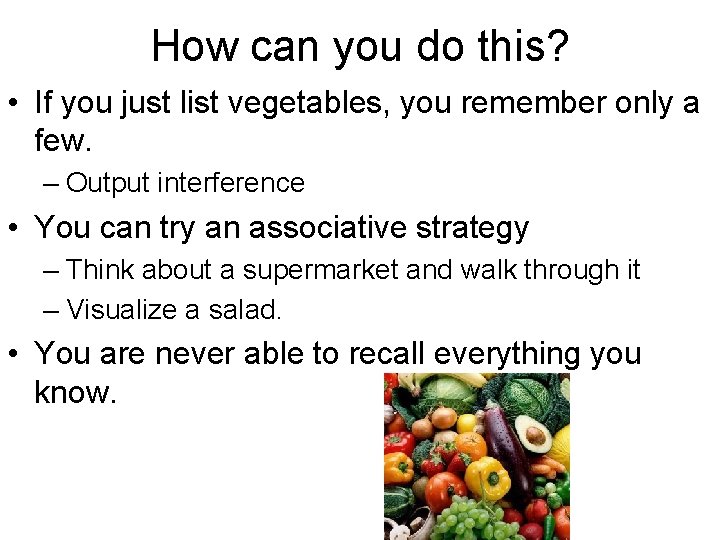
How can you do this? • If you just list vegetables, you remember only a few. – Output interference • You can try an associative strategy – Think about a supermarket and walk through it – Visualize a salad. • You are never able to recall everything you know.
The Rule of 3 • You remember about 3 things about an experience – Books, lectures, movie plots • You must control what others remember about their experiences with you.
Less is More • Organize your presentations around the three things you want people to remember – Decide in advance what those should be • Focus on those points in your presentation – Eliminate extraneous points – Give exercises to reinforce those points • Repeat those points at the end of the presentation
Exercise • Narrowing to Three – Really…
Structure Your Presentation • Tell ‘em what you’re going to tell ‘em • Tell ‘em what you told ‘em
Memory • Two types of memory – Explicit memory • Primacy and Recency • Depth of processing • Encoding specificity – Implicit memory • Procedural memory • Priming • What are you hoping to influence?
Maximizing Explicit Memory • Start and end with a summary • Maximize depth of processing – Get people to do things • Votes • Questions • Exercises • Think about retrieval cues – Where will this information be used? – Can you provide templates?
Implicit memory? • What procedures do people need to know? • Structure practice for people – Help them develop skills – Habits • Cannot do complete practice in a talk – Give people assignments – Practice schedules
This is crucial • If you do not influence people’s memory, nothing changes • Focus on the influence you want to have • Talk Template
Summary • The value of working backward • The Role of 3: Less is more • Influencing explicit and implicit memory

- Slides: 18