
Designing For Unknown Requirements Building boxes with flexibility
Designing For Unknown Requirements Building boxes with flexibility in mind Justin Denning 812 th AITS U. S. Air Force – Edwards AFB DISTRIBUTION STATEMENT A. Approved for public release; Distribution is unlimited 412 TW-PA-21130 Unclassified

Standard PCB Design Process 1. 2. 3. 4. 5. 6. 7. 8. 9. 10. 11. Receive Requirements (or the more common hand waived desires) Search for existing equipment that will satisfy the need Develop overall design plan Research components Generate a schematic Peer review the design Generate a PCB layout Perform validation checks Fabricate the PCB Populate the PCB Checkout and validate the design 2 Unclassified
Ideal PCB Design Process 1. 2. 3. 4. 5. 6. 7. 8. 9. 10. 11. Receive Requirements (or the more common hand waived desires) Search for existing equipment that will satisfy the need Develop overall design plan Research components DONE! Generate a schematic Peer review the design Generate a PCB layout Perform validation checks Fabricate the PCB Populate the PCB Checkout and validate the design 3 Unclassified

Design Philosophy • New designs must meet the current design requirements • If it doesn’t, it is an obvious fail • Anything that can be accomplished in firmware, use it. • Hardware is far harder to change than firmware code. • Code will likely need to be updated with a new hardware revision anyway, so prefer skipping the hardware effort • Focus on hardware flexibility • Make simple additions to a design that allow for flexibility in the future • This could avoid a complete hardware redesign or revision during the next project • Select components that have more capabilities than are needed • We work in very low quantities, a part costing $1 instead of the less capable $0. 70 part is well worth it for future flexibility 4 Unclassified
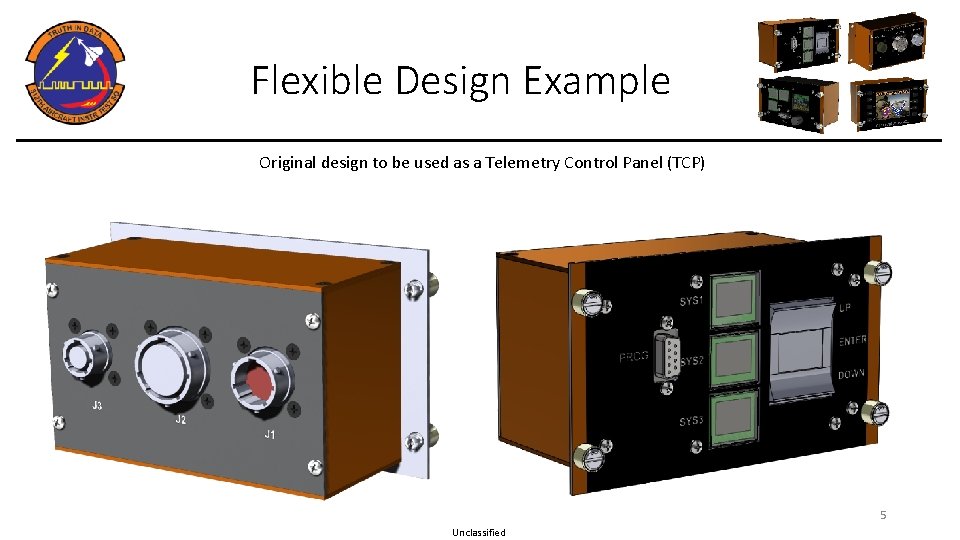
Flexible Design Example Original design to be used as a Telemetry Control Panel (TCP) 5 Unclassified

Flexible Design Example Capabilities Fully programmable with • 6 x full duplex RS-422 serial connections • Capable of up to 250 Kbps • 8 x optically isolated discrete outputs • Configurable to pull-up or pull-down • Capable of 700 m. A ON current, and 60 VDC open circuit voltage • 10 x optically isolated discrete inputs • Can be used in active-high or active-low configurations • 10/100 BASE-T Ethernet (not a requirement) • 3 x full-color 64 x 48 pixel display buttons • Rocker switch with 96 x 64 pixel monochrome display • 1 x front panel RS 232 port for configuration or control 6 Unclassified

Flexible Design Example Designed as a stack of 3 PCBs Aircraft Interface PCB • Contains all the circuitry that interacts with the external world Processor/Power PCB • Contains all the power filtering, conditioning, regulation, and the microcontroller (with most of its pins broken out to board-toboard connectors) User Interface PCB • Contains all the circuitry, buttons, displays, etc. that the user interacts with. 7 Unclassified
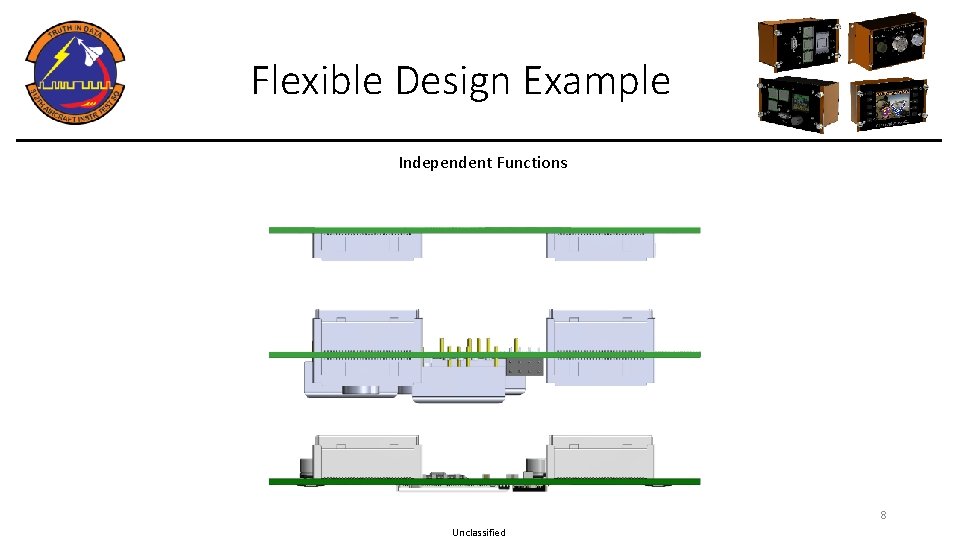
Flexible Design Example Independent Functions 8 Unclassified
Flexible Design Example Design Benefits • Separates the panel’s functions into three different parts 1. External interface 2. Main processor and power handling 3. User interface • Each part can be fully validated and used as a known good design for future boxes. • The power/processor board was validated, then used in future designs without the need for the extensive testing initially required • Everything is designed around the microcontroller • This allows the flexibility of the microcontroller to be fully exploited 9 Unclassified

Flexible Design Example 32 bit ARM® Cortext-M 4 F Core from Texas Instruments • Built in Flash and SDRAM memory • 128 pin, 90 GPIO • Multiplexed pin functions • Hardware peripherals • 8 x UART • 4 x SPI (quad SPI supported) • 10 x I 2 C • 1 x Ethernet (10/100 Mbps) • 1 x USB (Full speed) • 32 x µDMA • 8 x Timers (32 or 2 x 16 bit each) • 4 x PWM • 2 x ADC (multiplexed to 20 pins) • 2 x CAN • AES/DES Encryption/Decryption • MD 5/SHA Hashing • 1 x Quadrature Encoder input Microcontroller 10 Unclassified
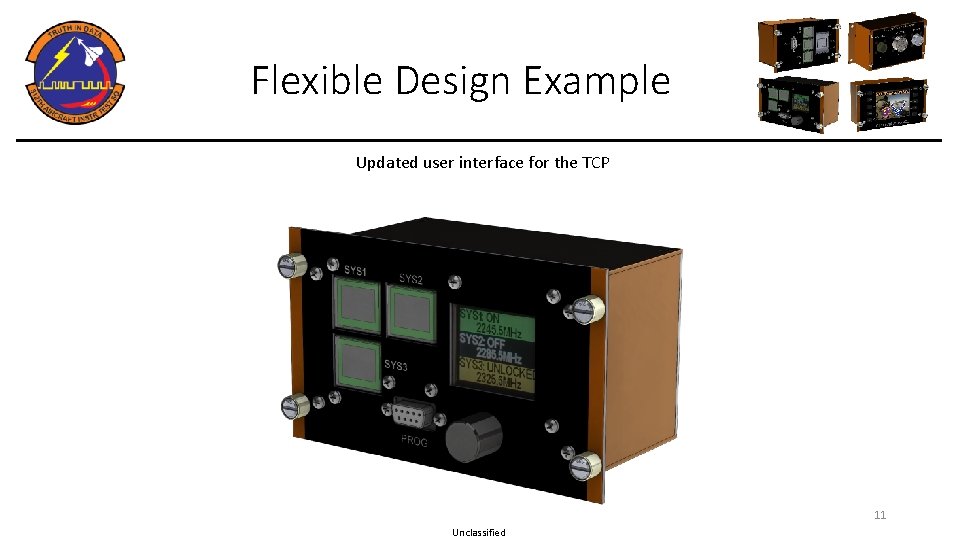
Flexible Design Example Updated user interface for the TCP 11 Unclassified
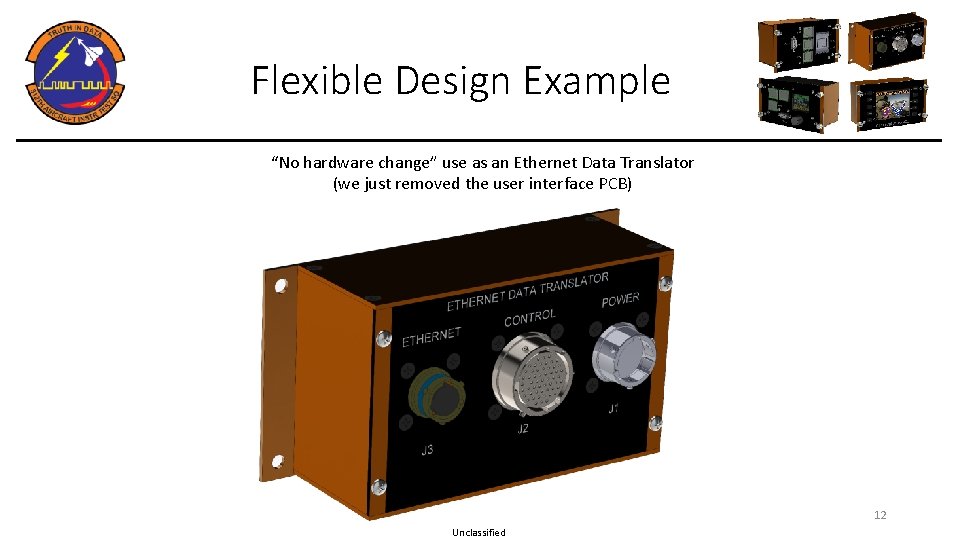
Flexible Design Example “No hardware change” use as an Ethernet Data Translator (we just removed the user interface PCB) 12 Unclassified
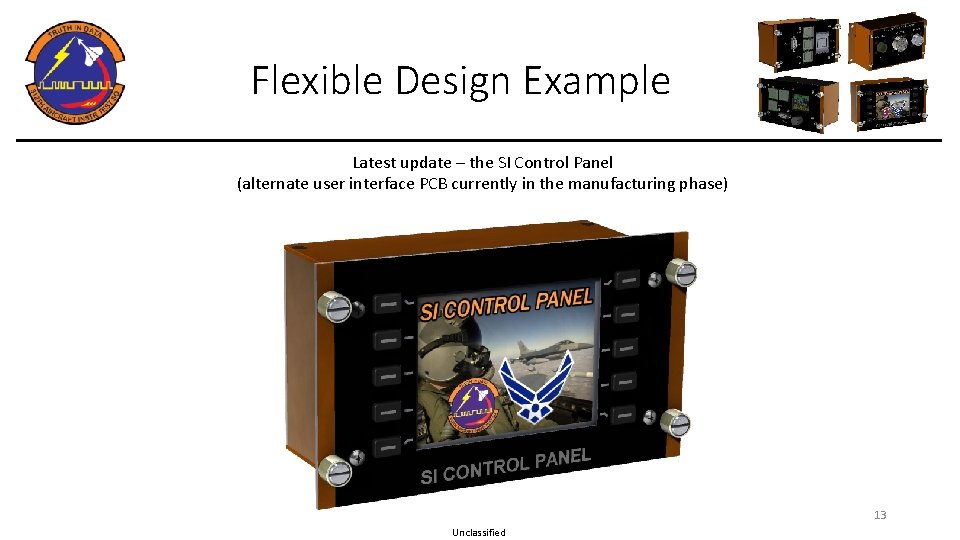
Flexible Design Example Latest update – the SI Control Panel (alternate user interface PCB currently in the manufacturing phase) 13 Unclassified

Flexible Design Example Known Future Updates • We are currently designing a single aircraft interface PCB that will support: • Data capture and conversion of military radio control data to Ethernet packets • PCM data generation for lab and ground testing • PCM reception with parameter display or relay out the Ethernet port • Wireless • Control • Remote display capability • Remote data collection 14 Unclassified
Conclusion • Modern designs leveraging firmware driven features are much easier to modify • Including useful capabilities, not immediately needed, could save significant design time in the future • The ability to adapt to changing requirements in the flight test world is a necessity 15 Unclassified
Conclusion And… Microcontrollers Rock! Thank You Justin Denning 812 th AITS “Given the opportunity, Justin would put a microcontroller in a hammer” -Douglas Pilcher Unclassified 16
- Slides: 16