
Designing for an Audience Assessment n How to





- Slides: 48
Designing for an Audience Assessment n How to identify, locate and reach groups of people who need your product or service? n The Art of Making Useful Generalizations
“A market is a group of people who reference each other when making buying decisions. ” Crossing the Chasm G. Moore.
“Owning” an Audience What does a publisher own? n A preferred relationship with an audience.
Audience Analysis n n n What do members of the audience have in common? Are there different segments in the audience? What kind of choices do they make and why might they choose my product or service? Where can I find them? What motivates them to buy? to participate? to join?
Reaching Your Audience How many ways exist for you to connect to your target audience? n What sources of information exist that allow you to understand the audience or market? n What companies do they know or what products do they use? n What media reaches them? n
In a Nutshell q We want to understand how communities are organized n Demographically n By Common Motivations n By Shared Affinities or Choices
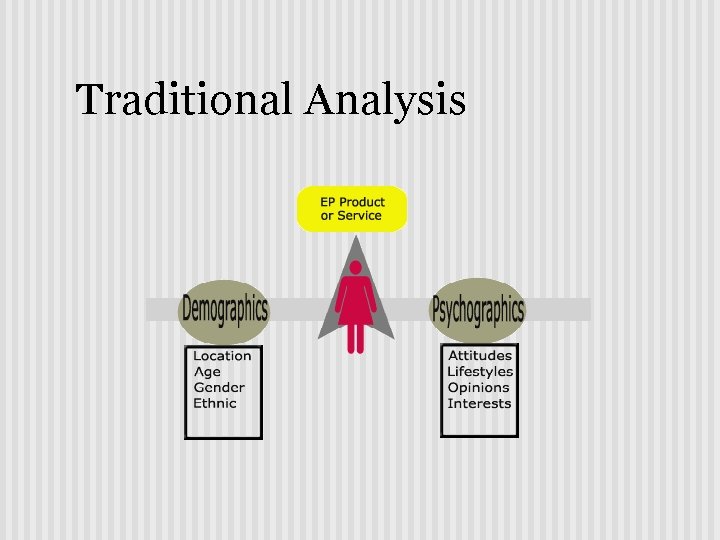
Traditional Analysis
Demographic Research Identify Characteristics of Populations n Geographic newspapers (sfgate. com) city guides (bayinsider. com) n Age/Stage of Life Senior. Net, Third. Age. com Parent. Soup n Student publications Gender / Race Women. com Net. Noir
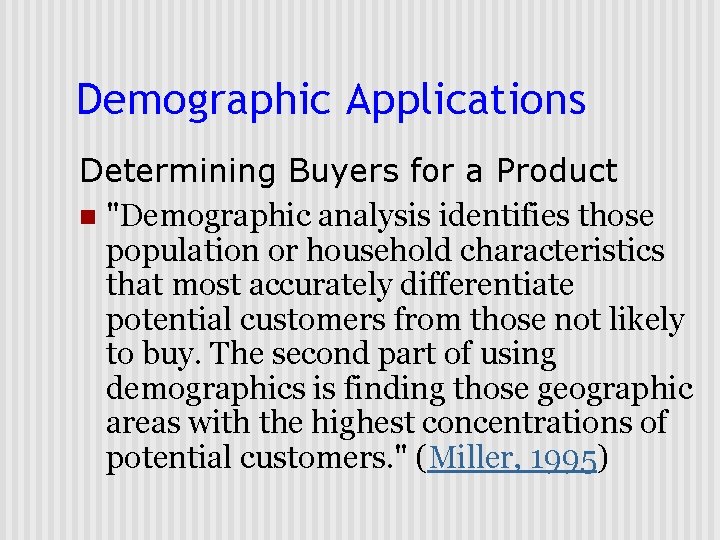
Demographic Applications Determining Buyers for a Product n "Demographic analysis identifies those population or household characteristics that most accurately differentiate potential customers from those not likely to buy. The second part of using demographics is finding those geographic areas with the highest concentrations of potential customers. " (Miller, 1995)
Profiling of Audiences for Advertisers ü What is the size of potential audience? ü What growth trends are associated with it? ü What economic factors make the audience attractive? Two Sides to Every Profile
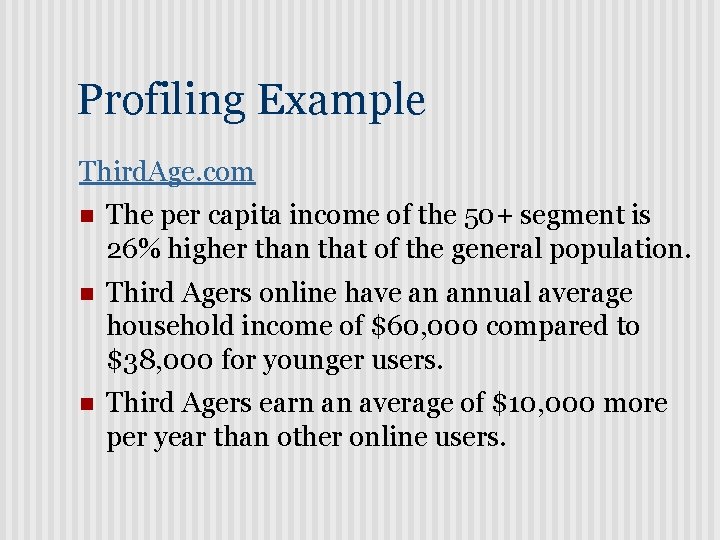
Profiling Example Third. Age. com n The per capita income of the 50+ segment is 26% higher than that of the general population. n Third Agers online have an annual average household income of $60, 000 compared to $38, 000 for younger users. n Third Agers earn an average of $10, 000 more per year than other online users.
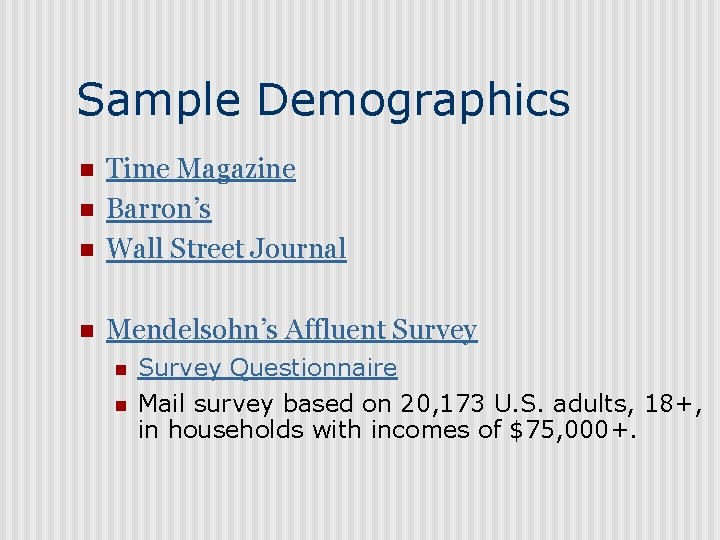
Sample Demographics n Time Magazine Barron’s Wall Street Journal n Mendelsohn’s Affluent Survey n n Survey Questionnaire Mail survey based on 20, 173 U. S. adults, 18+, in households with incomes of $75, 000+.
Online Demographic Sources n Zip Code Segmentation CACI n n Let's try 90210 US Census Bureau n Statistical Abstract of the US n American Demographics Magazine n U Michigan’s Documents Center - Stats
Psychographics n Understanding how values, lifestyles and attitudes influence behavior of groups of people.
What Motivates People n "Knowing where your customers live, how old they are, or how much money they make is important, but it isn't enough. To anticipate their behavior relative to your client's products, you must look at what motivates your customers - their values, behaviors, and beliefs. " (Market. Match)
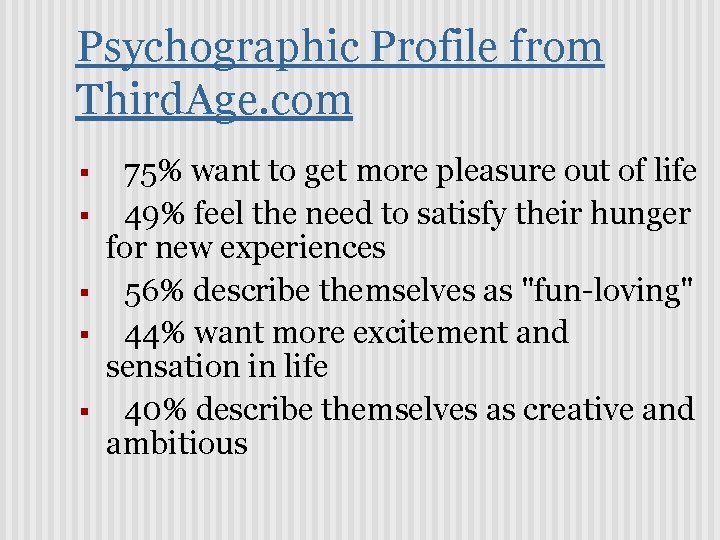
Psychographic Profile from Third. Age. com § § § 75% want to get more pleasure out of life 49% feel the need to satisfy their hunger for new experiences 56% describe themselves as "fun-loving" 44% want more excitement and sensation in life 40% describe themselves as creative and ambitious
Psychographic Applications n n Psychographic segmentation Segment individuals into groups based on where they fall on a spectrum of possible attitudes.
Travelling Types n Plog (1974) identified three personality types in relation to travel, each of which is associated with certain travel patterns and kinds of destination.
Travelling Types 2 n n n Psychocentrics focus on risk aversion and thus either do not travel at all, or restrict their travel to safe, familiar destinations. Allocentrics, in contrast, are confident and selfempowered, and tend to travel farther afield. Most of the population, however, is midcentric. (Weaver et al, 1995) n From "PSYCHOGRAPHICS AND TRAVEL BEHAVIOR OF SASKATCHEWAN OLDER ADULTS"
Segment Characteristic Product Psychocentric Reluctant to Travel Family-related travel. Goes to same place Travel Videos Midcentric Allocentric Frequent trips to unique locations Group packages; condo or vacation home Adventure travel
VALS SRI's Values and Lifestyles Program n Questionnaire Ø I am often interested in theories. Ø I like outrageous people and things. o. Mostly disagree o. Somewhat agree o. Mostly agree
VALS Eight Consumer Segments Actualizers Fulfilleds Achievers Experiencers Believers Strivers Makers Strugglers n Ranked from High to Low Resources
Resources n Resources refer to the full range of psychological, physical, demographic, and material means and capacities people have to draw upon. It encompasses education, income, self-confidence, health, eagerness to buy things, intelligence, and energy level. It is a continuum from minimal to abundant. Resources generally increase from adolescence through middle age but decrease with extreme age, depression, financial reverse, and physical or psychological impairment. (SRI, Vals Segment Profiles)
Communities of Interest Also called Affinity Groups. ü Hobbies ü Interests ü Functions (Work-related) ü Activities
Lifestyle choices Reflect lifestyle, attitudes and choices. n Behavioral patterns n Possible differentiation between psychographics and affinities is that individual chooses to belong to the group. n What groups of people form around a set of choices? How important to them are those choices? n
Examples n homeowner, bicycle rider, student, amateur photographer, horse rider, hiker, Mac user, guitar player, fitness fanatic; Civil War history buff n Sites visited frequently
Past Purchase Decisions n History n What things you already own are a good indication of what you might buy. n n Computer equipment n Books, CDs, etc. n Home, etc. What sites you visit is important.
Virtual Communities n net. gain (Hagel, Armstrong, 1997) describes how successful e-commerce is a result of organizing online communities.
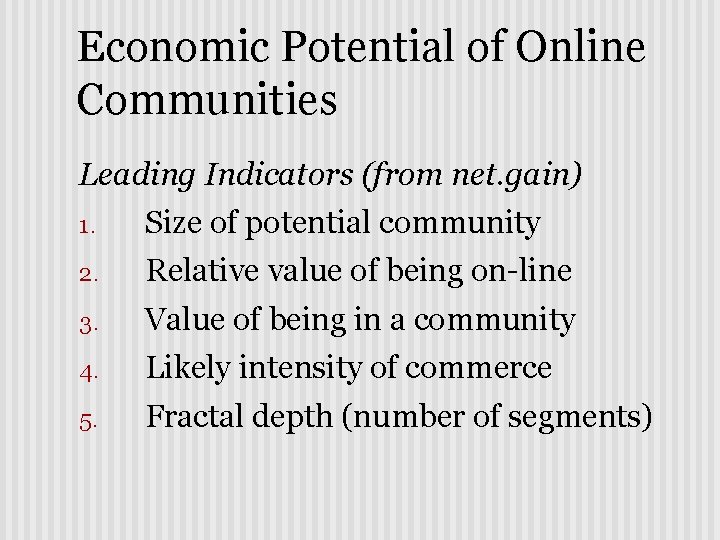
Economic Potential of Online Communities Leading Indicators (from net. gain) 1. Size of potential community 2. Relative value of being on-line 3. Value of being in a community 4. Likely intensity of commerce 5. Fractal depth (number of segments)
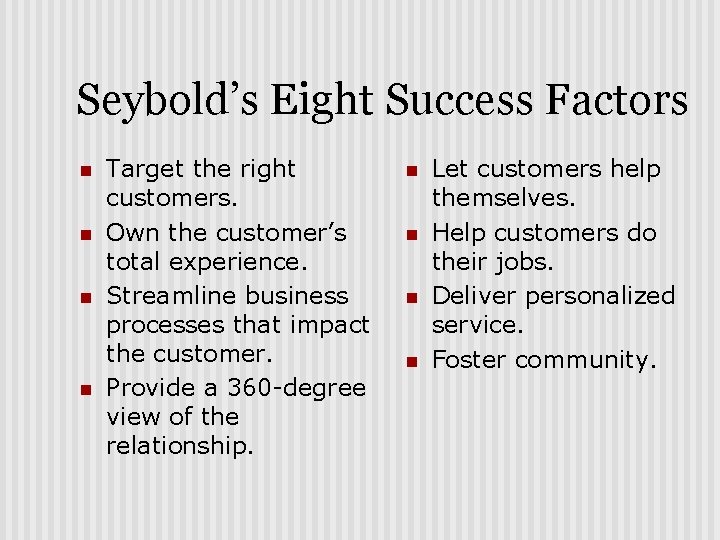
Seybold’s Eight Success Factors n n Target the right customers. Own the customer’s total experience. Streamline business processes that impact the customer. Provide a 360 -degree view of the relationship. n n Let customers help themselves. Help customers do their jobs. Deliver personalized service. Foster community.
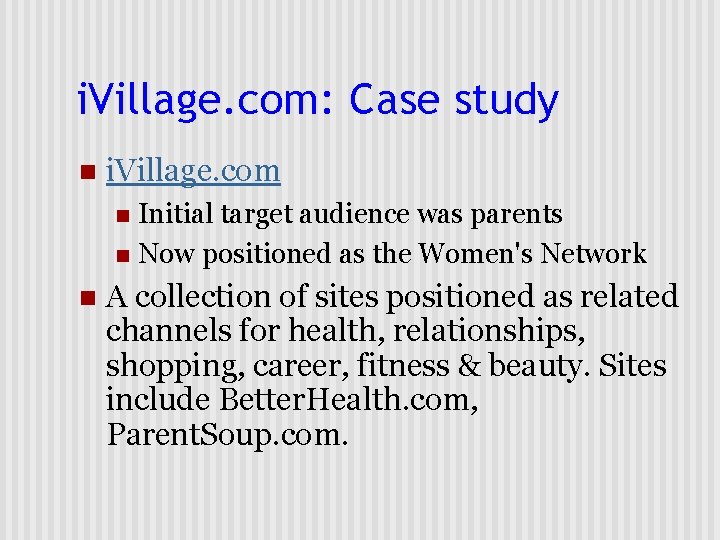
i. Village. com: Case study n i. Village. com Initial target audience was parents n Now positioned as the Women's Network n n A collection of sites positioned as related channels for health, relationships, shopping, career, fitness & beauty. Sites include Better. Health. com, Parent. Soup. com.
Internet Demographics n If your product or service depends on the Internet, then your audience demographics are linked to the Internet's demographics. n Nielsen Net. Ratings n Hot Off the Net
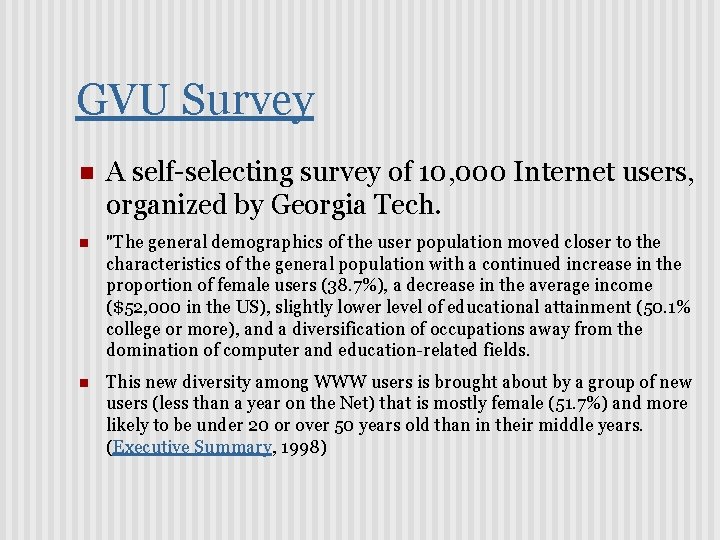
GVU Survey n A self-selecting survey of 10, 000 Internet users, organized by Georgia Tech. n "The general demographics of the user population moved closer to the characteristics of the general population with a continued increase in the proportion of female users (38. 7%), a decrease in the average income ($52, 000 in the US), slightly lower level of educational attainment (50. 1% college or more), and a diversification of occupations away from the domination of computer and education-related fields. n This new diversity among WWW users is brought about by a group of new users (less than a year on the Net) that is mostly female (51. 7%) and more likely to be under 20 or over 50 years old than in their middle years. (Executive Summary, 1998)
GVU Graphs • Gender, Education, Age, Household Income • Membership in Communities n Hours of Web Use n
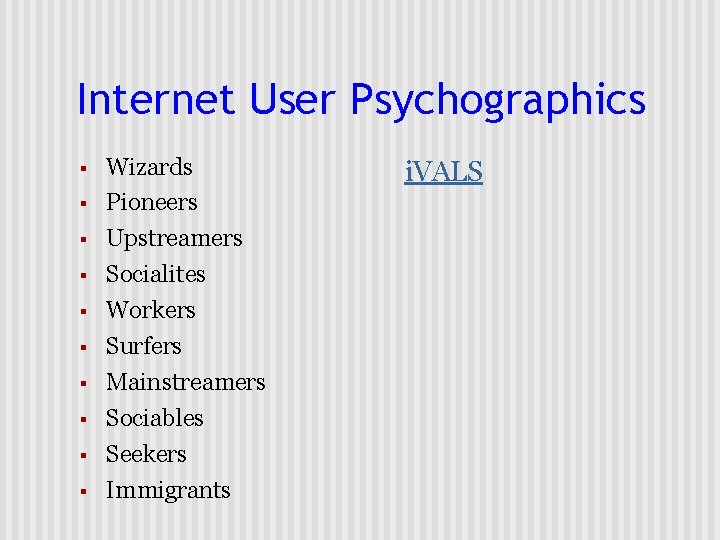
Internet User Psychographics § § § § § Wizards Pioneers Upstreamers Socialites Workers Surfers Mainstreamers Sociables Seekers Immigrants i. VALS
Questions About Internet Use n What percentage of a traditional print audience segment is online? n How is your segment growing online? n How active are they?
Crossing the Chasm Geoffrey A. Moore, 1991 n Technology Adoption Life Cycle n Defines five psychographic groups in terms of how they respond to new technology. Maps as a bell curve.
Technology Adopters
The Chasm n Moore's point is that there is a chasm between the early adopters and the early majority. It is difficult for high tech products that were favored by Innovators and Early Adopters to succeed with the Early Majority. Different strategies are required. References n Mainstream buyers require more and more references to make a buy decision. References may include publishers, other customers, etc.
Target Customer Characterization n n Moore writes that "target markets" characterized by numbers are "impersonal, abstract things. " He talks about developing "informed intuition" about the customers. He suggests that a team characterize each of the different kinds of customers and create scenarios in which each customer uses the product. This is a formal process that helps a group make decisions based on these characterizations. Moore, p. 97 -9.
Personal Profile and Job Description n Who is the person, what do they do for a living, what kind of organization do they work for, what do they value?
Resources n What resources does the person have available to them that is relevant to the product. Consider technical resources, but others as well.
A Day in the Life (Before) n Describe the person's life at the moment when your product or service would make a difference.
Dilemna n State the problem that the person faces that motivates this person to buy the product.
A New Day in the Life (After) n Describe how the product solves the problem and reinforces what the customer believes or values.
Surveys n We can ask users to tell us more about themselves. n We can benefit from direct interaction with users. n The more we know, the more refined our product or service becomes.
Developing Surveys n n Market Research uses surveys and focus groups to collect more detailed information about users. Email is preferred method to solicit interest and ask people to fill out a form online. Users online are more willing than most to participate in surveys, especially if they can learn from the results as well. List of Online Tests
Assignment: n Write an audience analysis. n Develop a 20 -question survey.