
Designing Engaging Lessons What do I want students

- Slides: 16
Designing Engaging Lessons What do I want students to learn? Restate the “objective” in one’s own words to make it more personal. Is the objective: Foundational: vocabulary, procedures, lists Application: comparing/contrasting, problem solving, investigative How can the objective be tied to students’ interests?
Designing Engaging Lessons How will I know if they have learned? What type of assessments will I be using? Informal: conversations, questioning, observation, pair share Formal: tests, quizzes, projects, products, ISNs, journals
Designing Engaging Lessons What will I do if they have not learned? What type of remediation will I use? One-on-one reteach? Small group reteach? Whole group reteach? Is it vocabulary related? All of which require constant monitoring What types of misunderstandings do you anticipate after getting to know your students? Do I need to scrap the lesson and start over?
Designing Engaging Lessons What will I do if they have? How can I celebrate and extend their learning? Extension activities: (TTTOP) Three things to Teach Our Parents Designing puzzles or games using new content Describing how their new knowledge applies in the “real world” Celebrations: Whooshes, snaps, high fives, private/public compliments, notes home, stickers, stamps, etc. Find out what they like.
Delivering Engaging Lessons One Day At The Beach
Delivering Engaging Lessons Engage / Enroll Opening Tradition/Focus Activity • Begin your lesson by capturing your students’ attention with your established Opening Tradition and with some type of quick activity: • A question • Story, narrative chain, poem, rap • Brief activity • Poll taken in the room to pique interests In other words: How do you get students to look at you, watch you, and listen to you?
Delivering Engaging Lessons Experience Before Label • Creating an experience for students that allows them to make connections and draw conclusions before stating the objective. • Allows for moments of questioning…creating interest. • Creates “light bulb” memories for students to comprehend and engage while their amygdala is relaxed. • Decreases stress and gives way for more meaningful retention. • Anything that is NOVELTY! Brains love it!!
Delivering Engaging Lessons For Lessons not lending themselves to a narrative chain or brief activity: State objective: Today you will be learning… State Learning expectation: After today you will be able to identify, describe, create, etc. with your new knowledge. Write objective: Have objectives written on the board in the same place everyday. “where are we going? ”
Delivering Engaging Lessons Review Behavioral Expectations Be sure you already have clear routines and procedures. Remind students with the room will “look like” and “sound like” before, during and after the lesson. Use lots of positives…”rewarding what you value”. Don’t be afraid to redirect disruptive behavior, but do it in a manner that promotes respect.
Delivering Engaging Lessons The “Lesson” • Incorporate the different learning styles into the lesson (VAK) • Connect the lesson to prior knowledge, especially with regards to their real-world experiences • Constantly monitor, checking for understanding (informal data collection)---Stay away from Teacher desk!!
Delivering Engaging Lessons The “Lesson” continued: • Reteach as necessary • Use appropriate questioning strategies and maintain high expectations throughout the lesson. • Provide constant feedback so students can monitor their own understanding of the concept.
Delivering Engaging Lessons Guided Practice • This is where the “real” checking for understanding takes place. • Be sure you choose or design a lesson that allows you to interact with your students. • May be a good time for work stations and/or giving students choice of assignments. Recap Be sure to review throughout the lesson so students understand the critical attributes of the concept you are teaching…be sure to identify these critical attributes during the planning of the lesson. Independent Practice This should come at the very end of the lesson and should only take about 58 minutes. Teacher is monitoring around the room giving constructive feedback, making sure students are not “practicing” something incorrectly and creating a bad habit that must later be broken and re-taught.
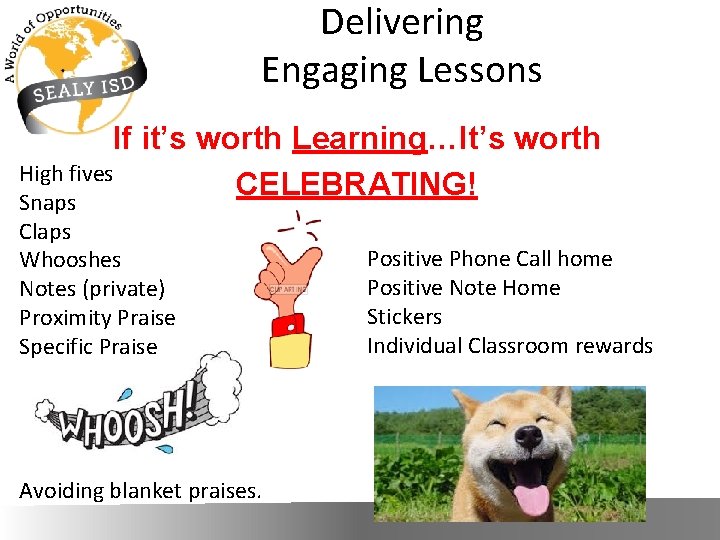
Delivering Engaging Lessons If it’s worth Learning…It’s worth High fives CELEBRATING! Snaps Claps Whooshes Notes (private) Proximity Praise Specific Praise Avoiding blanket praises. Positive Phone Call home Positive Note Home Stickers Individual Classroom rewards
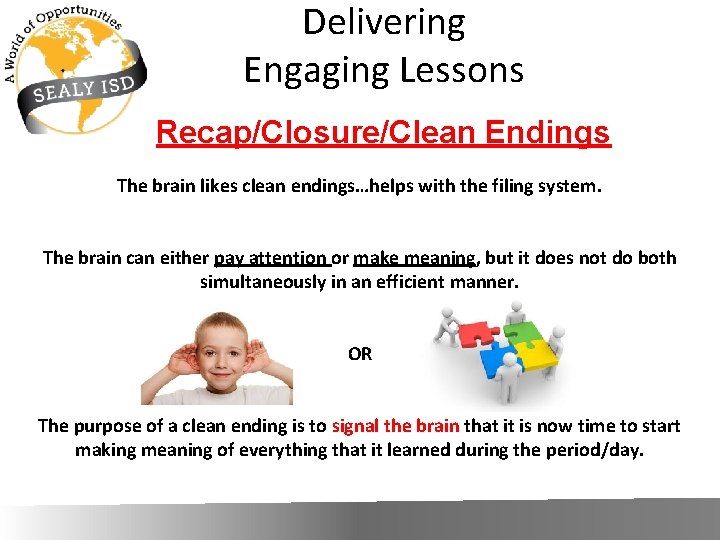
Delivering Engaging Lessons Recap/Closure/Clean Endings The brain likes clean endings…helps with the filing system. The brain can either pay attention or make meaning, but it does not do both simultaneously in an efficient manner. OR The purpose of a clean ending is to signal the brain that it is now time to start making meaning of everything that it learned during the period/day.
Delivering Engaging Lessons Recap/Closure/Clean Ending • Refer back to the opening activity or question (the hook) • Ask for students to volunteer stating the day’s objective • Ticket out the door on sticky notes/note cards/journal entry • Stand under content poster and recap/hand motions/chant/jingle • Return to anchor spots to review and recap • TTTOP (Things To Teach Our Parents)…be sure to follow up • Fill in the Mind Map/Unit Tree/KWL chart • What went well with you and this lesson? Questions you still have?
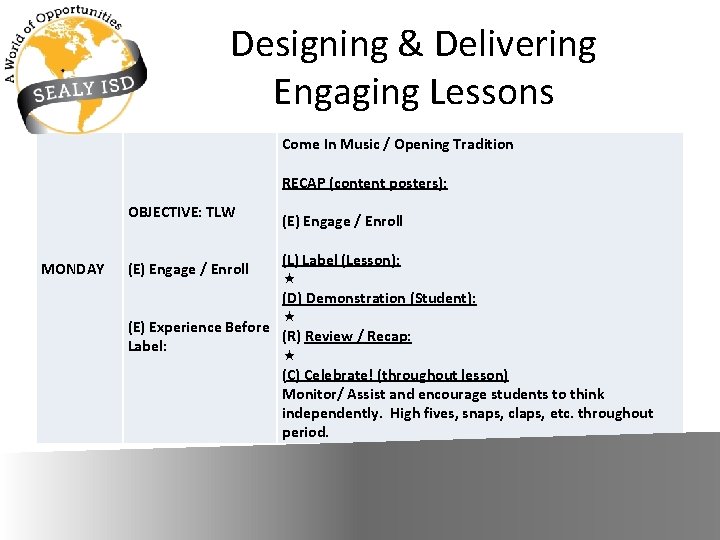
Designing & Delivering Engaging Lessons MONDAY Come In Music / Opening Tradition RECAP (content posters): OBJECTIVE: TLW (E) Engage / Enroll (L) Label (Lesson): (E) Engage / Enroll (D) Demonstration (Student): (E) Experience Before (R) Review / Recap: Label: (C) Celebrate! (throughout lesson) Monitor/ Assist and encourage students to think independently. High fives, snaps, claps, etc. throughout period.