
Designing Critical Thinking Assignments Across the Curriculum OECD
- Slides: 15
Designing Critical Thinking Assignments Across the Curriculum OECD Project: Fostering and assessing students' creative and critical thinking skills in higher education Jan. 12 th, 2021 Stephen Brookfield Antioch University Distinguished Scholar http: //www. stephenbrookfield. com/
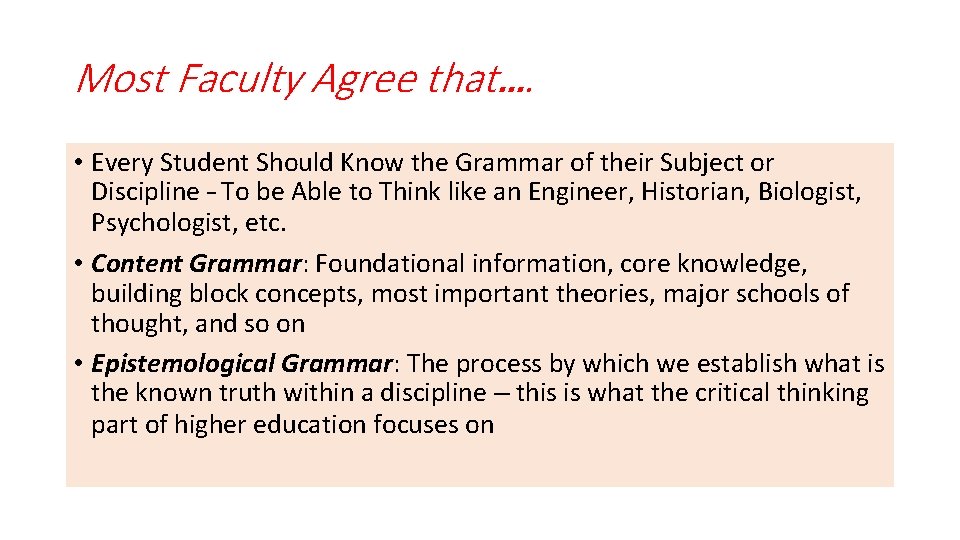
Most Faculty Agree that…. • Every Student Should Know the Grammar of their Subject or Discipline – To be Able to Think like an Engineer, Historian, Biologist, Psychologist, etc. • Content Grammar: Foundational information, core knowledge, building block concepts, most important theories, major schools of thought, and so on • Epistemological Grammar: The process by which we establish what is the known truth within a discipline – this is what the critical thinking part of higher education focuses on
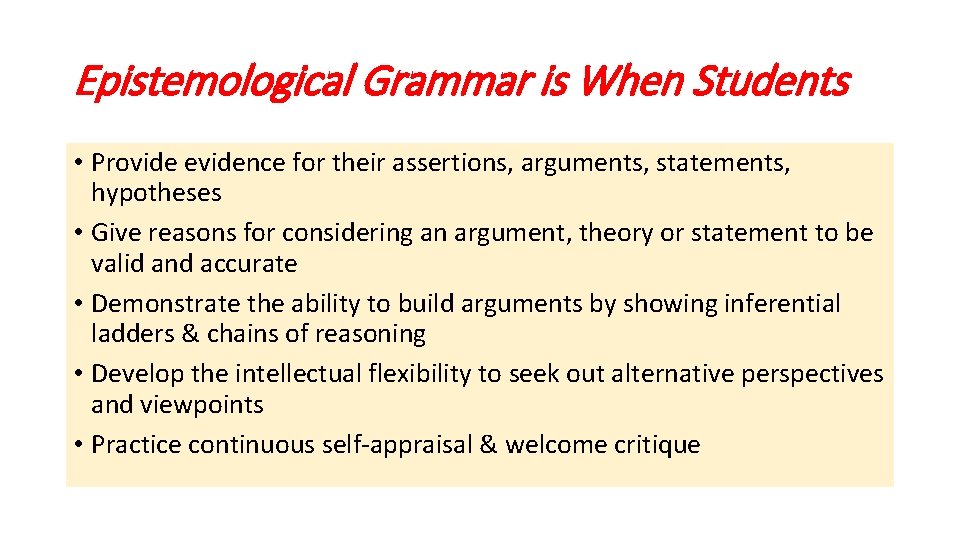
Epistemological Grammar is When Students • Provide evidence for their assertions, arguments, statements, hypotheses • Give reasons for considering an argument, theory or statement to be valid and accurate • Demonstrate the ability to build arguments by showing inferential ladders & chains of reasoning • Develop the intellectual flexibility to seek out alternative perspectives and viewpoints • Practice continuous self-appraisal & welcome critique
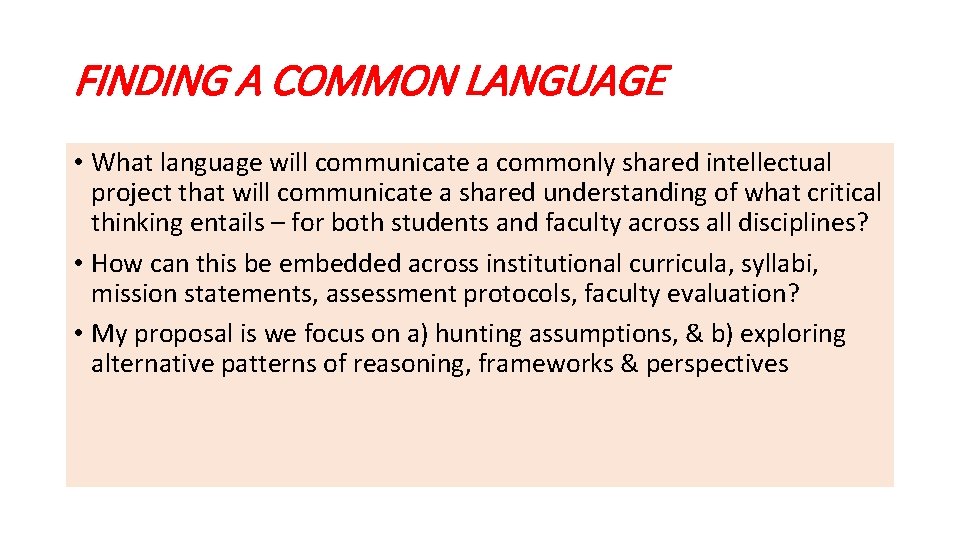
FINDING A COMMON LANGUAGE • What language will communicate a commonly shared intellectual project that will communicate a shared understanding of what critical thinking entails – for both students and faculty across all disciplines? • How can this be embedded across institutional curricula, syllabi, mission statements, assessment protocols, faculty evaluation? • My proposal is we focus on a) hunting assumptions, & b) exploring alternative patterns of reasoning, frameworks & perspectives
My Core Assumptions • Students need to be eased into critical thinking • Early modeling by faculty is helpful • Early activities start with applying critical thinking to case studies, scenario analyses & vignettes. Students are asked to speculate on the evidence & reasoning scholars in these scenarios take most seriously • Assignments & assessment rubrics emphasize constantly the importance of citing evidence, giving reasons, demonstrating how arguments are built & exploring multiple perspectives • Over time activities move closer to the students applying critical thinking to their own reasoning & arguments
EMBEDDING CRITICAL THINKING IN INSTITUTIONAL CULTURE • Modeled Explicitly by Those in Institutional Authority • Mission Statements, Strategic Plans, Visions – all need to highlight critical thinking as something the institution stands for • Syllabus Statements – reference / explain / define critical thinking • Unit/Module Objectives – state connection to critical thinking • Assignments – ask students to employ critical thinking • Student Assessment Protocols – include assessing students’ developing ability to think critically • Faculty Assessment Mechanisms – ask faculty to demonstrate how they model or teach critical thinking
What Students Say is Helpful • Provide Definitions, Explanations & Examples of CT in the Syllabus with the Same Definition Embedded in School Wide Program & Course Descriptions - Let us know specifically & concretely how you define critical thinking • When you introduce an assignment, lecture or activity please explain how it will help us do more & better critical thinking • Post Examples of Good (& Bad) Student Work Where Critical Thinking is Evident – give examples of past rubrics • In Each Assignment Provide Us with an Example of CT that Pertains to the Assignment • Over time we like the consistency of asking us to identify assumptions & show we’ve considered alternative perspectives. • If we’re confused about what CT is we need to be able to ask you about that without getting a reduced grade
What Students Say is Helpful • In assignments & tests let us know exactly how we can demonstrate critical thinking… • You will be demonstrating critical thinking when you…. . ” • “I will know you are thinking critically if you…. . ” • “Whenever you ……, that’s evidence you’re thinking critically” • We like to have rubrics that lay the process bare so we can see what we need to do to build up points / improve our grade • Don’t put all our critical thinking points into one assignment, test, midterm or final – give us multiple opportunities to earn CT points • It helps to have different formats in which to demonstrate critical thinking – exploring alternative perspectives done visually (chalk talk) • Give us a 2 nd chance to do it if we screw up
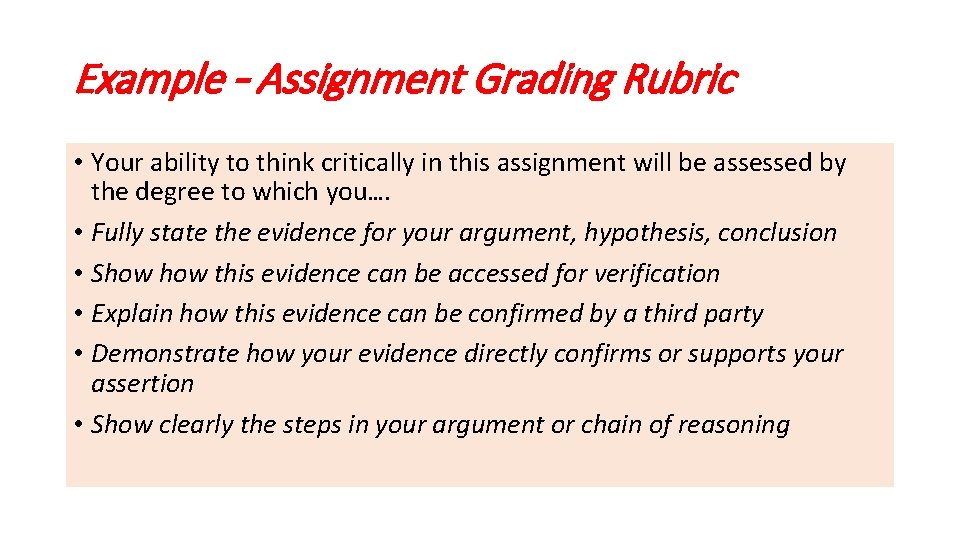
Example – Assignment Grading Rubric • Your ability to think critically in this assignment will be assessed by the degree to which you…. • Fully state the evidence for your argument, hypothesis, conclusion • Show this evidence can be accessed for verification • Explain how this evidence can be confirmed by a third party • Demonstrate how your evidence directly confirms or supports your assertion • Show clearly the steps in your argument or chain of reasoning
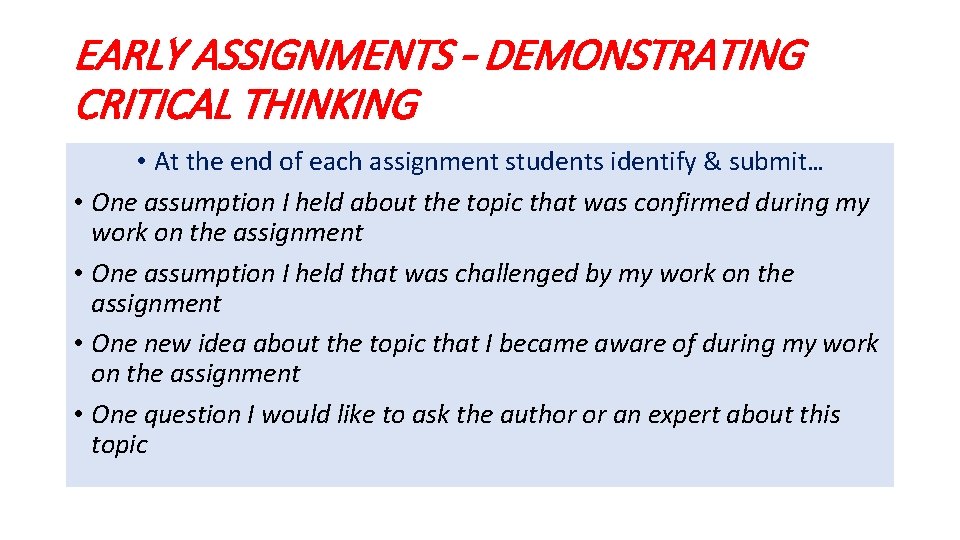
EARLY ASSIGNMENTS – DEMONSTRATING CRITICAL THINKING • At the end of each assignment students identify & submit… • One assumption I held about the topic that was confirmed during my work on the assignment • One assumption I held that was challenged by my work on the assignment • One new idea about the topic that I became aware of during my work on the assignment • One question I would like to ask the author or an expert about this topic
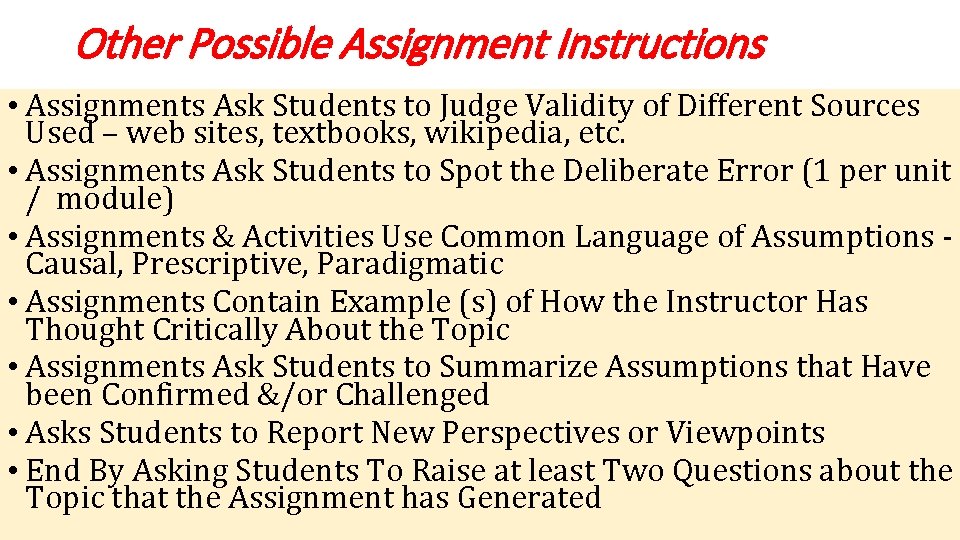
Other Possible Assignment Instructions • Assignments Ask Students to Judge Validity of Different Sources Used – web sites, textbooks, wikipedia, etc. • Assignments Ask Students to Spot the Deliberate Error (1 per unit / module) • Assignments & Activities Use Common Language of Assumptions Causal, Prescriptive, Paradigmatic • Assignments Contain Example (s) of How the Instructor Has Thought Critically About the Topic • Assignments Ask Students to Summarize Assumptions that Have been Confirmed &/or Challenged • Asks Students to Report New Perspectives or Viewpoints • End By Asking Students To Raise at least Two Questions about the Topic that the Assignment has Generated
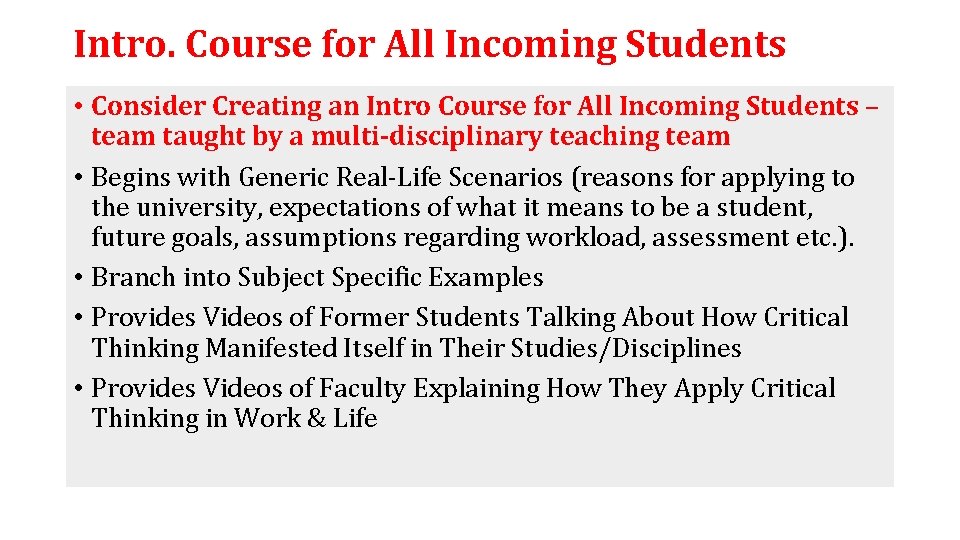
Intro. Course for All Incoming Students • Consider Creating an Intro Course for All Incoming Students – team taught by a multi-disciplinary teaching team • Begins with Generic Real-Life Scenarios (reasons for applying to the university, expectations of what it means to be a student, future goals, assumptions regarding workload, assessment etc. ). • Branch into Subject Specific Examples • Provides Videos of Former Students Talking About How Critical Thinking Manifested Itself in Their Studies/Disciplines • Provides Videos of Faculty Explaining How They Apply Critical Thinking in Work & Life
An Assignment Example – Scenario Analysis • Present disciplinary examples of scholars taking intellectual action & making scholarly choices in a recognizable situation. Students are asked to put themselves in the fictional scholars/researcher’s person’s shoes & propose: - the assumptions the scholar is operating under as she takes action or makes a choice - how the person could check these assumptions out - the different perspectives that could be taken on the scenario described
Scenario Analysis – Adaptations Across the Curriculum • * A fictional chemist who is trying to understand the cause and effect relationship in a particular chemical reaction sets up an experiment to test what she feels is a plausible hypothesis. Students reading this scenario are then asked to identify the reasoning behind the chemist’s choice of her particular hypothesis, and also encouraged to propose an alternative hypothesis that the fictional chemist could have chosen. • * A mathematician formulating a mathematical proof adapts a familiar mathematical protocol that the students are familiar with to construct an equation. Students reading this scenario are then asked to identify the reasoning behind the mathematician’s adaptation of the protocol and also encouraged to propose an alternative of constructing an equation. • * A fictional psychologist studying a child with learning difficulties concludes the child is autistic. Students reading this scenario are asked to identify the assumptions the fictional psychologist was operating under when he made the diagnosis, and how he could have checked out those assumptions. Students then suggest alternative diagnoses that the fictional psychologist could have been made based on the information provided in the scenario. • * A fictional climatologist is researching greenhouse gas emissions and concludes from studying records of iceberg movement that global warming is a hoax (or a real threat). Students read the scenario and try to identify the piece of evidence the fictional climatologist took most seriously. They try to pose alternative assessments of the existence of global warming that the climatologist might have made had he focused on different information. • * A fictional triage nurse in an understaffed emergency room makes a decision about the relative seriousness of a patient’s condition based on information he gathers from the patient. Students try to identify the information that they feel was most influential in the fictional nurse’s diagnosis. They offer alternative plausible diagnoses that could have been made if the fictional nurse had focused on different information.
Stephen’s Resources • My home page is open access so if you want to find out more about any of the exercises or activities I mention go to the page and click on the ‘Resources’ link. • There you will find multiple PDF files of workshop packets stuffed with activities as well as several power point presentations. • You do not need to ask my permission to use any of these resources. If they’re useful then please try them out and adapt them to your context. www. stephenbrookfield. com • Teaching for Critical Thinking: Tools & Techniques to Help Students Challenge their Assumptions. San Francisco: Jossey-Bass/Wiley (2016) • Becoming a Critically Reflective Teacher. San Francisco: Jossey-Bass/Wiley (2016)