
Designing Course Delivery Plan For Learning Centered Teaching





- Slides: 37
Designing Course Delivery Plan For Learning Centered Teaching Presented By : Prof. Alka Sharma ( Source : - Dr. Declan Kennedy , Department Of Education , UCC ) 1
� Recognise the importance of learning centered teaching in new paradigms of higher education. � Construct effective ‘Course Deliver Plan’ for learning centered teaching. � Identify what are Learning Outcomes. � Identify &translate Course Objectives for their respective courses into LO. � Identify right verbs to construct LO. � Relate LO with teaching & assessment strategy. � Appreciate potential benefits and problems associated with LO. At The End Of This Presentation The Participants Should Be Able To …. 2
� If your students aren’t learning, you’re not teaching. � Research shows that the time professors invest in improving their teaching often does not translate into greater student learning (Boice, 1991). � Repeating poor teaching mechanics can actually move us away. from, not closer to, our performance objective of effective student learning. Is Teaching = Students Learning 3
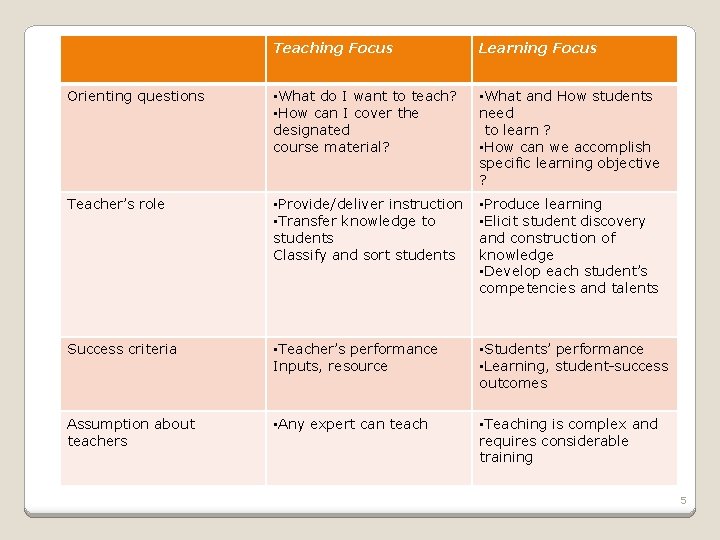
Recent Paradigm Shift in Higher Education SOURCE: Adapted from Barr and Tagg (1995, pp. 6 -7). 4
Teaching Focus Learning Focus Orienting questions • What do I want to teach? • How can I cover the designated course material? • What and How students need to learn ? • How can we accomplish specific learning objective ? Teacher’s role • Provide/deliver instruction • Transfer knowledge to students Classify and sort students • Produce learning • Elicit student discovery and construction of knowledge • Develop each student’s competencies and talents Success criteria • Teacher’s performance Inputs, resource • Students’ performance • Learning, student-success outcomes Assumption about teachers • Any expert can teach • Teaching is complex and requires considerable training 5
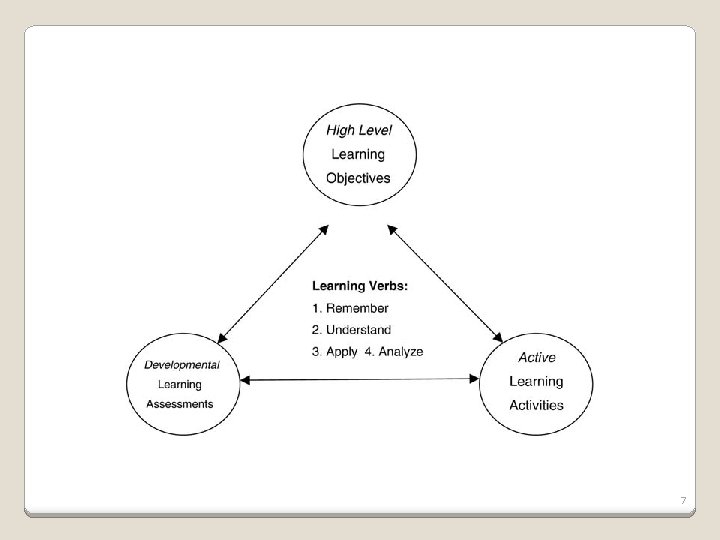
� In order to teach well, one must be competent in both course design and teacher-student interactions. � Out of these two activities, our ability to design courses well is usually the most limiting factor. � Most of us have had little or no training in how to design courses. Teaching Has Two Closely Related But Distinct Activities 6
7
� Encourages active learning. � Encourages teacher–student contact. � Encourages cooperation among students. � Gives prompt feedback. � Emphasizes task on time. � Communicates high expectations. � Respects diverse talents and ways of learning. SOURCE: Summary of Chickering and Gamson (1987). Seven Principles Of Learning Centered Course Plan Design 8
Importance of Unveiling Course Delivery Plan on Day One - A Religion to Live Throughout the Course. 9
“Learning outcomes are statements that specify what learners will know or be able to do as a result of a learning activity. Outcomes are usually expressed as knowledge, skills or attitudes”. (American Association of Law Libraries) Learning outcomes are explicit statements of what we want our students to know, understand or to be able to do as a result of completing our courses. (Univ. New South Wales, Australia) What Are Learning Outcomes? 10
Learning Outcomes Are Statements Of What A Student Should Know, Understand Or Be able To Do At The End Of A Learning Activity. The learning activity could be, for example, a lecture, a module or an entire programme. Learning outcomes must not simply be a “wish list” of what a student is capable of doing on completion of the learning activity. Learning outcomes must be simply and clearly described. Learning outcomes must be capable of being validly assessed. 11
� The content of teaching. � The teaching strategies you will use. � The sorts of learning activities/tasks you set for your students. � Appropriate assessment tasks. � Course evaluation. For Teaching Staff: It Informs 12
From The Definitions We See: � Emphasis is on the learner’s ability to do something. 13
�A solid framework to guide their studies and assist them to prepare for their assessment. � A point of articulation with graduate attributes at course and/or university (i. e. ; generic) level. For Students: The Set Of Learning Outcomes Provides Them With. 14
� Aims: Give broad purpose or general intention of the module. � Objectives: Information about what the teaching of the module hopes to achieve. � Outcomes : Focus on what we want the student to be able to do --use of terms like define, list, name, recall, analyse, calculate, design, etc. �Hence, there should be clear and well articulated link between the Programme Objective and Course Objective. Do Aims, Objective And Outcome Mean The Same ? 15
Outcomes versus Objectives 16
How Do I Write Learning Outcomes? 17
He looked on learning as a process - we build upon our former learning to develop more complex levels of understanding. Carried out research in the development of classification of levels of thinking behaviours in the process of learning. (Ph. D University of Chicago in 1942). Worked on drawing up levels of these thinking behaviours from the simple recall of facts at the lowest level up to evaluation at the highest level. Benjamin Bloom (1913 -1999) 18
Bloom’s taxonomy (1956) is a very useful aid to writing learning outcomes. The taxonomy consists of a hierarchy of increasingly complex processes which we want our students to acquire. Provides the structure for writing learning outcomes. Bloom’s Taxonomy is frequently used by teachers in writing learning outcomes as it provides a ready made structure and list of verbs. Bloom’s Taxonomy of Educational Objectives 19
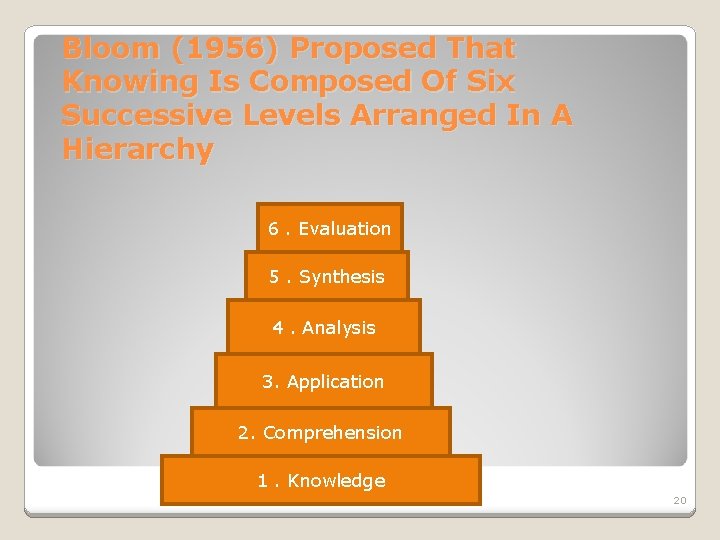
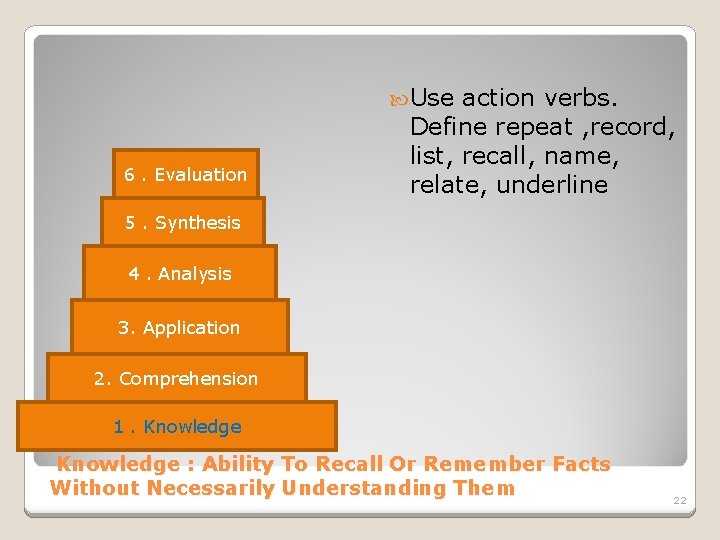
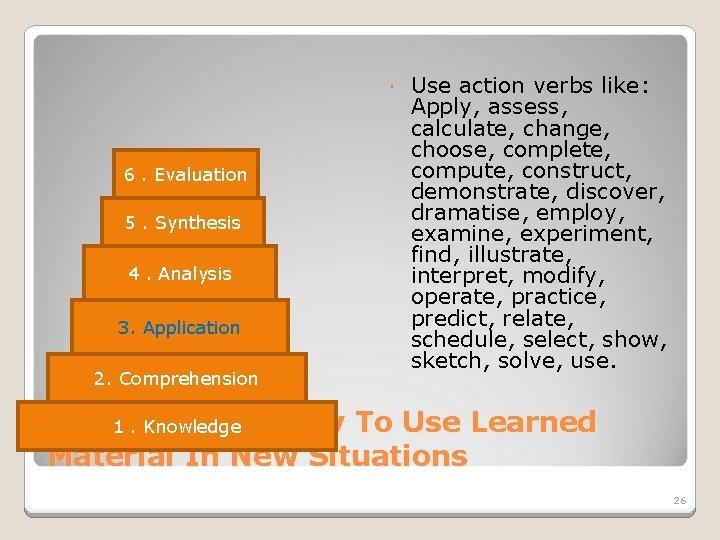
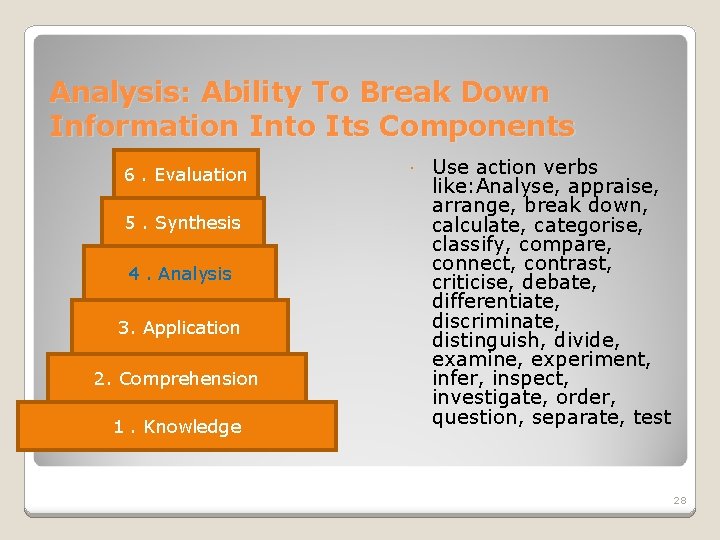
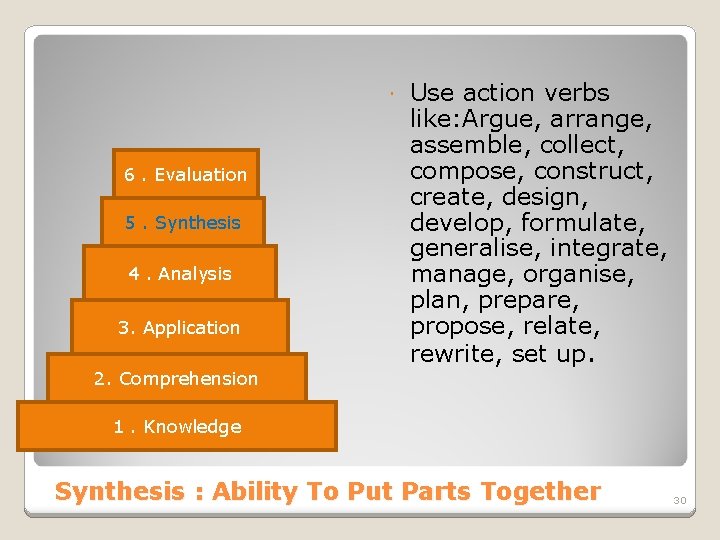
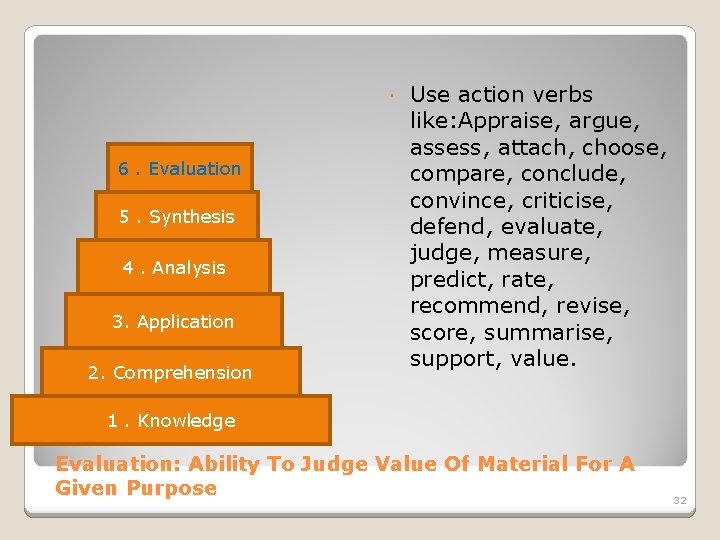
Bloom (1956) Proposed That Knowing Is Composed Of Six Successive Levels Arranged In A Hierarchy 6. Evaluation 5. Synthesis 4. Analysis 3. Application 2. Comprehension 1. Knowledge 20
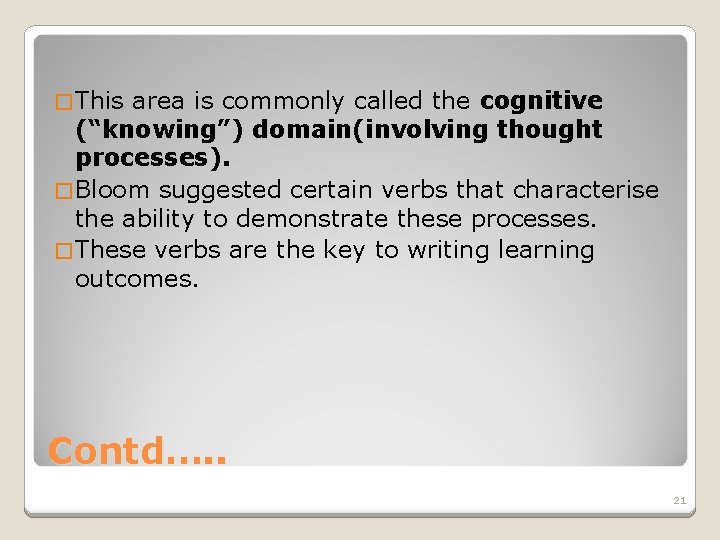
� This area is commonly called the cognitive (“knowing”) domain(involving thought processes). � Bloom suggested certain verbs that characterise the ability to demonstrate these processes. � These verbs are the key to writing learning outcomes. Contd…. . 21
Use 6. Evaluation action verbs. Define repeat , record, list, recall, name, relate, underline 5. Synthesis 4. Analysis 3. Application 2. Comprehension 1. Knowledge : Ability To Recall Or Remember Facts Without Necessarily Understanding Them 22
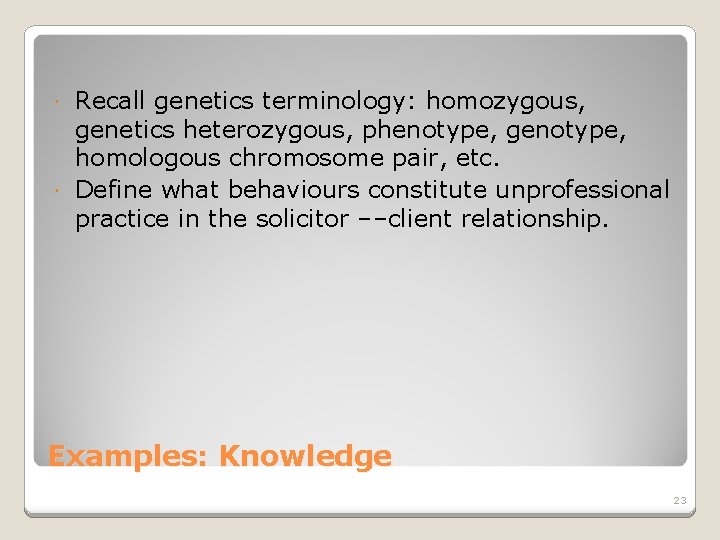
Recall genetics terminology: homozygous, genetics heterozygous, phenotype, genotype, homologous chromosome pair, etc. Define what behaviours constitute unprofessional practice in the solicitor ––client relationship. Examples: Knowledge 23
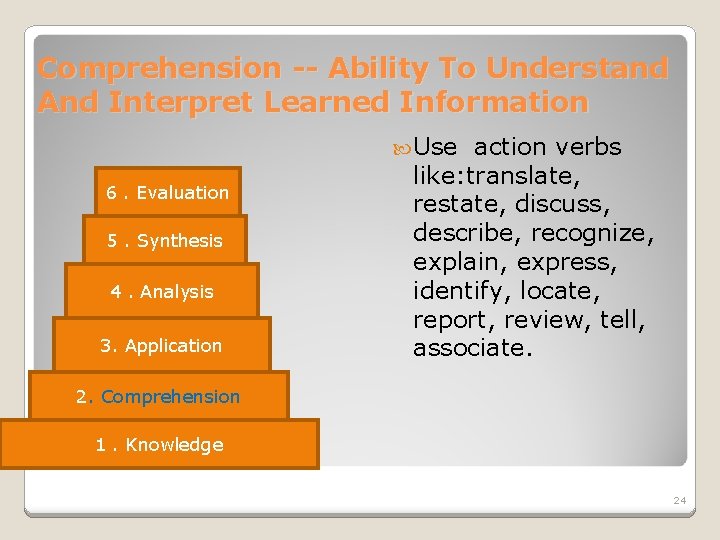
Comprehension -- Ability To Understand And Interpret Learned Information Use 6. Evaluation 5. Synthesis 4. Analysis 3. Application action verbs like: translate, restate, discuss, describe, recognize, explain, express, identify, locate, report, review, tell, associate. 2. Comprehension 1. Knowledge 24
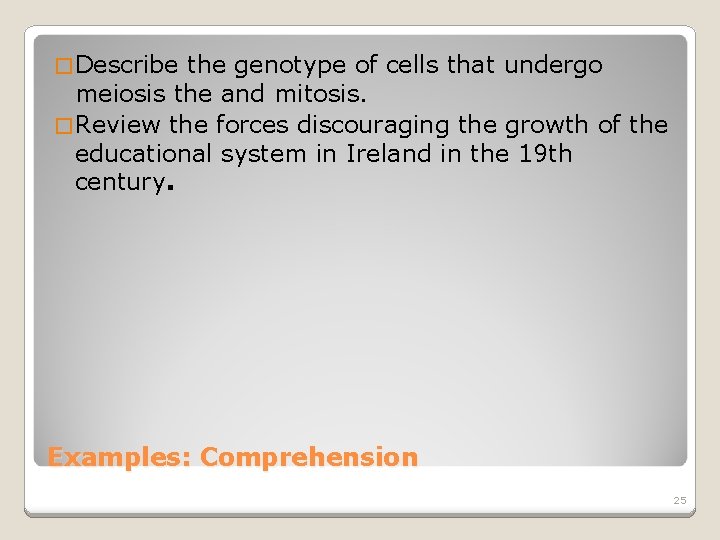
� Describe the genotype of cells that undergo meiosis the and mitosis. � Review the forces discouraging the growth of the educational system in Ireland in the 19 th century. Examples: Comprehension 25
6. Evaluation 5. Synthesis 4. Analysis 3. Application 2. Comprehension Use action verbs like: Apply, assess, calculate, change, choose, complete, compute, construct, demonstrate, discover, dramatise, employ, examine, experiment, find, illustrate, interpret, modify, operate, practice, predict, relate, schedule, select, show, sketch, solve, use. Application: 1. Knowledge Ability To Use Learned Material In New Situations 26
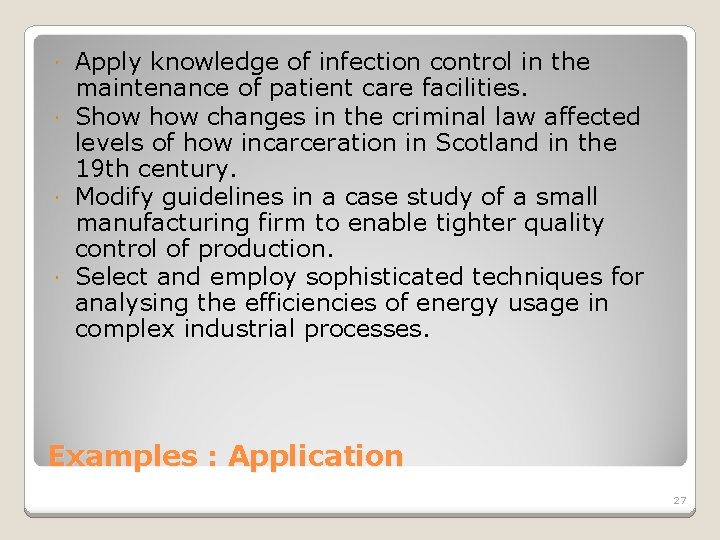
Apply knowledge of infection control in the maintenance of patient care facilities. Show changes in the criminal law affected levels of how incarceration in Scotland in the 19 th century. Modify guidelines in a case study of a small manufacturing firm to enable tighter quality control of production. Select and employ sophisticated techniques for analysing the efficiencies of energy usage in complex industrial processes. Examples : Application 27
Analysis: Ability To Break Down Information Into Its Components 6. Evaluation 5. Synthesis 4. Analysis 3. Application 2. Comprehension 1. Knowledge Use action verbs like: Analyse, appraise, arrange, break down, calculate, categorise, classify, compare, connect, contrast, criticise, debate, differentiate, discriminate, distinguish, divide, examine, experiment, infer, inspect, investigate, order, question, separate, test 28
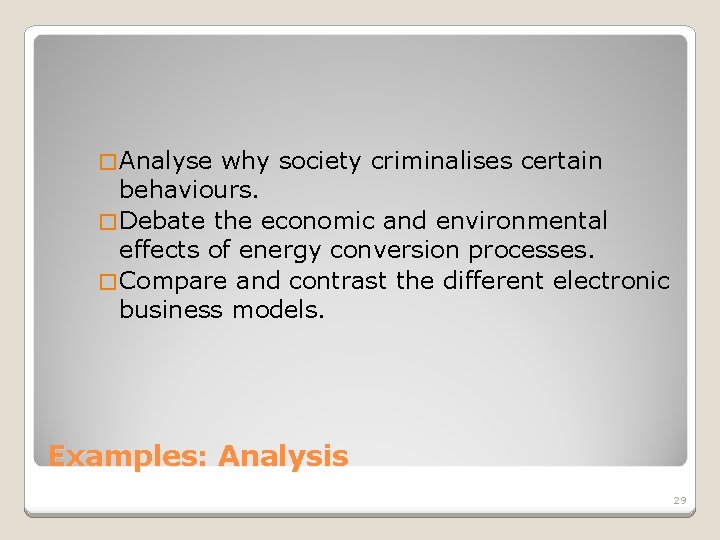
� Analyse why society criminalises certain behaviours. � Debate the economic and environmental effects of energy conversion processes. � Compare and contrast the different electronic business models. Examples: Analysis 29
6. Evaluation 5. Synthesis 4. Analysis 3. Application 2. Comprehension Use action verbs like: Argue, arrange, assemble, collect, compose, construct, create, design, develop, formulate, generalise, integrate, manage, organise, plan, prepare, propose, relate, rewrite, set up. 1. Knowledge Synthesis : Ability To Put Parts Together 30
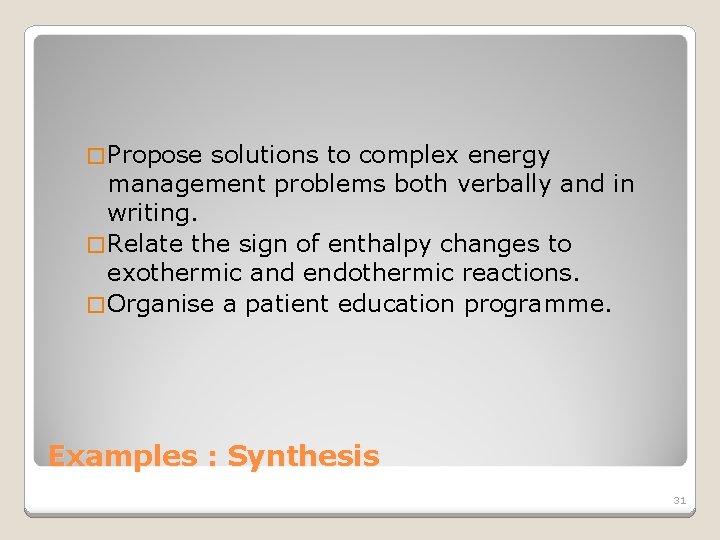
� Propose solutions to complex energy management problems both verbally and in writing. � Relate the sign of enthalpy changes to exothermic and endothermic reactions. � Organise a patient education programme. Examples : Synthesis 31
6. Evaluation 5. Synthesis 4. Analysis 3. Application 2. Comprehension Use action verbs like: Appraise, argue, assess, attach, choose, compare, conclude, convince, criticise, defend, evaluate, judge, measure, predict, rate, recommend, revise, score, summarise, support, value. 1. Knowledge Evaluation: Ability To Judge Value Of Material For A Given Purpose 32
� Evaluate marketing strategies for different electronic business models. � Assess the importance of key participants in bringing about change in Irish history. � Summarise the main contributions of Michael Faraday to the field of electromagnetic induction. Examples : Evaluation 33
� Specific � Measurable � Actionable � Relevant � Timed Characteristics Of Good LO 34
� Identify the major topics of a course. � Classify the outcomes : focus on student behaviour. � Identify the learning required of the student. � Choose a specific action verb for each outcome. � Decide how will you measure the achievement of the outcome. � State success criteria. Steps To Writing LO 35
� Differentiate between sales & marketing strategies. � Appraise the force impacting selling & sales management. � Critically evaluate modern sales management selling and sales management concepts , techniques and strategies. � Demonstrate selling skills and abilities. � Propose solutions to complex sales related problems. Sample LO of Sales Management 36
Thank You 37