
Designing and Manufacturing of a hand operated plastic
- Slides: 1
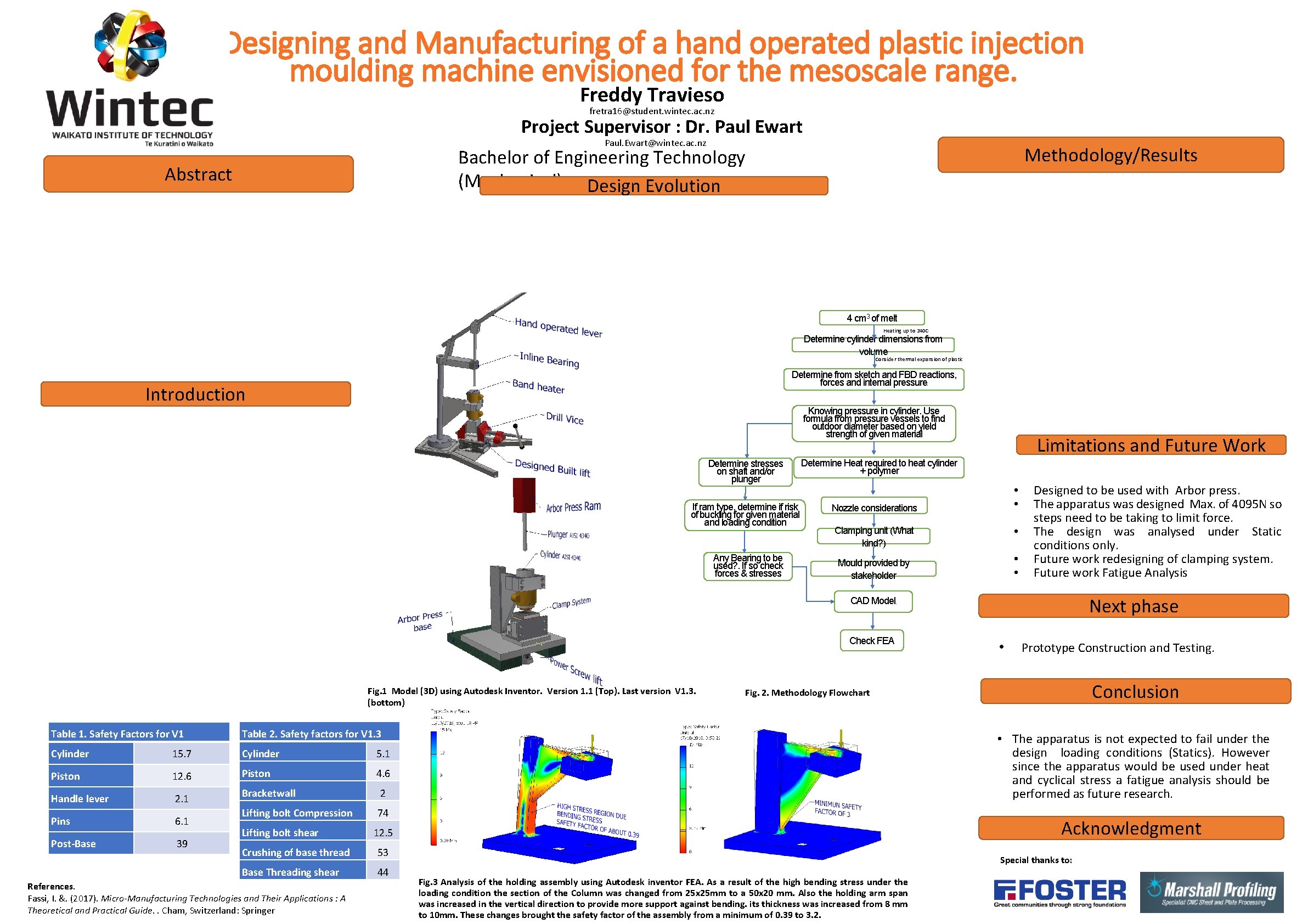
Designing and Manufacturing of a hand operated plastic injection moulding machine envisioned for the mesoscale range. Freddy Travieso fretra 16@student. wintec. ac. nz Project Supervisor : Dr. Paul Ewart Paul. Ewart@wintec. ac. nz Methodology/Results Bachelor of Engineering Technology (Mechanical) Design Evolution Abstract 4 cm 3 of melt Heating up to 240 C Determine cylinder dimensions from volume Consider thermal expansion of plastic Determine from sketch and FBD reactions, forces and internal pressure Introduction . Knowing pressure in cylinder. Use formula from pressure vessels to find outdoor diameter based on yield strength of given material Determine stresses on shaft and/or plunger If ram type, determine if risk of buckling for given material and loading condition Any Bearing to be used? . If so check forces & stresses Limitations and Future Work Determine Heat required to heat cylinder + polymer • • Nozzle considerations • Clamping unit (What kind? ) • • Mould provided by stakeholder Designed to be used with Arbor press. The apparatus was designed Max. of 4095 N so steps need to be taking to limit force. The design was analysed under Static conditions only. Future work redesigning of clamping system. Future work Fatigue Analysis Next phase CAD Model . Check FEA Fig. 1 Model (3 D) using Autodesk Inventor. Version 1. 1 (Top). Last version V 1. 3. (bottom) Table 1. Safety Factors for V 1 Table 2. Safety factors for V 1. 3 Cylinder 15. 7 Cylinder 5. 1 Piston 12. 6 Piston 4. 6 Handle lever 2. 1 Pins 6. 1 Post-Base 39 Bracketwall 2 Lifting bolt Compression 74 Lifting bolt shear 53 Base Threading shear 44 References. Fassi, I. &. (2017). Micro-Manufacturing Technologies and Their Applications : A Theoretical and Practical Guide. . Cham, Switzerland: Springer • Prototype Construction and Testing. Conclusion Fig. 2. Methodology Flowchart • The apparatus is not expected to fail under the design loading conditions (Statics). However since the apparatus would be used under heat and cyclical stress a fatigue analysis should be performed as future research. Acknowledgment 12. 5 Crushing of base thread Special thanks to: Fig. 3 Analysis of the holding assembly using Autodesk inventor FEA. As a result of the high bending stress under the loading condition the section of the Column was changed from 25 x 25 mm to a 50 x 20 mm. Also the holding arm span was increased in the vertical direction to provide more support against bending. its thickness was increased from 8 mm to 10 mm. These changes brought the safety factor of the assembly from a minimum of 0. 39 to 3. 2.