
Designing and Implementing an Advisor Development Program to

- Slides: 29
Designing and Implementing an Advisor Development Program to Keep Your Advising Champions Engaged Beth Eckelkamp – University of Missouri St. Louis beckelkamp@umsl. edu Kim Mc. Neley – University of Missouri Kansas City mcneleyk@umkc. edu Rachael Orr – Missouri University orrre@missouri. edu
UM Advise is a system-wide collaborative program to provide professional development opportunities for academic advisors and coaches in University of Missouri system. UM Advise components include: o UM System Advising Summits o UM Advisor Onboarding and Professional Development Support Modules o UM Advisor Development Program (ADP) 2
Our University of Missouri story: § Seeking to focus onboarding and professional development of advisors on key competencies to maximize achieved outcomes § Collaborating to create training resources and ongoing professional development events to focus on quality while recognizing savings § Creating a community of advisors from across the UM system to support innovation and implementation of new initiatives § Building framework and program to recognize and reward high performing advisors 3
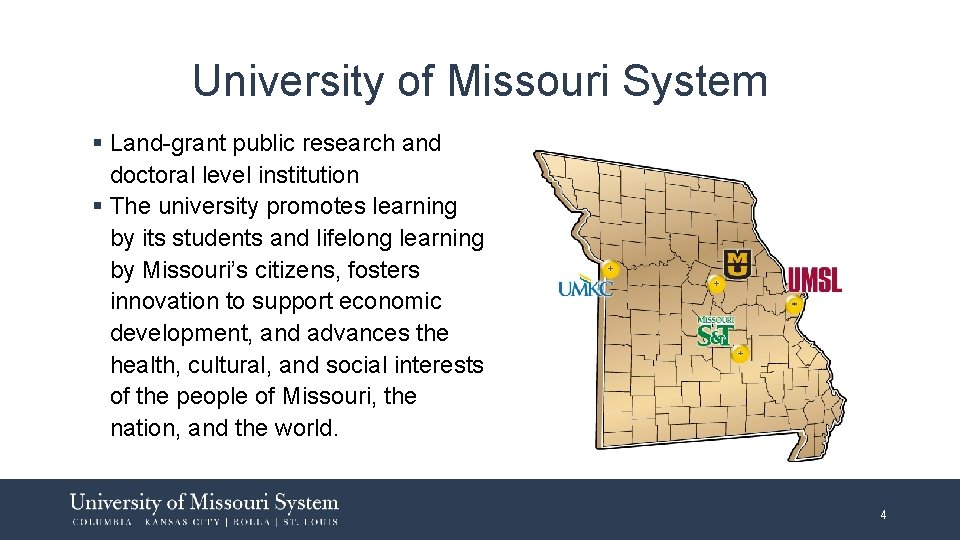
University of Missouri System § Land-grant public research and doctoral level institution § The university promotes learning by its students and lifelong learning by Missouri’s citizens, fosters innovation to support economic development, and advances the health, cultural, and social interests of the people of Missouri, the nation, and the world. 4
Snapshot of academic advising at campus and system level § No system level expectations articulated or oversight in place § Campus to campus advising outcomes and oversight vary widely § Campus to campus advising structures vary widely from nearly full reliance on faculty advising on one campus to a wide array of approaches on other campuses § Individual campus level advising structures and outcomes vary from unit to unit and department to department 5
UM President and UMAO Collaboration § Academic and Student Administrative Systems Oversight Committee (ASASOC) was created for IT governance over the “Student pillar” to mirror governance over the “HR pillar” and the “Financial pillar” with 2 reps from each campus charged to shore up student related functions in and out of the SIS § Advising function challenges rose to the surface resulting in investment by the president and Comprehensive Retention Initiative (CRI) funding became available for collaborative projects § Funding for training was built in to implementations of new systems but did not extend to end users § President’s Professional Development series designed to maximize expertise and collaboration on campuses
Early experiences of system-wide Collaborations § Original plan included: o President’ s Retention Summit - Administrative PD track o Advisor Professional Development - Advising PD track o Recruitment § Committee of reps from each campus developed budget and framework for series § Seen as a short-term, one time funding opportunity
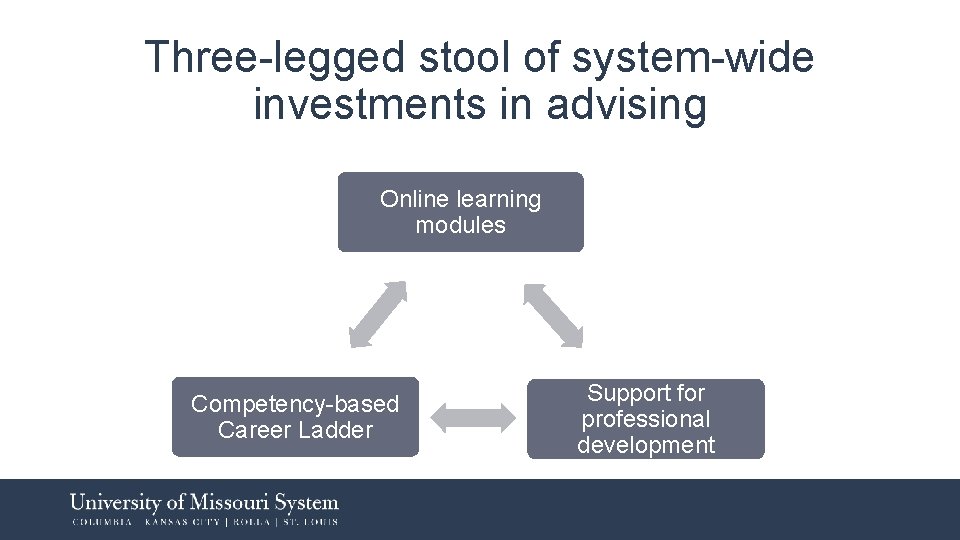
Building a case to extend investment in advising System wide survey to assess common needs and interests o Training needs in the first 6 months as a new advisor o Increased professional development needs § § § Assessing career and educational goals Fostering student initiative and responsibility Assisting students with career development issues Assisting students with financial concerns Utilizing technology o Competency-based career ladder and reward structure for advisors
Three-legged stool of system-wide investments in advising Online learning modules Competency-based Career Ladder Support for professional development
Competency based model as foundation § Seeking continuity for professional development series and a structure to drive training modules and career ladder § Performance management system based on core competencies for advisors developed at UMSL in 2012 § Context for credentialing and professionalizing advising across the system
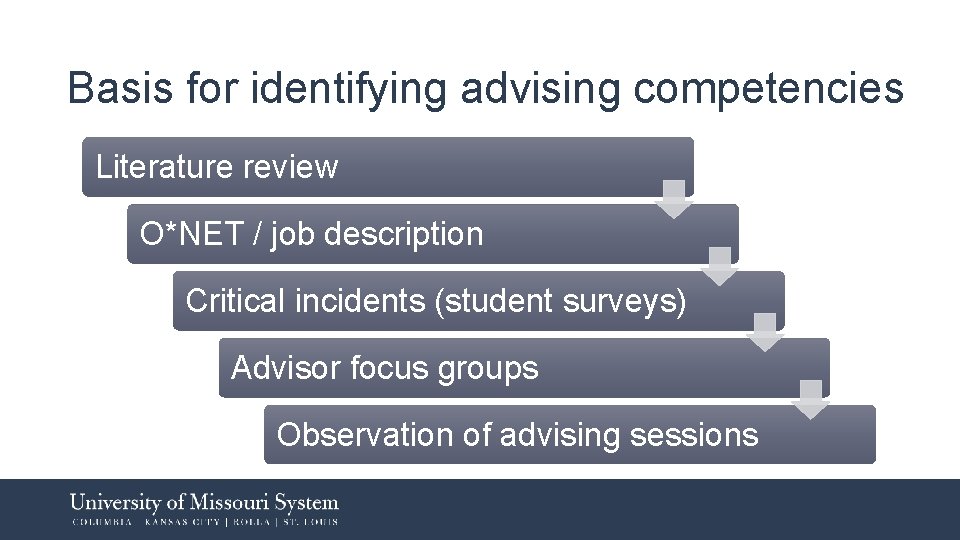
Basis for identifying advising competencies Literature review O*NET / job description Critical incidents (student surveys) Advisor focus groups Observation of advising sessions
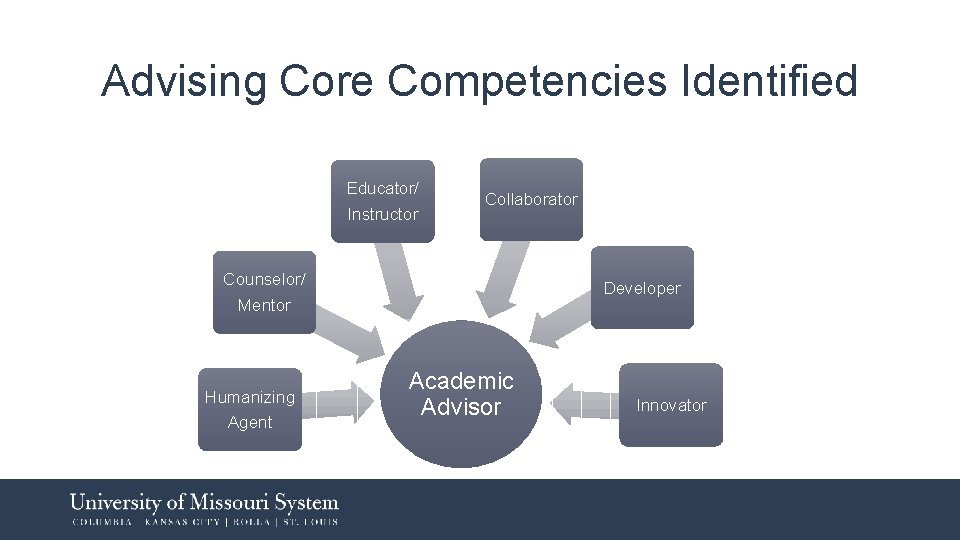
Advising Core Competencies Identified Educator/ Instructor Collaborator Counselor/ Mentor Humanizing Agent Developer Academic Advisor Innovator
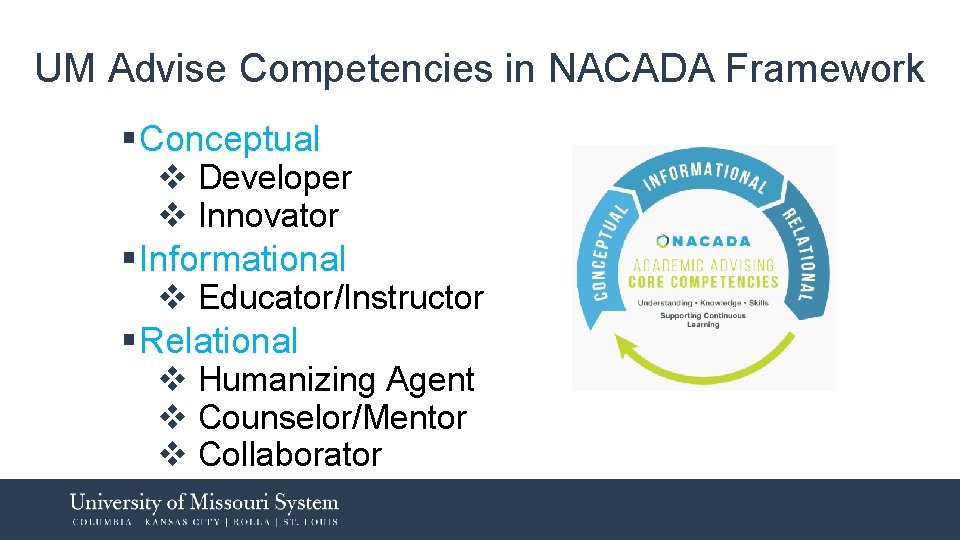
UM Advise Competencies in NACADA Framework § Conceptual v Developer v Innovator § Informational v Educator/Instructor § Relational v Humanizing Agent v Counselor/Mentor v Collaborator
Online Learning Modules § Shared service model to recognize savings § Common on-boarding needs to lay foundation for professionalization o Introduction to Academic Advising o Impact of Advising on Student Success o Theories Related to Academic Advising o Legal and Ethical Issues in Academic Advising o Inclusive Academic Advising § Archived and accessible 24/7 § Provide opportunities for refresher and self reflection for experienced advisors § Advising mentors have a foundation from which to base mentoring conversations
Advising Development Program (ADP) The UM System Advisor Development Program recognizes and further develops successful advising and academic coaching professionals who shape and implement student success strategies at the UM System Universities. 15
ADP…. § … is a prestigious personal and professional development program that affirms the vital role of professional advisors and student support staff in the student success landscape and seeks to enhance their advising and coaching competencies. § …recognizes that high performing academic advisors and coaches model excellence for their campus and system colleagues and provides an opportunity for these successful professionals to reflect on their own personal development as well as creating a professional development plan that they can implement in their workplace. 16
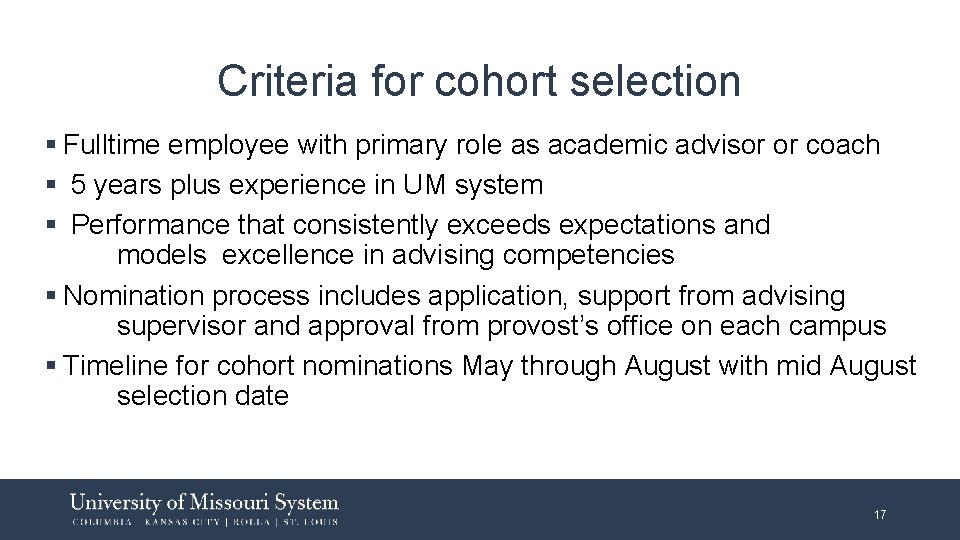
Criteria for cohort selection § Fulltime employee with primary role as academic advisor or coach § 5 years plus experience in UM system § Performance that consistently exceeds expectations and models excellence in advising competencies § Nomination process includes application, support from advising supervisor and approval from provost’s office on each campus § Timeline for cohort nominations May through August with mid August selection date 17
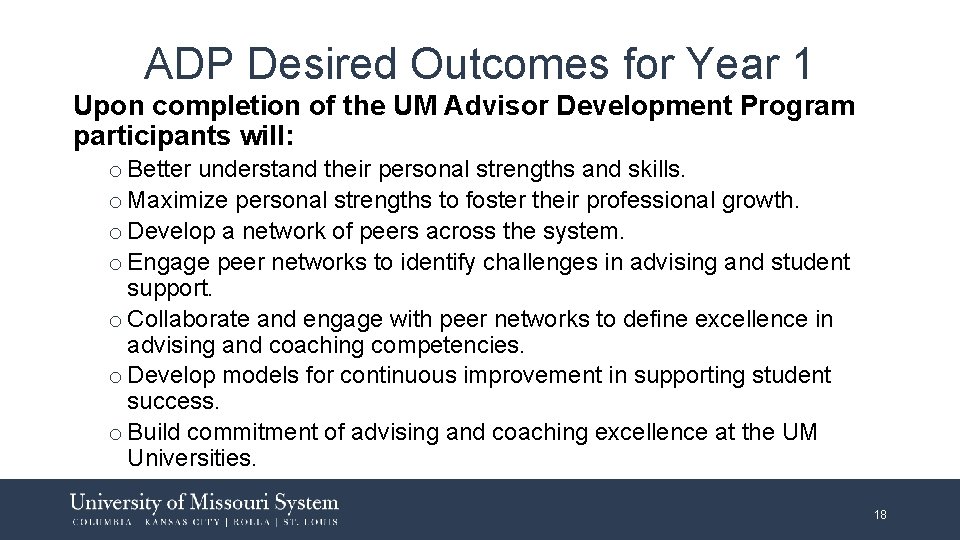
ADP Desired Outcomes for Year 1 Upon completion of the UM Advisor Development Program participants will: o Better understand their personal strengths and skills. o Maximize personal strengths to foster their professional growth. o Develop a network of peers across the system. o Engage peer networks to identify challenges in advising and student support. o Collaborate and engage with peer networks to define excellence in advising and coaching competencies. o Develop models for continuous improvement in supporting student success. o Build commitment of advising and coaching excellence at the UM Universities. 18
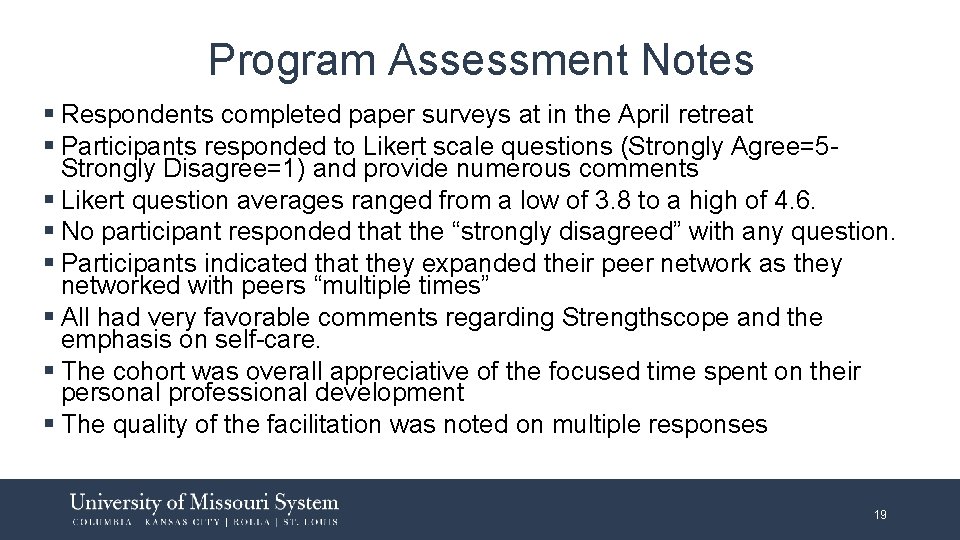
Program Assessment Notes § Respondents completed paper surveys at in the April retreat § Participants responded to Likert scale questions (Strongly Agree=5 Strongly Disagree=1) and provide numerous comments § Likert question averages ranged from a low of 3. 8 to a high of 4. 6. § No participant responded that the “strongly disagreed” with any question. § Participants indicated that they expanded their peer network as they networked with peers “multiple times” § All had very favorable comments regarding Strengthscope and the emphasis on self-care. § The cohort was overall appreciative of the focused time spent on their personal professional development § The quality of the facilitation was noted on multiple responses 19
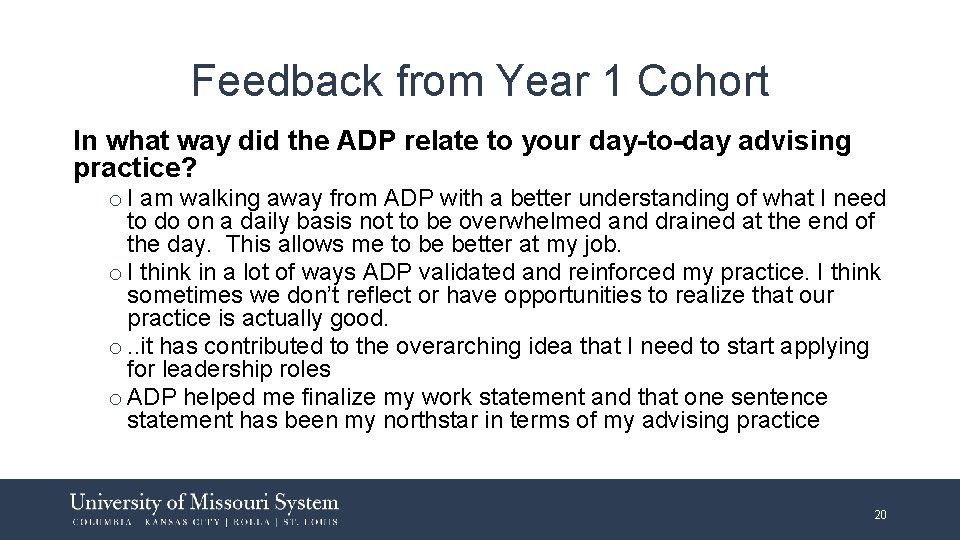
Feedback from Year 1 Cohort In what way did the ADP relate to your day-to-day advising practice? o I am walking away from ADP with a better understanding of what I need to do on a daily basis not to be overwhelmed and drained at the end of the day. This allows me to be better at my job. o I think in a lot of ways ADP validated and reinforced my practice. I think sometimes we don’t reflect or have opportunities to realize that our practice is actually good. o. . it has contributed to the overarching idea that I need to start applying for leadership roles o ADP helped me finalize my work statement and that one sentence statement has been my northstar in terms of my advising practice 20
Feedback from Year 1 Cohort What could we do better to improve the program? o Some heads up on the NACADA ideas for presentations. Or given more time to flesh out ideas. It was a large focus of the follow up meetings after the fall meeting. o More connections points, either Zoom or with just my campus cohort, more feedback further in advance for NACADA proposals, capitalize on Summits to arrange another meetup (or even casual dinner/breakfast) o More diversity in cohorts o I would have liked to have done some prep work to get more out of the fall retreat 21
Rationale for recommending the program to others (100% would recommend) § This is a good thing. I feel VALUED and RECOGNIZED and APPRECIATED. § I can’t say this enough but the relationships that are built across the UM system are very beneficial. § This professional development opportunity is invaluable, especially because it is the opportunity to become part of a cohort, and to “belong” to something. § I learned a lot about myself that I was able to apply immediately to my life. § Such a great opportunity to adjust perspectives on my position and refocus on why I love doing what I do. 22
Lessons Learned for cohort Year 2 § Need for much clearer expectations and prep prior to retreat o Zoom meetings with cohorts to define expectations o No “sneak attack” with conference proposal brainstorming o Readings/articles/documents sent to participants in advance § Need for more on-campus cohort development § Desired intent of retaining advisors may have backfired § DEI focus needs to be woven in more clearly throughout the program 23
ADP Desired Outcomes for Year 2 Upon completion of the UM Advisor Development Program participants will: o Reflect on and better understand personal strengths and skills o Learn to maximize strengths and improve in growth areas o Work with a network of peers to identify challenges in advising and student support o Build strategies collaboratively to address challenges through maximizing and building advising competencies o Build commitment among system colleagues toward advising excellence at UM campuses o Complete a conference proposal in collaboration with colleagues across UM system 24
ADP Year 2 Details and Logistics Program timeline o Virtual introductory sessions o Complete Strength. Scope individual assessment prior to retreat and solicit 360 evaluations o 2 day in-person professional development retreat in early October o 3 -5 Campus cohort meetings and 1 virtual full cohort meeting between November and March o Complete conference proposals o 1 day in-person session for session closing and graduation in April 25
2 Day Retreat Program Day 1 am: § Introductions, Cohort Building, DEI Framing, Day 1 pm: § Strength. Scope debrief, Strengthscope application, Self Care § Reception and Dinner Day 2 am: § Creating a conference proposal, Professionalizing Advising Day 2 pm: § Connection Academic Advising to Strategic Planning § Cohort meetings and debrief 26
Next Steps for UM Advise § Seeking renewed funding cycle for Summits and securing funding for overall program security § Onboarding module implementation plan and vision for future design § Timing to coordinate ADP “graduation”with campus recognitions § Consistent and improved oversight for advising across system § Need HR buy-in around advising competencies for annual review and career ladders 27
Tell us about your campus/system level advising PD pathways and opportunities!
29