
Designing and Implementing a High Density Electromyogram Sensor




- Slides: 19
Designing and Implementing a High Density Electromyogram Sensor Array Joshua Hernandez, EE Conor O'Reilly, EE Advisor - Professor Hanson
Our Goal is to… �Extract data representing activity of individual fingers from surface EMG data, by �Developing and implementing a sensor array, to be worn on the forearm, capable of providing both spatial and temporal EMG data, and �Developing a processing algorithm to utilize the spatial and/or temporal data to decompose the raw EMG data into its SMU constituents and interpret finger activity.
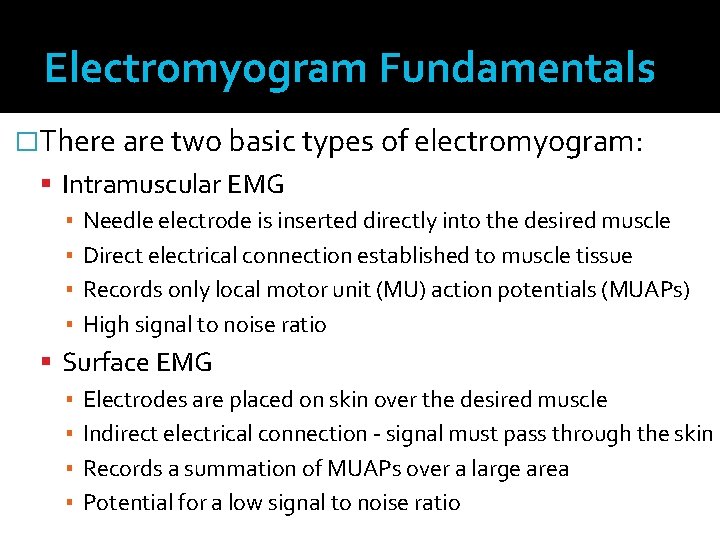
Electromyogram Fundamentals �There are two basic types of electromyogram: Intramuscular EMG ▪ Needle electrode is inserted directly into the desired muscle ▪ Direct electrical connection established to muscle tissue ▪ Records only local motor unit (MU) action potentials (MUAPs) ▪ High signal to noise ratio Surface EMG ▪ Electrodes are placed on skin over the desired muscle ▪ Indirect electrical connection - signal must pass through the skin ▪ Records a summation of MUAPs over a large area ▪ Potential for a low signal to noise ratio
Why Use a Surface EMG? �Intramuscular EMG requires needles. �Needles are no fun. �A surface EMG (s. EMG) is non-invasive � �Therefore, it is fun.
Inherent Problems with s. EMG �Time Delay Nerve impulse takes time to propagate through the MU ▪ Conduction Velocity (CV) is typically 1 - 10 meters/sec ▪ Muscle fibers within an MU contract at slightly different times Delay due to CV causes distortion of the recorded signal �Signals from multiple MUs present in signal A single muscle often has multiple MUs �Crosstalk Electrode may record signals from nearby muscles
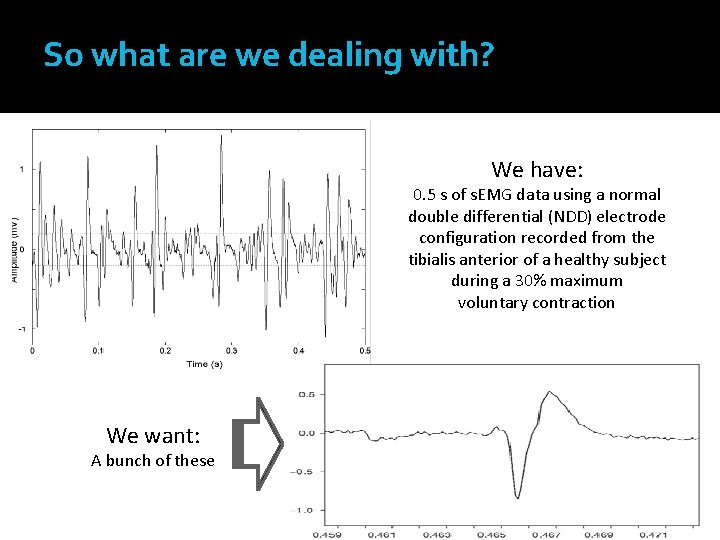
So what are we dealing with? We have: 0. 5 s of s. EMG data using a normal double differential (NDD) electrode configuration recorded from the tibialis anterior of a healthy subject during a 30% maximum voluntary contraction We want: A bunch of these
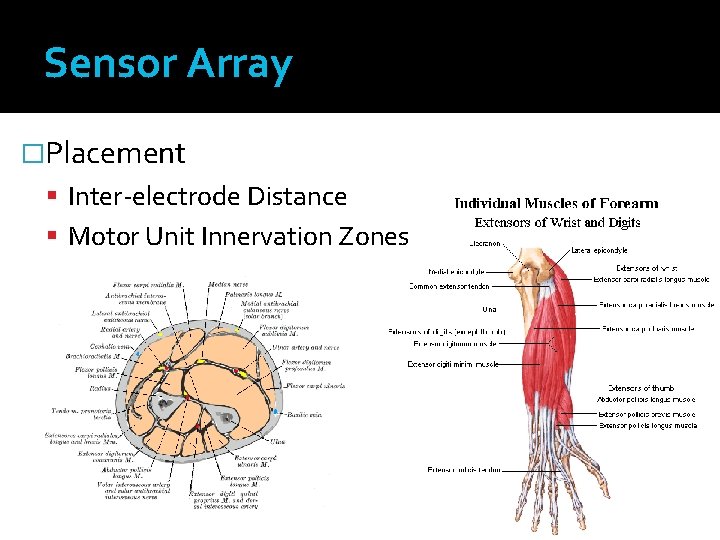
Sensor Array �Placement Inter-electrode Distance Motor Unit Innervation Zones
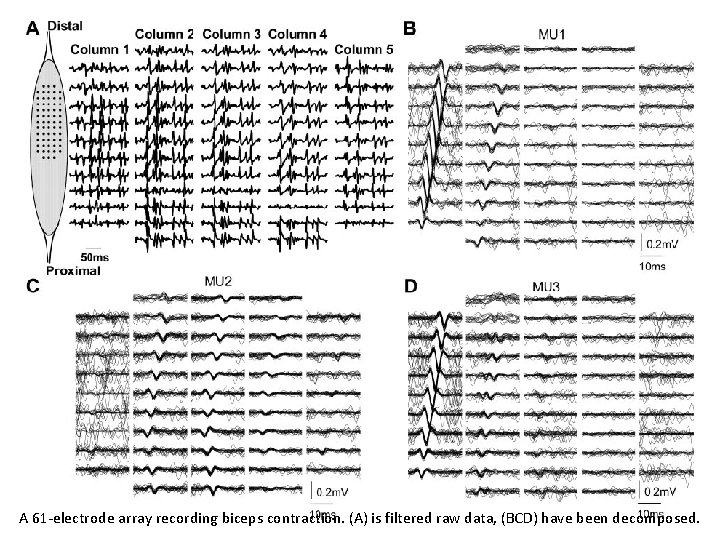
A 61 -electrode array recording biceps contraction. (A) is filtered raw data, (BCD) have been decomposed.
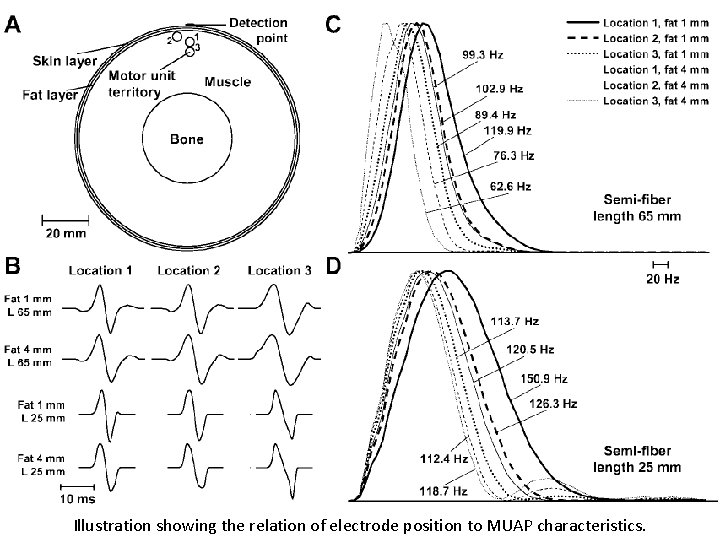
Illustration showing the relation of electrode position to MUAP characteristics.
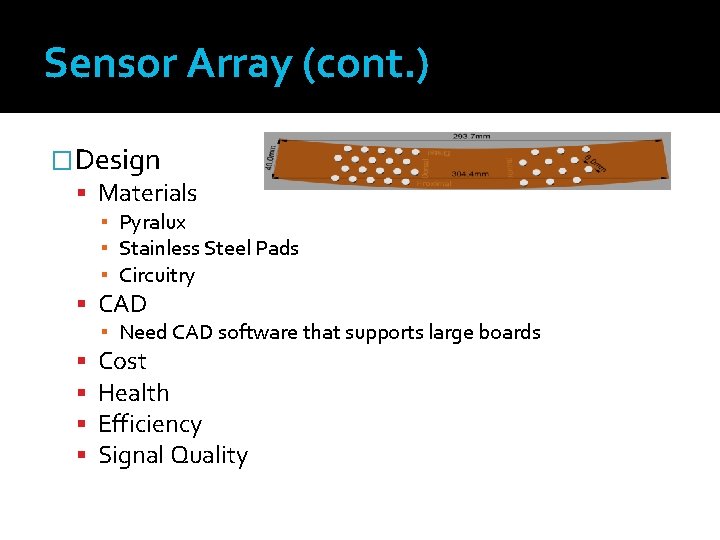
Sensor Array (cont. ) �Design Materials ▪ Pyralux ▪ Stainless Steel Pads ▪ Circuitry CAD ▪ Need CAD software that supports large boards Cost Health Efficiency Signal Quality
Sensor Array (cont. ) �Construction Printer/Pyralux Stainless Steel Pads Amplifiers �Testing Placement Spatial Resolution Signal Quality Determine Proper Sampling Rate
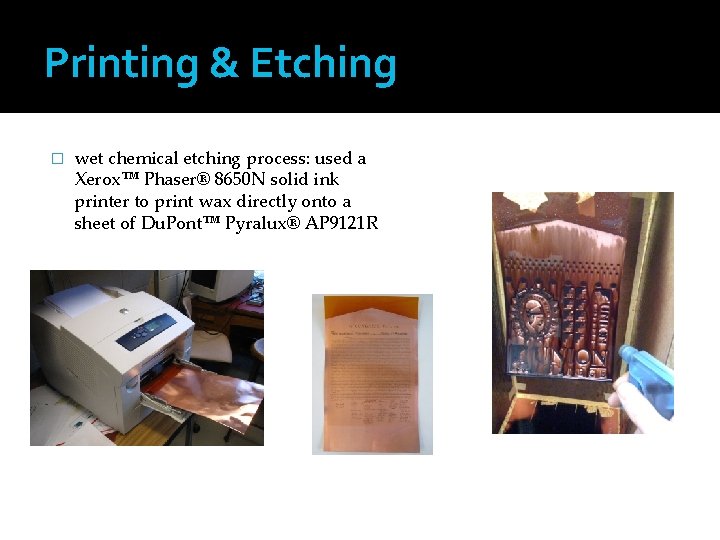
Printing & Etching � wet chemical etching process: used a Xerox™ Phaser® 8650 N solid ink printer to print wax directly onto a sheet of Du. Pont™ Pyralux® AP 9121 R
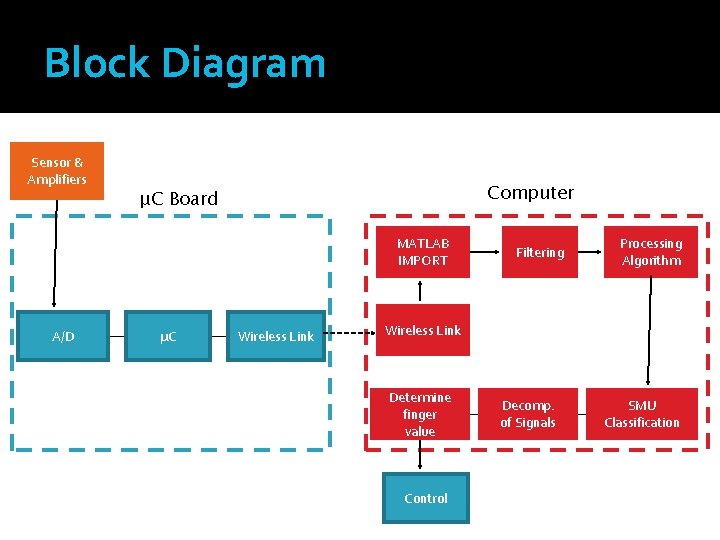
Block Diagram Sensor & Amplifiers Computer μC Board MATLAB IMPORT A/D μC Wireless Link Filtering Processing Algorithm Wireless Link Determine finger value Control Decomp. of Signals SMU Classification
Computer Connection �A/D Hardware Number of Channels Needed Bit Rate/ Depth Multiplexing? �Connection Microprocessor Microproccessing USB connection ▪ Possible Future radio Link Drivers ▪ Import to MATLAB
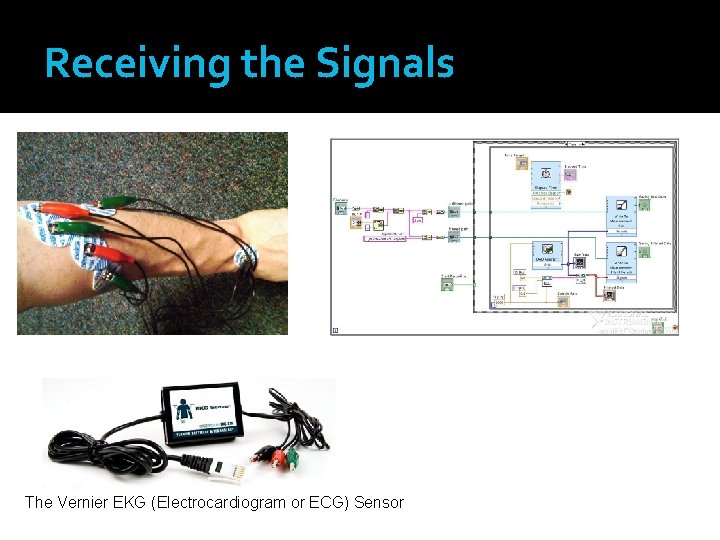
Receiving the Signals The Vernier EKG (Electrocardiogram or ECG) Sensor
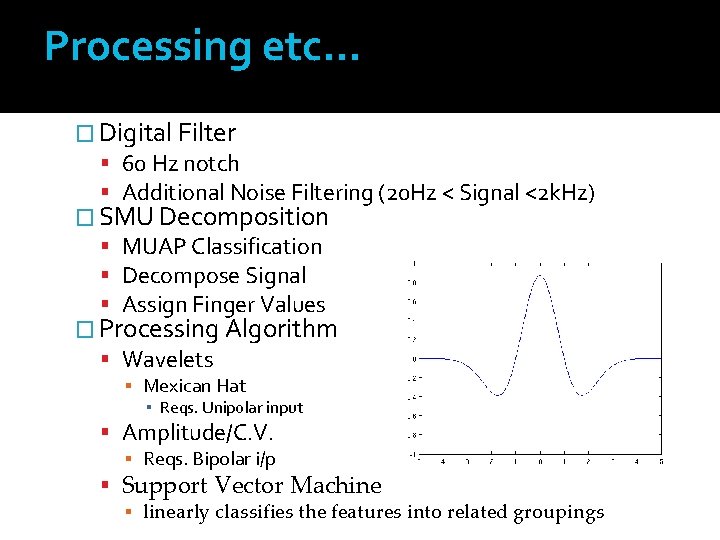
Processing etc… � Digital Filter 60 Hz notch Additional Noise Filtering (20 Hz < Signal <2 k. Hz) � SMU Decomposition MUAP Classification Decompose Signal Assign Finger Values � Processing Algorithm Wavelets ▪ Mexican Hat ▪ Reqs. Unipolar input Amplitude/C. V. ▪ Reqs. Bipolar i/p Support Vector Machine ▪ linearly classifies the features into related groupings
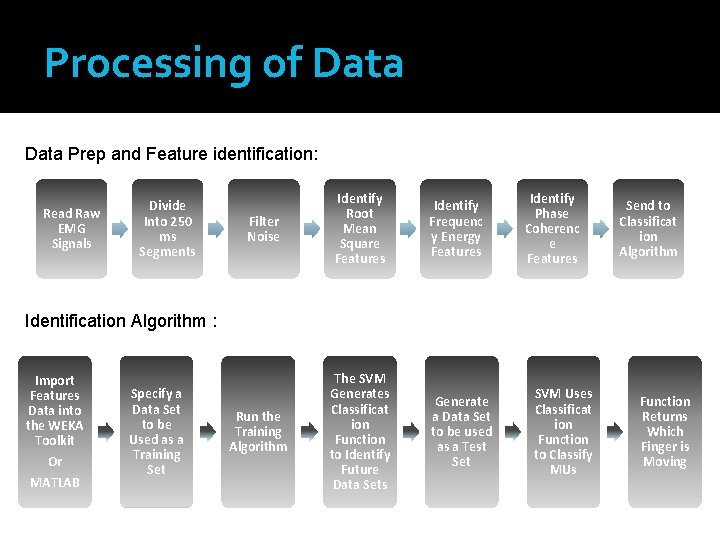
Processing of Data Prep and Feature identification: Read Raw EMG Signals Divide Into 250 ms Segments Filter Noise Identify Root Mean Square Features Identify Frequenc y Energy Features Identify Phase Coherenc e Features Send to Classificat ion Algorithm Identification Algorithm : Import Features Data into the WEKA Toolkit Or MATLAB Specify a Data Set to be Used as a Training Set Run the Training Algorithm The SVM Generates Classificat ion Function to Identify Future Data Sets Generate a Data Set to be used as a Test Set SVM Uses Classificat ion Function to Classify MUs Function Returns Which Finger is Moving
Questions?
Special Thanks to… �Konstantin Avdaschenko, EE �Demarcus Hamm, EE �Travis Hoh, Neuroscience �Prof. Hanson, EE �Prof. Hedrick, EE �Prof. Catravas, EE �Prof. Olberg, Neuroscience �Prof. Rice, Biology