
Designing and Exploring the Structure of Launch Vehicles

- Slides: 14
Designing and Exploring the Structure of Launch Vehicles to Create Optimal Theoretical and Small-Scale Experimental Models Cole Errico Aerospace Engineering Arizona State University Tempe, AZ Timothy Takahashi, JD/Ph. D Aerospace Engineering Arizona State University Tempe, AZ 1
Motivation – Ease of Design • Design is arguably the most time-consuming aspect of any astronautics project and consumes enormous amounts of labor and cost for any size of undertaking. • Every little detail of every piece prepared for the launch must be meticulously designed to optimize for any number of properties. • Being able to automatically produce a functional design that applies to any portion of the design will cut down on cost and time drastically. • GOAL: Create a series of programs to generate feasible and scalable models for a launch vehicle that can be applied to real-life applications. 2
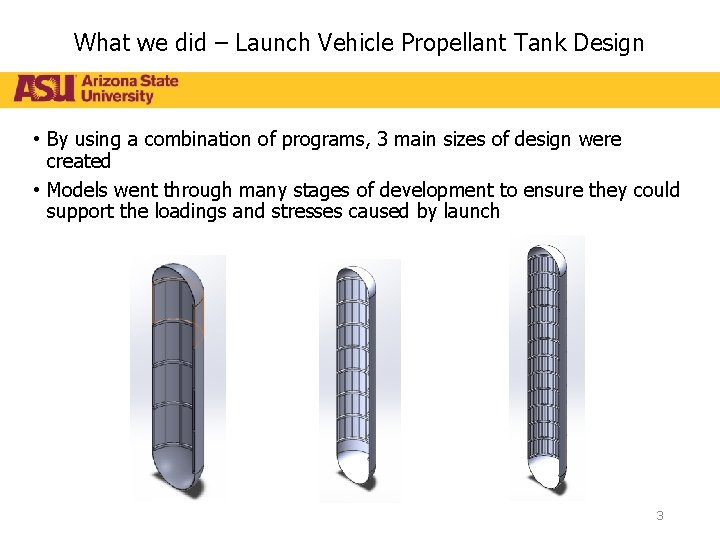
What we did – Launch Vehicle Propellant Tank Design • By using a combination of programs, 3 main sizes of design were created • Models went through many stages of development to ensure they could support the loadings and stresses caused by launch 3
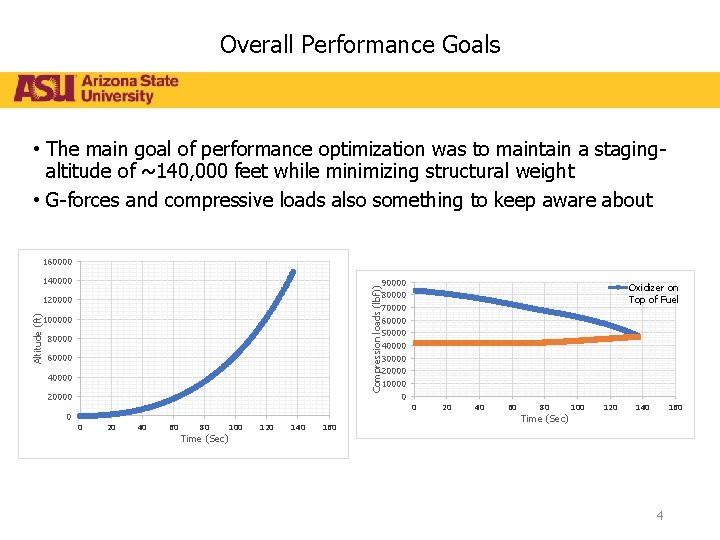
Overall Performance Goals • The main goal of performance optimization was to maintain a stagingaltitude of ~140, 000 feet while minimizing structural weight • G-forces and compressive loads also something to keep aware about 160000 Compression loads (lbf)) 140000 Altitude (ft) 120000 100000 80000 60000 40000 20000 0 0 20 40 60 80 Time (Sec) 100 120 140 160 90000 80000 70000 60000 50000 40000 30000 20000 10000 0 Oxidizer on Top of Fuel 0 20 40 60 80 Time (Sec) 100 120 140 160 4
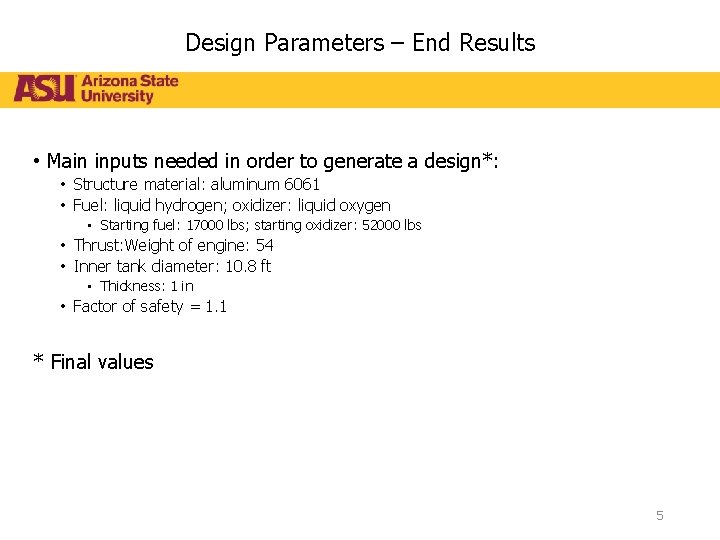
Design Parameters – End Results • Main inputs needed in order to generate a design*: • Structure material: aluminum 6061 • Fuel: liquid hydrogen; oxidizer: liquid oxygen • Starting fuel: 17000 lbs; starting oxidizer: 52000 lbs • Thrust: Weight of engine: 54 • Inner tank diameter: 10. 8 ft • Thickness: 1 in • Factor of safety = 1. 1 * Final values 5
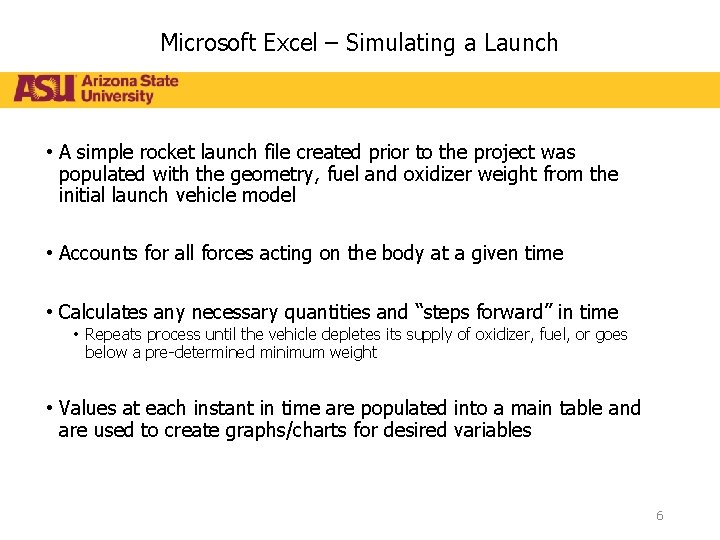
Microsoft Excel – Simulating a Launch • A simple rocket launch file created prior to the project was populated with the geometry, fuel and oxidizer weight from the initial launch vehicle model • Accounts for all forces acting on the body at a given time • Calculates any necessary quantities and “steps forward” in time • Repeats process until the vehicle depletes its supply of oxidizer, fuel, or goes below a pre-determined minimum weight • Values at each instant in time are populated into a main table and are used to create graphs/charts for desired variables 6
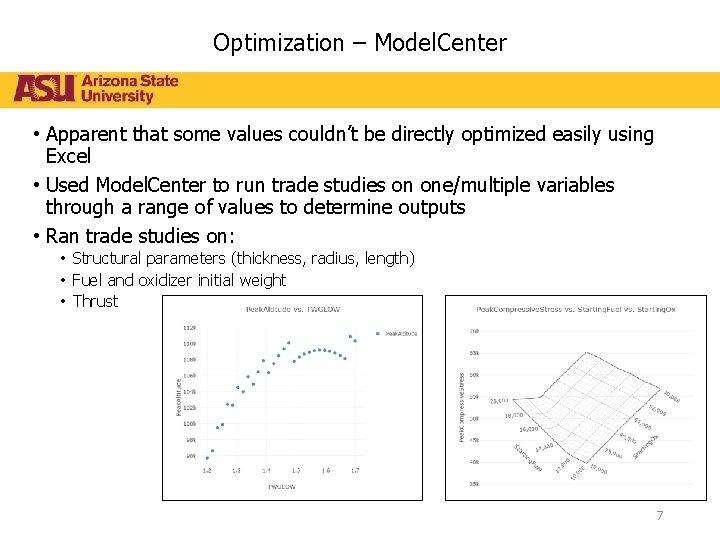
Optimization – Model. Center • Apparent that some values couldn’t be directly optimized easily using Excel • Used Model. Center to run trade studies on one/multiple variables through a range of values to determine outputs • Ran trade studies on: • Structural parameters (thickness, radius, length) • Fuel and oxidizer initial weight • Thrust 7
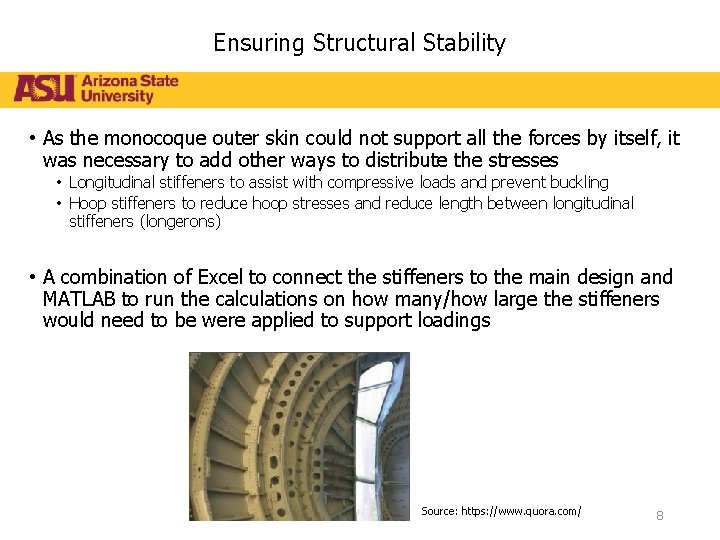
Ensuring Structural Stability • As the monocoque outer skin could not support all the forces by itself, it was necessary to add other ways to distribute the stresses • Longitudinal stiffeners to assist with compressive loads and prevent buckling • Hoop stiffeners to reduce hoop stresses and reduce length between longitudinal stiffeners (longerons) • A combination of Excel to connect the stiffeners to the main design and MATLAB to run the calculations on how many/how large the stiffeners would need to be were applied to support loadings Source: https: //www. quora. com/ 8
What about scaling? • Final (and arguably most important) objective was to determine whether a design could be scaled up or down by changing a few parameters • Went back to the Excel simulation – goal was to scale booster so crosssectional area was 0. 5 and 1. 5 times the original model • Values of the Excel simulation were plugged into Model. Center and refined, then into MATLAB for longerons and hoop stiffeners • All values were used with Solidworks in order to generate final models 9
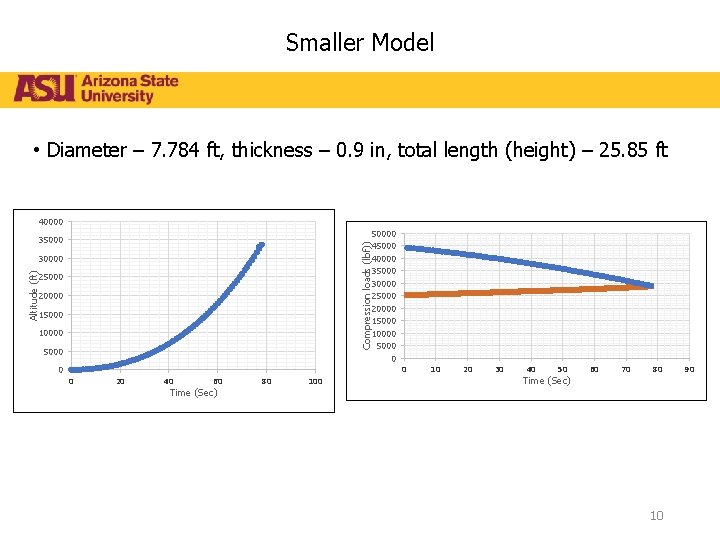
Smaller Model • Diameter – 7. 784 ft, thickness – 0. 9 in, total length (height) – 25. 85 ft 40000 Compression loads (lbf)) 35000 Altitude (ft) 30000 25000 20000 15000 10000 5000 0 0 20 40 60 Time (Sec) 80 100 50000 45000 40000 35000 30000 25000 20000 15000 10000 5000 0 0 10 20 30 40 50 Time (Sec) 60 70 80 10 90
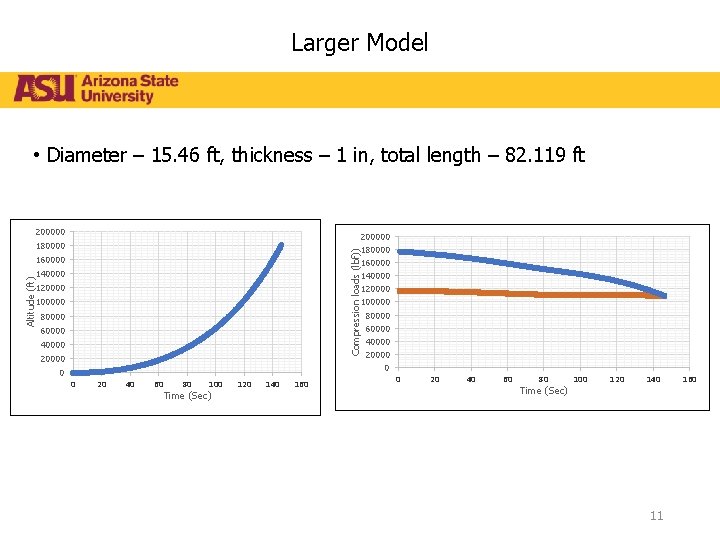
Larger Model • Diameter – 15. 46 ft, thickness – 1 in, total length – 82. 119 ft 200000 Compression loads (lbf)) 180000 Altitude (ft) 160000 140000 120000 100000 80000 60000 40000 20000 0 0 20 40 60 80 100 Time (Sec) 120 140 160 200000 180000 160000 140000 120000 100000 80000 60000 40000 20000 0 0 20 40 60 80 Time (Sec) 100 120 140 11 160
To Sum it all Up • Simplifying or streamlining the design process for large scale aerostructures can bring benefits in terms of time and cost • Through a combination of programs and routines, a method of determining a structurally stable launch vehicle has been created • Further work into the real-life viability of these launch vehicles is needed in order to fully develop the model. 12
Acknowledgments • My mentor: Dr. Timothy Takahashi • The Ira A. Fulton Schools of Engineering and the School for Engineering of Matter, Transport, and Energy • The ASU/NASA Space Grant Program and the Arizona Space Grant Consortium 13
Thank you!