
Designing and Building the Iron Genie Harmonograph And
Designing and Building the Iron Genie Harmonograph And a bit about its history Anita Chowdry
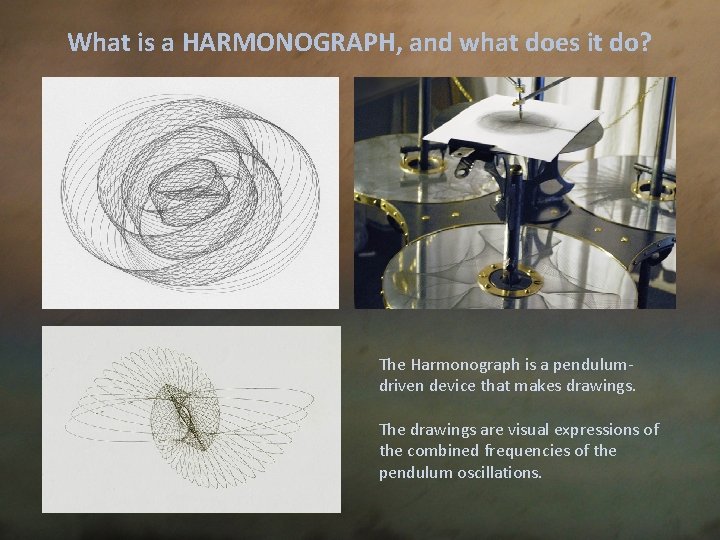
What is a HARMONOGRAPH, and what does it do? The Harmonograph is a pendulumdriven device that makes drawings. The drawings are visual expressions of the combined frequencies of the pendulum oscillations.
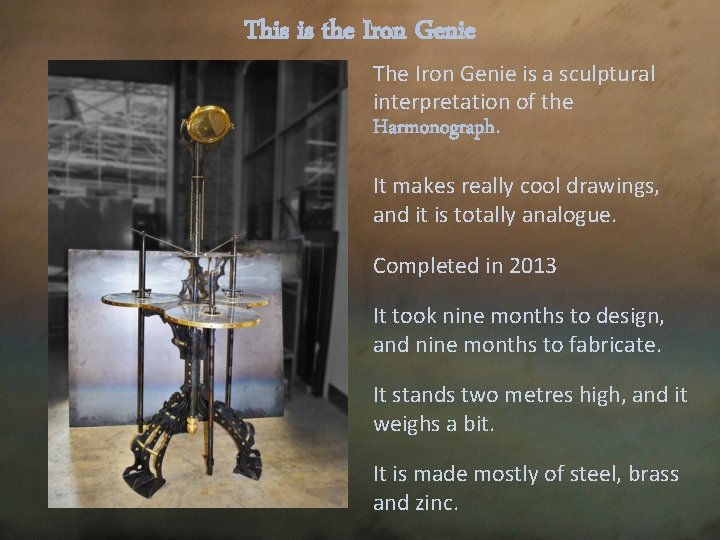
This is the Iron Genie The Iron Genie is a sculptural interpretation of the Harmonograph. It makes really cool drawings, and it is totally analogue. Completed in 2013 It took nine months to design, and nine months to fabricate. It stands two metres high, and it weighs a bit. It is made mostly of steel, brass and zinc.
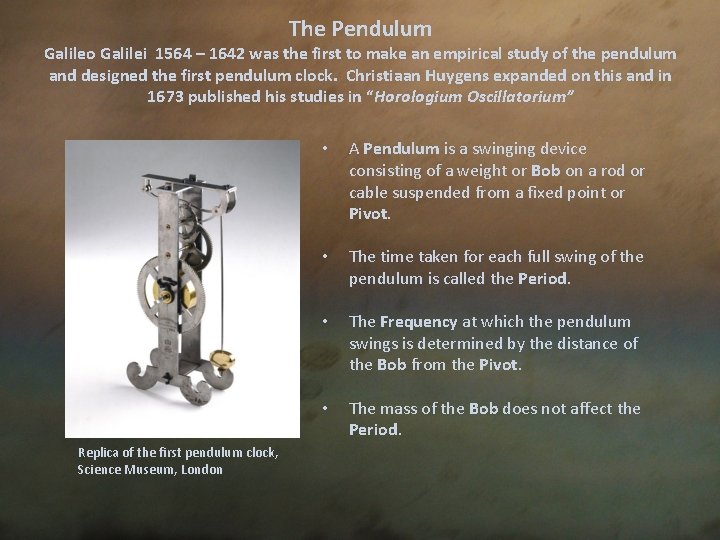
The Pendulum Galileo Galilei 1564 – 1642 was the first to make an empirical study of the pendulum and designed the first pendulum clock. Christiaan Huygens expanded on this and in 1673 published his studies in “Horologium Oscillatorium” Replica of the first pendulum clock, Science Museum, London • A Pendulum is a swinging device consisting of a weight or Bob on a rod or cable suspended from a fixed point or Pivot. • The time taken for each full swing of the pendulum is called the Period. • The Frequency at which the pendulum swings is determined by the distance of the Bob from the Pivot. • The mass of the Bob does not affect the Period.
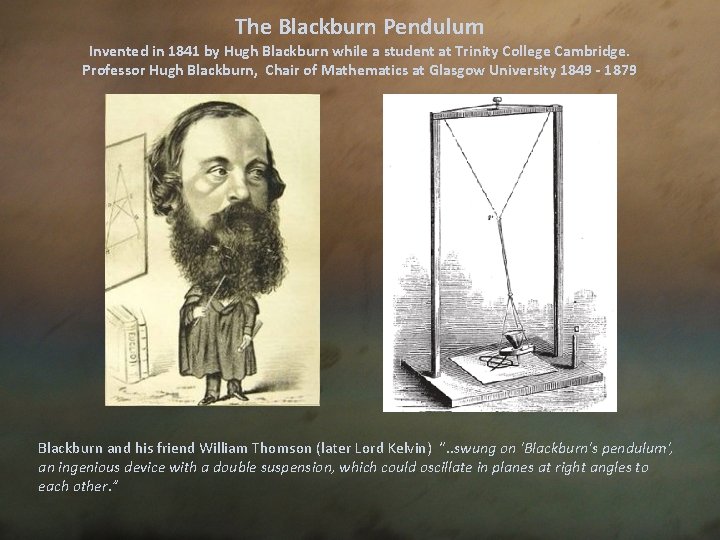
The Blackburn Pendulum Invented in 1841 by Hugh Blackburn while a student at Trinity College Cambridge. Professor Hugh Blackburn, Chair of Mathematics at Glasgow University 1849 - 1879 Blackburn and his friend William Thomson (later Lord Kelvin) “. . swung on 'Blackburn's pendulum', an ingenious device with a double suspension, which could oscillate in planes at right angles to each other. ”
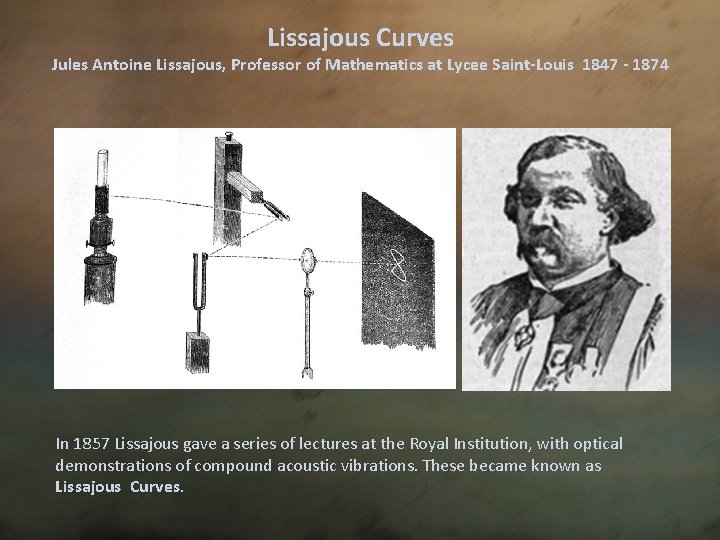
Lissajous Curves Jules Antoine Lissajous, Professor of Mathematics at Lycee Saint-Louis 1847 - 1874 In 1857 Lissajous gave a series of lectures at the Royal Institution, with optical demonstrations of compound acoustic vibrations. These became known as Lissajous Curves.
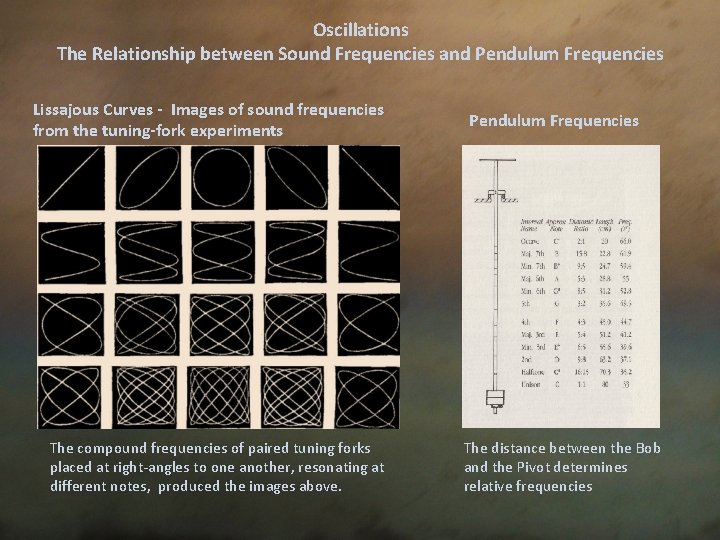
Oscillations The Relationship between Sound Frequencies and Pendulum Frequencies Lissajous Curves - Images of sound frequencies from the tuning-fork experiments The compound frequencies of paired tuning forks placed at right-angles to one another, resonating at different notes, produced the images above. Pendulum Frequencies The distance between the Bob and the Pivot determines relative frequencies
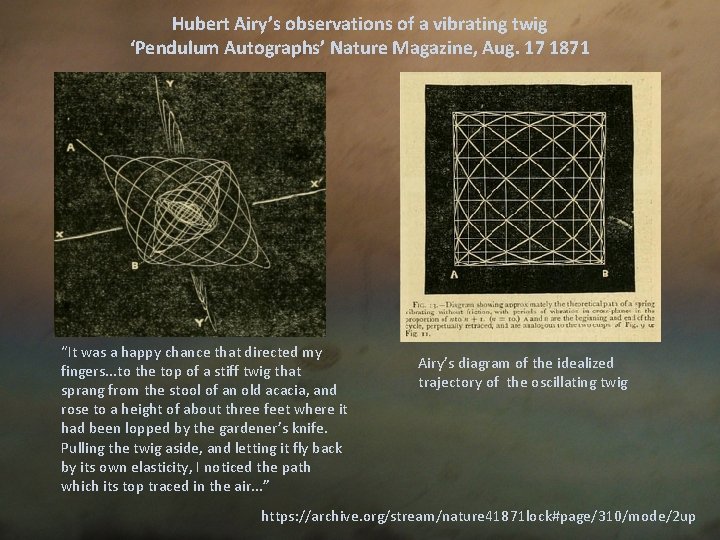
Hubert Airy’s observations of a vibrating twig ‘Pendulum Autographs’ Nature Magazine, Aug. 17 1871 “It was a happy chance that directed my fingers. . . to the top of a stiff twig that sprang from the stool of an old acacia, and rose to a height of about three feet where it had been lopped by the gardener’s knife. Pulling the twig aside, and letting it fly back by its own elasticity, I noticed the path which its top traced in the air. . . ” Airy’s diagram of the idealized trajectory of the oscillating twig https: //archive. org/stream/nature 41871 lock#page/310/mode/2 up
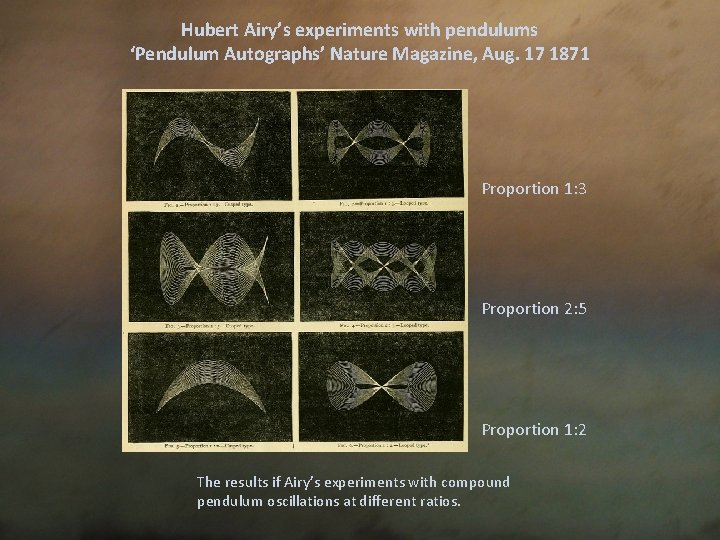
Hubert Airy’s experiments with pendulums ‘Pendulum Autographs’ Nature Magazine, Aug. 17 1871 Proportion 1: 3 Proportion 2: 5 Proportion 1: 2 The results if Airy’s experiments with compound pendulum oscillations at different ratios.
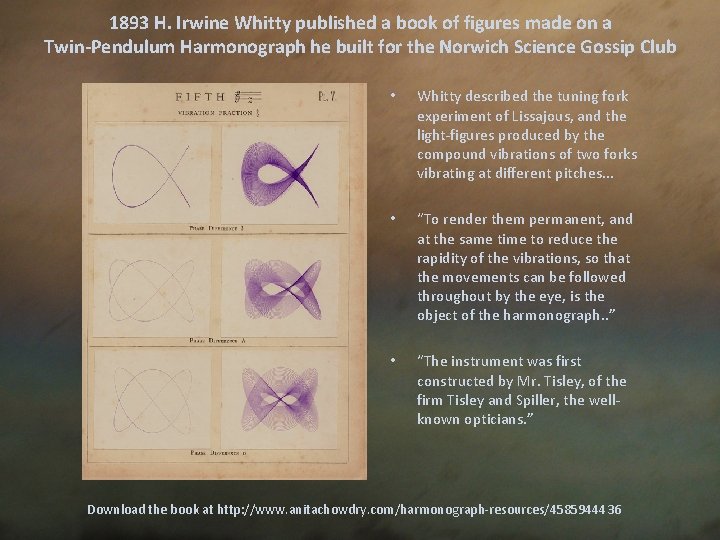
1893 H. Irwine Whitty published a book of figures made on a Twin-Pendulum Harmonograph he built for the Norwich Science Gossip Club • Whitty described the tuning fork experiment of Lissajous, and the light-figures produced by the compound vibrations of two forks vibrating at different pitches. . . • “To render them permanent, and at the same time to reduce the rapidity of the vibrations, so that the movements can be followed throughout by the eye, is the object of the harmonograph. . ” • “The instrument was first constructed by Mr. Tisley, of the firm Tisley and Spiller, the wellknown opticians. ” Download the book at http: //www. anitachowdry. com/harmonograph-resources/4585944436
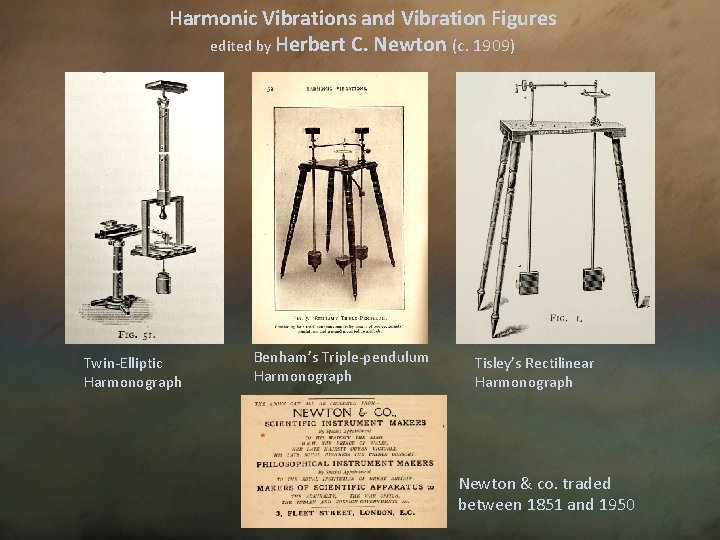
Harmonic Vibrations and Vibration Figures edited by Herbert C. Newton (c. 1909) Twin-Elliptic Harmonograph Benham’s Triple-pendulum Harmonograph Tisley’s Rectilinear Harmonograph Newton & co. traded between 1851 and 1950
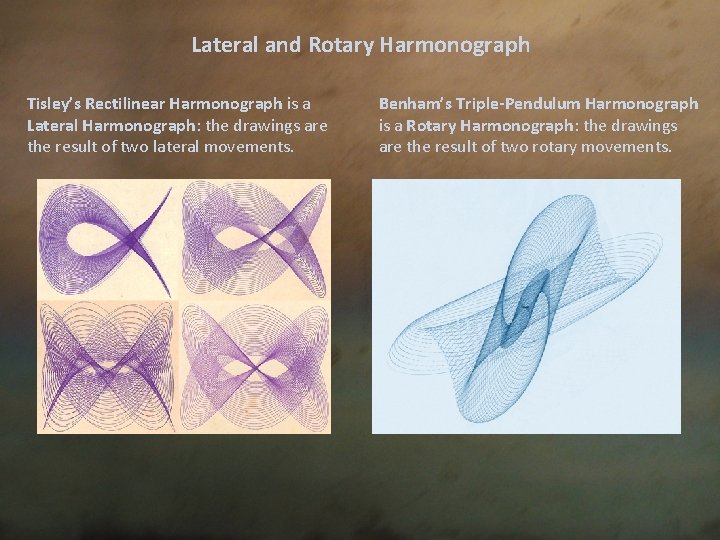
Lateral and Rotary Harmonograph Tisley’s Rectilinear Harmonograph is a Lateral Harmonograph: the drawings are the result of two lateral movements. Benham’s Triple-Pendulum Harmonograph is a Rotary Harmonograph: the drawings are the result of two rotary movements.
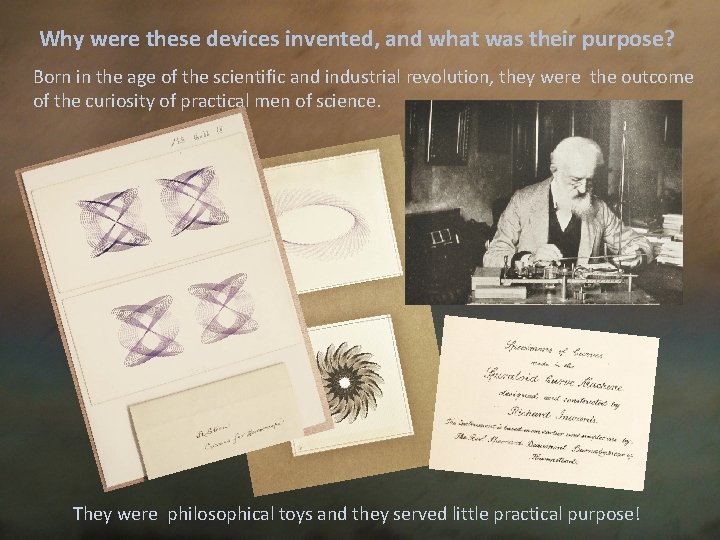
Why were these devices invented, and what was their purpose? Born in the age of the scientific and industrial revolution, they were the outcome of the curiosity of practical men of science. They were philosophical toys and they served little practical purpose!
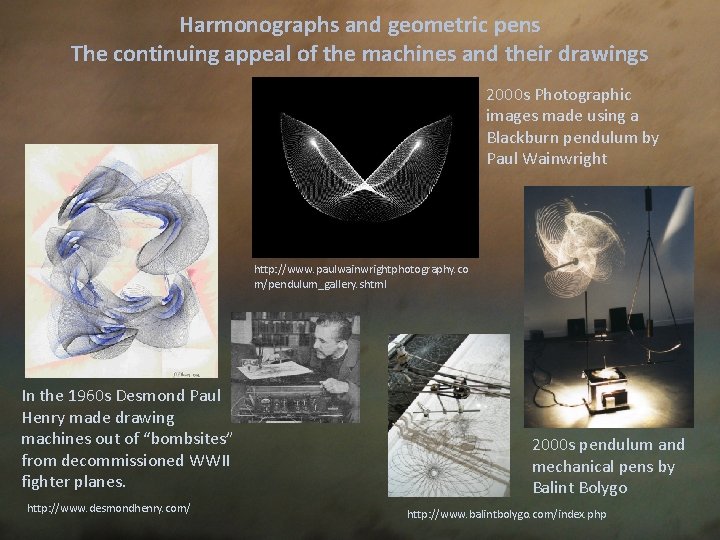
Harmonographs and geometric pens The continuing appeal of the machines and their drawings 2000 s Photographic images made using a Blackburn pendulum by Paul Wainwright http: //www. paulwainwrightphotography. co m/pendulum_gallery. shtml In the 1960 s Desmond Paul Henry made drawing machines out of “bombsites” from decommissioned WWII fighter planes. http: //www. desmondhenry. com/ 2000 s pendulum and mechanical pens by Balint Bolygo http: //www. balintbolygo. com/index. php
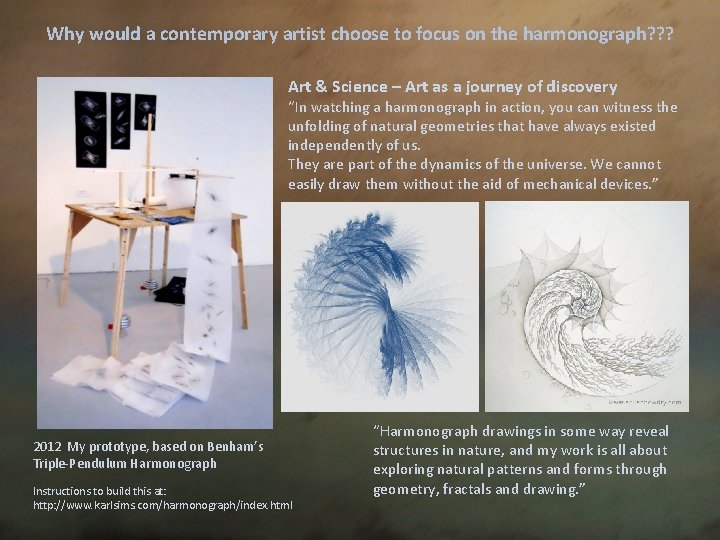
Why would a contemporary artist choose to focus on the harmonograph? ? ? Art & Science – Art as a journey of discovery “In watching a harmonograph in action, you can witness the unfolding of natural geometries that have always existed independently of us. They are part of the dynamics of the universe. We cannot easily draw them without the aid of mechanical devices. ” 2012 My prototype, based on Benham’s Triple-Pendulum Harmonograph Instructions to build this at: http: //www. karlsims. com/harmonograph/index. html “Harmonograph drawings in some way reveal structures in nature, and my work is all about exploring natural patterns and forms through geometry, fractals and drawing. ”
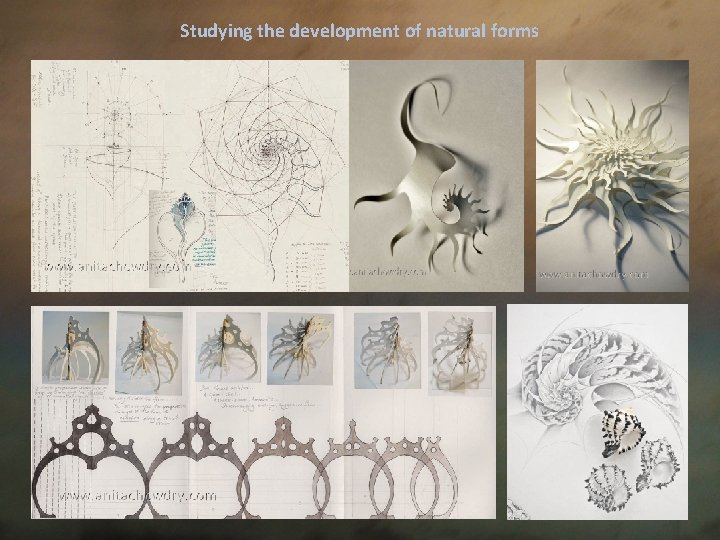
Studying the development of natural forms
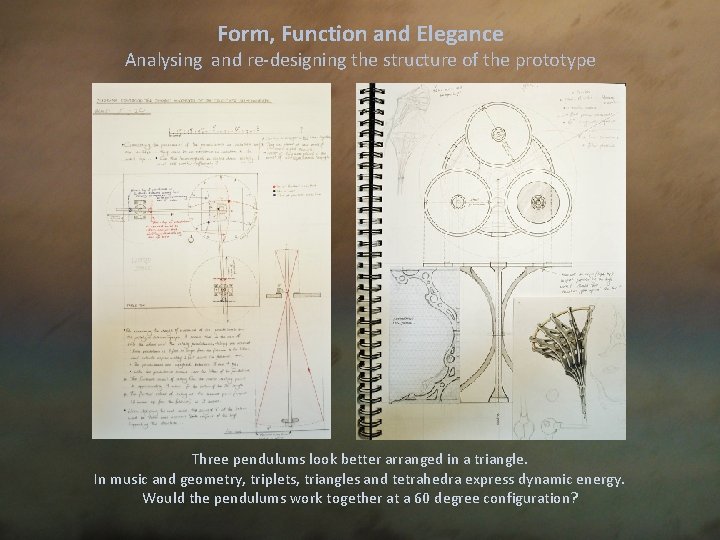
Form, Function and Elegance Analysing and re-designing the structure of the prototype Three pendulums look better arranged in a triangle. In music and geometry, triplets, triangles and tetrahedra express dynamic energy. Would the pendulums work together at a 60 degree configuration?
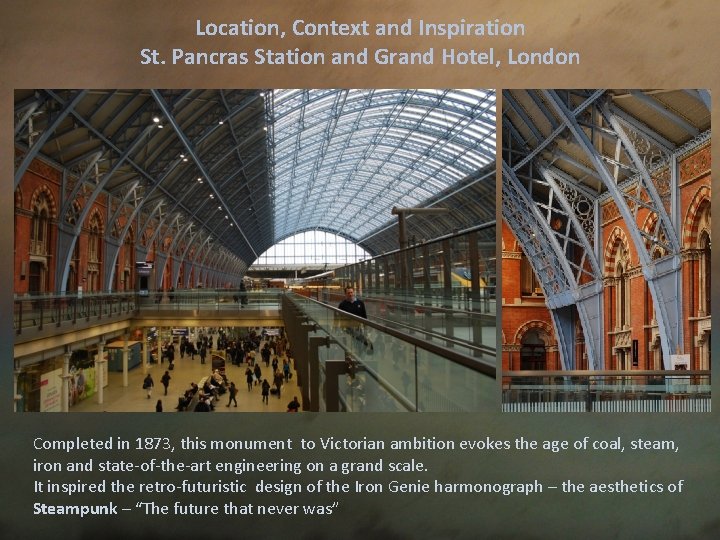
Location, Context and Inspiration St. Pancras Station and Grand Hotel, London Completed in 1873, this monument to Victorian ambition evokes the age of coal, steam, iron and state-of-the-art engineering on a grand scale. It inspired the retro-futuristic design of the Iron Genie harmonograph – the aesthetics of Steampunk – “The future that never was”
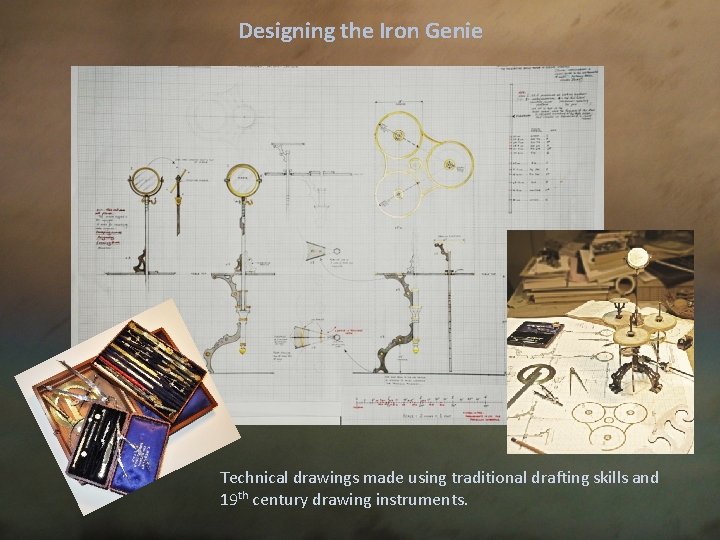
Designing the Iron Genie Technical drawings made using traditional drafting skills and 19 th century drawing instruments.

Fabrication Learning to work with steel at Central Saint Martin‘s, U. A. L.
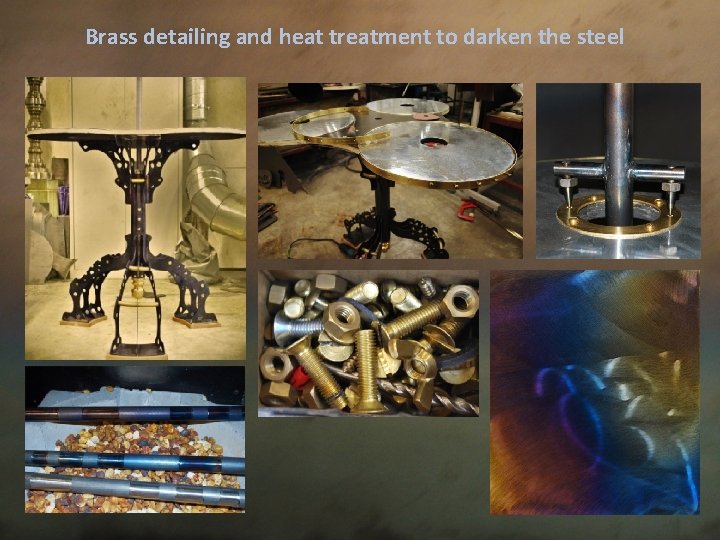
Brass detailing and heat treatment to darken the steel
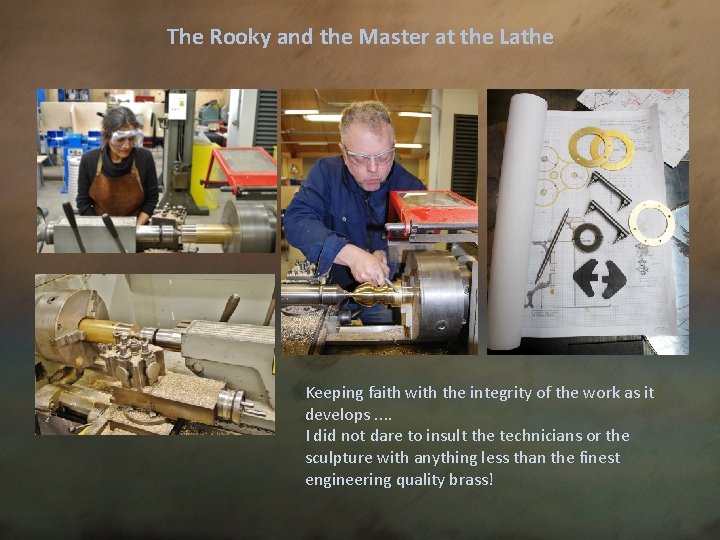
The Rooky and the Master at the Lathe Keeping faith with the integrity of the work as it develops. . I did not dare to insult the technicians or the sculpture with anything less than the finest engineering quality brass!
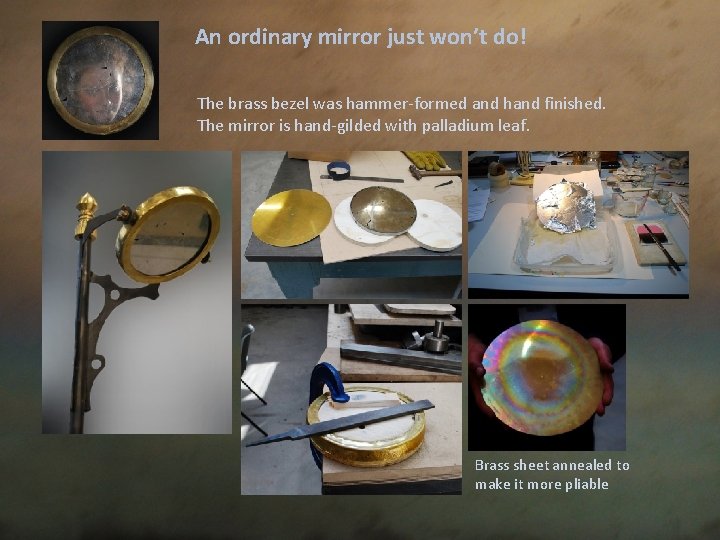
An ordinary mirror just won’t do! The brass bezel was hammer-formed and hand finished. The mirror is hand-gilded with palladium leaf. Brass sheet annealed to make it more pliable
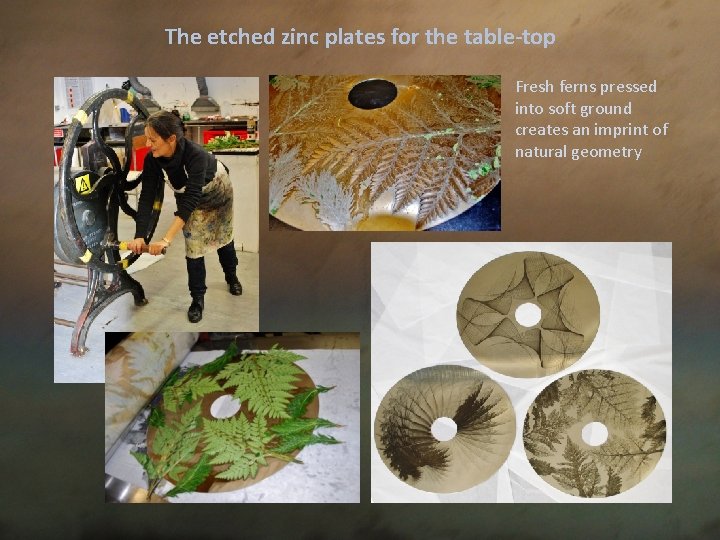
The etched zinc plates for the table-top Fresh ferns pressed into soft ground creates an imprint of natural geometry
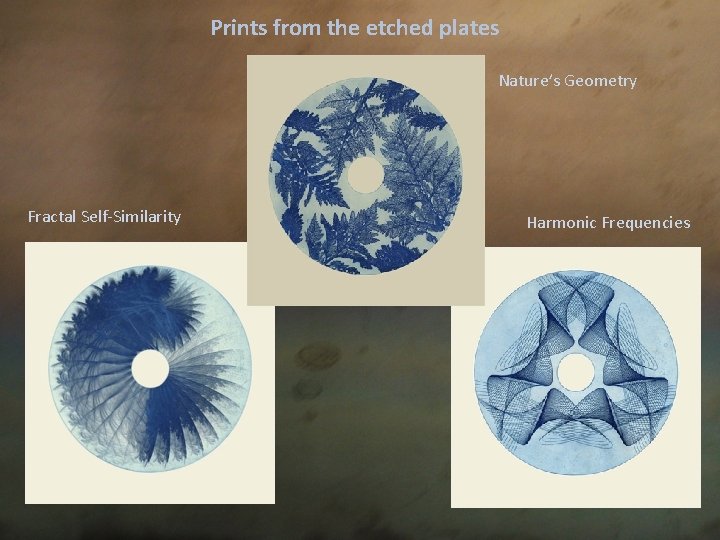
Prints from the etched plates Nature’s Geometry Fractal Self-Similarity Harmonic Frequencies
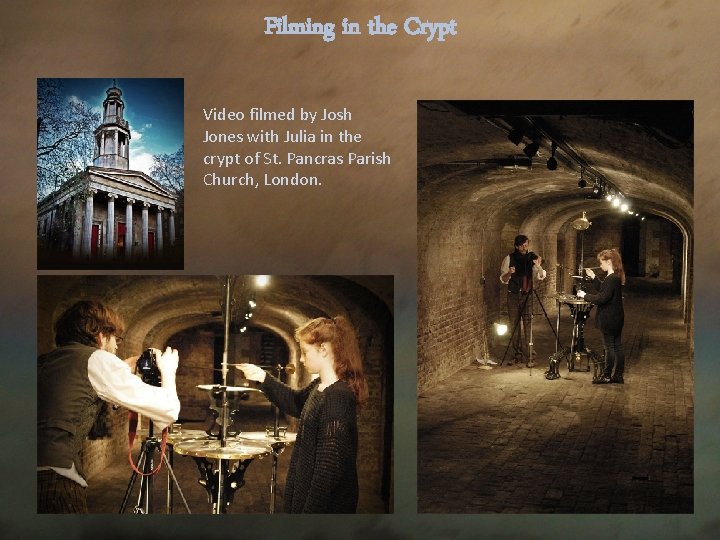
Filming in the Crypt Video filmed by Josh Jones with Julia in the crypt of St. Pancras Parish Church, London.
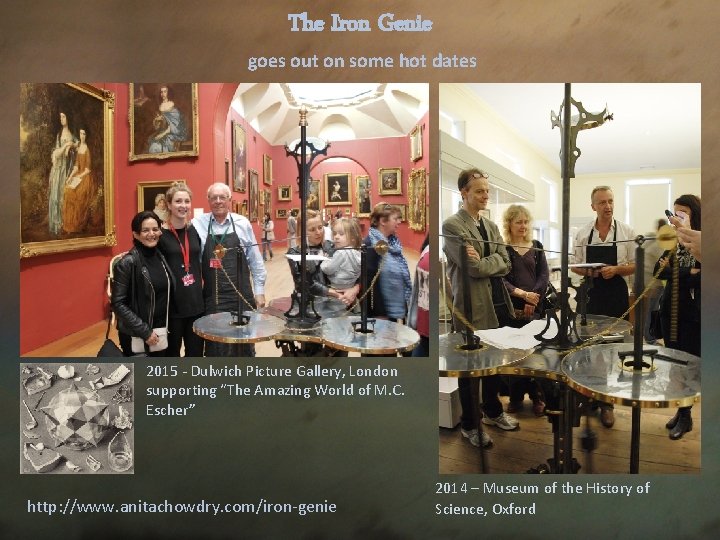
The Iron Genie goes out on some hot dates 2015 - Dulwich Picture Gallery, London supporting “The Amazing World of M. C. Escher” http: //www. anitachowdry. com/iron-genie 2014 – Museum of the History of Science, Oxford
- Slides: 27