
Designing an Open Source Web Application for Visualizing

Designing an Open Source Web Application for Visualizing Aquifers Mitchell Sodek Advisor: Dr. Pat Kennelly Penn State University AAG Conference San Francisco, CA April 2016
Project Proposal �Develop an open source web-based mapping application that will generate user customized aquifer data in a graphical format.
Objectives �Utilize open source software to create a responsive web map design that functions within a browser on any device �Create custom stratigraphic column and cross section graphs generated from grid cell elevation values representing the various aquifer layers �Develop a simple, powerful, and user friendly interface/experience for a wide number of public users �Employ a design that can be easily duplicated and one that is scalable for additional data and features
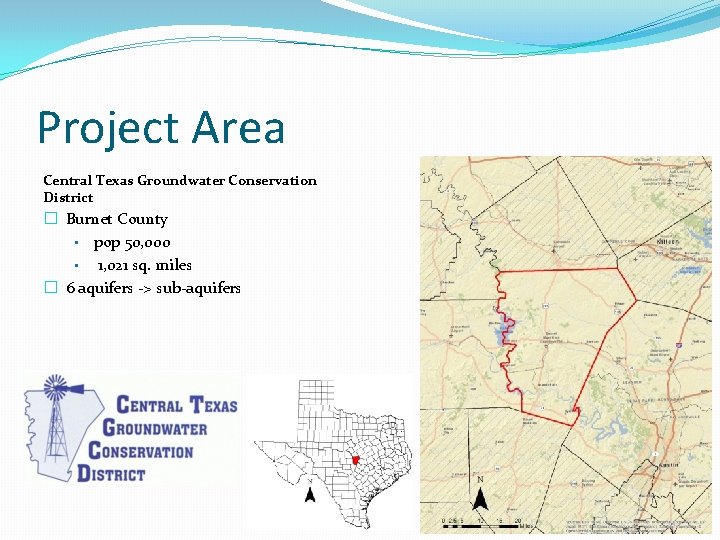
Project Area Central Texas Groundwater Conservation District � Burnet County • pop 50, 000 • 1, 021 sq. miles � 6 aquifers -> sub-aquifers
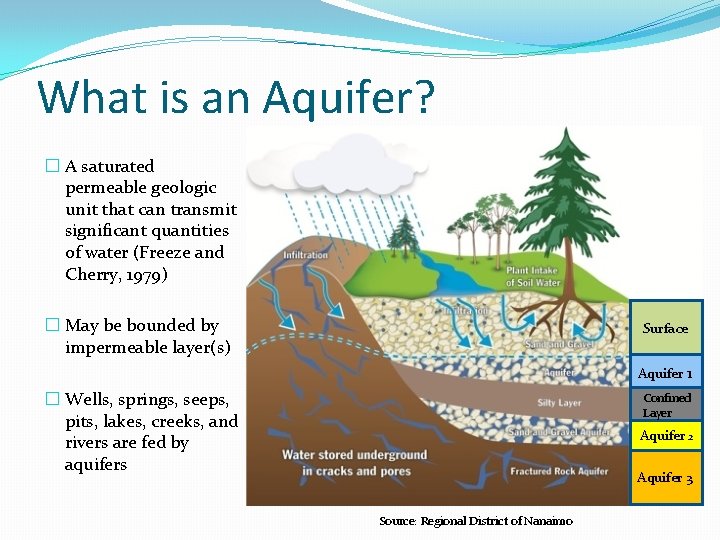
What is an Aquifer? � A saturated permeable geologic unit that can transmit significant quantities of water (Freeze and Cherry, 1979) � May be bounded by impermeable layer(s) Surface Aquifer 1 � Wells, springs, seeps, pits, lakes, creeks, and rivers are fed by aquifers Confined Layer Aquifer 2 Aquifer 3 Source: Regional District of Nanaimo
Who Needs Aquifer Data? Groundwater District Public �Vital for managing an aquifer �Multiple aquifers overly each other �Production assigned by aquifer �New wells can be designed with greater accuracy �Educating the general public �Well owners want to know from which aquifer they produce �New proposed well owners want to know the depth and cost �Drought contingency plans
Current Challenges �Aquifer data exist but are not easily attainable for the public �A professional is needed to compile data, analyze, and interpret the results �Specialized software is needed to visualize the underlying aquifers
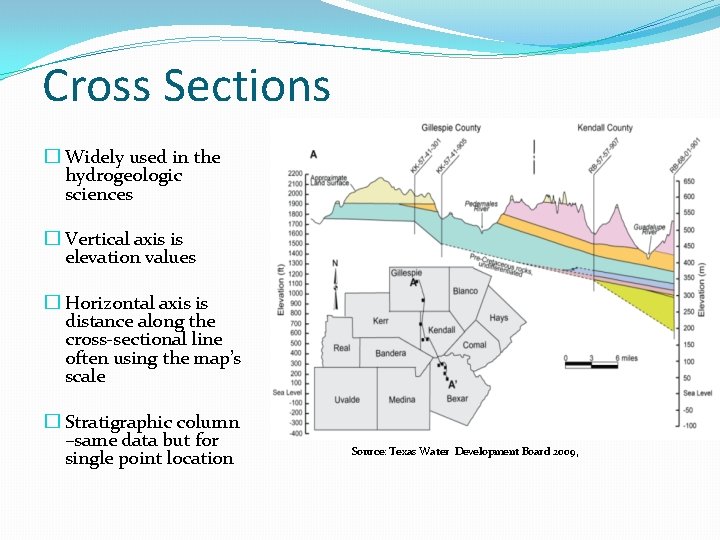
Cross Sections � Widely used in the hydrogeologic sciences � Vertical axis is elevation values � Horizontal axis is distance along the cross-sectional line often using the map’s scale � Stratigraphic column –same data but for single point location Source: Texas Water Development Board 2009,
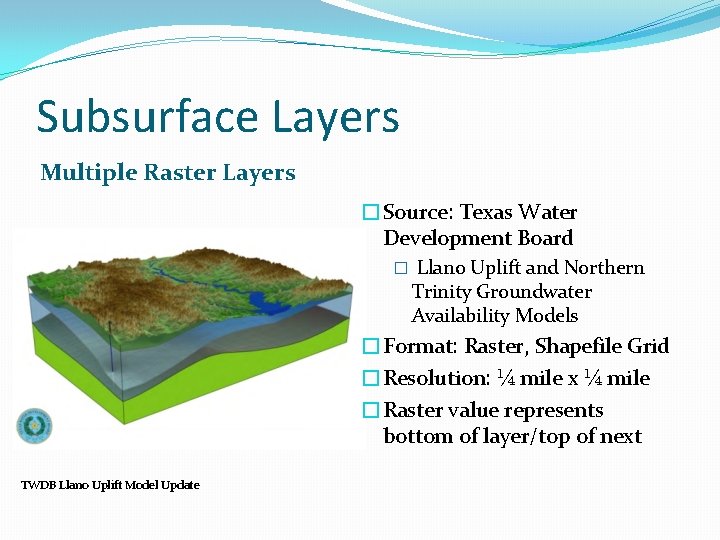
Subsurface Layers Multiple Raster Layers �Source: Texas Water Development Board � Llano Uplift and Northern Trinity Groundwater Availability Models �Format: Raster, Shapefile Grid �Resolution: ¼ mile x ¼ mile �Raster value represents bottom of layer/top of next TWDB Llano Uplift Model Update
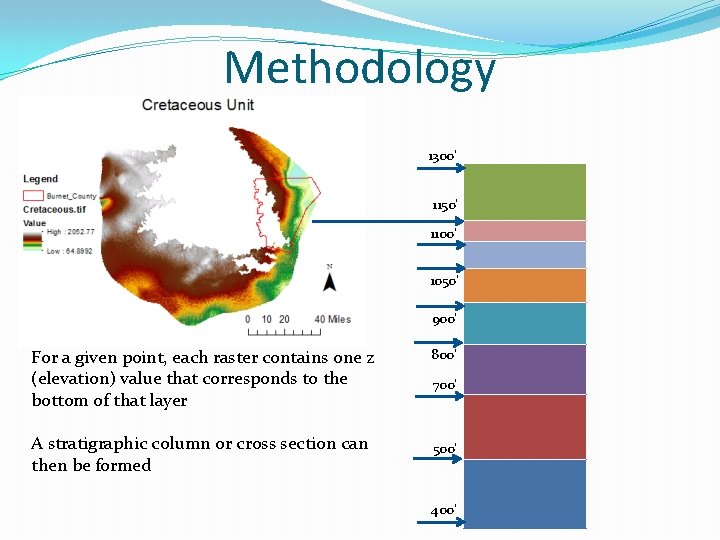
Methodology 1300’ 1150’ 1100’ 1050’ 900’ For a given point, each raster contains one z (elevation) value that corresponds to the bottom of that layer A stratigraphic column or cross section can then be formed 800’ 700’ 500’ 400’
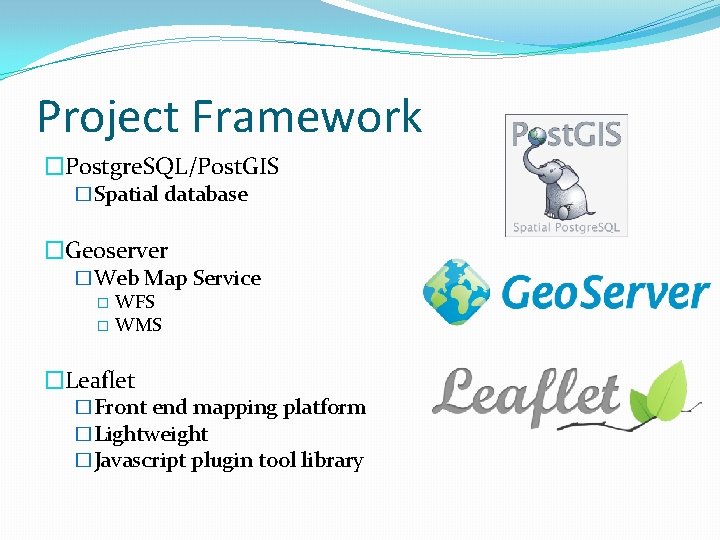
Project Framework �Postgre. SQL/Post. GIS �Spatial database �Geoserver �Web Map Service � WFS � WMS �Leaflet �Front end mapping platform �Lightweight �Javascript plugin tool library
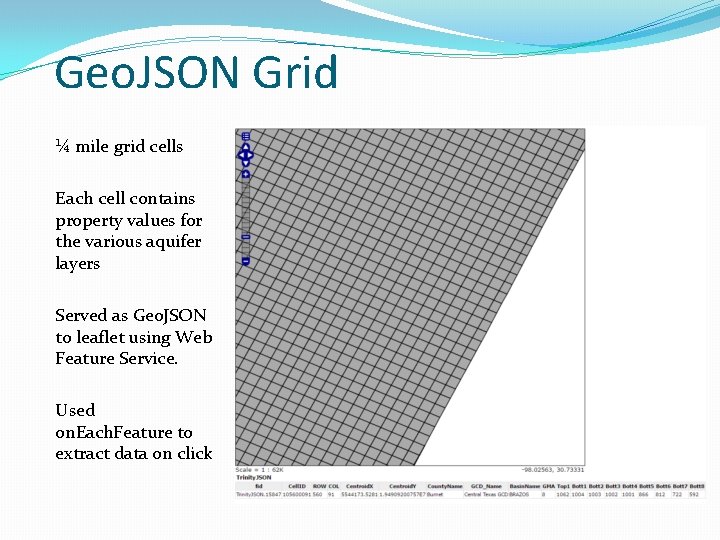
Geo. JSON Grid ¼ mile grid cells Each cell contains property values for the various aquifer layers Served as Geo. JSON to leaflet using Web Feature Service. Used on. Each. Feature to extract data on click
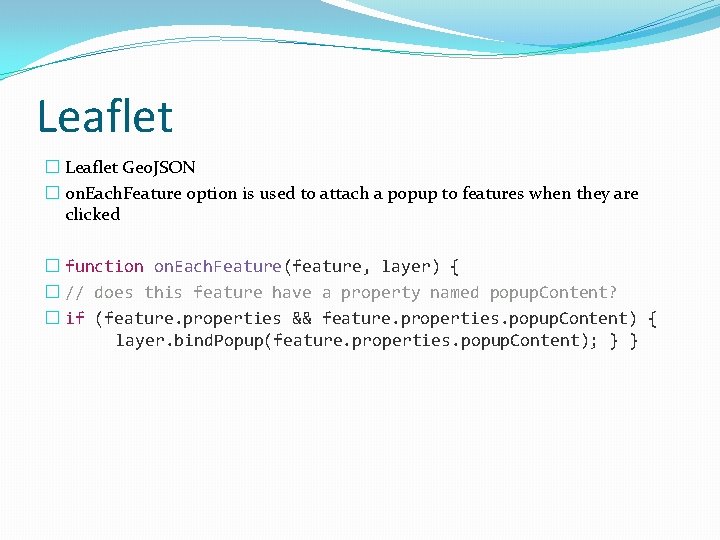
Leaflet � Leaflet Geo. JSON � on. Each. Feature option is used to attach a popup to features when they are clicked � function on. Each. Feature(feature, layer) { � // does this feature have a property named popup. Content? � if (feature. properties && feature. properties. popup. Content) { layer. bind. Popup(feature. properties. popup. Content); } }
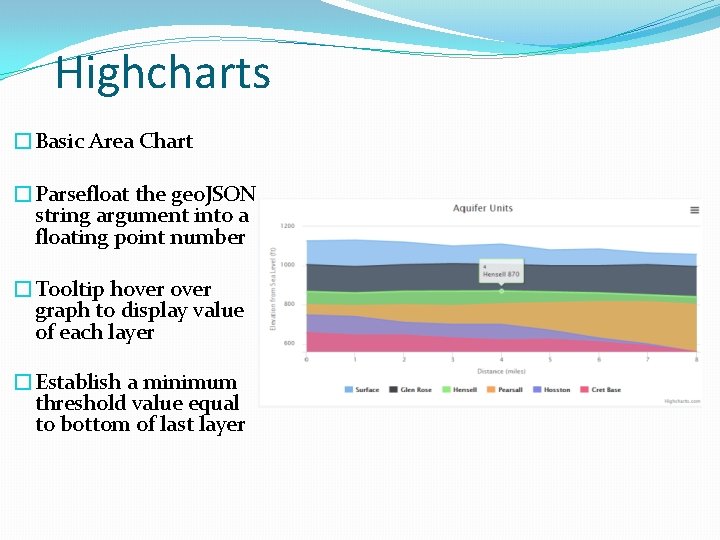
Highcharts �Basic Area Chart �Parsefloat the geo. JSON string argument into a floating point number �Tooltip hover graph to display value of each layer �Establish a minimum threshold value equal to bottom of last layer
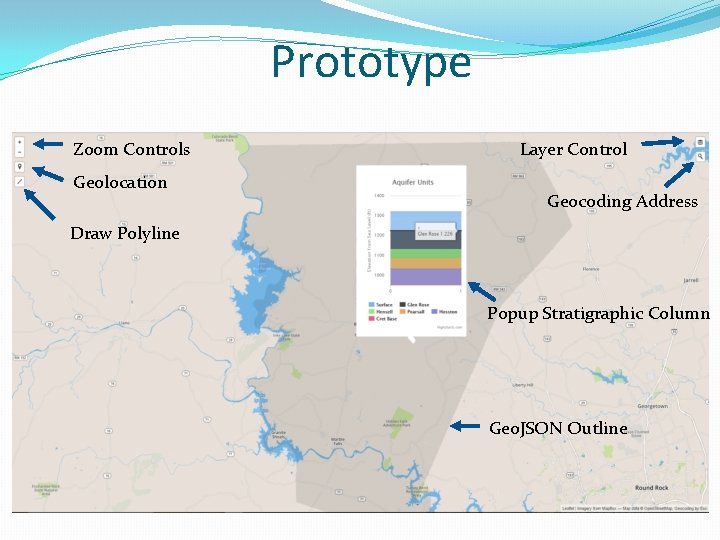
Prototype Zoom Controls Geolocation Layer Control Geocoding Address Draw Polyline Popup Stratigraphic Column Geo. JSON Outline
Polyline Cross Section �L. Geometry. Util plugin �interpolate. On. Line(map, latlngs, the) �Returns the coordinate of the point located on a line at the specified ratio of the line length.
Challenges � Wide user group � Keep design simple � Offer help screen � Coding � Javascript � CSS � Highchart � Graphics display � Screen size � Printable Opportunities �Easily duplicated for other areas �Location services using GPS from mobile devices �Framework built for other data sets � Wells � Water levels � Water quality � Brackish water
References � Central Texas Groundwater Conservation District, Maps, Retrieved on June 16, 2015 from http: //www. centraltexasgcd. org/maps-2/ � Final Report on the Update of the Trinity/Woodbine Groundwater Availability Model, November 3, 2014, Intera. � Freeze, R. A. , & Cherry, J. A. (1979). Groundwater. � High Plains Aquifer System-Water Levels Time Series, Retrieved on June 12, 2015 from http: //hpasgam. intera. com/ � Highway 1431 to Kingsland to Marble Falls, (N. D. ) Morelock Retrieved on March 31 st, 2016 from http: //geology. uprm. edu/Morelock/1431 K. htm � Minnesota Geological Survey, Online Map Services, Retrieved on June 15, 2015 from http: //www. mngs. umn. edu/service. htm � Regional District of Nanaimo, Watersheds and Aquifers 101, Retrieved on July 16, 2015 from http: //www. rdn. bc. ca/cms. asp? wp. ID=2415 � Texas Water Development Board, 2009, “Groundwater Availability Model for the Hill Country Portion of the Trinity Aquifer System, Texas” � The Edwards Aquifer Website, Gregg Eckhardt, Retrieved on June 17, 2015 from http: //www. edwardsaquifer. net/geology. html � United States Department of Energy Hanford Site, Annual Reports, Retrieved on June 12, 2015 from http: //higrv. hanford. gov/Hanford_Reports/Cross_Section_Tool/ � United States Geological Survey Texas Science Center, Texas Geology Web Map Viewer, Retrieved on June 5, 2015 from http: //txpub. usgs. gov/dss/texasgeology/
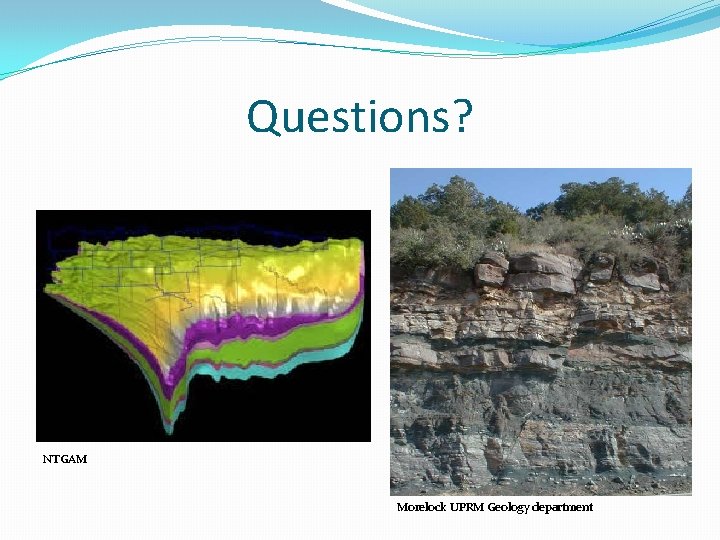
Questions? NTGAM Morelock UPRM Geology department
- Slides: 19