
Designing an Ideal OBOR Curriculum for Law Students
Designing an Ideal OBOR Curriculum for Law Students Larry Catá Backer (白 轲) W. Richard and Mary Eshelman Faculty Scholar Professor of Law and International Affairs Pennsylvania State University | 239 Lewis Katz Building, University Park, PA 16802 Seminar delivered at Henan Normal University 河南师范大学 Law Faculty Xin Xiang, Henan, PRC, April 23, 2018
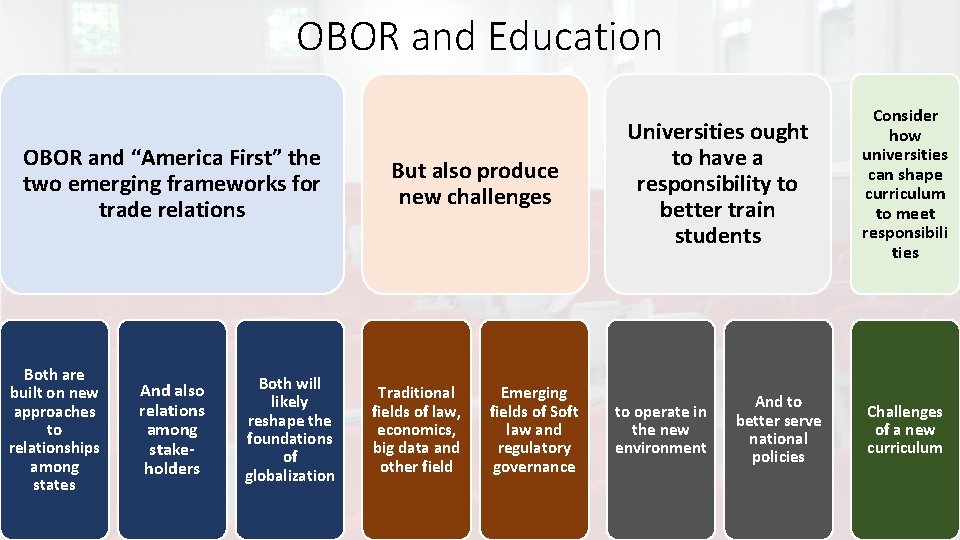
OBOR and Education OBOR and “America First” the two emerging frameworks for trade relations Both are built on new approaches to relationships among states And also relations among stakeholders Both will likely reshape the foundations of globalization But also produce new challenges Traditional fields of law, economics, big data and other field Emerging fields of Soft law and regulatory governance Universities ought to have a responsibility to better train students to operate in the new environment And to better serve national policies Consider how universities can shape curriculum to meet responsibili ties Challenges of a new curriculum
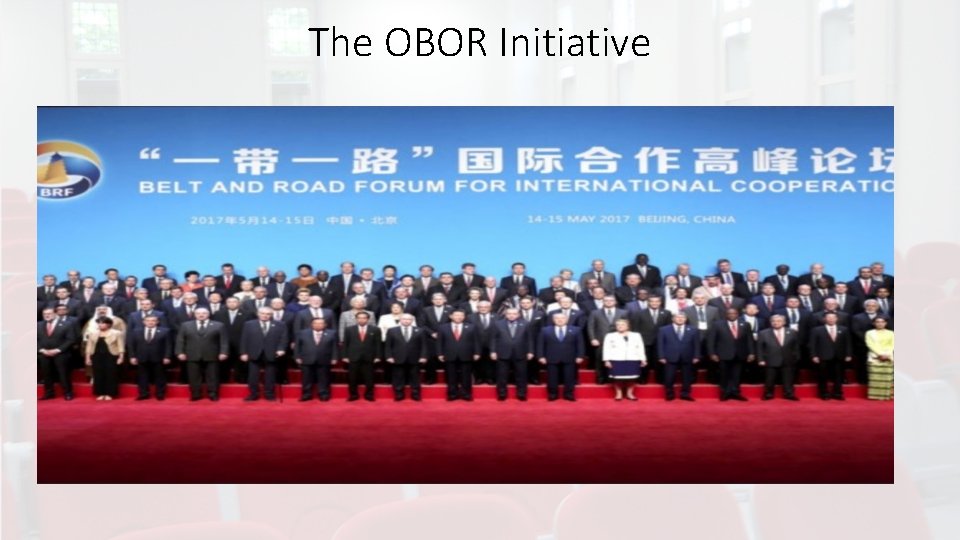
The OBOR Initiative
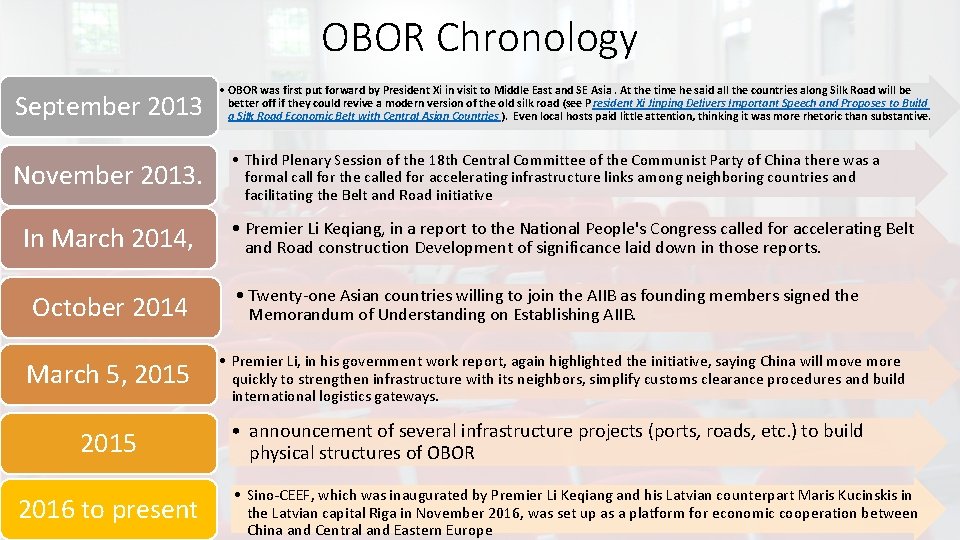
OBOR Chronology September 2013 November 2013. In March 2014, October 2014 March 5, 2015 2016 to present • OBOR was first put forward by President Xi in visit to Middle East and SE Asia. At the time he said all the countries along Silk Road will be better off if they could revive a modern version of the old silk road (see President Xi Jinping Delivers Important Speech and Proposes to Build a Silk Road Economic Belt with Central Asian Countries ). Even local hosts paid little attention, thinking it was more rhetoric than substantive. • Third Plenary Session of the 18 th Central Committee of the Communist Party of China there was a formal call for the called for accelerating infrastructure links among neighboring countries and facilitating the Belt and Road initiative • Premier Li Keqiang, in a report to the National People's Congress called for accelerating Belt and Road construction Development of significance laid down in those reports. • Twenty-one Asian countries willing to join the AIIB as founding members signed the Memorandum of Understanding on Establishing AIIB. • Premier Li, in his government work report, again highlighted the initiative, saying China will move more quickly to strengthen infrastructure with its neighbors, simplify customs clearance procedures and build international logistics gateways. • announcement of several infrastructure projects (ports, roads, etc. ) to build physical structures of OBOR • Sino-CEEF, which was inaugurated by Premier Li Keqiang and his Latvian counterpart Maris Kucinskis in the Latvian capital Riga in November 2016, was set up as a platform for economic cooperation between China and Central and Eastern Europe
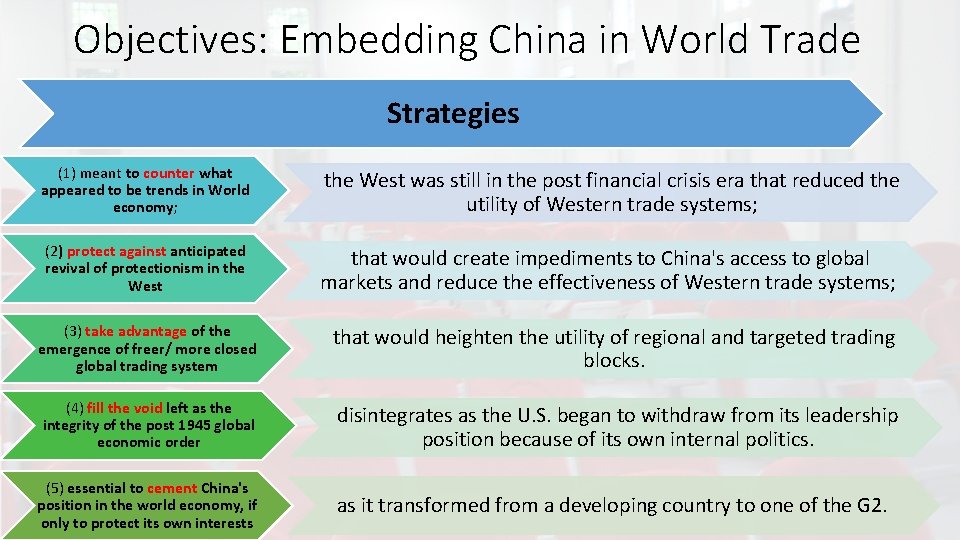
Objectives: Embedding China in World Trade Strategies (1) meant to counter what appeared to be trends in World economy; the West was still in the post financial crisis era that reduced the utility of Western trade systems; (2) protect against anticipated revival of protectionism in the West that would create impediments to China's access to global markets and reduce the effectiveness of Western trade systems; (3) take advantage of the emergence of freer/ more closed global trading system that would heighten the utility of regional and targeted trading blocks. (4) fill the void left as the integrity of the post 1945 global economic order disintegrates as the U. S. began to withdraw from its leadership position because of its own internal politics. (5) essential to cement China's position in the world economy, if only to protect its own interests as it transformed from a developing country to one of the G 2.
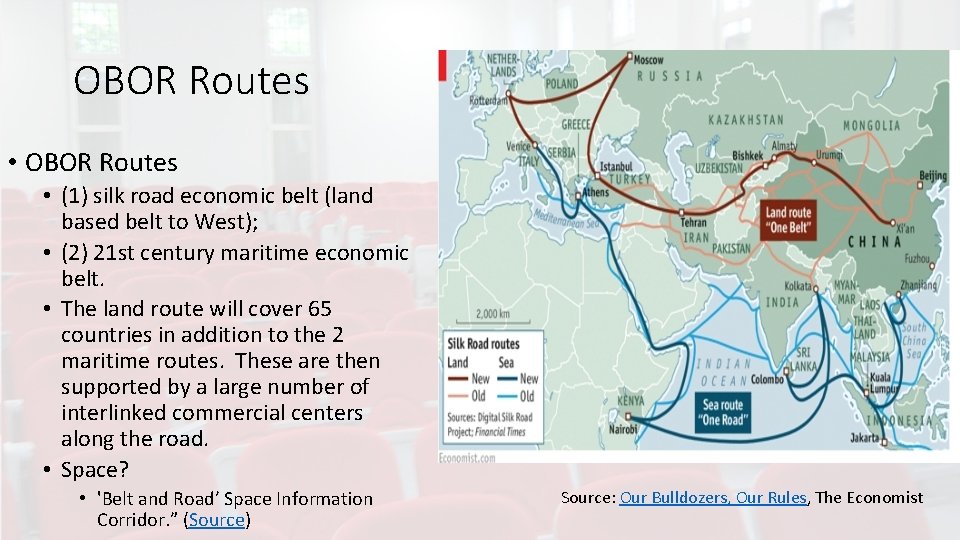
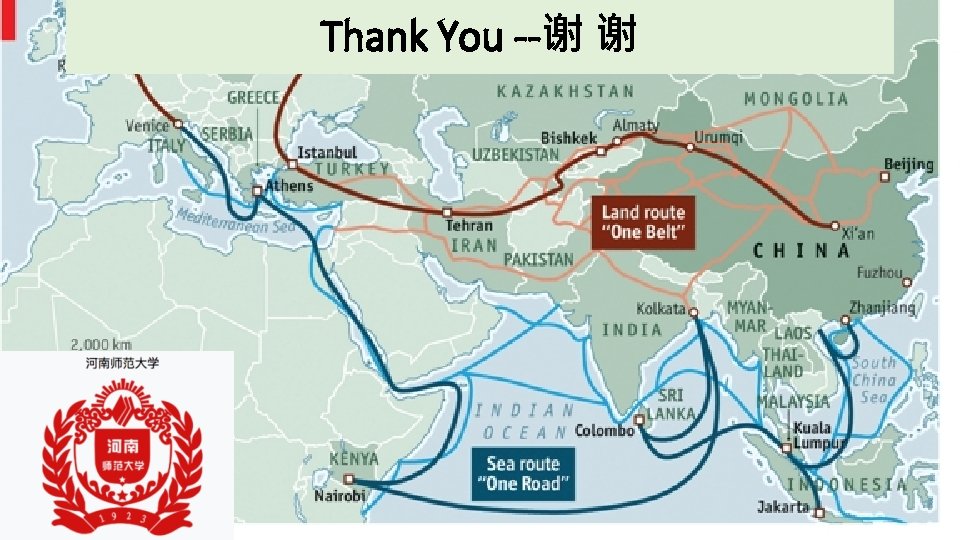
OBOR Routes • (1) silk road economic belt (land based belt to West); • (2) 21 st century maritime economic belt. • The land route will cover 65 countries in addition to the 2 maritime routes. These are then supported by a large number of interlinked commercial centers along the road. • Space? • 'Belt and Road’ Space Information Corridor. ” (Source) Source: Our Bulldozers, Our Rules, The Economist
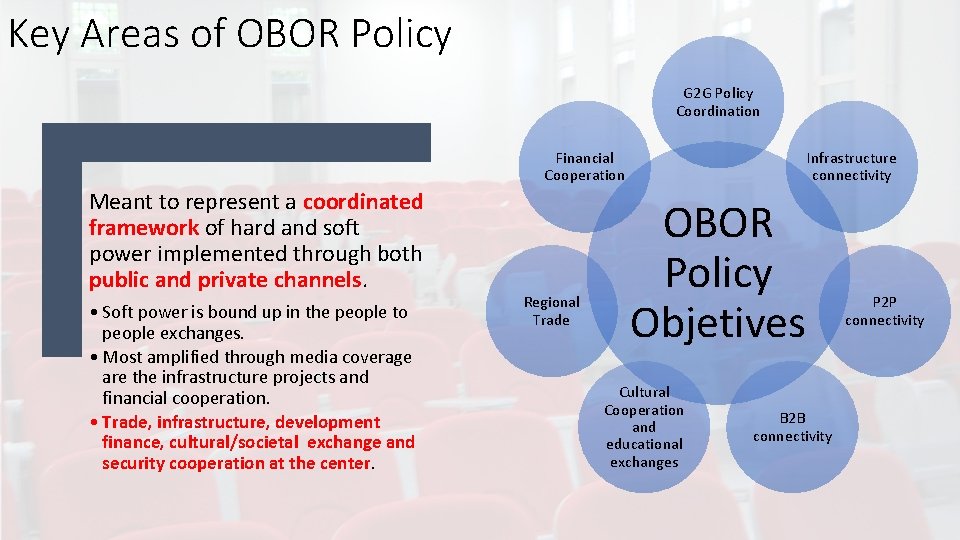
Key Areas of OBOR Policy G 2 G Policy Coordination Financial Cooperation Meant to represent a coordinated framework of hard and soft power implemented through both public and private channels. • Soft power is bound up in the people to people exchanges. • Most amplified through media coverage are the infrastructure projects and financial cooperation. • Trade, infrastructure, development finance, cultural/societal exchange and security cooperation at the center. Regional Trade Infrastructure connectivity OBOR Policy Objetives Cultural Cooperation and educational exchanges B 2 B connectivity P 2 P connectivity
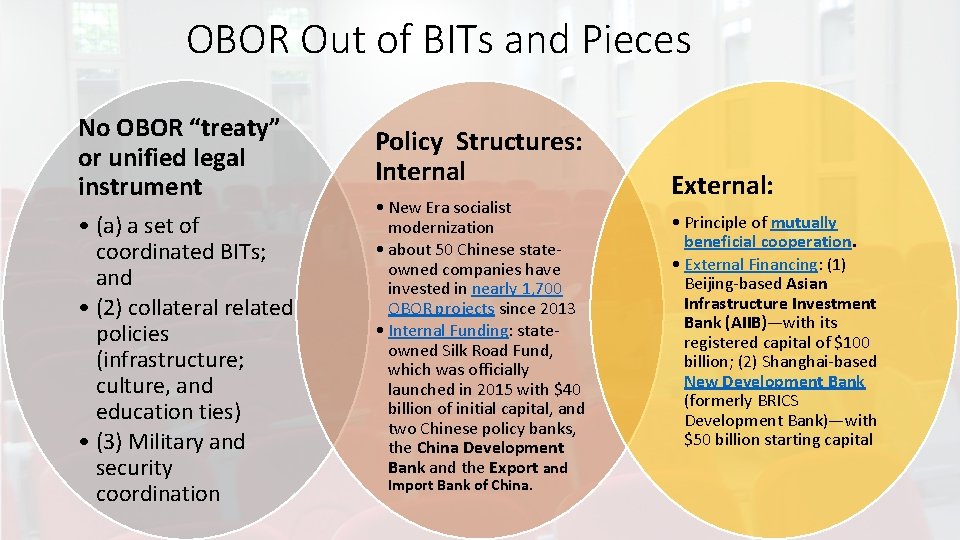
OBOR Out of BITs and Pieces No OBOR “treaty” or unified legal instrument • (a) a set of coordinated BITs; and • (2) collateral related policies (infrastructure; culture, and education ties) • (3) Military and security coordination Policy Structures: Internal • New Era socialist modernization • about 50 Chinese stateowned companies have invested in nearly 1, 700 OBOR projects since 2013 • Internal Funding: stateowned Silk Road Fund, which was officially launched in 2015 with $40 billion of initial capital, and two Chinese policy banks, the China Development Bank and the Export and Import Bank of China. External: • Principle of mutually beneficial cooperation. • External Financing: (1) Beijing-based Asian Infrastructure Investment Bank (AIIB)—with its registered capital of $100 billion; (2) Shanghai-based New Development Bank (formerly BRICS Development Bank)—with $50 billion starting capital
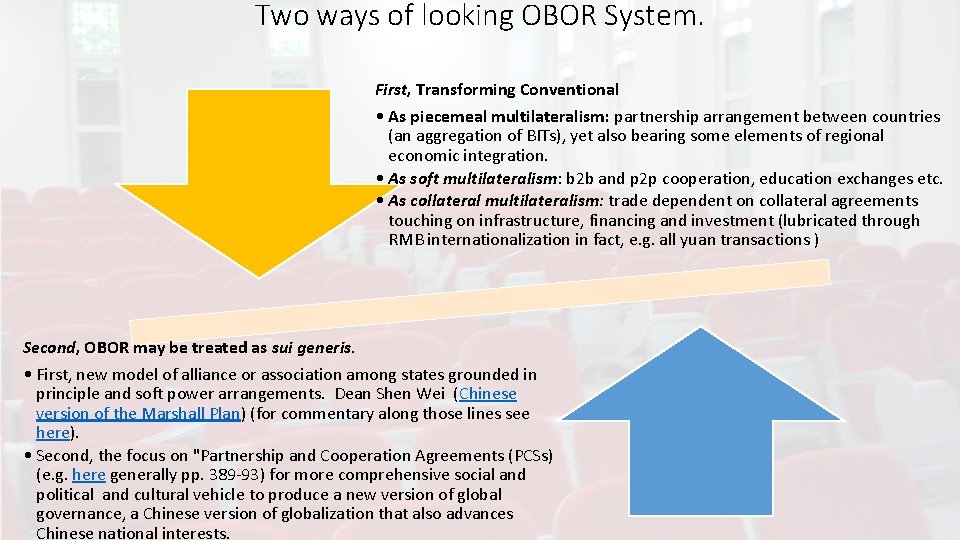
Two ways of looking OBOR System. First, Transforming Conventional • As piecemeal multilateralism: partnership arrangement between countries (an aggregation of BITs), yet also bearing some elements of regional economic integration. • As soft multilateralism: b 2 b and p 2 p cooperation, education exchanges etc. • As collateral multilateralism: trade dependent on collateral agreements touching on infrastructure, financing and investment (lubricated through RMB internationalization in fact, e. g. all yuan transactions ) Second, OBOR may be treated as sui generis. • First, new model of alliance or association among states grounded in principle and soft power arrangements. Dean Shen Wei (Chinese version of the Marshall Plan) (for commentary along those lines see here). • Second, the focus on "Partnership and Cooperation Agreements (PCSs) (e. g. here generally pp. 389 -93) for more comprehensive social and political and cultural vehicle to produce a new version of global governance, a Chinese version of globalization that also advances Chinese national interests.
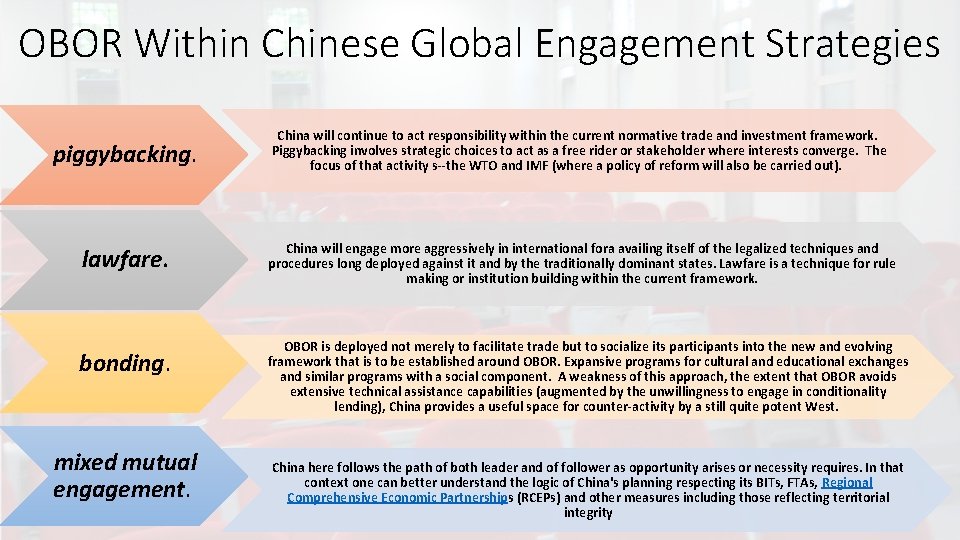
OBOR Within Chinese Global Engagement Strategies piggybacking. China will continue to act responsibility within the current normative trade and investment framework. Piggybacking involves strategic choices to act as a free rider or stakeholder where interests converge. The focus of that activity s--the WTO and IMF (where a policy of reform will also be carried out). lawfare. China will engage more aggressively in international fora availing itself of the legalized techniques and procedures long deployed against it and by the traditionally dominant states. Lawfare is a technique for rule making or institution building within the current framework. bonding. mixed mutual engagement. OBOR is deployed not merely to facilitate trade but to socialize its participants into the new and evolving framework that is to be established around OBOR. Expansive programs for cultural and educational exchanges and similar programs with a social component. A weakness of this approach, the extent that OBOR avoids extensive technical assistance capabilities (augmented by the unwillingness to engage in conditionality lending), China provides a useful space for counter-activity by a still quite potent West. China here follows the path of both leader and of follower as opportunity arises or necessity requires. In that context one can better understand the logic of China's planning respecting its BITs, FTAs, Regional Comprehensive Economic Partnerships (RCEPs) and other measures including those reflecting territorial integrity
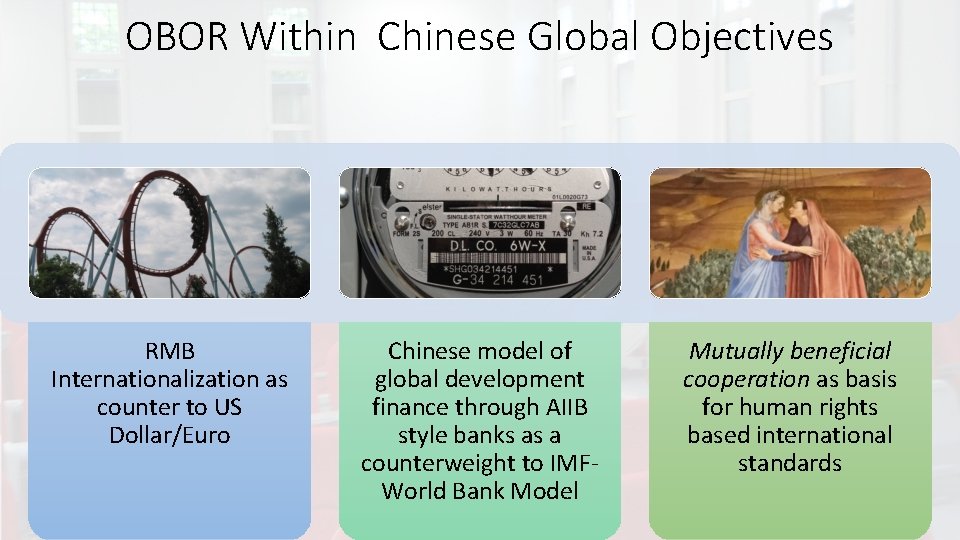
OBOR Within Chinese Global Objectives RMB Internationalization as counter to US Dollar/Euro Chinese model of global development finance through AIIB style banks as a counterweight to IMFWorld Bank Model Mutually beneficial cooperation as basis for human rights based international standards
What Can Universities Contribute? Knowledge Production Analysis Data Analytics Preparing Students for Effective Participation
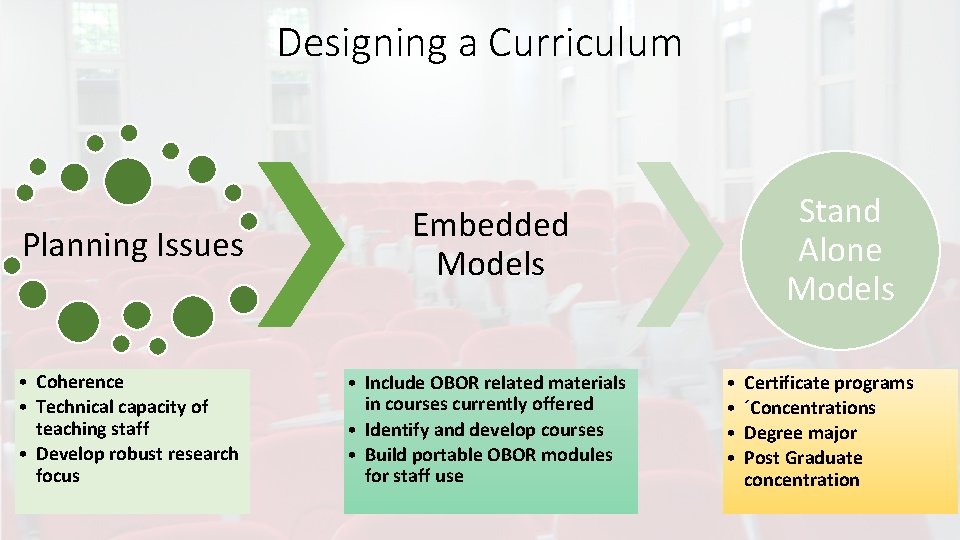
Designing a Curriculum Planning Issues Embedded Models • Coherence • Technical capacity of teaching staff • Develop robust research focus • Include OBOR related materials in courses currently offered • Identify and develop courses • Build portable OBOR modules for staff use Stand Alone Models • • Certificate programs ´Concentrations Degree major Post Graduate concentration
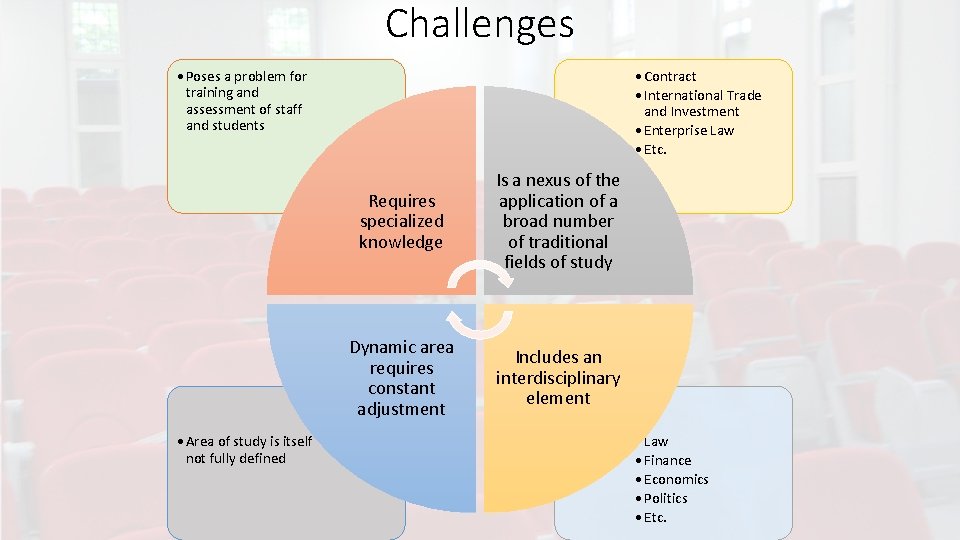
Challenges • Poses a problem for training and assessment of staff and students • Area of study is itself not fully defined • Contract • International Trade and Investment • Enterprise Law • Etc. Requires specialized knowledge Is a nexus of the application of a broad number of traditional fields of study Dynamic area requires constant adjustment Includes an interdisciplinary element • Law • Finance • Economics • Politics • Etc.
Thank You --谢 谢
- Slides: 15