
Designing an Accountability System for Higher Education in

Designing an Accountability System for Higher Education in Massachusetts Department of Higher Education Boston, Massachusetts June 19, 2018 National Center for Higher Education Management Systems nchems. org higheredinfo. org
Why is the Performance Measurement Project Important? • Ensuring that the goals of the board and other stakeholders are being addressed. • Designing relevant and effective strategic plans and policy implementations. • Monitoring institutional effectiveness and quality (especially during difficult times for many higher education institutions). • Reinforcing the critical roles and responsibilities of state higher education executive offices. 2
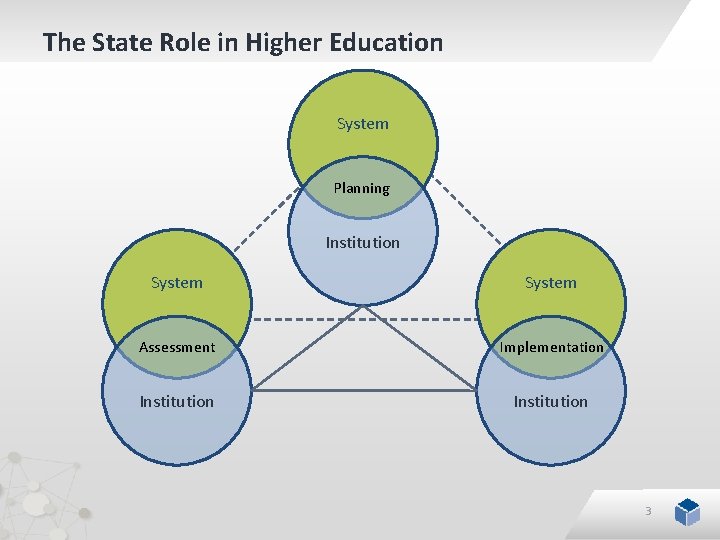
The State Role in Higher Education System Planning Institution System Assessment Implementation Institution 3
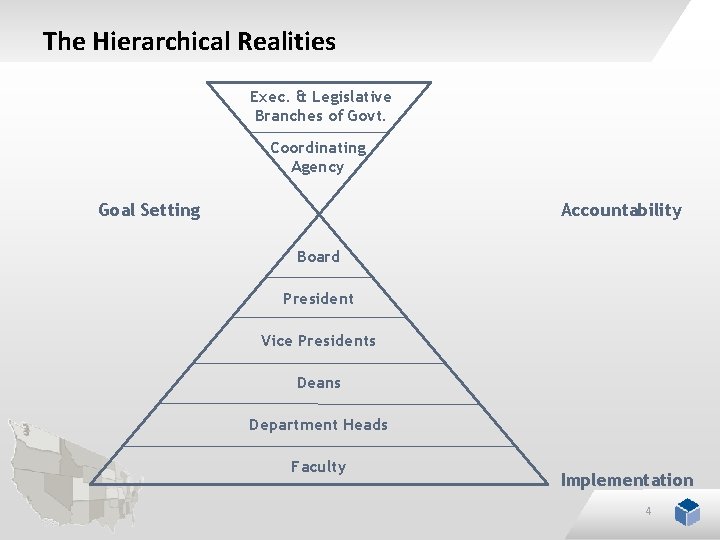
The Hierarchical Realities Exec. & Legislative Branches of Govt. Coordinating Agency Goal Setting Accountability Board President Vice Presidents Deans Department Heads Faculty Implementation 4
What are the Characteristics of a Good Accountability System? • Includes a broad array of important state and institutional performance factors: access, success, affordability, fiscal health, etc. • Institution-level goals and benchmarks • Coordinated with strategic planning and policy making Example of a Good Accountability System: Tennessee Higher Education Commission • • • Goals that are recognized by all policymakers Metrics and benchmarks that drive effective policy implementation Thoughtful alignment with performance funding and other decisionmaking 5
What are Good Accountability System Metrics • Metrics are – Valid – they offer a true indication of the concept in question – “Face” valid – users believe the metric reflects the concept – Reliable – they are replicable – different analysts’ calculations yield the same value – Feasible – the data needed to construct the metrics are obtainable • Metrics have a basis for interpretation – performance vis-à-vis – Target or goal – High performing peers 6
Good Accountability Systems Require Good Data Systems • Well developed student unit-record databases that allow monitoring progress • Thoughtful uniform definitions of variables • Reliable Longitudinal data for trend analyses • Data regarding the performance of carefully selected peers • Robust and easily accessible data exploration and visualization applications 7
Good Accountability Systems Also require a Leadership & Oversight Capacity - The Importance of “Systemness” • Benefits of a cohesive system of higher education – – – Promotes a consistent focus on goals Increased collaboration Enhanced student success Improved transfer & articulation Improved fiscal efficiencies • Approaches to ensuring a cohesive system of higher education – Strong Governing Board – Coordinating Board with strong planning, resource allocation, and accountability authority. 8
Massachusetts is on the Right Track for Building a Strong Accountability System • 1 st time in 9 years fulfilling the DHE role and mandate to publically report institution-level analyses • Emphasis on newly developed metrics, especially with regard to student success and workforce outcomes • New focus on enhanced benchmarks, including comparisons with similarly-situated peer institutions • Using sophisticated analytic and visualization tools to foster a system-wide community of researchers and analysts 9

For More Information Contact: Dennis Jones National Center for Higher Education Management Systems dennis@nchems. org 303 -497 -0301
Institutional Viability • Operating revenues exceed expenses • Status of financial reserves • Coverage of debt – unrestricted net assets in relationship to debt 11
Maintaining Assets – Attending to the Balance Sheet • • Building/physical plant Equipment/technology Programs Human assets – faculty and staff Financial assets Students Intangible assets (image/reputation) 12
Utilization of Assets - Productivity • Overall – Expenditures per degree awarded – benchmarked to peers • Separate metrics for different productive assets (personnel, programs, etc. ) – Also benchmarked to peers – More appropriate for institutional leaders than Board members (these measure “hows”) 13
- Slides: 13