
Designing a Rotating Vessel For Production of 3
![Designing a Rotating Vessel For Production of 3 -D Cardiac Tissue [Roli Kumar] [Advisors:](https://slidetodoc.com/presentation_image_h2/de48a4e9455831e52149ff7fb33b89d3/image-1.jpg "Designing a Rotating Vessel For Production of 3 -D Cardiac Tissue [Roli Kumar] [Advisors:")
- Slides: 13
Designing a Rotating Vessel For Production of 3 -D Cardiac Tissue [Roli Kumar] [Advisors: Dr. Joey Barnett] 10/22/2021
Overview l Importance of designing and building a rotating vessel l objectives l Protocol for Cell Dissociation l Design (Building + Testing) l Results 10/22/2021
Background: Importance of 3 -D Tissue l Replacement of damaged heart tissue caused by – disease • myocardial infarction (heart attack) – surgical procedures – radiational procedures l Research – a new route to drug delivery 10/22/2021
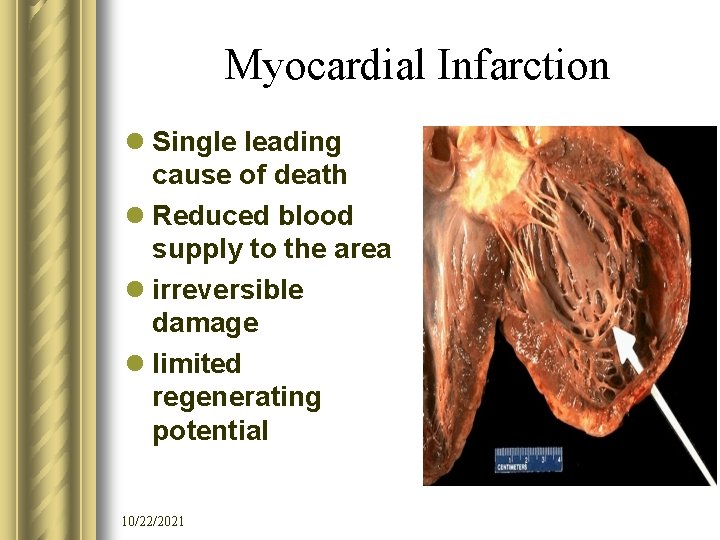
Myocardial Infarction l Single leading cause of death l Reduced blood supply to the area l irreversible damage l limited regenerating potential 10/22/2021
Objectives l Place cardiomyocytes in a rotating vessel and the cells should adhere to the walls. l The cells should divide and become confluent. l With continuous rotation the cells should adhere on top of another l Therefore formation of 3 -D tissue and they will connect and beat. 10/22/2021
Tasks l 1. Develop a protocol for dissociation of cardiomyocytes (CMC) l 2. Design and test the rotating vessel l 3. Display results with photographs 10/22/2021
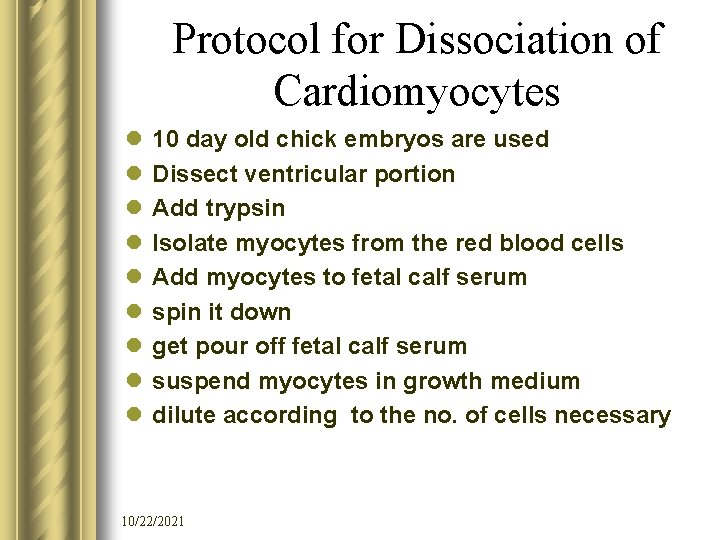
Protocol for Dissociation of Cardiomyocytes l l l l l 10 day old chick embryos are used Dissect ventricular portion Add trypsin Isolate myocytes from the red blood cells Add myocytes to fetal calf serum spin it down get pour off fetal calf serum suspend myocytes in growth medium dilute according to the no. of cells necessary 10/22/2021
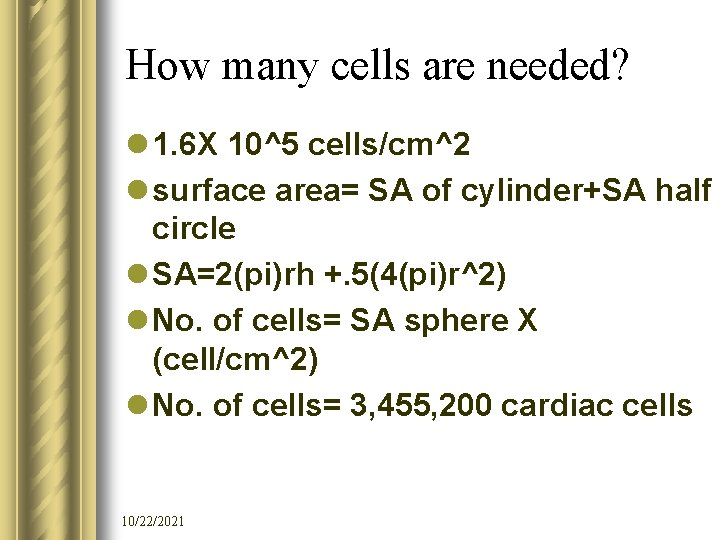
How many cells are needed? l 1. 6 X 10^5 cells/cm^2 l surface area= SA of cylinder+SA half circle l SA=2(pi)rh +. 5(4(pi)r^2) l No. of cells= SA sphere X (cell/cm^2) l No. of cells= 3, 455, 200 cardiac cells 10/22/2021
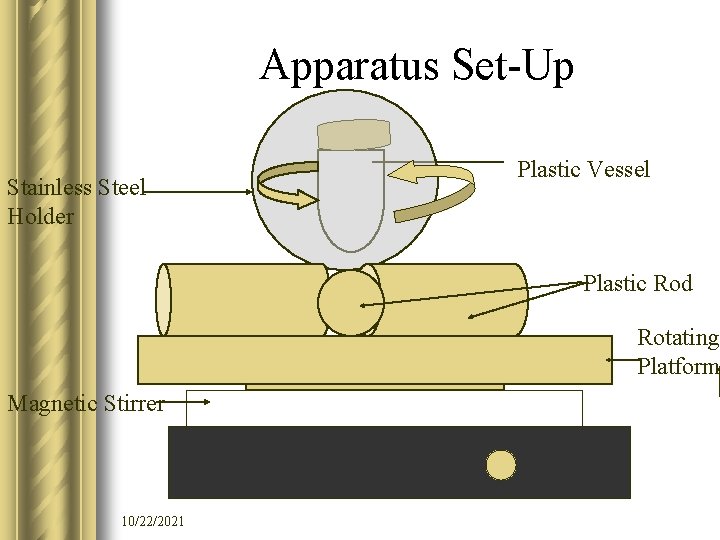
Apparatus Set-Up Stainless Steel Holder Plastic Vessel Plastic Rod Rotating Platform Magnetic Stirrer 10/22/2021
Design Specifications (Needs) l End-over end mixing – measurements at various speeds – problem: too fast, too slow l Solid body rotation – suspending cells in a liquid medium – proper cell to growth medium ratio l Aeration – medium usually contain bicarbonate – Problem: CO 2 is produced in a closed container 10/22/2021
Design Specifications (Actual) l End over end mixing – Rotational speeds 100 rotations per minute l Solid Body Rotation – A ratio of 3 X 10^5 cell/ml – Container holds 10 ml l Aeration – A Hepes buffer was used 10/22/2021
Results l Visually see the difference between the monolayer growth in a plate and 3 -D growth in a rotating vessel l Pictures were taken of the monolayer growth after day 1 and day 5 l Pictures have been taken after day 1 to show that the myocytes adhered to the wall. 10/22/2021
Current & Future Work l Finding how long cells grow in Hepes buffer? l Continuously rotate until multiple layers adhere to the wall and one and another l Take Pictures of 3 -D tissue 10/22/2021