
Designing a research question and Matching the study
- Slides: 31
Designing a research question and Matching the study design to the research question Dr. Rahul Mhaskar Director Office of Research, Innovation and Scholarly Endeavors (RISE) Associate Professor Department of Internal Medicine Morsani College of Medicine University of South Florida
Learning objectives At the end of this session participants will be able to • Evaluate the importance of a specific research question in clinical research and clinical decision making • Describe the framework used to design research questions • Summarize how to match the research question to a study design • Explain the potential biases in key study designs
Learning Environment • Learning format • Interactive (i. e. informal) • Active participation from the participants is highly desired • Questioning/interruption • Expected (there are no stupid questions)
What is a research question? The researcher asks a very specific question and tests a specific hypothesis. Broad questions are usually broken into smaller, testable hypotheses or questions. Often called an objective or aim, though calling it a question tends to help with focusing the hypothesis and thinking about how to find an answer • PICOTS format
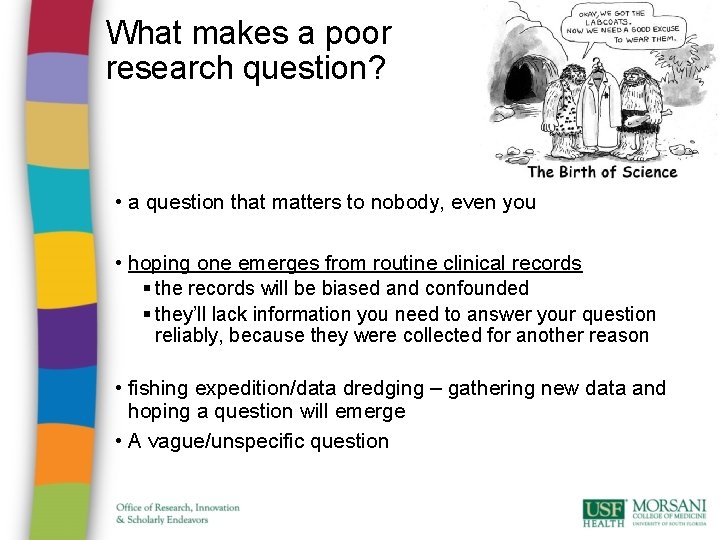
What makes a poor research question? • a question that matters to nobody, even you • hoping one emerges from routine clinical records § the records will be biased and confounded § they’ll lack information you need to answer your question reliably, because they were collected for another reason • fishing expedition/data dredging – gathering new data and hoping a question will emerge • A vague/unspecific question
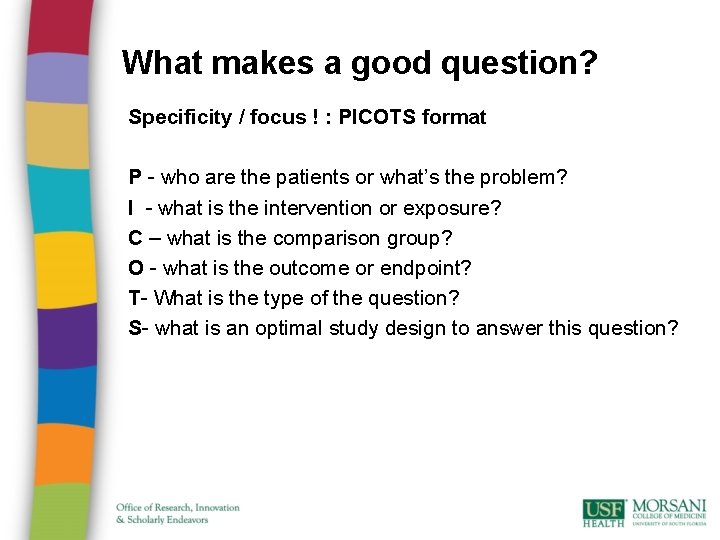
What makes a good question? Specificity / focus ! : PICOTS format P - who are the patients or what’s the problem? I - what is the intervention or exposure? C – what is the comparison group? O - what is the outcome or endpoint? T- What is the type of the question? S- what is an optimal study design to answer this question?
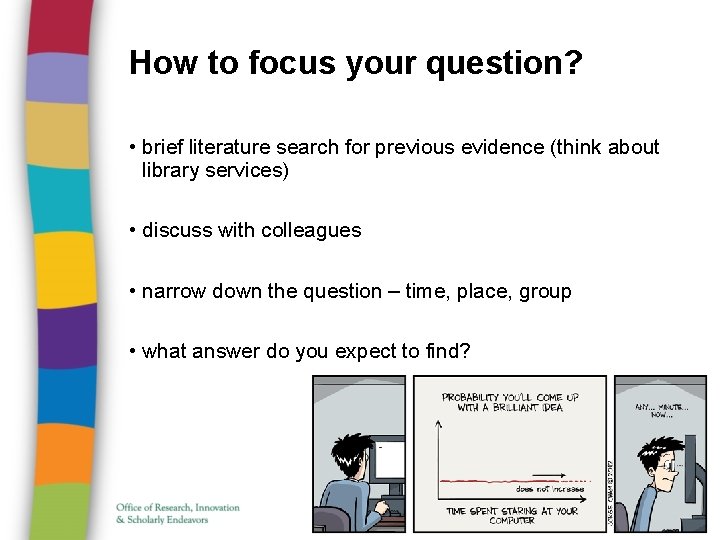
How to focus your question? • brief literature search for previous evidence (think about library services) • discuss with colleagues • narrow down the question – time, place, group • what answer do you expect to find?
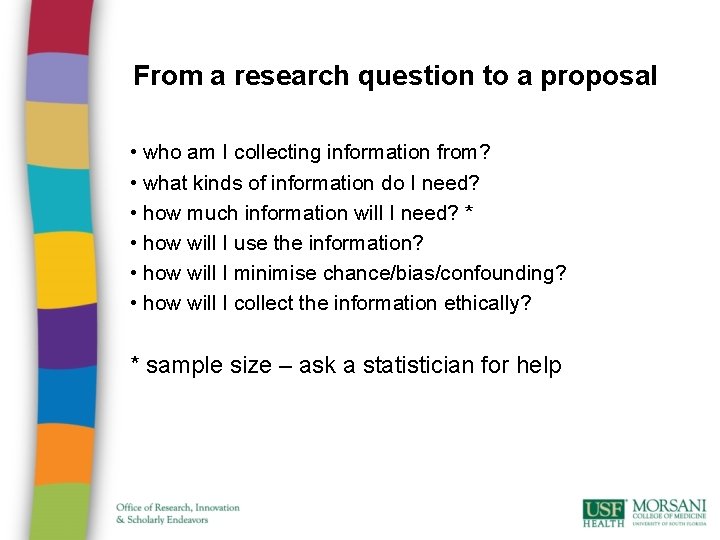
From a research question to a proposal • who am I collecting information from? • what kinds of information do I need? • how much information will I need? * • how will I use the information? • how will I minimise chance/bias/confounding? • how will I collect the information ethically? * sample size – ask a statistician for help
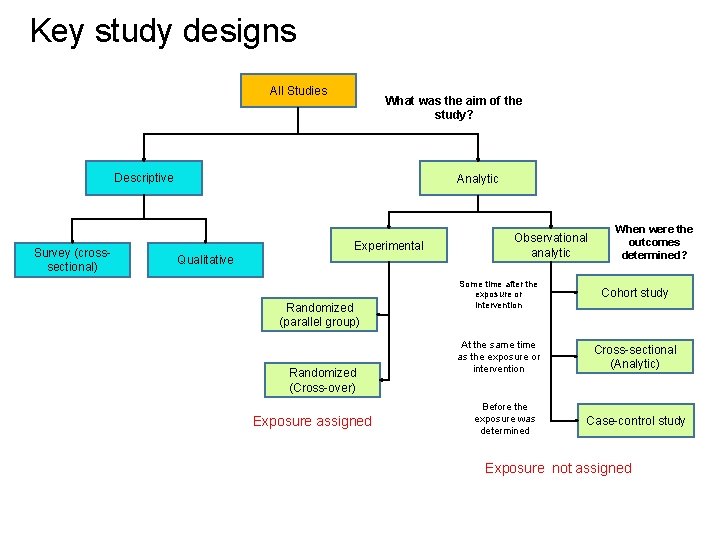
Key study designs All Studies What was the aim of the study? Descriptive Survey (crosssectional) Analytic Experimental Qualitative Randomized (parallel group) Randomized (Cross-over) Exposure assigned Observational analytic When were the outcomes determined? Some time after the exposure or intervention Cohort study At the same time as the exposure or intervention Cross-sectional (Analytic) Before the exposure was determined Case-control study Exposure not assigned
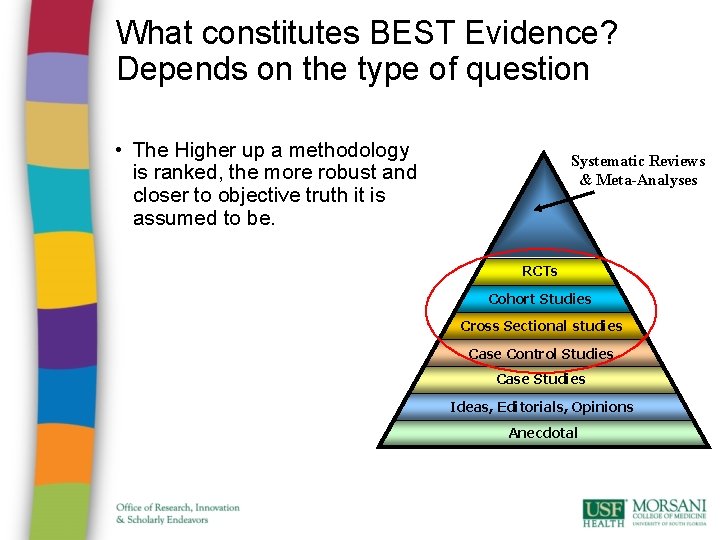
What constitutes BEST Evidence? Depends on the type of question • The Higher up a methodology is ranked, the more robust and closer to objective truth it is assumed to be. Systematic Reviews & Meta-Analyses RCTs Cohort Studies Cross Sectional studies Case Control Studies Case Studies Ideas, Editorials, Opinions Anecdotal
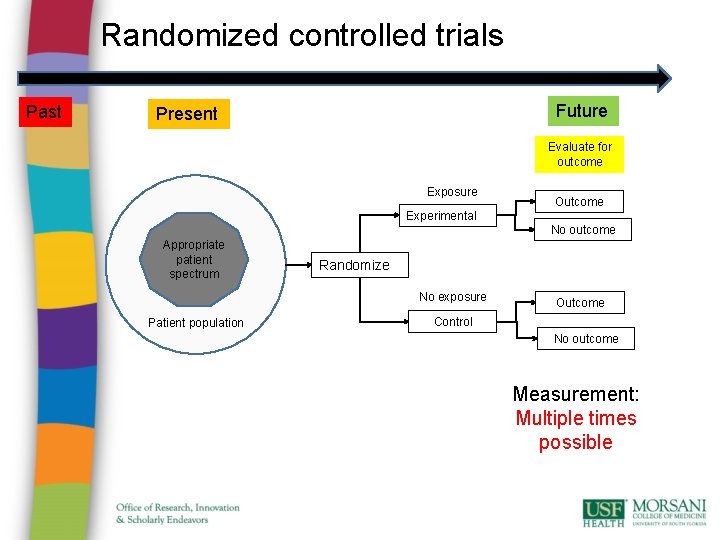
Randomized controlled trials Past Future Present Evaluate for outcome Exposure Outcome Experimental No outcome Appropriate patient spectrum Randomize No exposure Patient population Outcome Control No outcome Measurement: Multiple times possible
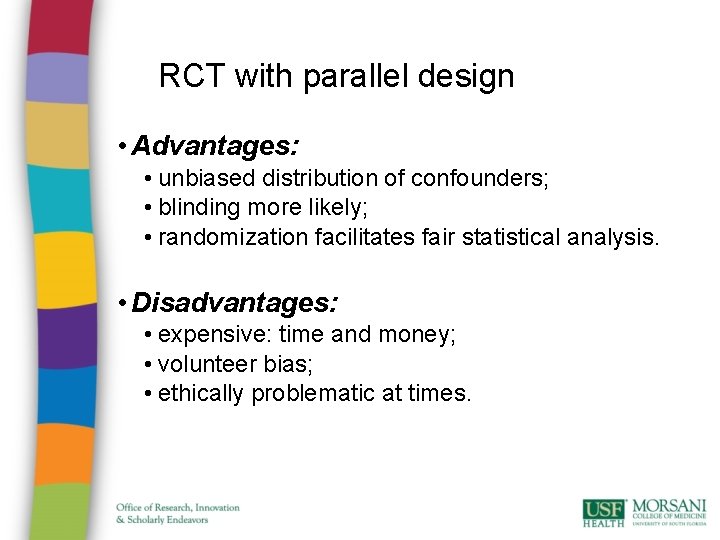
RCT with parallel design • Advantages: • unbiased distribution of confounders; • blinding more likely; • randomization facilitates fair statistical analysis. • Disadvantages: • expensive: time and money; • volunteer bias; • ethically problematic at times.
Cross-over RCT Advantages: • all participants serve as own controls and error variance is reduced, thus reducing sample size needed • all participants receive treatment (at least some of the time) • statistical tests assuming randomisation can be used • blinding can be maintained Disadvantages: • all participants receive placebo or alternative treatment at some point • washout period lengthy or unknown • cannot be used for treatments with permanent effects
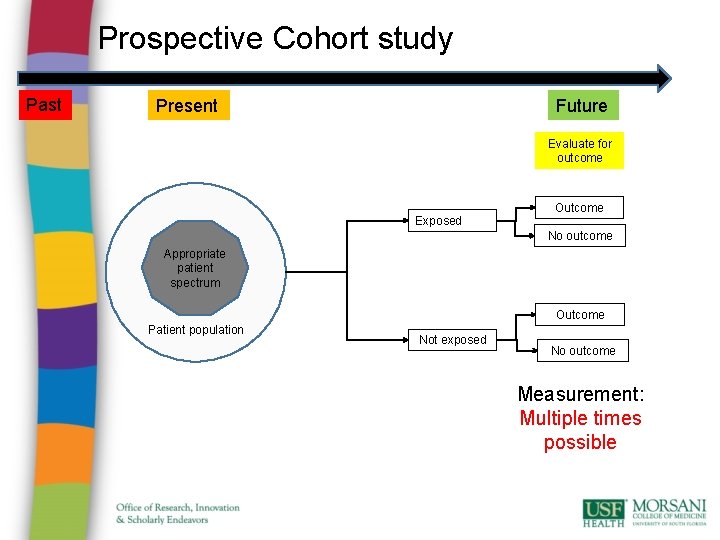
Prospective Cohort study Past Future Present Evaluate for outcome Exposed Outcome No outcome Appropriate patient spectrum Outcome Patient population Not exposed No outcome Measurement: Multiple times possible
Cohort study • Advantages: • ethically safe; • subjects can be matched; • can establish timing and directionality of events; • eligibility criteria and outcome assessments can be standardized; • administratively easier and cheaper than RCT. • Disadvantages: • controls may be difficult to identify; • exposure may be linked to a hidden confounder; • blinding is difficult; • randomization not present; • for rare disease, large sample sizes or long follow-up necessary.
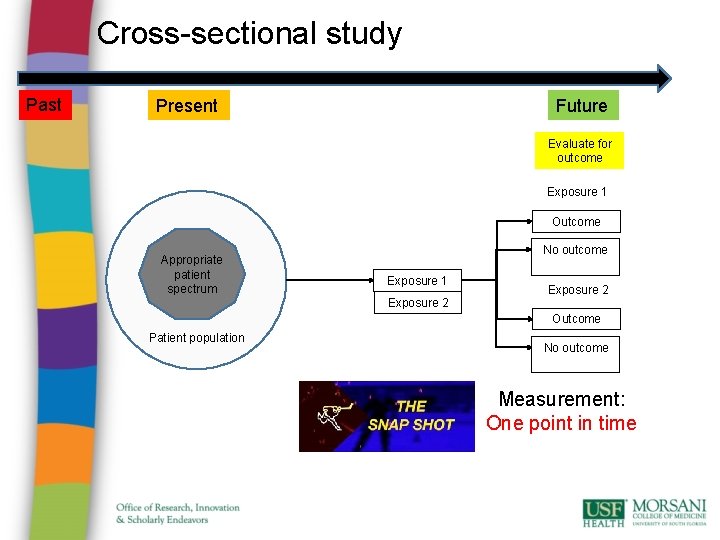
Cross-sectional study Past Future Present Evaluate for outcome Exposure 1 Outcome Appropriate patient spectrum No outcome Exposure 1 Exposure 2 Outcome Patient population No outcome Measurement: One point in time
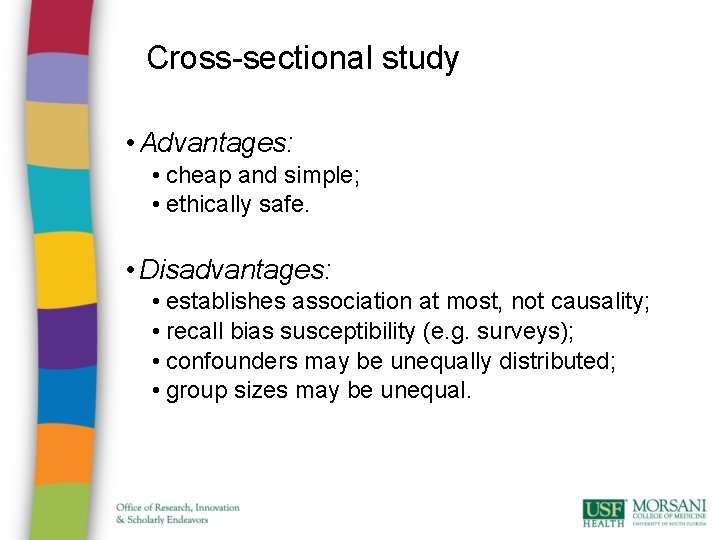
Cross-sectional study • Advantages: • cheap and simple; • ethically safe. • Disadvantages: • establishes association at most, not causality; • recall bias susceptibility (e. g. surveys); • confounders may be unequally distributed; • group sizes may be unequal.
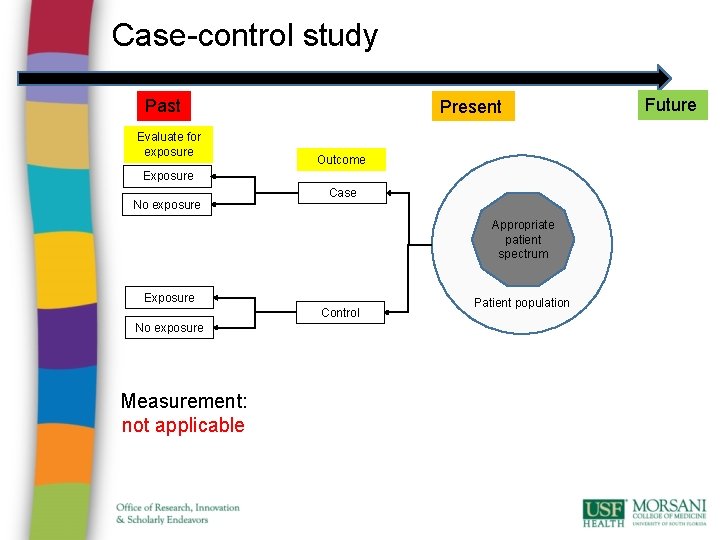
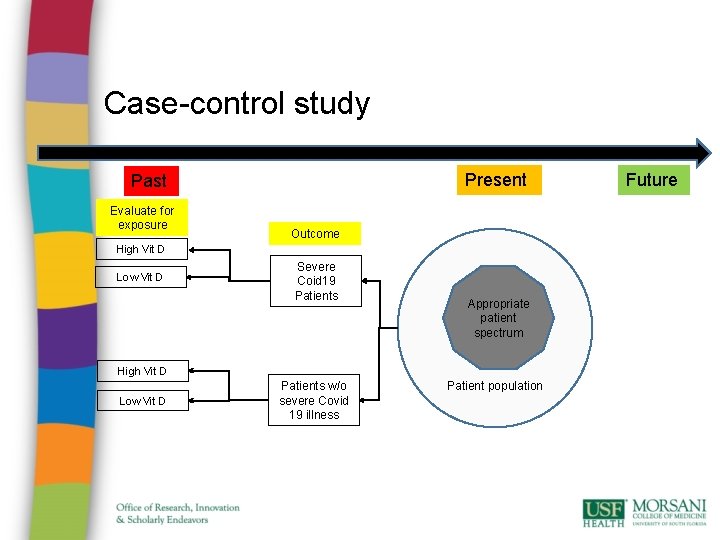
Case-control study Past Evaluate for exposure Present Outcome Exposure No exposure Case Appropriate patient spectrum Exposure Control No exposure Measurement: not applicable Patient population Future
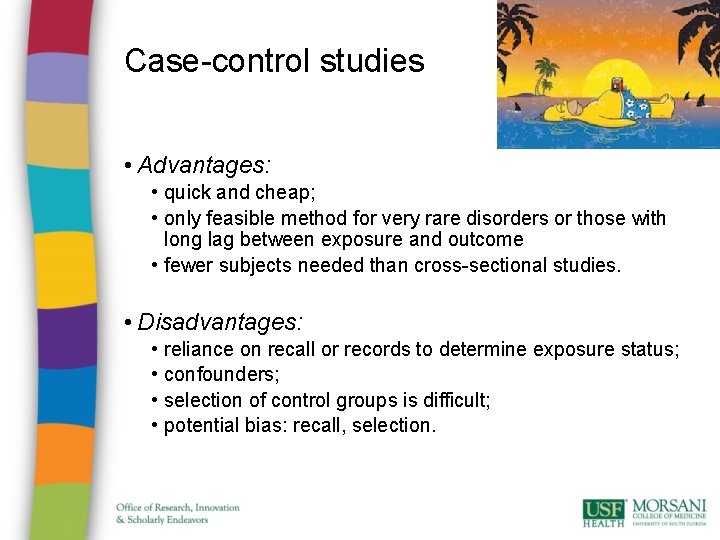
Case-control studies • Advantages: • quick and cheap; • only feasible method for very rare disorders or those with long lag between exposure and outcome • fewer subjects needed than cross-sectional studies. • Disadvantages: • • reliance on recall or records to determine exposure status; confounders; selection of control groups is difficult; potential bias: recall, selection.
• Vitamin D is the key to good health • Be sure to eat Vitamin D fortified foods • Vitamin D–improves the good gut microbiome • Vitamin D–improves overall immune response
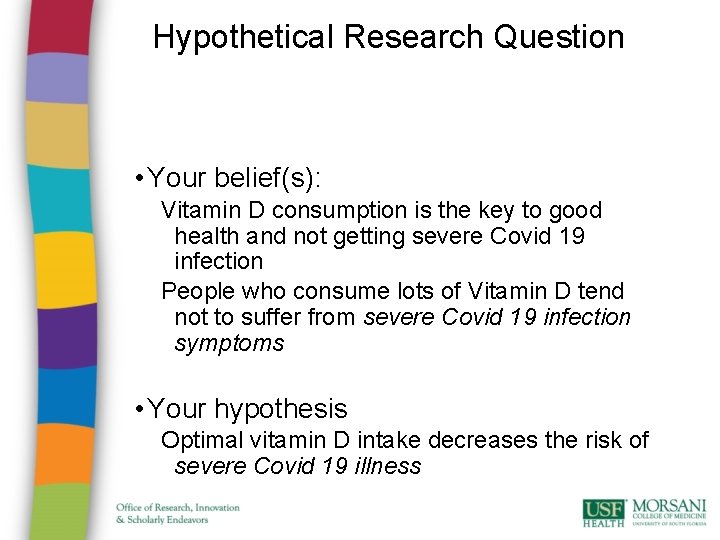
Hypothetical Research Question • Your belief(s): Vitamin D consumption is the key to good health and not getting severe Covid 19 infection People who consume lots of Vitamin D tend not to suffer from severe Covid 19 infection symptoms • Your hypothesis Optimal vitamin D intake decreases the risk of severe Covid 19 illness
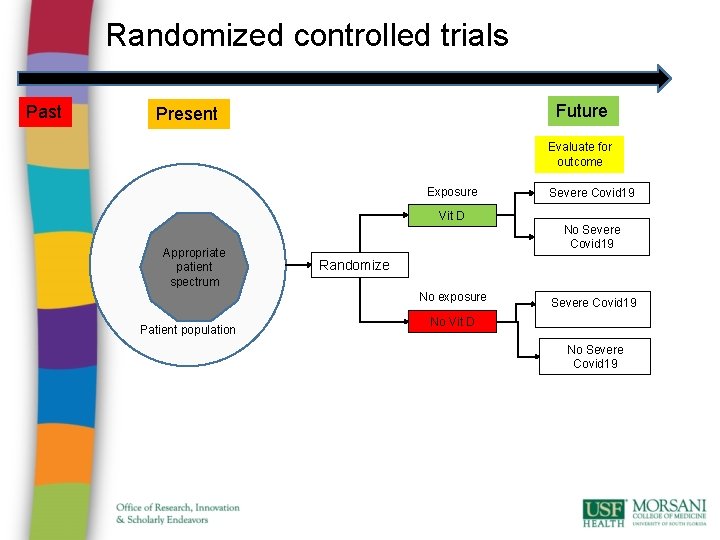
Randomized controlled trials Past Future Present Evaluate for outcome Exposure Severe Covid 19 Vit D Appropriate patient spectrum No Severe Covid 19 Randomize No exposure Patient population Severe Covid 19 No Vit D No Severe Covid 19
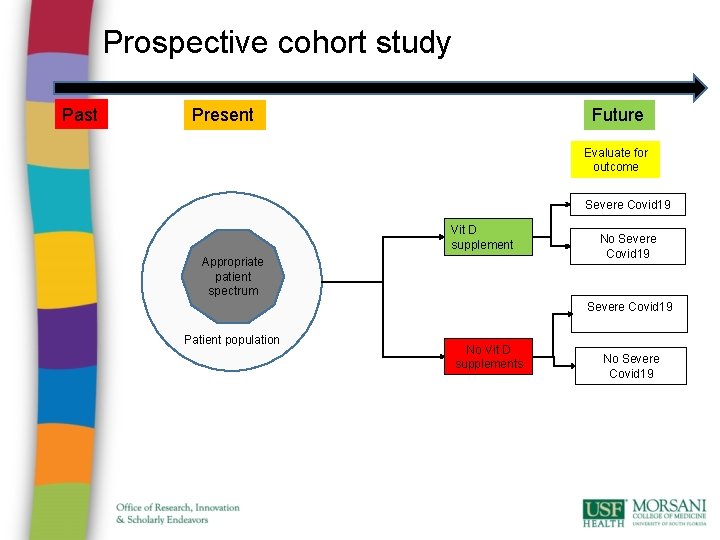
Prospective cohort study Past Future Present Evaluate for outcome Severe Covid 19 Vit D supplement Appropriate patient spectrum No Severe Covid 19 Patient population No Vit D supplements No Severe Covid 19
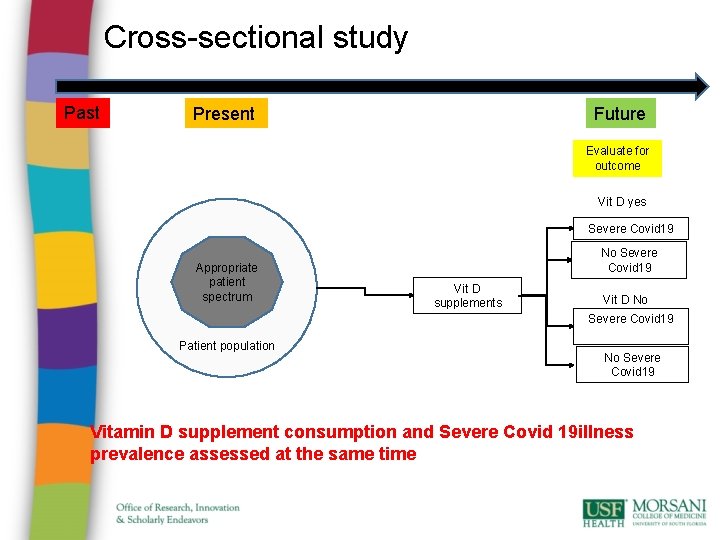
Cross-sectional study Past Future Present Evaluate for outcome Vit D yes Severe Covid 19 Appropriate patient spectrum No Severe Covid 19 Vit D supplements Vit D No Severe Covid 19 Patient population No Severe Covid 19 Vitamin D supplement consumption and Severe Covid 19 illness prevalence assessed at the same time
Case-control study Present Past Evaluate for exposure Outcome High Vit D Low Vit D Severe Coid 19 Patients Appropriate patient spectrum High Vit D Low Vit D Patients w/o severe Covid 19 illness Patient population Future
On morning rounds in the Hem/Onc unit, a first year resident turns to you for consultation. She wants to discuss options for managing moderate nausea and vomiting that result following chemotherapy. She shares an experience a relative had taking ginger when prochlorperazine didn’t provide effective relief and asks for your input. What is your clinical question in PICO format? What type of clinical question is this? What is the best study design to answer this type of clinical question? 1. 2. 3. 4. Case control Cohort Cross-sectional Randomized controlled trial
Traditionally, clinicians have used a conservative approach for the diagnostic evaluation of head-injured infants, arguing that infants are at increased risk of intracranial injury (ICI) and that symptoms or signs of brain injury may not be reliably present in those with ICI. A number of previous studies have reported that a significant fraction of ICIs in infants occur in patients with a normal neurological status and with no signs or symptoms of brain injury. You want to see how well clinical features predict ICI in infants. What is your clinical question in PICO format? What type of clinical question is this? What is the best study design to answer this type of clinical question? 1. 2. 3. 4. Case control Cohort Cross-sectional Randomized controlled trial
You recall a conversation from your medical school days with one of your favorite anatomy professors. The professor observed that most students from his class who were good in anatomy tend to become radiologists. As believer in science you decided to explore if there is any truth to this observation. Which study design is most suited to address the hypothesis that good anatomy students are most likely to become radiologists? 1. 2. 3. 4. Case control Cohort Cross-sectional Randomized controlled trial
A 48 -year-old man presents to the emergency department for severe alcohol abuse with nausea and vomiting. He reports no other significant medical problems. The patient is confused and hepatomegaly is discovered on physical exam. You establish that patient is cirrhotic and most cirrhotic patients develop esophageal varices, with a lifetime incidence as high as 8090%. You decide to send the patient for Esophagogastroduodenoscopy (EGD) which you know is not a very pleasing experience for the patient. You remember that recently a colleague mentioned that why not use capsule endoscopy. You wonder how effective is capsule endoscopy in accurately identifying esophageal varices in cirrhotic patients? In your search for an answer you would attempt to find a study employing which of the following study designs? 1. 2. 3. 4. Case control Cohort Cross-sectional Randomized controlled trial
Following up on our cirrhotic patient the capsule endoscopy reveled acute variceal bleeding. You know that cirrhosis in Child–Pugh class C or those in class B who have persistent bleeding at endoscopy are at high risk for treatment failure and a poor prognosis. You decide to recommend treatment right away with a transjugular intrahepatic portosystemic shunt (TIPS). However a colleague of yours suggests to continue treatment with vasoactive-drug therapy, followed after 3 to 5 days by treatment with propranolol and long-term endoscopic band ligation (EBL), with insertion of a TIPS if needed as rescue therapy only. Which study design is best suited to provide most unbiased answer to the question of immediate versus rescue treatment with TIPS? 1. Case control 2. Cohort 3. Cross-sectional 4. Randomized controlled trial
All the best. . Contact me if you have further questions or need assistance Email: rmhaksar@usf. edu Or Schedule an appointment to see us in the RISE office. https: //usfhealth. az 1. qualtrics. com/jfe/for m/SV_9 Lx. CL 6 t 2 ST 8 SEvj Thank you.