
Designing a Remote Communication System with and for
- Slides: 9
Designing a Remote Communication System with and for Individuals with Cognitive Disabilities and their Caregivers Melissa Dawe Center for Life. Long Learning and Design University of Colorado 22 April 2006 Melissa Dawe, CHI 2006 Workshop 1 of 6
Background: Mobile Communication • Remote communication through mobile devices (such as mobile phones) are changing the way we communicate, plan, and socially interact • Mobile communication has the potential to increase safety, independence, and social connectedness However: • At the UI level: Off-the-shelf mobile phones are not designed with users with cognitive impairments in mind • At the socio-technical level: The way people with cognitive disabilities communicate remotely with caregivers is not well understood 22 April 2006 Melissa Dawe, CHI 2006 Workshop 2 of 6
Research Problem How can we design a remote communication system with and for individuals with cognitive disabilities and their caregivers, in the context of supporting safety, social connectedness, and increased independence? 22 April 2006 Melissa Dawe, CHI 2006 Workshop 3 of 6
Conceptual Framework: Participatory and Meta-Design • Software development is a co-creative process between technologists and end users • Designers can’t predict how the system will be used, and so end users must be empowered to act as designers during use time • Socio-technical systems will and should evolve over time 22 April 2006 Melissa Dawe, CHI 2006 Workshop 4 of 6
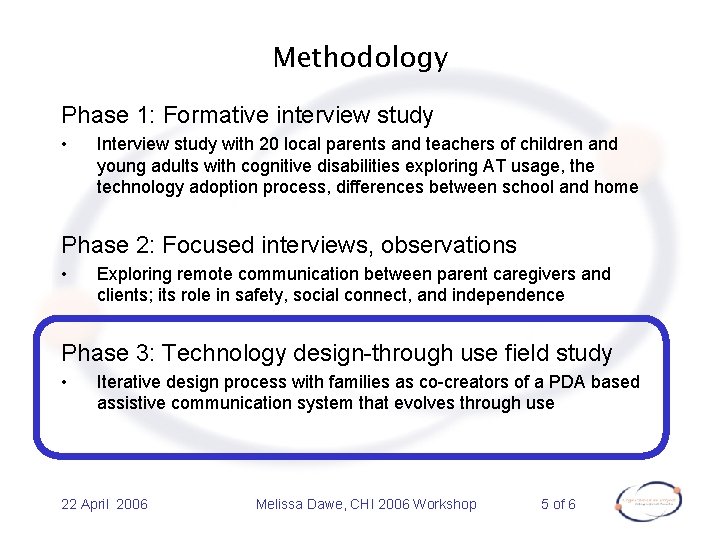
Methodology Phase 1: Formative interview study • Interview study with 20 local parents and teachers of children and young adults with cognitive disabilities exploring AT usage, the technology adoption process, differences between school and home Phase 2: Focused interviews, observations • Exploring remote communication between parent caregivers and clients; its role in safety, social connect, and independence Phase 3: Technology design-through use field study • Iterative design process with families as co-creators of a PDA based assistive communication system that evolves through use 22 April 2006 Melissa Dawe, CHI 2006 Workshop 5 of 6
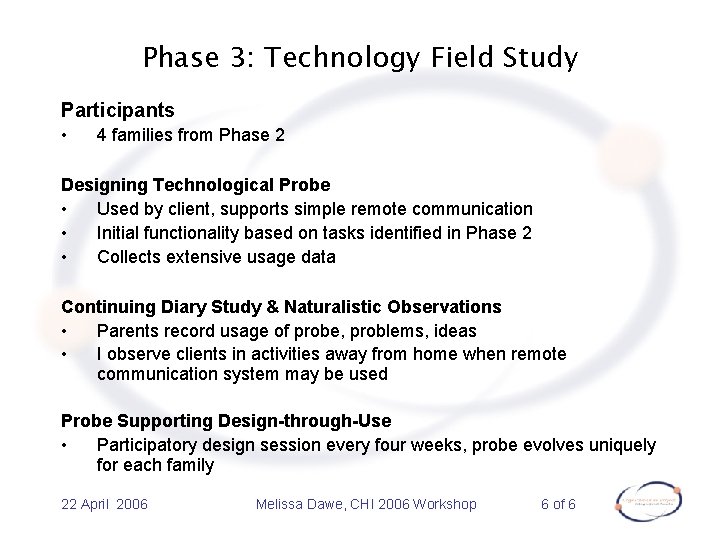
Phase 3: Technology Field Study Participants • 4 families from Phase 2 Designing Technological Probe • Used by client, supports simple remote communication • Initial functionality based on tasks identified in Phase 2 • Collects extensive usage data Continuing Diary Study & Naturalistic Observations • Parents record usage of probe, problems, ideas • I observe clients in activities away from home when remote communication system may be used Probe Supporting Design-through-Use • Participatory design session every four weeks, probe evolves uniquely for each family 22 April 2006 Melissa Dawe, CHI 2006 Workshop 6 of 6
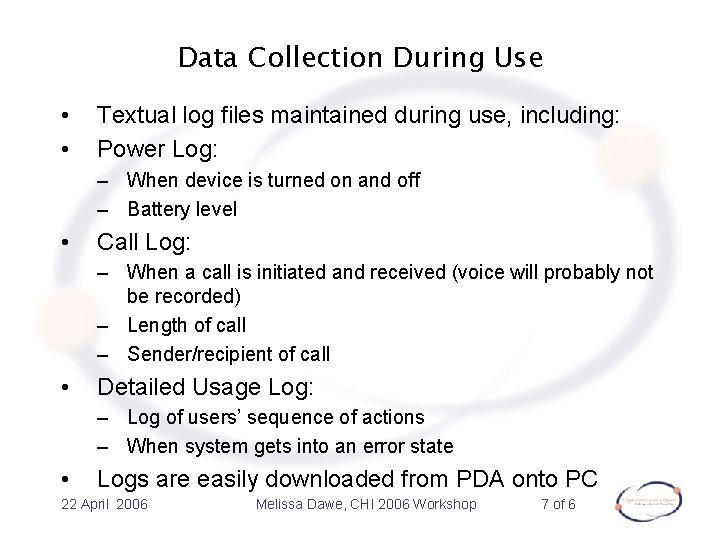
Data Collection During Use • • Textual log files maintained during use, including: Power Log: – When device is turned on and off – Battery level • Call Log: – When a call is initiated and received (voice will probably not be recorded) – Length of call – Sender/recipient of call • Detailed Usage Log: – Log of users’ sequence of actions – When system gets into an error state • Logs are easily downloaded from PDA onto PC 22 April 2006 Melissa Dawe, CHI 2006 Workshop 7 of 6
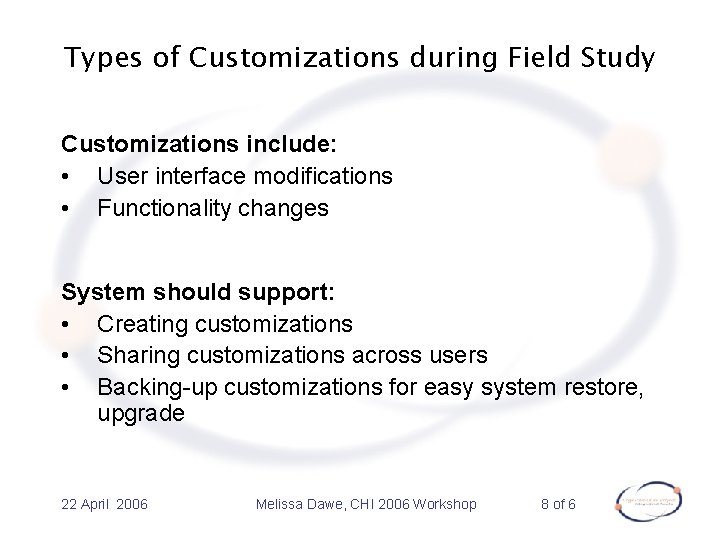
Types of Customizations during Field Study Customizations include: • User interface modifications • Functionality changes System should support: • Creating customizations • Sharing customizations across users • Backing-up customizations for easy system restore, upgrade 22 April 2006 Melissa Dawe, CHI 2006 Workshop 8 of 6
Expected Outcomes and Contributions Design • The interviews and design-in-use field-study will inform user interface guidelines as well as design methods for building assistive technology on mobile devices for people with cognitive disabilities System development • This research advances our theoretical and practical understanding of meta-design by designing, building, and evaluating a system architecture to support the meta-design principles of end-user system modification at use time through customization and sharing Theoretical contributions grounded in empirical research • • The role of mobile communication in independence and safety between parental caregivers and their children; The technology adoption process for individuals with cognitive disabilities, and the role of the caregiver network 22 April 2006 Melissa Dawe, CHI 2006 Workshop 9 of 6