
Designing a Controlled Experiment Fill out the Designing
- Slides: 10
Designing a Controlled Experiment Fill out the “Designing a Controlled Experiment” note worksheet as you go through this power point 1) Read the introduction 2) Fill in the Scientific Process Skills using the reading 3) Complete the flow chart on page 2 using the reading and your background knowledge.
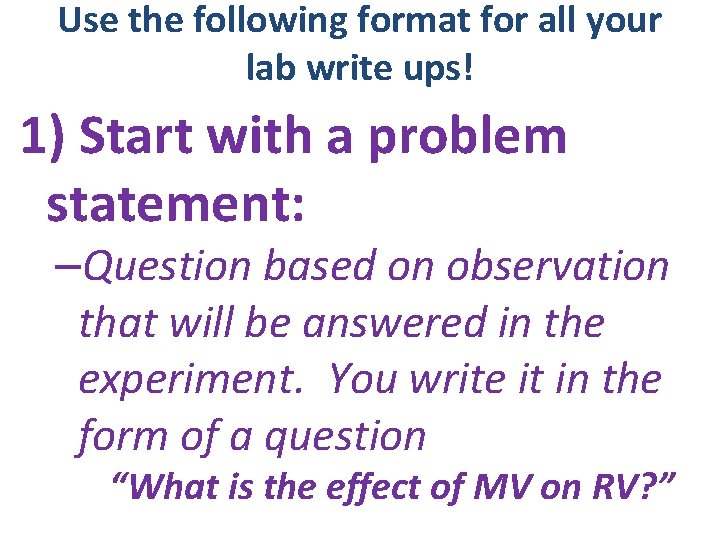
Use the following format for all your lab write ups! 1) Start with a problem statement: –Question based on observation that will be answered in the experiment. You write it in the form of a question “What is the effect of MV on RV? ”
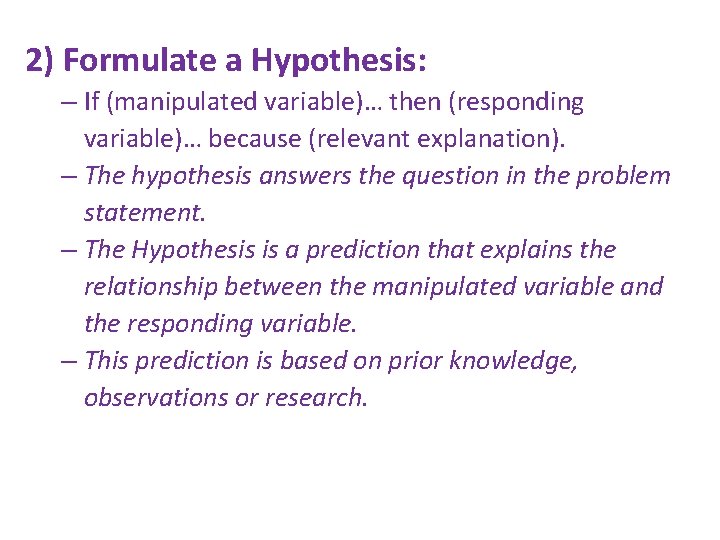
2) Formulate a Hypothesis: – If (manipulated variable)… then (responding variable)… because (relevant explanation). – The hypothesis answers the question in the problem statement. – The Hypothesis is a prediction that explains the relationship between the manipulated variable and the responding variable. – This prediction is based on prior knowledge, observations or research.
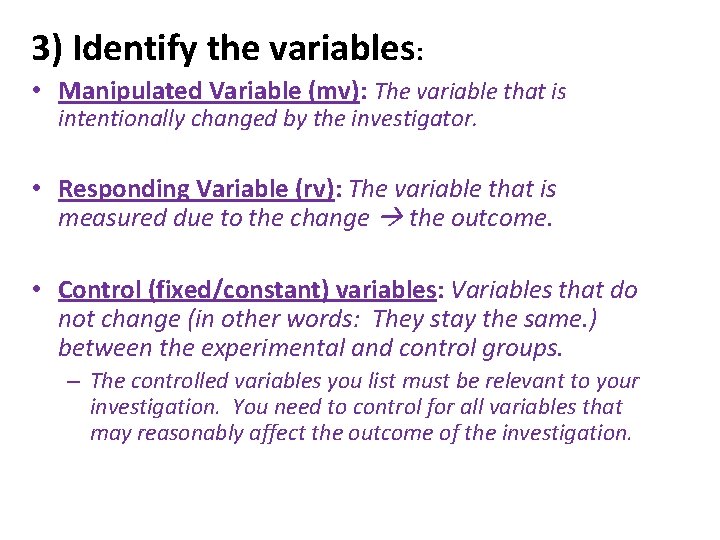
3) Identify the variables: • Manipulated Variable (mv): The variable that is intentionally changed by the investigator. • Responding Variable (rv): The variable that is measured due to the change the outcome. • Control (fixed/constant) variables: Variables that do not change (in other words: They stay the same. ) between the experimental and control groups. – The controlled variables you list must be relevant to your investigation. You need to control for all variables that may reasonably affect the outcome of the investigation.
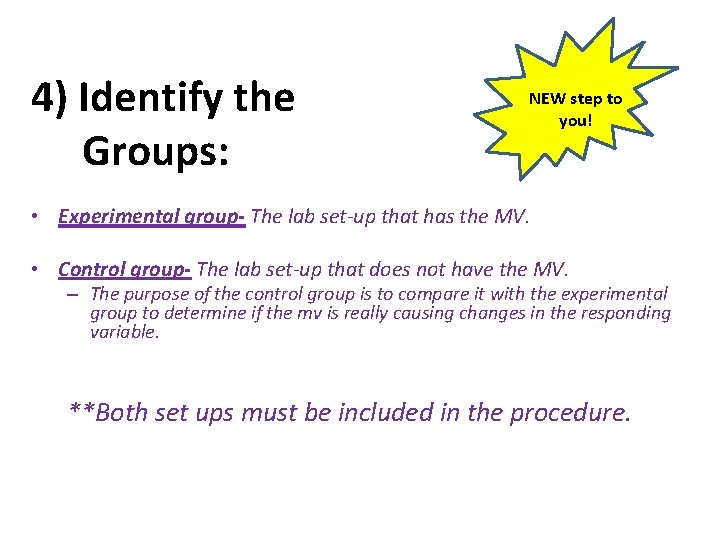
4) Identify the Groups: NEW step to you! • Experimental group- The lab set-up that has the MV. • Control group- The lab set-up that does not have the MV. – The purpose of the control group is to compare it with the experimental group to determine if the mv is really causing changes in the responding variable. **Both set ups must be included in the procedure.
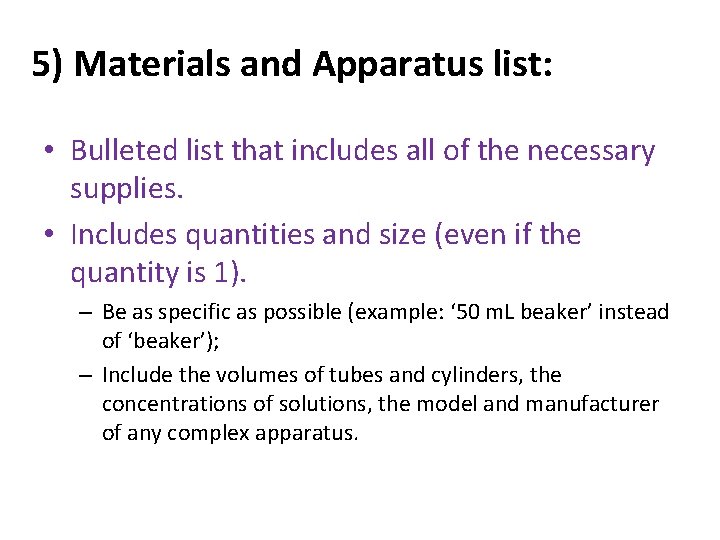
5) Materials and Apparatus list: • Bulleted list that includes all of the necessary supplies. • Includes quantities and size (even if the quantity is 1). – Be as specific as possible (example: ‘ 50 m. L beaker’ instead of ‘beaker’); – Include the volumes of tubes and cylinders, the concentrations of solutions, the model and manufacturer of any complex apparatus.
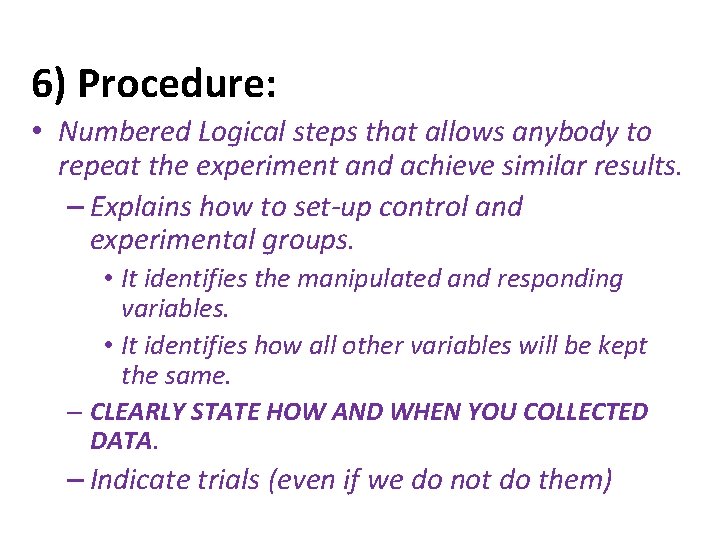
6) Procedure: • Numbered Logical steps that allows anybody to repeat the experiment and achieve similar results. – Explains how to set-up control and experimental groups. • It identifies the manipulated and responding variables. • It identifies how all other variables will be kept the same. – CLEARLY STATE HOW AND WHEN YOU COLLECTED DATA. – Indicate trials (even if we do not do them)
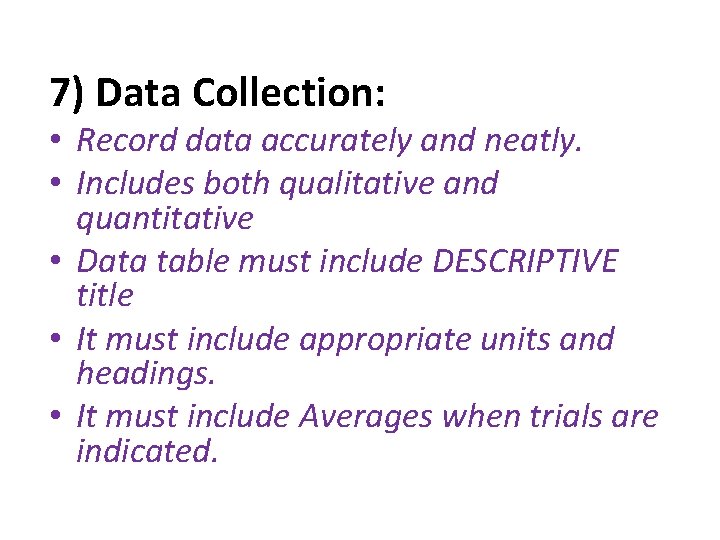
7) Data Collection: • Record data accurately and neatly. • Includes both qualitative and quantitative • Data table must include DESCRIPTIVE title • It must include appropriate units and headings. • It must include Averages when trials are indicated.
8) Data Analysis: • Process data in a meaningful way. • Look for patterns and trends. • Graph and/or mathematical calculations
9) Conclusion: 4 parts 1. State whether your hypothesis is “supported” or “not supported. ” 2. Evidence that your hypothesis is supported or not supported…. • Use concrete data. Use range of data when available(low and high values for the manipulated variable with accompanying responding variable values. 3. Errors or improvements (realistic). 4. Modifications to the procedure for these errors or improvements.