
Designing a Communication Program Communication Strategy Designing a

![• “Successful [health communication] is a believable promise made to the right audience.](https://slidetodoc.com/presentation_image_h2/8cd308052d8df049bf631e41a28b5ace/image-16.jpg "• “Successful [health communication] is a believable promise made to the right audience.")
- Slides: 30
Designing a Communication Program Communication Strategy
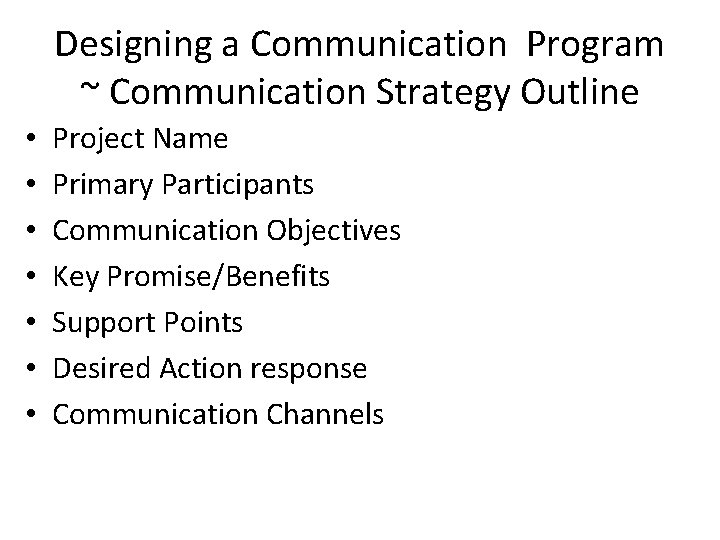
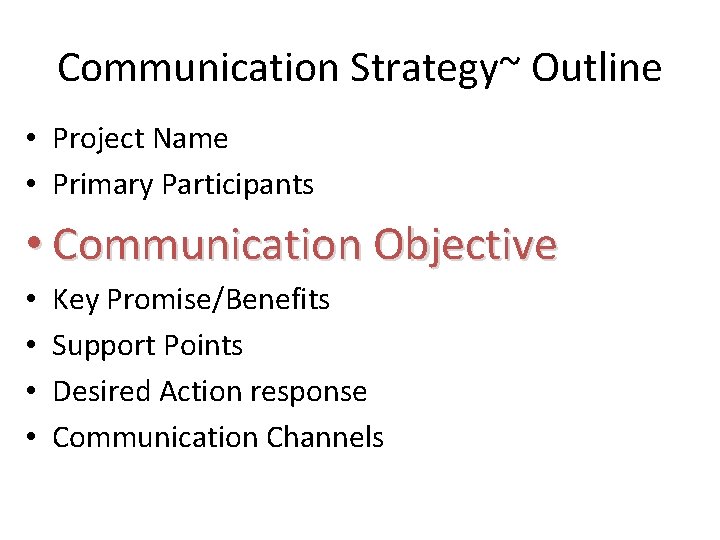
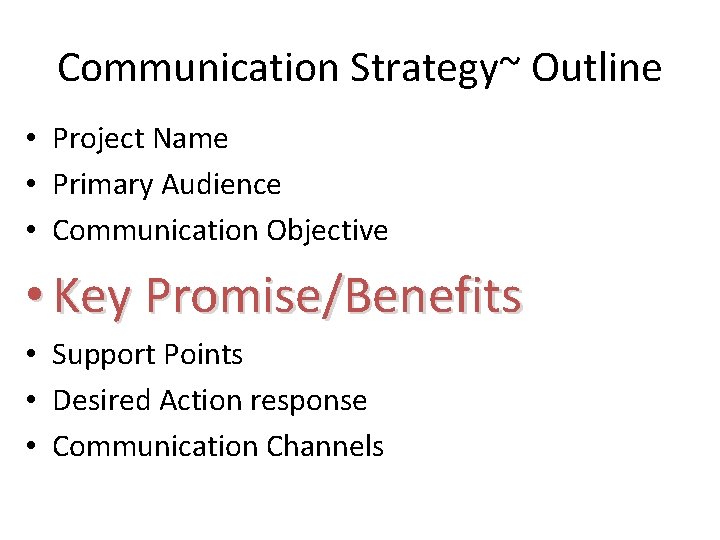
Designing a Communication Program ~ Communication Strategy Outline • • Project Name Primary Participants Communication Objectives Key Promise/Benefits Support Points Desired Action response Communication Channels
Communication Strategy~ Outline • Project Name • • • Primary Participants Communication Objective Key Promise/Benefits Support Points Desired Action response Communication Channels
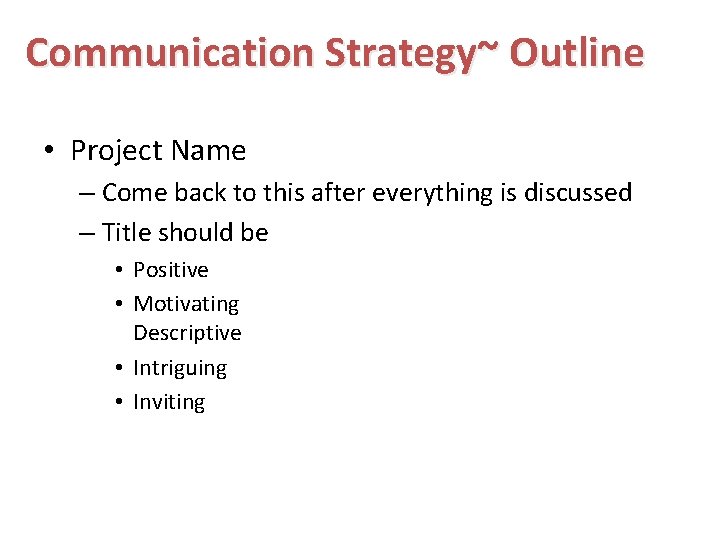
Communication Strategy~ Outline • Project Name – Come back to this after everything is discussed – Title should be • Positive • Motivating Descriptive • Intriguing • Inviting
Communication Strategy~ Outline • Project Name • Primary Participants • • • Communication Objective Key Promise/Benefits Support Points Desired Action response Communication Channels
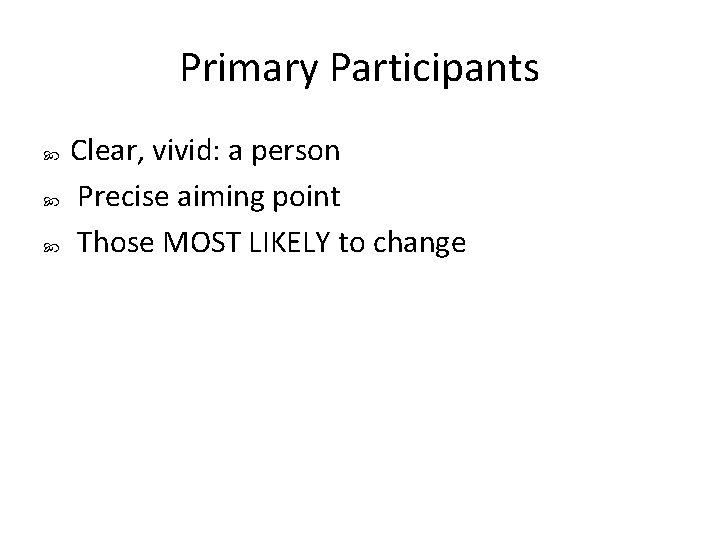
Primary Participants Clear, vivid: a person Precise aiming point Those MOST LIKELY to change
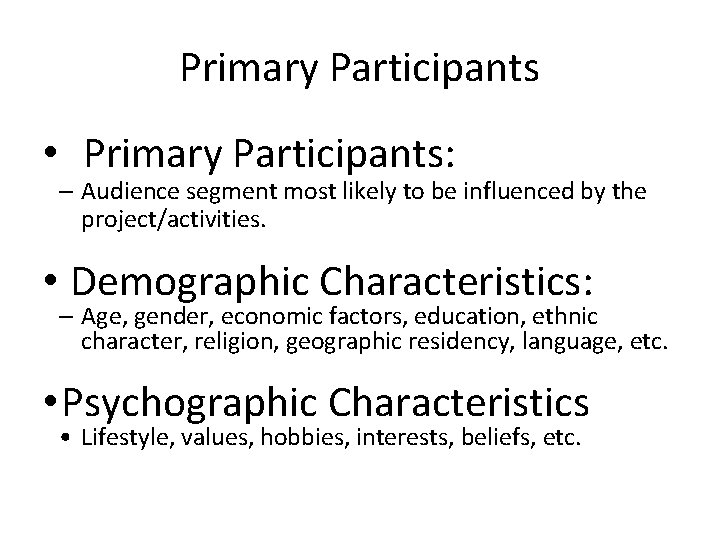
Primary Participants • Primary Participants: – Audience segment most likely to be influenced by the project/activities. • Demographic Characteristics: – Age, gender, economic factors, education, ethnic character, religion, geographic residency, language, etc. • Psychographic Characteristics • Lifestyle, values, hobbies, interests, beliefs, etc.
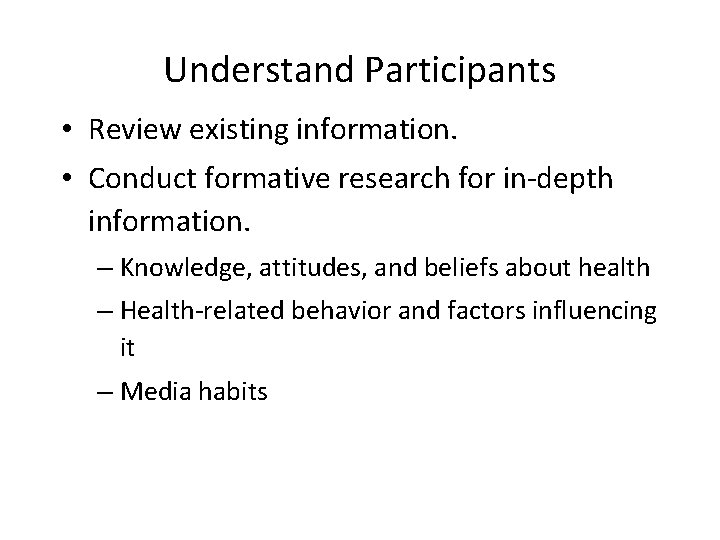
Understand Participants • Review existing information. • Conduct formative research for in-depth information. – Knowledge, attitudes, and beliefs about health – Health-related behavior and factors influencing it – Media habits
Meet Kwame: A Man in Ghana • A farmer living in the Central Region of Ghana • 42 years old; has two wives and five children (ages 8 to 20) • Lives a traditional Ghanaian rural lifestyle – Spends his early morning tending his field – Spends the late afternoon with his friends in the chop bar • Considers himself to be a family man • But occasionally has extramarital affairs • Cares about his children’s well-being and would like them to live a better life than he does • Cares about his two wives because they raise his children • Not at ease communicating with his wives about intimate matters, such as reproductive health • More comfortable having his wives talk to their children about these matters than talking to them himself Communication for Better Health
Communication Strategy~ Outline • Project Name • Primary Participants • Communication Objective • • Key Promise/Benefits Support Points Desired Action response Communication Channels
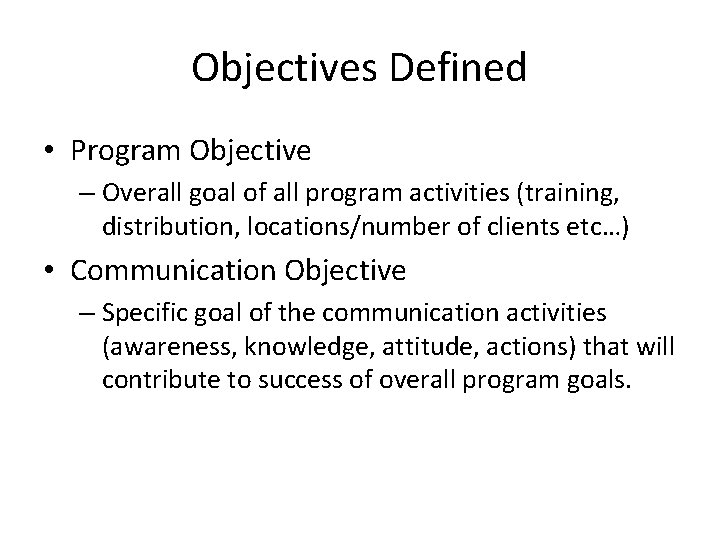
Objectives Defined • Program Objective – Overall goal of all program activities (training, distribution, locations/number of clients etc…) • Communication Objective – Specific goal of the communication activities (awareness, knowledge, attitude, actions) that will contribute to success of overall program goals.
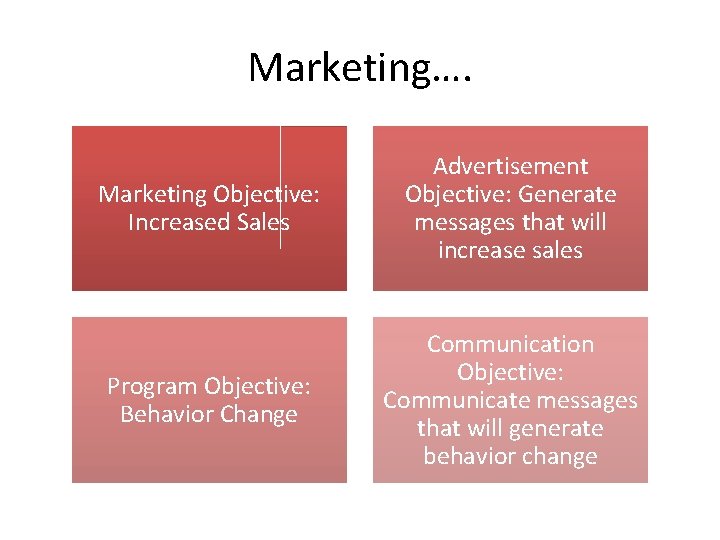
Marketing…. Marketing Objective: Increased Sales Advertisement Objective: Generate messages that will increase sales Program Objective: Behavior Change Communication Objective: Communicate messages that will generate behavior change
Objectives • The communication objective should convey exactly what you want the audience to do as a result of exposure to the message
Communication Strategy~ Outline • Project Name • Primary Audience • Communication Objective • Key Promise/Benefits • Support Points • Desired Action response • Communication Channels
What is a key promise/benefit • Benefit – Reward – Subjective experience in participants’ minds – In the future…
• “Successful [health communication] is a believable promise made to the right audience. John Caples, Pioneer Direct Marketing The promise must be truthful and be relevant!
“In the factory we make cosmetics, in the store we sell hope. ” Charles Revson Founder of Revlon
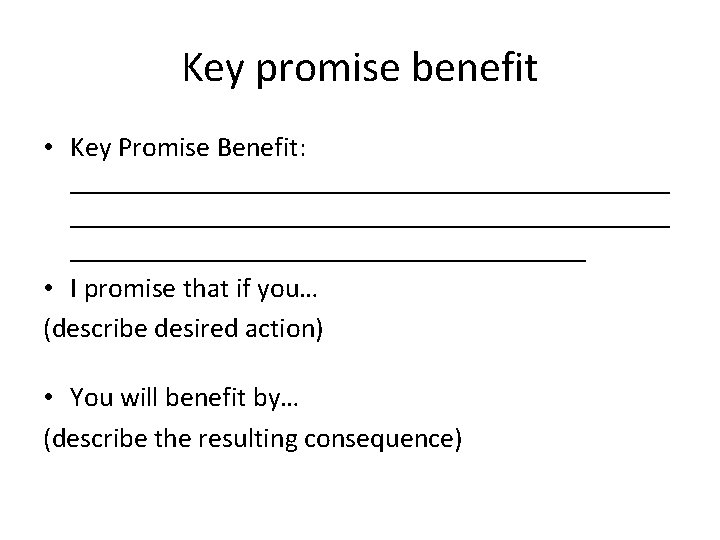
Key promise benefit • Key Promise Benefit: ___________________________________________ • I promise that if you… (describe desired action) • You will benefit by… (describe the resulting consequence)
More = Less Focus Demands Sacrifice
Key Promise Benefit • What single benefit will be the primary theme of the message? • Why one should change their behavior. • If you will (Desired Action), then you will benefit by (future reward). • Try to focus on one primary benefit theme (or as few as possible. )
Communication Strategy~ Outline • • Project Name Primary Audience Communication Objective Key Promise/Benefits • Support Points • Desired Action response • Communication Channels
Support Points • You will benefit as described above BECAUSE of the following related reasons: – Facts-Research Results - Expert Opinion – Demonstration (side-by-side comparisons) – Graphs - Illustrations – Testimonials - Celebrity endorsements - Referrals – Guarantees, Government approvals - Seals of approval
Case Scenarios: Q&A • Case 1: Sanitation and Access to Clean Water • Case 2: Access to Education • Case 3: Child Soldiers and Human Trafficking You have been asked to develop a strategic plan for ONE of the three case scenarios above. Q&A: What support points will you include in your communication strategy for your case scenario?
Communication Strategy~ Outline • • • Project Name Primary Audience Communication Objective Key Promise/Benefits Support Points • Desired Action response • Communication Channels
Desired Action Response • What specific action do you want the audience to take as a result of seeing this message? • What action is realistic for this communication to achieve? • Should help to achieve the objective.
Communication Strategy~ Outline • • • Project Name Primary Audience Communication Objective Key Promise/Benefits Support Points Desired Action response • Communication Channels
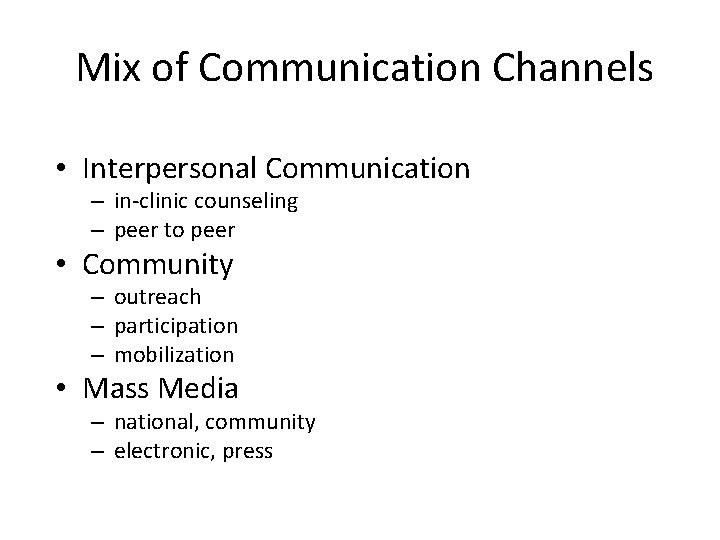
Mix of Communication Channels • Interpersonal Communication – in-clinic counseling – peer to peer • Community – outreach – participation – mobilization • Mass Media – national, community – electronic, press
Ideal Mix of Communication Interventions?
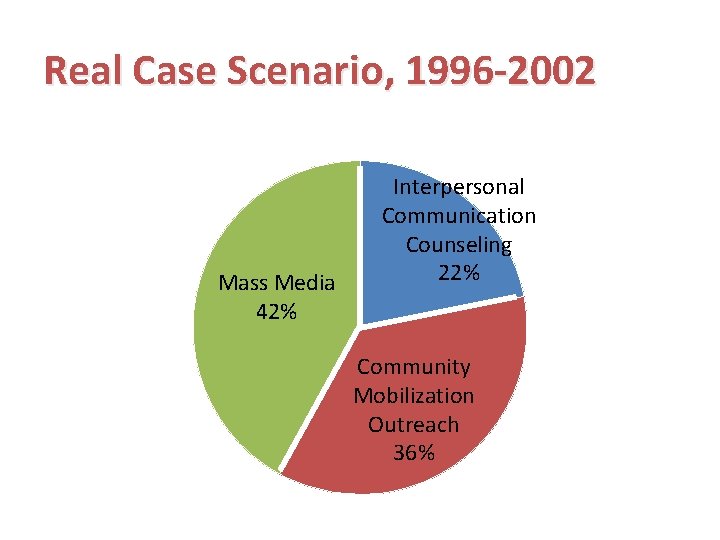
Real Case Scenario, 1996 -2002 Mass Media 42% Interpersonal Communication Counseling 22% Community Mobilization Outreach 36%
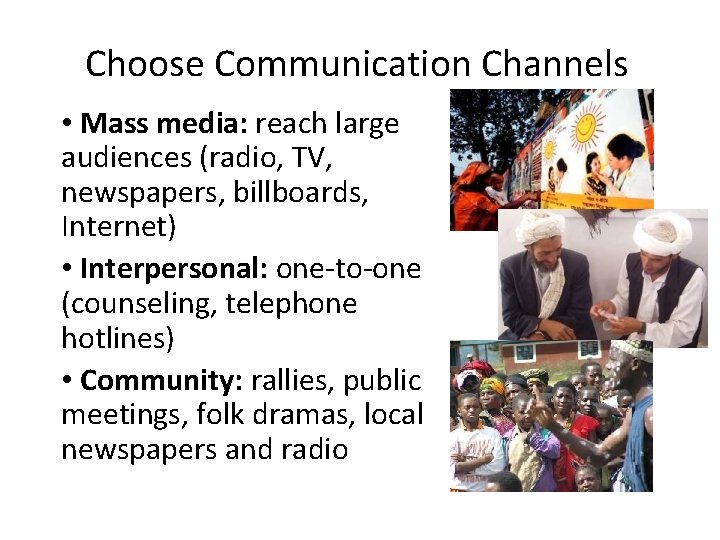
Choose Communication Channels • Mass media: reach large audiences (radio, TV, newspapers, billboards, Internet) • Interpersonal: one-to-one (counseling, telephone hotlines) • Community: rallies, public meetings, folk dramas, local newspapers and radio