
Designing a 2021 Toronto Rehab Poster 90 pt
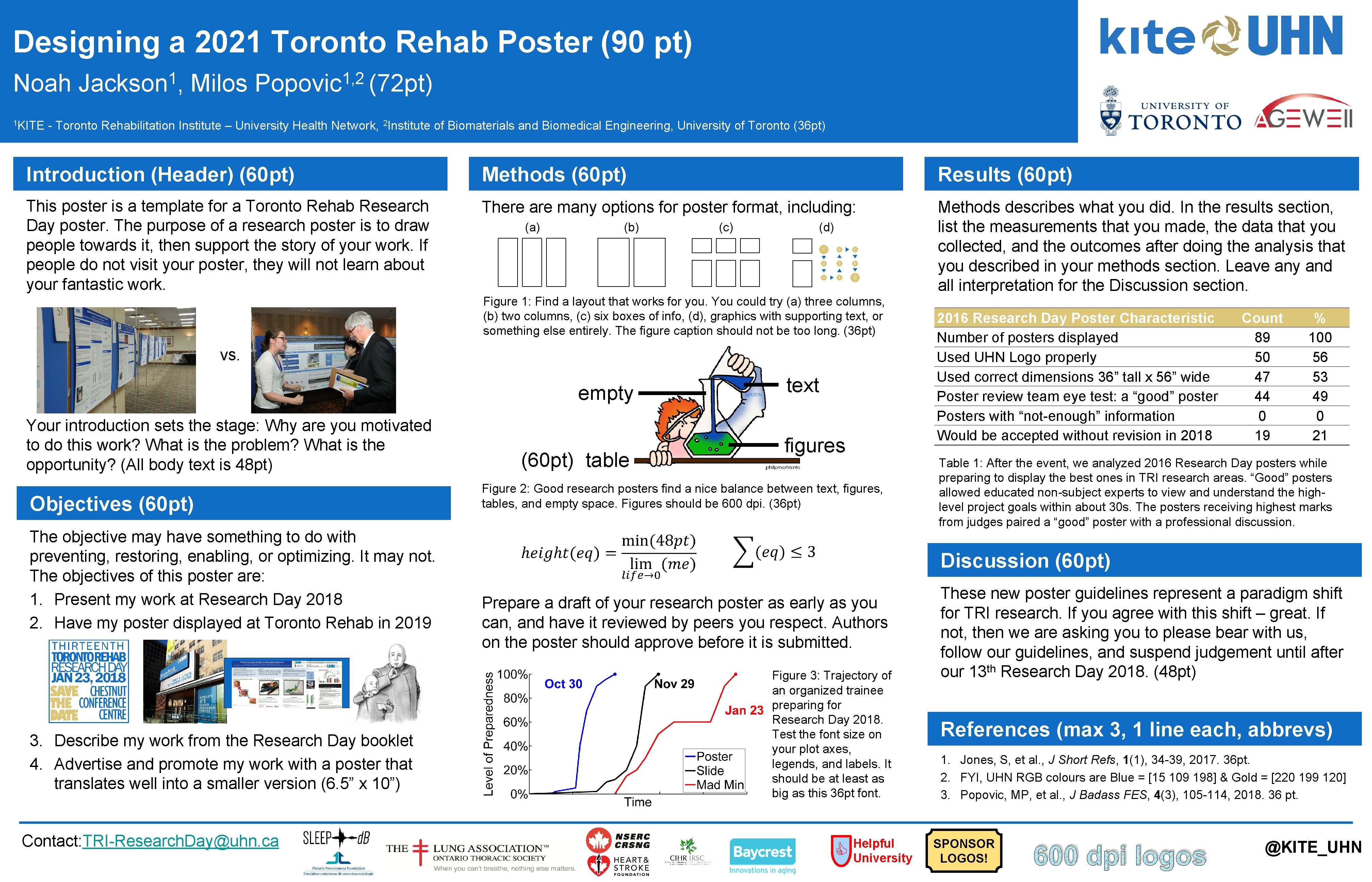
Designing a 2021 Toronto Rehab Poster (90 pt) Noah 1 KITE 1 Jackson , Milos 1, 2 Popovic (72 pt) - Toronto Rehabilitation Institute – University Health Network, 2 Institute of Biomaterials and Biomedical Engineering, University of Toronto (36 pt) Introduction (Header) (60 pt) Methods (60 pt) Results (60 pt) This poster is a template for a Toronto Rehab Research Day poster. The purpose of a research poster is to draw people towards it, then support the story of your work. If people do not visit your poster, they will not learn about your fantastic work. There are many options for poster format, including: Methods describes what you did. In the results section, list the measurements that you made, the data that you collected, and the outcomes after doing the analysis that you described in your methods section. Leave any and all interpretation for the Discussion section. (a) (b) (c) (d) 1 6 7 2 5 8 3 4 9 Figure 1: Find a layout that works for you. You could try (a) three columns, (b) two columns, (c) six boxes of info, (d), graphics with supporting text, or something else entirely. The figure caption should not be too long. (36 pt) vs. empty Your introduction sets the stage: Why are you motivated to do this work? What is the problem? What is the opportunity? (All body text is 48 pt) Objectives (60 pt) The objective may have something to do with preventing, restoring, enabling, or optimizing. It may not. The objectives of this poster are: 1. Present my work at Research Day 2018 2. Have my poster displayed at Toronto Rehab in 2019 3. Describe my work from the Research Day booklet 4. Advertise and promote my work with a poster that translates well into a smaller version (6. 5” x 10”) Contact: TRI-Research. Day@uhn. ca (60 pt) table text figures Figure 2: Good research posters find a nice balance between text, figures, tables, and empty space. Figures should be 600 dpi. (36 pt) 2016 Research Day Poster Characteristic Number of posters displayed Used UHN Logo properly Used correct dimensions 36” tall x 56” wide Poster review team eye test: a “good” poster Posters with “not-enough” information Would be accepted without revision in 2018 Count 89 50 47 44 0 19 % 100 56 53 49 0 21 Table 1: After the event, we analyzed 2016 Research Day posters while preparing to display the best ones in TRI research areas. “Good” posters allowed educated non-subject experts to view and understand the highlevel project goals within about 30 s. The posters receiving highest marks from judges paired a “good” poster with a professional discussion. Discussion (60 pt) Prepare a draft of your research poster as early as you can, and have it reviewed by peers you respect. Authors on the poster should approve before it is submitted. Figure 3: Trajectory of an organized trainee preparing for Research Day 2018. Test the font size on your plot axes, legends, and labels. It should be at least as big as this 36 pt font. Helpful University These new poster guidelines represent a paradigm shift for TRI research. If you agree with this shift – great. If not, then we are asking you to please bear with us, follow our guidelines, and suspend judgement until after our 13 th Research Day 2018. (48 pt) References (max 3, 1 line each, abbrevs) 1. Jones, S, et al. , J Short Refs, 1(1), 34 -39, 2017. 36 pt. 2. FYI, UHN RGB colours are Blue = [15 109 198] & Gold = [220 199 120] 3. Popovic, MP, et al. , J Badass FES, 4(3), 105 -114, 2018. 36 pt. SPONSOR LOGOS! 600 dpi logos @KITE_UHN

1 KITE - Toronto Rehabilitation Institute – University Health Network, 2 Institute of Biomaterials and Biomedical Engineering, University of Toronto (36 pt) @KITE_UHN
- Slides: 2