
DesignBuild Public Infrastructure Challenges Risks and Opportunities for
Design-Build Public Infrastructure: Challenges, Risks and Opportunities for Consulting Engineers ACEC/NHDOT 6 th Annual Winter Technical Meeting January 10, 2020 David J. Hatem, PC Donovan Hatem LLP dhatem@donovanhatem. com
Design-Build Public Infrastructure: Challenges, Risks and Opportunities For Consulting Engineers • Industry Trends in DB Public Infrastructure: Projects: Exit From Fixed Price Contracting • Design Development Risk • Significant and Concerning Claims Experience for Consulting Engineers • No Longer Simply Large Firm Problem • Problem is National in Dimension 2
Design-Build Public Infrastructure: Challenges, Risks and Opportunities For Consulting Engineers Statement of the Problem and the Challenge • Substantial Increases In Final Design and Construction Cost Compared to DB Contract Award Amount • Increases Manifest During Post-Award Design Development Process • Design-Builder Has No Contractual Cost Adjustment Remedy From Project Owner • Design-Builder Seeks Alternative Source for Recovery of “Cost Overrun” – Professional Liability Claim Against Consulting Engineer 3
Design-Build Public Infrastructure: Challenges, Risks and Opportunities For Consulting Engineers “Fixing the Industry’s Fixed-Price Conundrum” Engineering News-Record November 20, 2019 Root Causes • Aggressive, Unrealistic Pricing and Contingencies • Imbalanced Risk Allocation 4
Design-Build Public Infrastructure: Challenges, Risks and Opportunities For Consulting Engineers Class Action Securities Lawsuit Recently a class action was filed against a major infrastructure contractor (previously having a dominant involvement in P 3 and DB projects) alleging violations of federal securities laws based on alleged misleading statements and failures to disclose that (a) the contractor “had assumed certain risks in connection with its heavy civil joint venture projects”, and (b) “there was ‘untenable’ imbalance of risk sharing” between the contractor and the project owners on certain P 3 and DB projects. (Douglas Greene, et al. v. Granite Construction, United States District Court, Norther District of California, No. 3 -19 -CV-04744 -WHA, Complaint, ¶ 7). 5
Design-Build Public Infrastructure: Challenges, Risks and Opportunities For Consulting Engineers What do those root causes mean for Consulting Engineers? “Engineer’s Fixed-Price Risk” Letter to the Editor Engineering News-Record December 16, 2019 The article “Fixing Construction’s Fixed- Price Conundrum” (ENR 11/18 -25 p. 28) definitely identified a critically important issue that materially impacts continued successful utilization of design-build and P 3 approaches in North America. The demonstrated negative impact on construction of DB and P 3 fixed-price procurement, exacerbated by unreasonable and imbalanced contractual risk allocation, has another important negative by-product—the frequency and severity of professional liability claims asserted by design-builders against consulting engineer subconsultants. Significantly, many derive from the same problems and challenges discussed in the article. The trickle-down effect of fixed-price and imbalanced risk allocation on consulting engineers warrants equal attention. 6
Design-Build Public Infrastructure: Challenges, Risks and Opportunities For Consulting Engineers In the last decade, design-builder professional liability claims against consulting engineers in P 3 and DB projects have risen dramatically. The trend is extraordinarily concerning. I am extremely cautious generalizing as to cause, but what underlies or motivates claims often is unfair risk allocation between owner and concessionaire in P 3 s or owner and design-builder in DBs. The design-builder’s inability to seek recourse against its upstream contracting partner produces the mechanism of a professional liability claim against its consulting engineer. The concerning claims experience for engineers in P 3 s and DBs derives directly and significantly from the same root causes that underlie the fixed price problem addressed. The converged realities and negative consequences of aggressive and highly competitive pre-award pricing (with inadequate design development contingency) in the context of fixed-price/imbalanced risk typically are disguised and transposed into a professional liability claim. The engineer’s conceptual or preliminary pre-award design or studies, investigations or recommendations did not meet the standard of care, resulting in cost overruns that the design-builder is not able to recover from the owner. 7
Design-Build Public Infrastructure: Challenges, Risks and Opportunities For Consulting Engineers The design-builder’s pre-award failures to identify and assess design development and related risks (and adequately price and carry contingency for them) often provides an important part of the defense or explanation of claims, but it is equally true that fixed-price and uneven risk allocation are significant underlying factors and reasons impelling them. Despite recent court victories for consulting engineers in this claim context, this trend is simply not sustainable for contractors and engineers; the ENR article provides compelling and convincing evidence to that effect. Industry should not look to courts as the primary solution. It mainly rests with owners. Contractors, typically the design-build lead, and consulting engineers often are adversaries in this context, but they share a common concern about unfair risk allocation in the fixed-price P 3 and DB contractual setting. 8
Design-Build Public Infrastructure: Challenges, Risks and Opportunities For Consulting Engineers For the past decade, owners have had the advantage and benefit of significant competition among contractors and artificially low fixed-price cost for P 3 and DB projects. The recent trend obviously moves decisively in a very different direction. Owners need to get the message about the importance of balance in risk allocation and recalibrate procurement and contract practices. For the last several years, I have predicted that unless something fundamentally changes in DB and P 3 s, there will be design and construction casualties. Public awareness is an important step in averting that consequence. Thank you for an excellent article that increases that awareness. DAVID J. HATEM, PC Boston, Mass. 9
Focus on the Problem and the Challenge • Design Development Risk in DB: Perfect Storm • Professional Liability Claims Experience For Consulting Engineers in DB • Meeting the Challenge 10
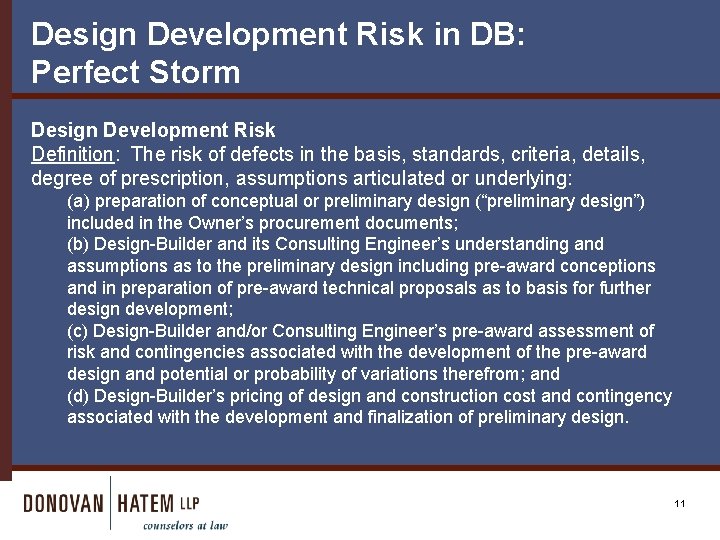
Design Development Risk in DB: Perfect Storm Design Development Risk Definition: The risk of defects in the basis, standards, criteria, details, degree of prescription, assumptions articulated or underlying: (a) preparation of conceptual or preliminary design (“preliminary design”) included in the Owner’s procurement documents; (b) Design-Builder and its Consulting Engineer’s understanding and assumptions as to the preliminary design including pre-award conceptions and in preparation of pre-award technical proposals as to basis for further design development; (c) Design-Builder and/or Consulting Engineer’s pre-award assessment of risk and contingencies associated with the development of the pre-award design and potential or probability of variations therefrom; and (d) Design-Builder’s pricing of design and construction cost and contingency associated with the development and finalization of preliminary design. 11
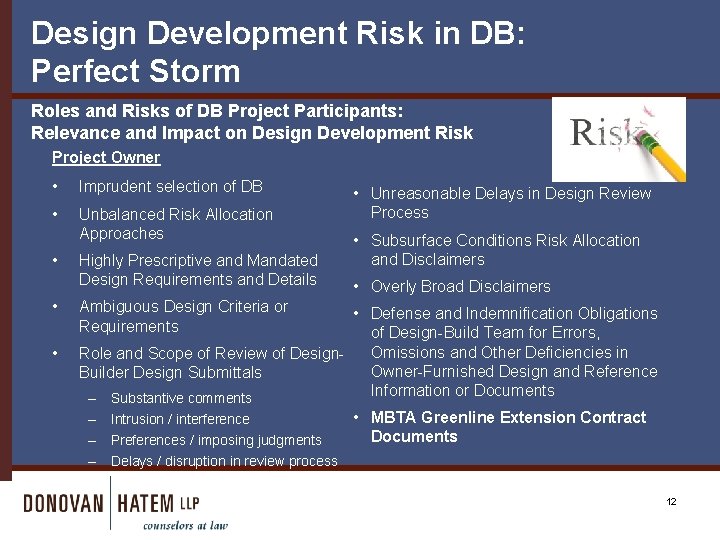
Design Development Risk in DB: Perfect Storm Roles and Risks of DB Project Participants: Relevance and Impact on Design Development Risk Project Owner • Imprudent selection of DB • Unbalanced Risk Allocation Approaches • • • Highly Prescriptive and Mandated Design Requirements and Details • Unreasonable Delays in Design Review Process • Subsurface Conditions Risk Allocation and Disclaimers • Overly Broad Disclaimers Ambiguous Design Criteria or Requirements • Defense and Indemnification Obligations of Design-Build Team for Errors, Omissions and Other Deficiencies in Role and Scope of Review of Design. Owner-Furnished Design and Reference Builder Design Submittals Information or Documents – Substantive comments – Intrusion / interference – Preferences / imposing judgments – Delays / disruption in review process • MBTA Greenline Extension Contract Documents 12
Design Development Risk in DB: Perfect Storm Roles and Risks of DB Project Participants: Relevance and Impact on Design Development Risk Design-Builder • • • Aggressive Bid Pricing • Unreasonable Risk Allocation (e. g. , quantity overrun contractual liability), and heightened standard of care contractual terms • Insistence on Payment Withholding and Backcharge Provisions that Diminish or Negate Otherwise Available Professional Liability Insurance Coverage No or Inadequate Design Development Contingency Unreasonably Restrictive Scope of Consulting Engineer Pre-Award Design and Investigation/Verification Services 13
Design Development Risk in DB: Perfect Storm Roles and Risks of DB Project Participants: Relevance and Impact on Design Development Risk Consulting Engineer • Failure to Comprehend or Clarify Project Owner Design Criteria, Standards or Requirements • Failure to Recommend Investigations, Studies or Further Design Development During Pre-Award Phase • Failure to Adequately Identify, Evaluate and Advise as to Design Risks and Potential Post-Award Consequences • • Delays in Preparation of Design Submittals Failure to Adhere to Professional Standard of Care in Design Development Process 14
Design Development Contingency Design-Builder’s Pricing Should Include Design Development Contingency to Address Costs Due to: • • • Natural progression of design development following contract award The recognition that optimistic, minimally-compliant or aggressive bid (proposal) design assumptions may not be accepted by the owner Variables such as owner preferences, unreasonable regulatory interpretations, delay in third-party approvals may impact design development process The level of effort, degree of technical support, detail or engineering validation required by the owner may exceed what is customarily accepted in DBB Errors, omissions or other deficiencies in proposal design or design development services that do not rise to the level of professional standard of care departure. 15
Design Development Contingency As a Massachusetts Superiour Court has recently commented in the context of a designbuilder claim asserted against a consulting engineer: “A number of experts testified concerning industry standards regarding the amount of contingency that a contractor should include when bidding a design/build project; consensus seemed to be that cost increases in the range of 10% should be expected. It is unnecessary for the court to find as a fact what the proper percentage for contingency was in this case; indeed, an appropriate contingency is undoubtedly dependent on the project and the amount of time available to the engineering team to advance toward a final design before bid submission. All of the experts, however, agreed, and the court finds, that in design/build projects weights, complexities and therefore construction costs invariably increase after the contract is awarded as design development proceeds to the final approved-by-owner construction design. ” • The Middlesex Corporation, Inc. v. Fay, Spofford & Thorndike, Inc. , Commonwealth of Massachusetts, Superior Court, Civil Action 15 -02992 -BLS 1, Memorandum of Decision, June 28, 2019, pp. 13 -14. 16
Professional Liability Claims Experience for Consulting Engineers in DB Design Development Risk • Professional Liability Claims Based on Design Development Risk § Severity § Frequency • Design Development Risk Claims Represent a Major Professional Liability Exposure for Consulting Engineers in DB 17
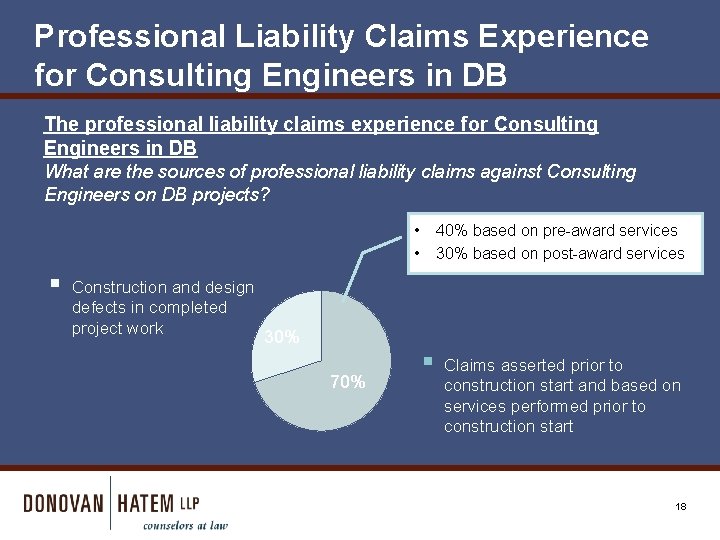
Professional Liability Claims Experience for Consulting Engineers in DB The professional liability claims experience for Consulting Engineers in DB What are the sources of professional liability claims against Consulting Engineers on DB projects? • • § Construction and design defects in completed project work 40% based on pre-award services 30% based on post-award services 30% 70% § Claims asserted prior to construction start and based on services performed prior to construction start 18
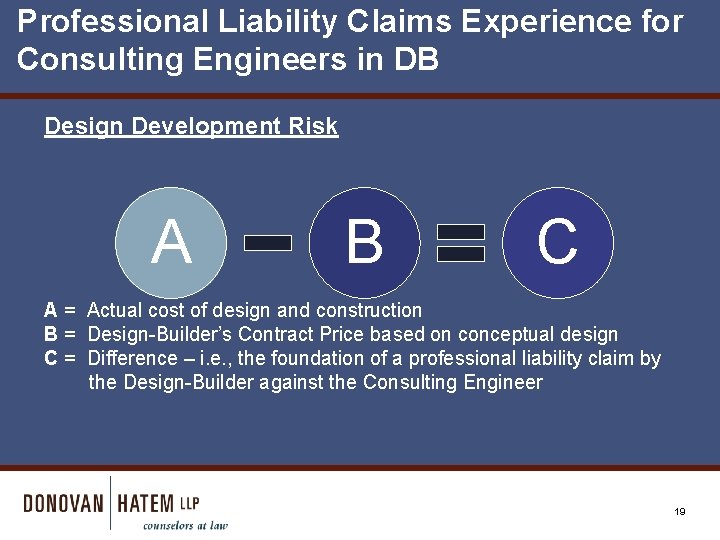
Professional Liability Claims Experience for Consulting Engineers in DB Design Development Risk A B C A = Actual cost of design and construction B = Design-Builder’s Contract Price based on conceptual design C = Difference – i. e. , the foundation of a professional liability claim by the Design-Builder against the Consulting Engineer 19
Professional Liability Claims Experience for Consulting Engineers in DB Key Issues: Design Development Risk 1. Application of the Professional Standard of Care to Professional Liability Claims Arising out of Design Development Risk? 2. Relevance of Project Owner Procurement, Contractual and Risk Allocation Practices to Design Development Risk 3. Relevance of Design-Builder Bid Pricing, Estimating and Contingency to Design Development Risk 4. How do these Issues relate to Availability, Terms and Pricing of Project-Specific Professional Liability Insurance 20
Professional Liability Claims Experience for Consulting Engineers in DB Professional Standard of Care – Application to Design Development Risk • Reasonable care under the circumstances – Scope of services – Time constraints – Roles, responsibilities and risks of Owner and Design-Builder – Other factors and considerations • Role of expert opinions • No presently recognized industry standard: Much subjectivity and advocacy in expert opinions 21
Meeting the Challenge Need for industry standards for evaluation of design development risk claims – Best Practices Guidelines – Design Development Risk Factors to be considered in those Guidelines include: 1. The degree of design development, detailing and prescription furnished 2. 3. 4. by the Owner and included in the RFP. The Owner’s approach to design and related (e. g. DSC) risk allocation. Disclaimers and non-reliance provisions in the RFP as to preliminary design risk; and defense and indemnification obligations as to Ownerfurnished preliminary design defects. The extent and reasonableness of validation and verification (investigation, studies, etc. ) expected or required of the Design-Builder and/or its Consulting Engineer with respect to the Owner-furnished preliminary design (or related reports or information). 22
Meeting the Challenge 5. The standards required of the Design-Builder in the DB Contract as to compliance with preliminary design, and the extent to which those standards are flowed-down to the Consulting Engineer, and conflict with the latter’s standard of care obligation. 6. The relationship and compatibility between preliminary design furnished in the procurement documents and other Owner-furnished information, investigations, etc. (e. g. subsurface); and how risk is allocated in those other respects. 7. The scope of services and professional standard of care reasonably expected of the Consulting Engineer in evaluating the preliminary design, verifying Owner-furnished information, and in preparing a proposal design; and how that standard is defined and applied relative to the cost of designing and constructing the approved final design and construction documents. 23
Meeting the Challenge 8. Reasonable standards for design development contingency to be priced in the DB Proposal and maintained by the Design-Builder. 9. The contractual (legal) significance of the Owner’s acceptance of the Design-Builder’s Technical Proposal; and how alternative technical concepts relate to the allocation of preliminary design risk. 10. The role of professional liability insurance for the Consulting Engineer in the context of design development design risk, and best practices in specification and procurement of coverage. 24
Meeting the Challenge • Improving Upstream and Relational Risk Allocation in DB § Transportation Research Board, Guidelines for Managing Geotechnical Risks in Design-Build Projects, NCHRP Research Report 884 (September, 2018) § Essex, R. , Hatem, D. , Reilly, J. , “Alternative Delivery Drives Alternative Risk Allocation Methods, ” paper to be presented at the North American Tunneling Conference, Washington, D. C. , 24 -27 June, 2018 § D. J. Hatem, Subsurface Conditions and Design Adequacy Risk Allocation in Design Build: Dynamics, Interactions and Interdependencies, Tunnel Business Magazine, October 2018 • Progressive Design-Build/Scope Validation • Industry Convocation to Discuss Relevant Issues Relating to Design Development Risk • Developing Best Practice Guidelines – Design Development Risk 25
Meeting the Challenge Data Collection and Validation Collect Data on Design-Build and P 3 Projects over the Last 10 Years – With construction values of $500 m, or more – That are either completed or in which design is 90% or more complete For each subject project, ascertain – Whether any claims were made by the Design-Builder against its Consulting – – – – Engineer The amount and bases (e. g. errors/omissions in design development; errors/omissions in RFC design) of the claims Resolution of the claims Professional Liability Insurer financial contribution to resolution Consulting Engineer status (e. g. ENR 100 Firm) Amount of Design-Build Contract Price Amount of Owner’s Estimate of Construction Cost Amount of Design-Builder Design Development Contingency Included in its Price ACEC Study - 2020 26
Contact Information David J. Hatem, PC dhatem@donovanhatem. com Direct: 617 -406 -4800 Donovan Hatem LLP Exchange Place 53 State Street Boston, MA 02109 Donovan Hatem LLP © 2019 27
- Slides: 27