
DesignBuild Processes Training Module 1 DESIGNBUILD TRAINING SERIES
Design-Build Processes Training Module 1

DESIGN-BUILD TRAINING SERIES DB training modules describe NAVFAC Design-Build policies and processes and an explanation of the tools and documents available. • • • Introduction to Design-Build Standard RFP Template Design-Build Processes Small Project Template D-B Master Management Training for Criteria Managers The NAVFAC Construction manager training series provides the information to effectively manage NAVFAC Construction Contracts. These modules are accessed through Total Workforce Management System (TWMS). DB Modules in that series: – NAVFAC CI Design-Build Post Award Process – NAVFAC CI Post Award Kickoff Meeting (PAK) 2
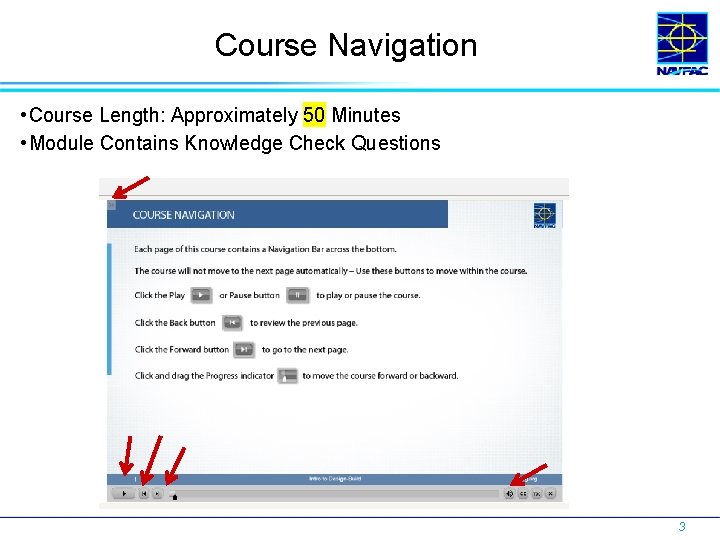
Course Navigation • Course Length: Approximately 50 Minutes • Module Contains Knowledge Check Questions 3
Learning Objectives • Get Familiar with Characteristics of the 4 Design-Build Processes • Know the Commonalities and Differences between the 4 Design-Build Processes • Understand the Design-Build Team Makeup • Learn About the NAVFAC Business Management System (BMS) • Understand BMS Roles and Responsibilities • Know the Post-award Processes 4
Design-Build Processes NAVFAC’s Design-Build processes: • Standard Design-Build Process o Standard Design-Build, In-House RFP Development o Standard Design-Build, A-E RFP Development • Multiple Award Construction Contract (MACC) DB Process • Sole Source Negotiated Scope DB Process • Small Project DB Process 5
Business Management System (BMS) • NAVFAC’s Business Management System – Documents all NAVFAC processes – Web-Based tool accessible on NAVFAC Portal – BMS are continually being updated • Always a work-in-progress • Allows input for continuous improvement • Review regularly for updates to processes 6
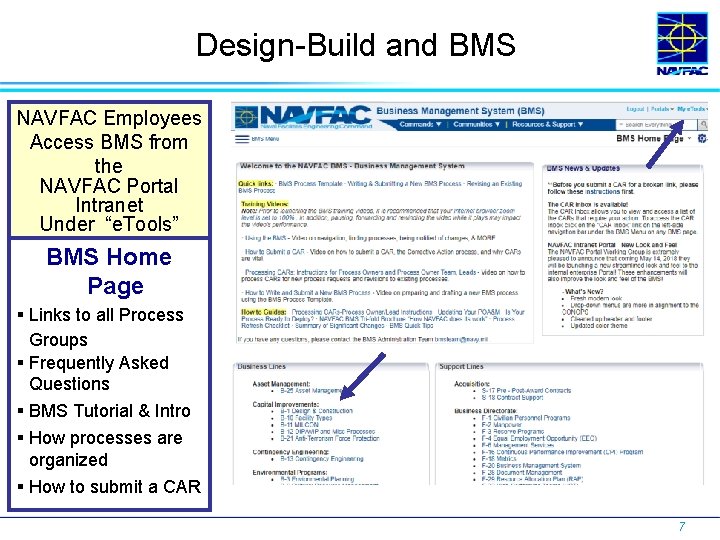
Design-Build and BMS NAVFAC Employees Access BMS from the NAVFAC Portal Intranet Under “e. Tools” BMS Home Page § Links to all Process Groups § Frequently Asked Questions § BMS Tutorial & Intro § How processes are organized § How to submit a CAR 7
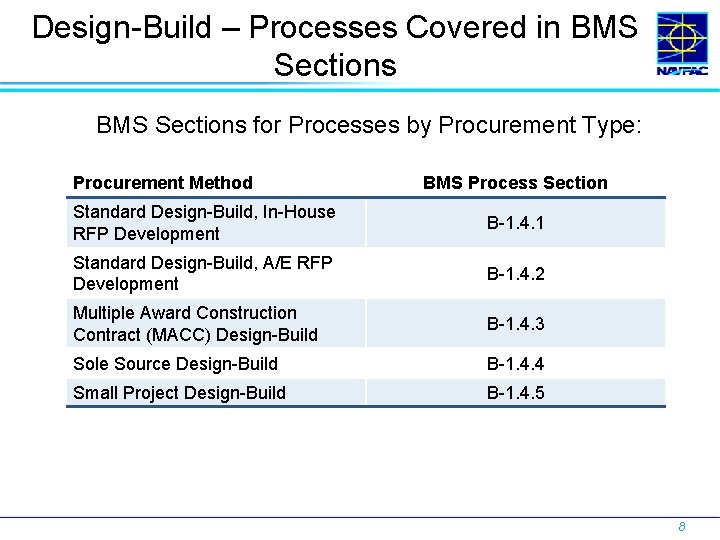
Design-Build – Processes Covered in BMS Sections for Processes by Procurement Type: Procurement Method BMS Process Section Standard Design-Build, In-House RFP Development B-1. 4. 1 Standard Design-Build, A/E RFP Development B-1. 4. 2 Multiple Award Construction Contract (MACC) Design-Build B-1. 4. 3 Sole Source Design-Build B-1. 4. 4 Small Project Design-Build B-1. 4. 5 8
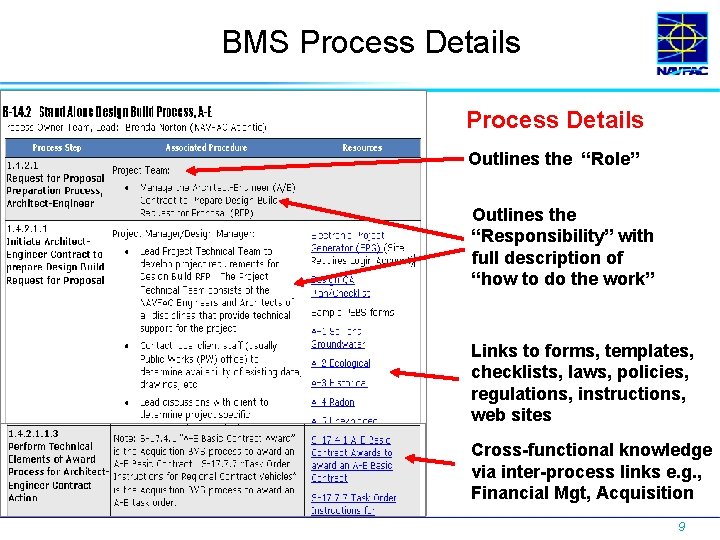
BMS Process Details Outlines the “Role” Outlines the “Responsibility” with full description of “how to do the work” Links to forms, templates, checklists, laws, policies, regulations, instructions, web sites Cross-functional knowledge via inter-process links e. g. , Financial Mgt, Acquisition 9
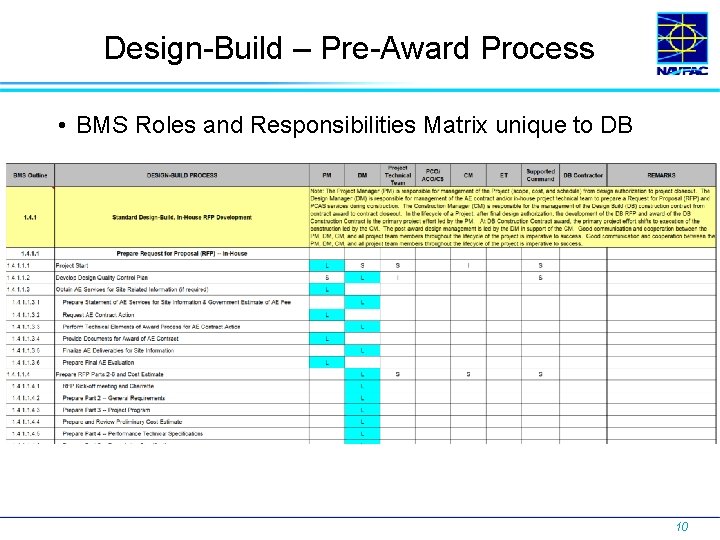
Design-Build – Pre-Award Process • BMS Roles and Responsibilities Matrix unique to DB 10

Design-Build – NAVFAC Personnel Roles • Roles and Responsibilities Matrix in BMS Defines responsibilities for Government personnel on DB projects Key NAVFAC Personnel • Project Manager (PM) – Responsible for management of project (scope, cost, and schedule) from design authorization to project closeout. Relinquishes project lead to CM after award • Design Manager (DM) – Manages A/E Contract, or in-house project team, for development of RFP and leads the review effort of DB Team’s design • Construction Manager (CM) – Leads project beginning at award through close-out 11

Knowledge Check #1 12
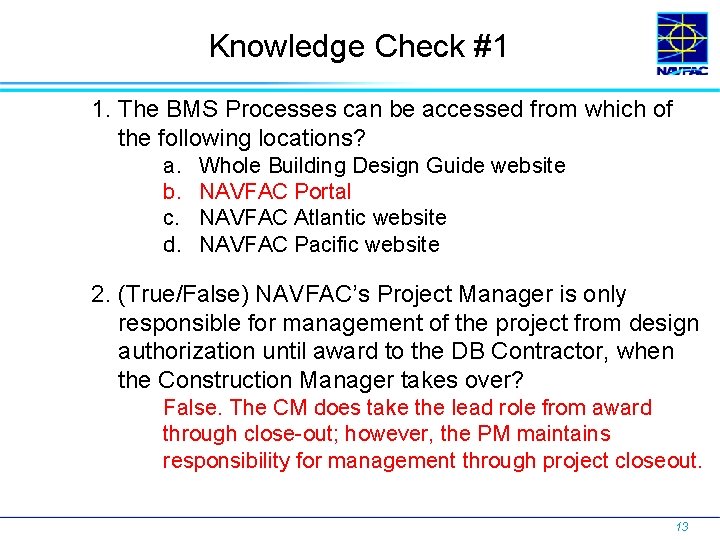
Knowledge Check #1 1. The BMS Processes can be accessed from which of the following locations? a. b. c. d. Whole Building Design Guide website NAVFAC Portal NAVFAC Atlantic website NAVFAC Pacific website 2. (True/False) NAVFAC’s Project Manager is only responsible for management of the project from design authorization until award to the DB Contractor, when the Construction Manager takes over? False. The CM does take the lead role from award through close-out; however, the PM maintains responsibility for management through project closeout. 13

Common Components All four processes: • Use NAVFAC standard 6 -part RFP format • Use Uniformat Work Breakdown Structure (WBS) to define systems and materials • Use the same Team structure • Use Performance Based requirements – minimizing prescriptive requirements as much as possible 14
Differences The main differences between the processes are: • The contents of Part 2, 4, and 5 • The procurement process – Stand Alone Contracts – Multiple Award Construction Contracts (MACC) – Sole Source (8(a), JOC, etc. ) 15

NAVFAC DB PROCESSES Develop RFP Stand Alone MACC Sole Source RFP Issued KTR Proposal 5%-15% Design Gov’tt RFP Development KTR Design Standard DB RFP Issued MACC DB Small Project KTR Proposals 0% Design KTR Proposal Approximate 15%Design RFP Issued Gov’t RFP Development Build KTR Design Gov’t RFP Development Sole Source Design-Build the Project Contract Procurement Award Develop Scope, Budget & Schedule Contract Type KTR Design Sole Source Negotiated Small Project 16 NOTE: This slide depicts process, not a timeline Build
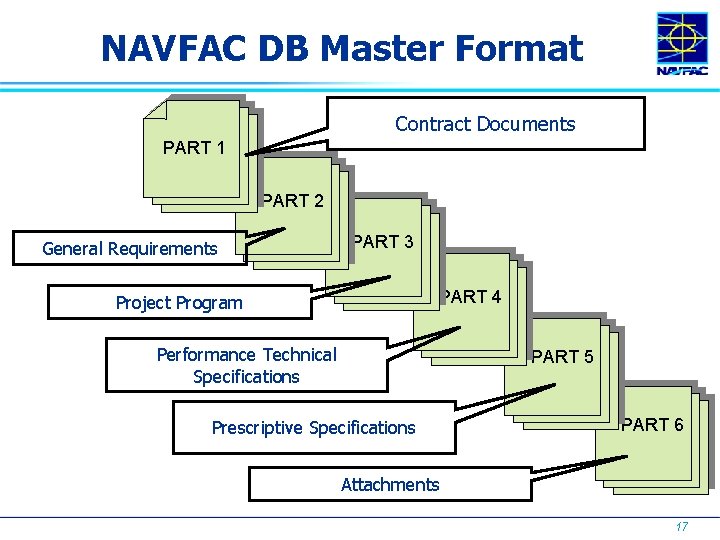
NAVFAC DB Master Format Contract Documents PART 1 PART 2 General Requirements PART 3 PART 4 Project Program Performance Technical Specifications PART 5 Prescriptive Specifications PART 6 Attachments 17
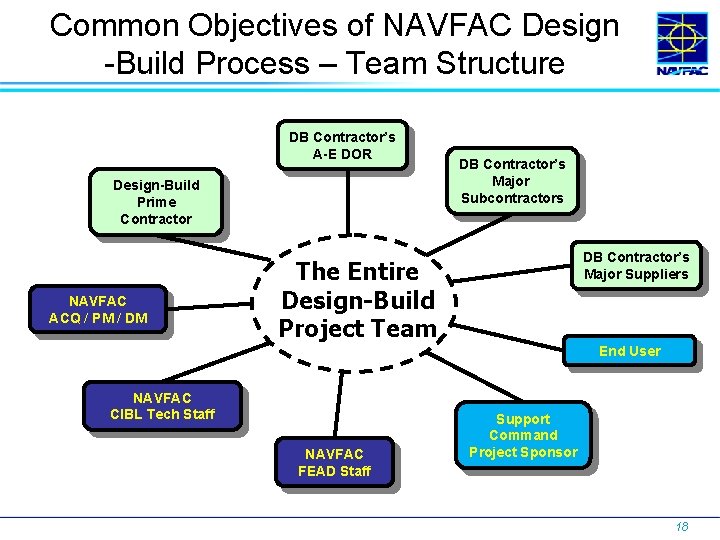
Common Objectives of NAVFAC Design -Build Process – Team Structure DB Contractor’s A-E DOR Design-Build Prime Contractor NAVFAC ACQ / PM / DM DB Contractor’s Major Subcontractors DB Contractor’s Major Suppliers The Entire Design-Build Project Team End User NAVFAC CIBL Tech Staff NAVFAC FEAD Staff Support Command Project Sponsor 18
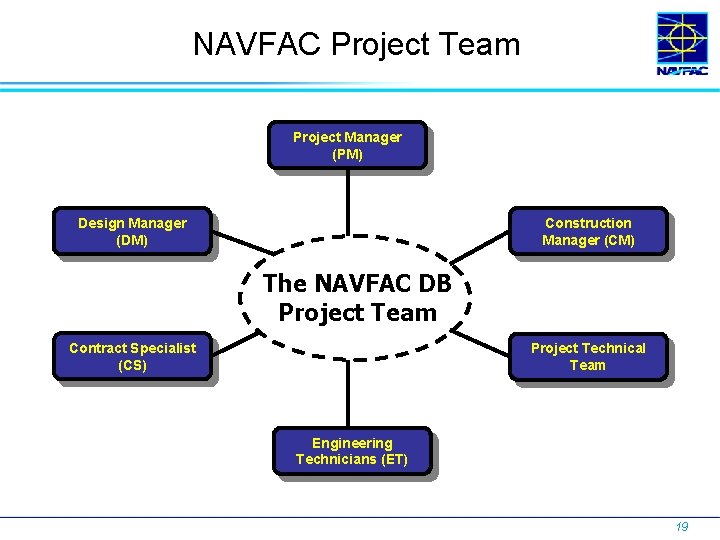
NAVFAC Project Team Project Manager (PM) Construction Manager (CM) Design Manager (DM) The NAVFAC DB Project Team Contract Specialist (CS) Project Technical Team Engineering Technicians (ET) 19
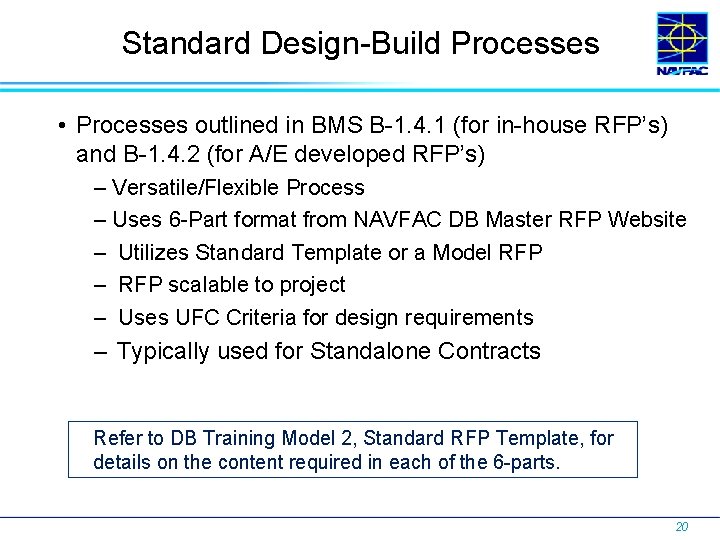
Standard Design-Build Processes • Processes outlined in BMS B-1. 4. 1 (for in-house RFP’s) and B-1. 4. 2 (for A/E developed RFP’s) – Versatile/Flexible Process – Uses 6 -Part format from NAVFAC DB Master RFP Website – Utilizes Standard Template or a Model RFP – RFP scalable to project – Uses UFC Criteria for design requirements – Typically used for Standalone Contracts Refer to DB Training Model 2, Standard RFP Template, for details on the content required in each of the 6 -parts. 20
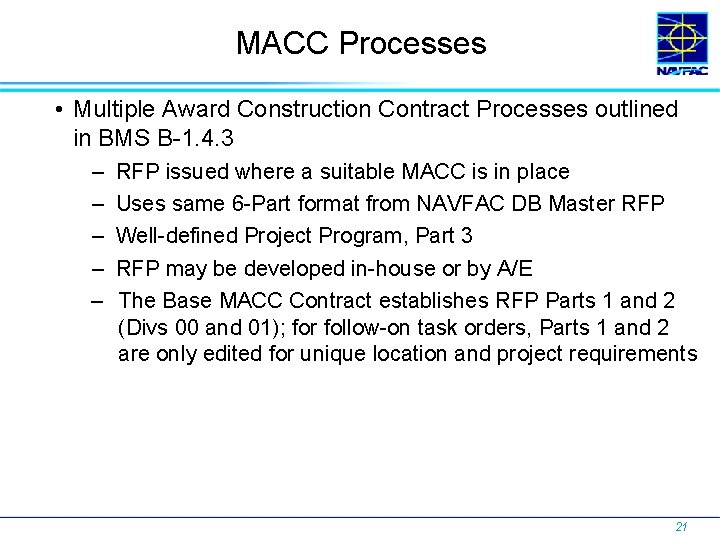
MACC Processes • Multiple Award Construction Contract Processes outlined in BMS B-1. 4. 3 – – – RFP issued where a suitable MACC is in place Uses same 6 -Part format from NAVFAC DB Master RFP Well-defined Project Program, Part 3 RFP may be developed in-house or by A/E The Base MACC Contract establishes RFP Parts 1 and 2 (Divs 00 and 01); for follow-on task orders, Parts 1 and 2 are only edited for unique location and project requirements 21
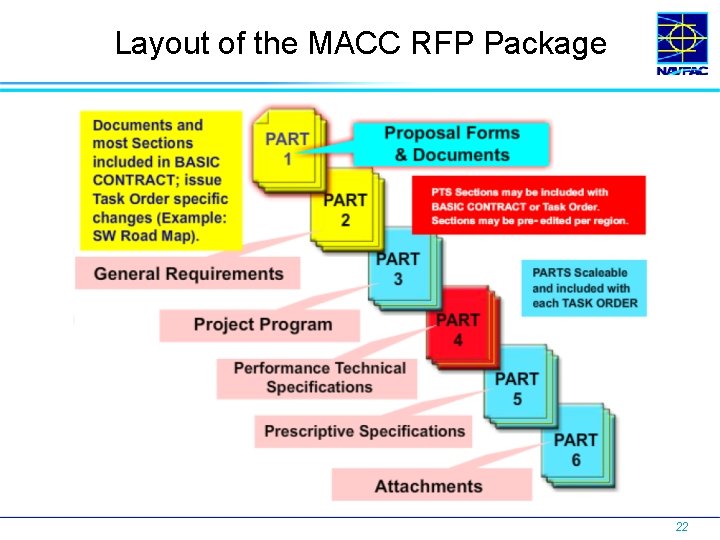
Layout of the MACC RFP Package 22
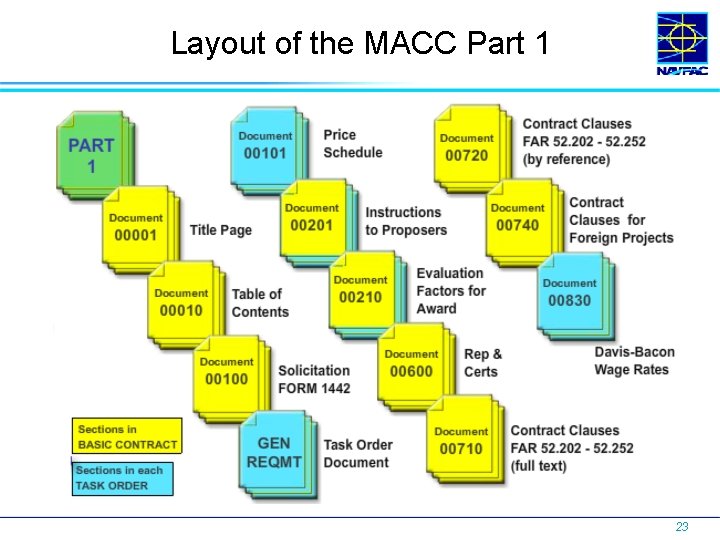
Layout of the MACC Part 1 23
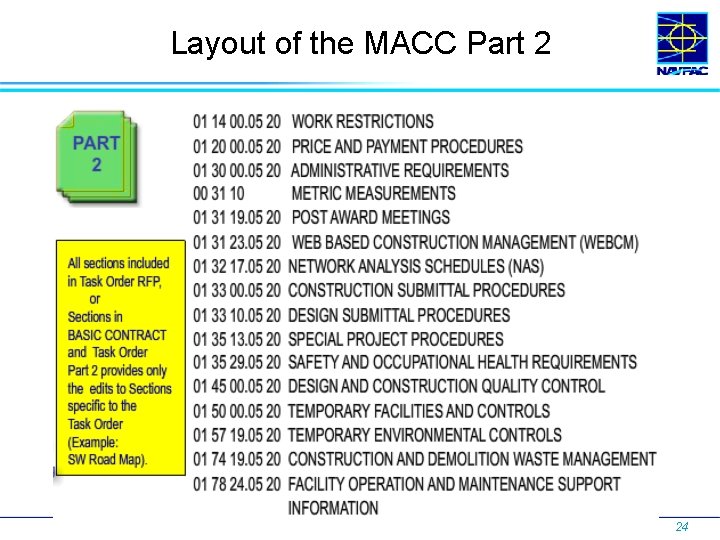
Layout of the MACC Part 2 24
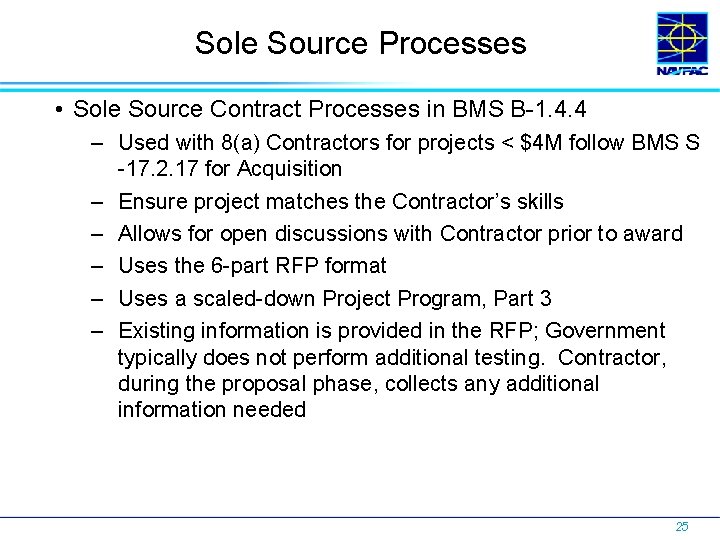
Sole Source Processes • Sole Source Contract Processes in BMS B-1. 4. 4 – Used with 8(a) Contractors for projects < $4 M follow BMS S -17. 2. 17 for Acquisition – Ensure project matches the Contractor’s skills – Allows for open discussions with Contractor prior to award – Uses the 6 -part RFP format – Uses a scaled-down Project Program, Part 3 – Existing information is provided in the RFP; Government typically does not perform additional testing. Contractor, during the proposal phase, collects any additional information needed 25
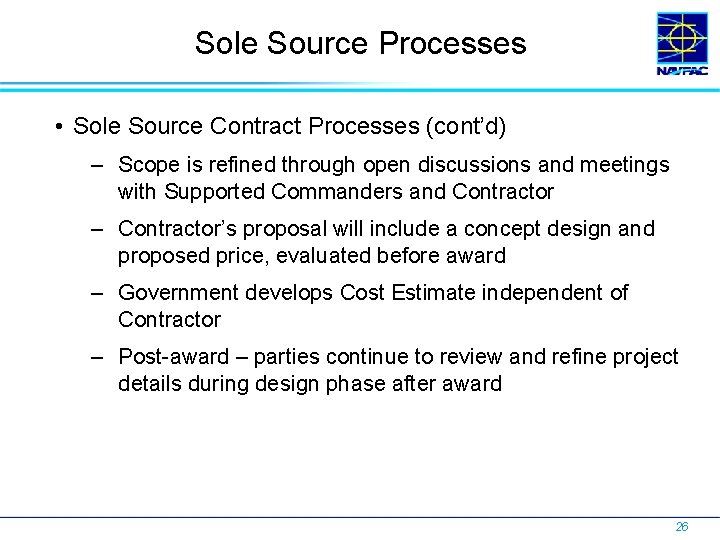
Sole Source Processes • Sole Source Contract Processes (cont’d) – Scope is refined through open discussions and meetings with Supported Commanders and Contractor – Contractor’s proposal will include a concept design and proposed price, evaluated before award – Government develops Cost Estimate independent of Contractor – Post-award – parties continue to review and refine project details during design phase after award 26

Knowledge Check #2 27
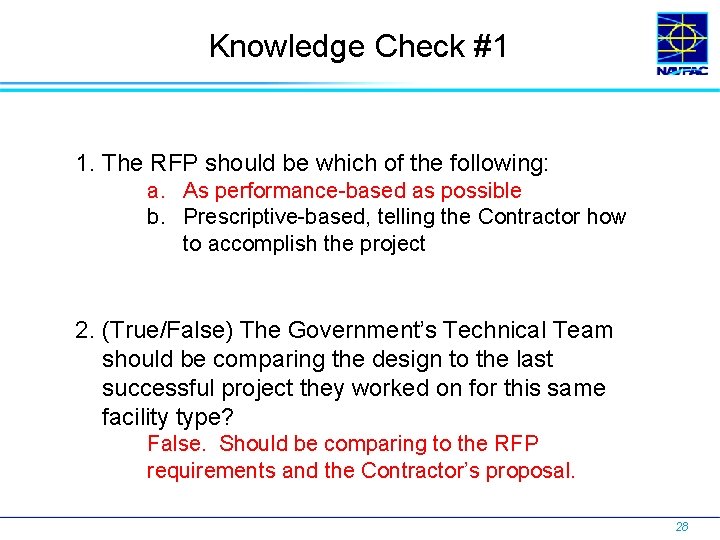
Knowledge Check #1 1. The RFP should be which of the following: a. As performance-based as possible b. Prescriptive-based, telling the Contractor how to accomplish the project 2. (True/False) The Government’s Technical Team should be comparing the design to the last successful project they worked on for this same facility type? False. Should be comparing to the RFP requirements and the Contractor’s proposal. 28
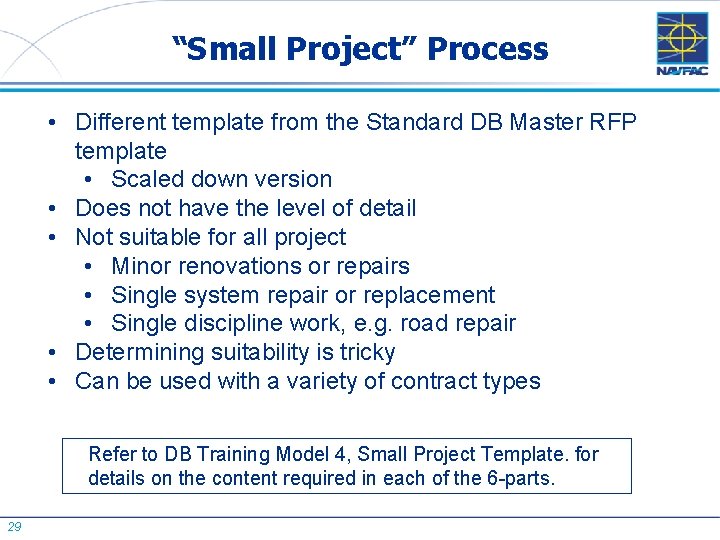
“Small Project” Process • Different template from the Standard DB Master RFP template • Scaled down version • Does not have the level of detail • Not suitable for all project • Minor renovations or repairs • Single system repair or replacement • Single discipline work, e. g. road repair • Determining suitability is tricky • Can be used with a variety of contract types Refer to DB Training Model 4, Small Project Template. for details on the content required in each of the 6 -parts. 29
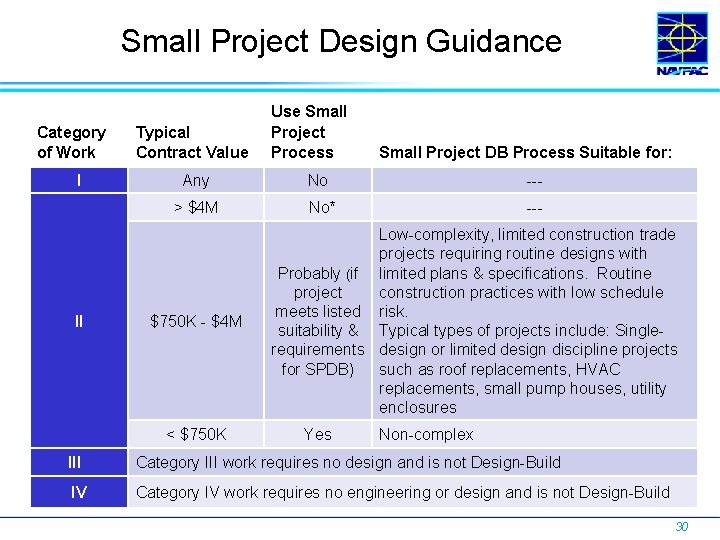
Small Project Design Guidance Category of Work I II Typical Contract Value Use Small Project Process Small Project DB Process Suitable for: Any No --- > $4 M No* --- $750 K - $4 M < $750 K Low-complexity, limited construction trade projects requiring routine designs with Probably (if limited plans & specifications. Routine project construction practices with low schedule meets listed risk. suitability & Typical types of projects include: Singlerequirements design or limited design discipline projects for SPDB) such as roof replacements, HVAC replacements, small pump houses, utility enclosures Yes Non-complex III Category III work requires no design and is not Design-Build IV Category IV work requires no engineering or design and is not Design-Build 30
Contract Procurement Design Build Construction Contracts are procured through three main type of contract vehicles. • Standalone Contracts • MACC Task Orders • Sole Source Contracts 31
Standalone Contracts FAR Part 36. 3 requires the use of a Two-Phase Selection Procedures for Design-Build for competitive contracts. Two-Phase Selections applies to Stand Alone and the Initial award (basic) for Multiple Award Construction Contracts (MACCs) – Best Value Source Selection Evaluation Methods • Tradeoff Analysis – Guidance and supporting tools provide • Evaluation board structure • Roles and responsibilities of the Technical Evaluation Team • Business Rules on writing a concise findings documentation (report) 32
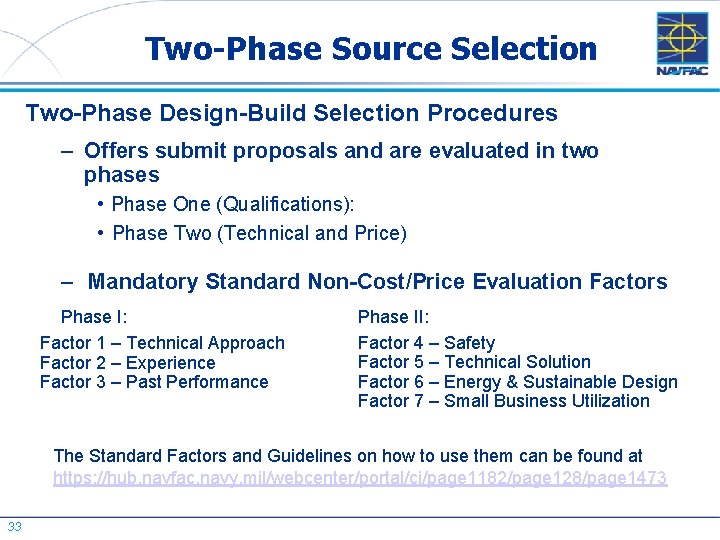
Two-Phase Source Selection Two-Phase Design-Build Selection Procedures – Offers submit proposals and are evaluated in two phases • Phase One (Qualifications): • Phase Two (Technical and Price) – Mandatory Standard Non-Cost/Price Evaluation Factors Phase I: Factor 1 – Technical Approach Factor 2 – Experience Factor 3 – Past Performance Phase II: Factor 4 – Safety Factor 5 – Technical Solution Factor 6 – Energy & Sustainable Design Factor 7 – Small Business Utilization The Standard Factors and Guidelines on how to use them can be found at https: //hub. navfac. navy. mil/webcenter/portal/ci/page 1182/page 128/page 1473 33
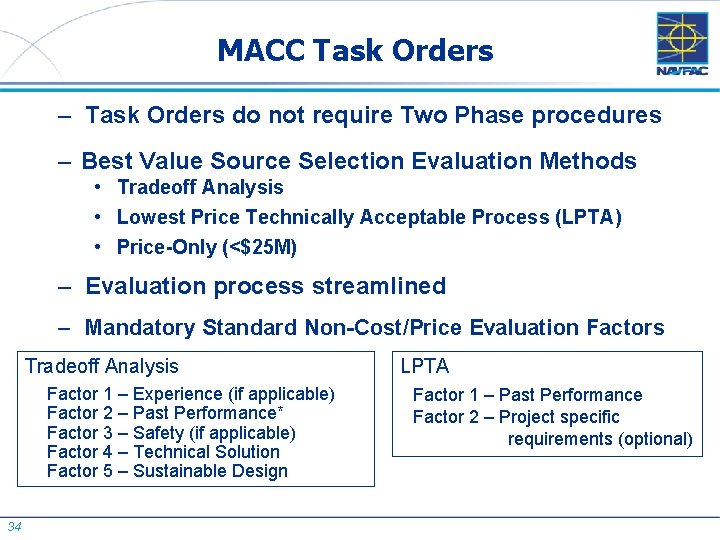
MACC Task Orders – Task Orders do not require Two Phase procedures – Best Value Source Selection Evaluation Methods • Tradeoff Analysis • Lowest Price Technically Acceptable Process (LPTA) • Price-Only (<$25 M) – Evaluation process streamlined – Mandatory Standard Non-Cost/Price Evaluation Factors Tradeoff Analysis Factor 1 – Experience (if applicable) Factor 2 – Past Performance* Factor 3 – Safety (if applicable) Factor 4 – Technical Solution Factor 5 – Sustainable Design 34 LPTA Factor 1 – Past Performance Factor 2 – Project specific requirements (optional)
Sole Source Selection Process • For Sole Source selections, follow BMS S-17. 2. 17 • Selection Process – – Informal process Coordinated with Small Business Specialist Search Construction Contractor Register (CCR) Match Contractor with project • Capabilities evaluation – check key personnel • Validate past performance with FEAD/ROICC and CPARS • Typical Considerations – Past performance – Past experience –key personnel – Management approach (emphasizes integrated team) 35
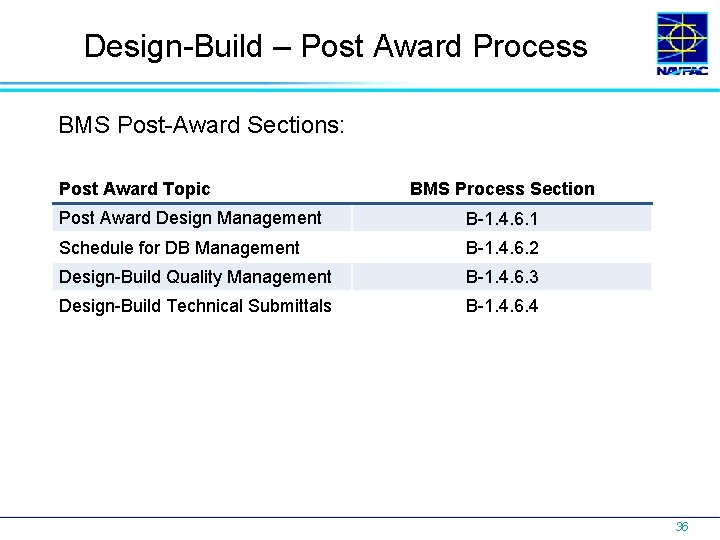
Design-Build – Post Award Process BMS Post-Award Sections: Post Award Topic BMS Process Section Post Award Design Management B-1. 4. 6. 1 Schedule for DB Management B-1. 4. 6. 2 Design-Build Quality Management B-1. 4. 6. 3 Design-Build Technical Submittals B-1. 4. 6. 4 36
Post Award Kick-off (PAK) Meeting • The Post Award Kickoff (PAK) meeting is the critical timeframe to collaboratively establish the design schedule and identify all design submittal packages • After award the Government Technical Team: – Is the client’s technical representative and provides input, including lessons learned, to the Contractor’s team – Confirms conformance with the Contract; Technical team should be comparing design to the RFP requirements and Contractor’s proposal – Evaluates the Contractor’s design process (life cycle cost analysis, functional analysis, BIM, etc. ) 37
Design-Build – Post-Award Process • Roles and Responsibilities Key NAVFAC Personnel – Post-Award • Construction Manager (CM) – Leads Contract Management from construction contract award through contract close-out • Project Manager (PM) – Responsible for management of project (scope, cost, and schedule) from design authorization to project closeout. Relinquishes project lead to CM after award • Design Manager (DM) – leads the review effort of DB Team’s design • Engineering Technician (ET) – Provides quality assurance during construction with periodic reviews. See BMS B-1. 4. 6 for Post-Award Processes 38
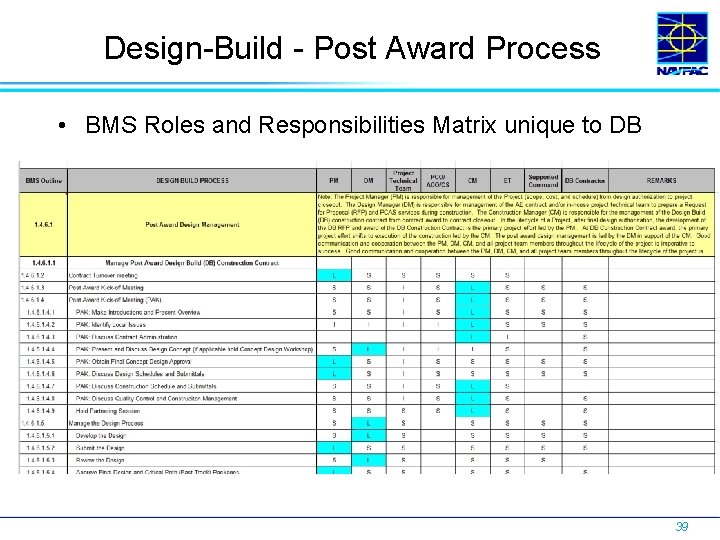
Design-Build - Post Award Process • BMS Roles and Responsibilities Matrix unique to DB 39

Final Knowledge Check 40
Final Knowledge Check 1. (True/False) There are separate BMS processes for Standard RFP’s developed In-house vs. those developed by A/E firms. True. BMS B-1. 4. 1 covers processes when RFP’s are developed in-house and B-1. 4. 2 outlines processes when RFP’s are developed by A/E’s. 2. NAVFAC has how many basic Design-Build processes? Answer: 4. These include: a. Standard b. MACC c. Sole Source Negotiated d. Small Project 41
Final Knowledge Check (cont’d) 3. (True/False) All NAVFAC Design-Build RFP’s use a 6 -Part format. True. Regardless of the Design-Build process being used, all NAVFAC RFP’s use a 6 -Part format. 4. (True/False) The Small Project process and RFP template can be used for any project provided it is edited appropriately. False. There is decision guidance in ECB 2006 -04 and BMS B-1. 4. 5 for when Small Project process and RFP is appropriate for a project. 42
Review of Learning Objectives Today you have learned: ü Commonalities of 4 Design-Build Processes ü Design-Build Team Make-up ü NAVFAC Business Management System ü BMS Roles and Responsibilities ü Characteristics of 4 Design-Build Processes ü Post-award Processes 43
Design-Build Training Modules • Introduction to Design-Build • Standard RFP Template • Design-Build Processes • Small Project Design-Build • Design-Build Master Management Training for Criteria Managers 44
Conclusion Resource link: Access BMS from the NAVFAC Portal Intranet Under “e. Tools” https: //hub. navfac. navy. mil/webcenter/portal/bms Points of contact: Kate Reid, RA, DBIA NAVFAC Atlantic kathleen. o. reid@navy. mil 45
- Slides: 45